



Résumer cet article :
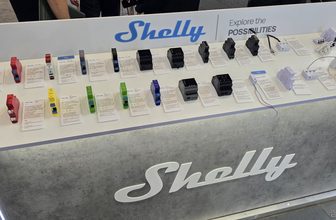
I didn’t see it coming. At the beginning of September, I was at the Shelly booth at IFA in Berlin, checking out the new products and talking with the brand representatives. Three weeks later, Schneider Electric announced its intention to acquire Shelly Group.
This is not a partnership nor a stake purchase. On September 24, 2026, the French group announced its intention to launch a voluntary public takeover bid for all the shares of Shelly Group, for around 1.2 billion euros.
If you’ve been involved in home automation for a few years, you understand what this means. Shelly has carved out a niche with affordable and especially open products: they work locally and integrate with just about everything.
With Shelly, Schneider is acquiring small Wi-Fi modules, but also a technology already present in millions of connected homes and in several energy management installations.
70 euros per share and a valuation of 1.2 billion euros
The offer is fully in cash: 70 euros per Shelly share. This is 27% more than the unaffected price on July 28, 2026 (55.20 euros) and 22% more than that on September 23.
The two founders, Dimitar Dimitrov and Svetlin Todorov, who together hold about 57% of the capital, support the offer. Dimitar Dimitrov is even set to reinvest part of what he receives alongside Schneider Electric for at least three years.
However, nothing is signed yet. The offer still needs to obtain regulatory approvals and reach a minimum threshold of 95% of the capital. If all goes as planned, Schneider is aiming for finalization in the first quarter of 2027.
For now, it is thus an announced takeover bid and supported by Shelly, not a finalized acquisition.
Why is Schneider Electric so interested in Shelly?
Shelly is no longer the small company known only to enthusiasts, those who slipped a module behind their switches. The numbers illustrate this well.
In the first half of 2026, Shelly Group achieved 68.3 million euros in revenue (+26.5%), with an EBIT of 17.7 million and a net profit of 15.4 million. For the year, the group aims for between 195 and 205 million euros.
Jefferies also provides some orders of magnitude: Shelly is present in 6.7 million households, with 2.9 million cloud users and over 8,600 partner installers. Since 2022, its revenues have been growing by more than 40% per year on average.
For Schneider Electric, which is worth over 160 billion euros on the stock market, it’s a small purchase. But it falls at the right time.
Schneider states it wants to combine Shelly’s residential energy management software platform with what it knows how to do in residential settings, renovations, and small tertiary buildings. At Jefferies, analysts see this as a real industrial logic with many possible synergies with the group’s residential activity.
And this is where it directly concerns us.
Shelly no longer only makes home automation modules
When I started with Shelly, the interest was simple: we slipped a connected relay behind a switch, and we could control a light or a roller shutter, or measure consumption, without having to redo the installation.
But what made the difference is the openness.
Accessible APIs, local commands, MQTT, integration into Home Assistant, Jeedom, and many others, many products usable without going through the cloud… Shelly has done pretty much the opposite of most manufacturers in the connected home, who tend to keep their customers in their ecosystem.
Enthusiasts and integrators have not been mistaken.
Recent products go even further. The current generations include a scripting engine that executes certain automations directly on the device, locally, without the Internet and sometimes even without a home automation server. Advanced users love it.
Shelly has also joined the Works with Home Assistant program, which clearly indicates what side the brand is on.
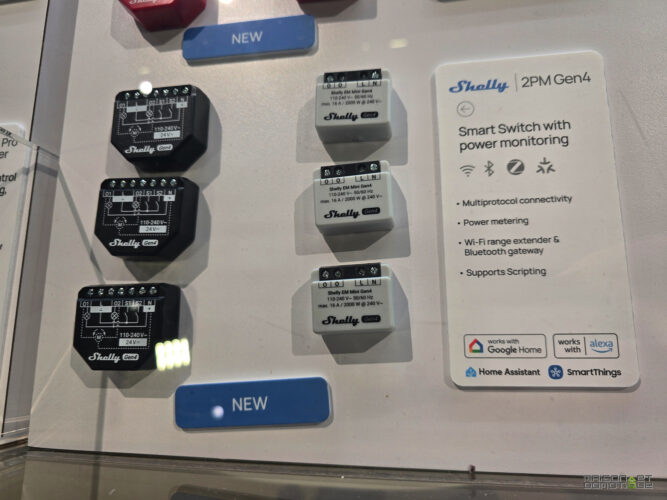
The Shelly Pro 3EM, the de facto standard for solar storage
The other subject is energy.
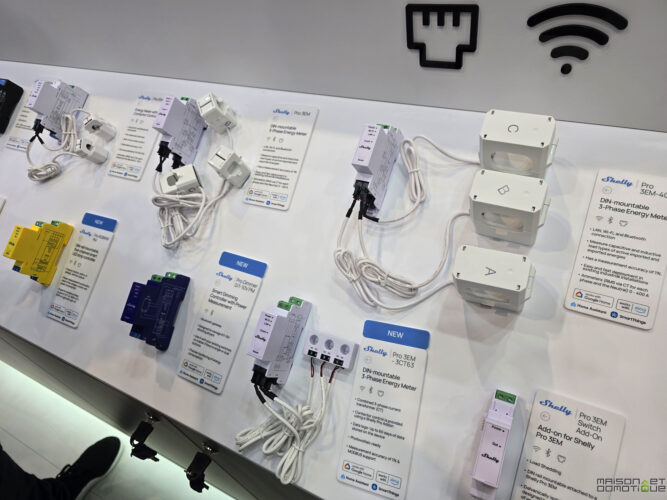
If you regularly read Maison et Domotique, you have surely encountered the Shelly Pro 3EM in a number of domestic solar storage systems.
This three-phase DIN rail energy meter rapidly measures the electrical flows of the house. A battery can thus know that the home is sending 800 W of surplus photovoltaic energy to the grid and increase its charge. In the other direction, if the house draws 500 W from the grid, it adjusts its discharge to return to zero.
Zendure officially supports the Shelly 3EM and Pro 3EM on its SolarFlow systems, even with direct local communication between certain devices and the Pro 3EM.
EcoFlow has gone further with co-branded versions of the Shelly Pro 3EM and Plug S Gen3, integrated into its ecosystem.
You can also find Shelly in other energy management and storage solutions. The brand serves as a sort of bridge between equipment that initially had nothing to do with each other.
For Schneider Electric, this is a golden position. In addition to a catalog of relays and connected plugs, the group would gain access to a technology already well established in energy measurement, photovoltaics, home storage, and consumption control.
On the user side, concerns are already there
On paper, the rapprochement makes sense.
Schneider Electric has the industrial power, the global network, and the presence among professionals that Shelly would have taken years to build alone. The group could also help it obtain certifications and enter more demanding markets in terms of regulation.
Shelly assures that the operation will preserve its corporate culture, its organization, and its teams in Bulgaria.
Among users, enthusiasm is much more measured.
In the Home Assistant and home automation communities, initial reactions are mostly cautious, with some notes of optimism.
On Reddit, some fear price increases, less open products, or increased dependency on the cloud. Several recall their memories of brands acquired by Schneider, like APC. These are individual feelings, which do not say much about what will happen to Shelly.
Others are more nuanced. They remind that Schneider also sells connected solutions that work locally, like the Wiser ecosystem, or see this acquisition as an opportunity for Shelly to reach many more people and improve the certification and distribution of its products.
But one question keeps coming up everywhere: Will Schneider let Shelly make its own technical choices?
What makes Shelly’s value is its openness
For me, that’s the whole question.
A Shelly 1 that turns on a lamp from a smartphone is nothing exceptional. Hundreds of products do that.
Shelly’s reputation comes from elsewhere: you can never touch the cloud, integrate the module directly into Home Assistant, Jeedom, or a home system, go through MQTT or local APIs, write your own scripts, and set up your installation as you wish.
This freedom is worth a lot.
This is why some are already talking about cutting off their modules’ Internet access, or switching to ESPHome if the brand’s policy changes. It is probably premature: nothing in the announcements suggests that Schneider wants to eliminate local APIs or close the ecosystem. No one can say today that Shelly is going to shut down.
But these reactions show what the community’s trust is based on. And Schneider would have much to lose by tampering with it.
Schneider could also help Shelly grow
One can also see the glass as half full.
Imagine if Schneider keeps the APIs, local operation, MQTT, Home Assistant integrations, and the current philosophy, while bringing its industrial power and its installer network.
Then it would become really promising. We would see Shelly modules integrating much more naturally into electrical panels, energy management systems, charging stations, photovoltaics, batteries, and Schneider’s professional ranges.
Shelly would bring what large industrial players often lack: the ability to move quickly and a community of enthusiasts. Schneider would bring its global presence, its energy expertise, and its professional channels.
The marriage is not absurd. RBC Capital Markets speaks of a complementary acquisition, consistent with Schneider’s strategy in smart buildings, and Jefferies emphasizes the synergies with the residential activity.
IFA 2026 seen differently
This announcement still leaves me with a strange impression.
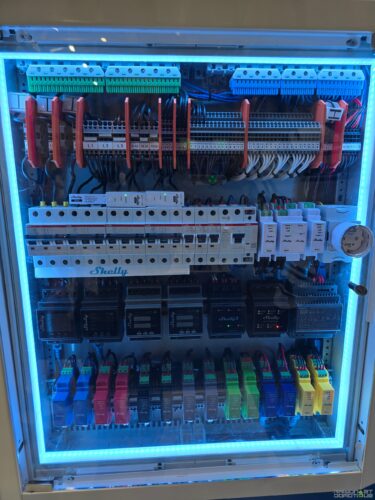
At the beginning of September, I was with the Shelly teams in Berlin. The brand presented its new products as an independent, fast-growing company, not revealing anything.
The discussions were already well advanced. This file did not come out of nowhere: on July 29, 2026, after press articles, Shelly had confirmed it was in preliminary discussions with Schneider Electric, while specifying that they might not lead to anything.
Two months later, the agreement is on the table.
At 1.2 billion euros, Schneider is obviously not acquiring Shelly to sell a few more micromodules behind our switches.
Energy is taking an increasingly prominent place in the connected home. Solar panels, batteries, electric car charging, water heaters, heat pumps, dynamic pricing: all this needs to measure, communicate, and react in real-time. And Shelly already has a good part of the building blocks to do it.
The remaining question for all those who have dozens of modules at home is: Will Shelly remain an open, local brand compatible with just about everything?
Officially, nothing suggests otherwise. Schneider and Shelly even talk about preserving the culture of the Bulgarian company.
I hope they understand well what they are buying. Tampering with Shelly’s openness would be exactly what Schneider has just paid 1.2 billion euros for.



Please remain courteous: a hello and a thank you cost nothing! We're here to exchange ideas in a constructive way. Trolls will be deleted.