


'/%3E%3Cpath%20fill='%23b2b2b2'%20d='M241%20382q0%2016%2017%2026%2017%2011%2042%2011t42-11q16-11%2017-26V269H241'/%3E%3Cpath%20fill='%239f7e00'%20d='M241%20379q0%2014%208%2023%209%209%2021%209%2014%200%2021-9%209-9%209-23V269h-59'/%3E%3Cpath%20d='M241%20339v-70h59v110q0%2014-9%2023l-6%205v-68h-15v72q-8%200-14-4v-68zm59%2040c0%2022%2015%2032%2029%2032%2021%200%2030-18%2030-32v-40h-59'/%3E%3Cpath%20fill='%239f7e00'%20d='M266%20277v5h2v12h-3v-5h2v-5h-9v5h2v5h-4v9h3v18h-5v10h34v-10h-5v-18h3v-9h-4v-5h2v-5h-9v5h2v5h-3v-12h2v-5zm42%20101q0%2010%206%2017%206%206%2015%207%2010-1%2016-7%206-7%206-17v-29h-43'/%3E%3Ccircle%20fill='%230044ad'%20cx='329.5'%20cy='372'%20r='6'/%3E%3Cellipse%20fill='%230044ad'%20cx='300'%20cy='340'%20rx='16'%20ry='21'/%3E%3C/svg%3E)

'/%3E%3C/g%3E%3Cuse%20href='%23c'%20transform='matrix(-1%200%200%201%20720%200)'/%3E%3C/svg%3E)


'%3E%3Cpath%20stroke='%23000'%20stroke-width='4'%20d='m-35-37-13%2020m5%203%2013-20m5%203-13%2020m63%2042%206-9m1-2%206-9m5%203-6%209m-1%202-6%209m5%203%206-9m1-2%206-9m-96%200%2013%2020m5-3-6-9m-1-2-6-9m5-3%2013%2020m63-42-6-9m-1-2-6-9m5-3%2013%2020m5-3-6-9m-1-2-6-9'/%3E%3Ccircle%20r='24'%20fill='%23cd2e3a'/%3E%3Cpath%20fill='%230047a0'%20d='M0%200a12%2012%200%201%201%2020%2013%2024%2024%200%201%201-40-26A12%2012%200%201%200%200%200'/%3E%3C/g%3E%3C/svg%3E)


Résumer cet article :
A few years ago, talking about Shelly almost always meant talking about a small hidden Wi-Fi module behind a switch. Handy, not too expensive, open, and compact enough to avoid having to redo the electrical installation. This is how many of us discovered the brand.
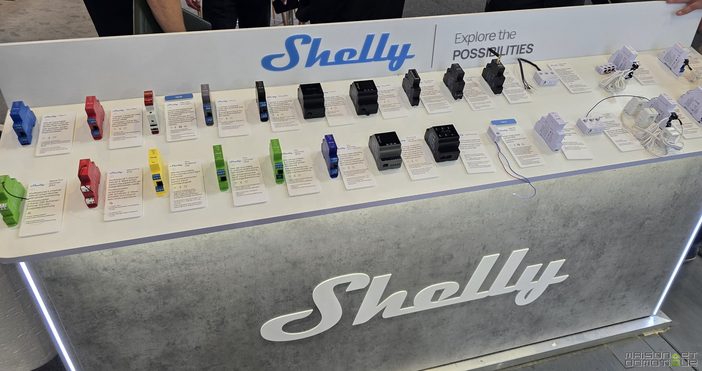
At the IFA 2026 in Berlin, I of course found these famous micromodules again. But after the full presentation of the new products, I came away with a rather different impression: Shelly now wants to cover a good part of the technical needs of the connected home.
There are still relays, but also Zigbee, Matter, energy measurement, outdoor sensors, heating, a new wall screen, a camera, and even LED drivers designed for professional installations. With, as a backdrop, an idea I really like: keeping a classic electrical installation that works on its own and adding intelligence on top of it.
Let’s take a look at all this because there was quite a lot on the stand!
Shelly 1L Gen4 and 2L Gen4: neutral is no longer mandatory
I start with two small modules that are likely to provide some useful services during renovations: the Shelly 1L Gen4 and Shelly 2L Gen4.

If you’ve ever tried to add a micromodule behind a switch in an older home, you probably know the problem. You remove the device, pull out the wires, and… no neutral. Nothing unusual: on many installations, only the light return arrives at the switch. The neutral remains at the level of the light fixture.
The new Shelly devices are precisely designed to work without a neutral behind the switch. The 1L controls one circuit, the 2L controls two independent circuits. A bypass is provided for low-power lighting when needed.
The Shelly 1L Gen4 accepts a load of up to 200 W. The 2L has a slightly different configuration with up to 200 W on the first output and 700 W on the second.
What especially changes with this generation is everything that happens around the relay. We find Wi-Fi 6, Bluetooth 5.0, Zigbee 3.0, and Matter.
In other words, the little Shelly installed today behind a switch is not doomed to stay in the Shelly ecosystem. It can join various home automation installations according to evolving needs.
And in renovations, this is exactly the kind of solution I like: we keep the switch chosen by the homeowner, don’t redo half the wiring, and externally, nothing changes.
The Shelly i4 Gen4 keeps the switches… and multiplies the possibilities
The Shelly i4 Gen4 follows a slightly different logic. It has four inputs but no relay. Therefore, it cannot be asked to directly power a lamp. Its job is to capture the actions performed on four switches or buttons and transmit them to the home automation system.

This opens up many possibilities. A button can normally control the lighting. A double press can close all the shutters. A long press can start a “leaving home” scene. Another switch can control several lights that have no physical connection to it. All while keeping real buttons on the wall, a detail I value a lot.
The transition to Gen4 brings Wi-Fi, Bluetooth, Zigbee, and Matter. And since it is powered continuously, the i4 Gen4 can also serve as a Zigbee repeater. The more we install in the building, the more they can participate in the Zigbee mesh.
Advanced users will also find MQTT(S), webhooks, Shelly Script, and virtual components. More surprisingly for such a small device, KNXnet/IP is also supported.
We are starting to have a small module that can bridge traditional electrical equipment and much more advanced home automation installations.
Why Shelly is now betting heavily on Zigbee
I had the opportunity to discuss this with one of the managers at Shelly. His thoughts on Zigbee were interesting.
The first years of the protocol weren’t always straightforward. Behind the same Zigbee logo, some manufacturers added their own particularities, with sometimes random compatibilities. Zigbee 3.0 has significantly improved things, and the Shelly manager believes it is now sufficiently common among the different platforms to genuinely facilitate interoperability.
This better explains the proliferation of Shelly devices capable of speaking multiple protocols. Essentially, Shelly does not want to bet its entire range on a single horse.
An installer can place a product to meet an immediate need without necessarily knowing which box or platform will be used in five years. Wi-Fi, Zigbee, Bluetooth, Matter, MQTT… depending on the product and project, several doors remain open.
For a device that will be hidden behind a switch for ten years, I find this approach quite reassuring.
Keep wired and add home automation later: a philosophy I share
Our discussion drifted to roller shutters, and here, I completely found myself in the philosophy mentioned.
When installing a motorization, the temptation is great to choose a proprietary radio solution directly with its remote control and ecosystem. Personally, when I have the option, I prefer a classic wired motor with its switch, then a home automation module behind it.
The Shelly manager told me about a quite similar situation to equip the shutters of a 91-year-old person. Her smartphone? Clearly not the interface to prioritize. A remote control or physical switch remains much more natural. Home automation can work behind the scenes without complicating her daily life. It’s simple, but sometimes we forget this rule when trying to make a house “smart”.
A light should still be able to turn on if the Internet goes down. A shutter should be able to lower without taking out your phone. And no one should need to explain to their guests which app to download to light up the bathroom ;-)
Automation then brings comfort.
Shelly EM-63 Gen4: precisely monitor a circuit up to 63 A
Energy management continues to gain traction at Shelly.
The new Shelly EM-63 Gen4 is a compact single-phase meter designed to monitor a circuit up to 63 A using an external current transformer. It measures voltage, current, active and apparent power, power factor, and cumulative energy.
For example, one could place it on the circuit of a heat pump, water heater, charging station, or photovoltaic installation.

One detail I particularly like: at least seven days of measurements are recorded directly in the device, with a record every minute. The real-time clock also keeps a correct timeline if Internet synchronization disappears. No need to depend on the cloud just to find out what happened yesterday at 3 PM.
MQTT, HTTP, and WebSocket are available, with TLS encryption. The built-in web interface also allows for local operation.
The format is designed for installations where the electrical panel is already starting to get quite full: the case can be installed near the circuit breakers without monopolizing several DIN modules.
Wall Display X1i: the wall dashboard is beefing up
I really appreciated the idea of the Wall Display: having a home automation interface accessible to everyone without having to pull out a smartphone. Shelly is now pushing the concept further with the Wall Display X1i.

The color touch screen remains at a diagonal of 4 inches, but the electronics have significantly progressed: quad-core processor, 8 GB of flash memory, dual-band Wi-Fi 6 (2.4/5 GHz), Bluetooth 5.0, and a 1 W speaker. Shelly also adds light, proximity, and gesture sensors.

The screen can thus wake up when approached, and certain gestures can trigger actions. I see this type of control quite well in an entrance: a gesture when leaving, and the house turns off the lights, closes the shutters, and sets the heating to absence mode.
The major new hardware feature also comes from the interchangeable power base, which integrates a 5 A relay output.
The Wall Display X1i can display and control Shelly devices, manage heating and lighting, launch scenes, or display the consumption of Shelly PM devices. It can also control Bluetooth or Sonos speakers.
And, good news, Home Assistant is officially supported.
This is typically the kind of screen that I would love to see in a family Home Assistant installation: simple enough for everyone to use, without sacrificing the possibilities behind it.
Shelly Presence Gen4: it doesn’t just detect movement, but actual presence
Among all the new products discovered at the stand, the Shelly Presence Gen4 is probably one of the ones I am most interested in. And yet, on paper, a new presence detector doesn’t seem very spectacular. Except here, Shelly is not offering yet another PIR detector.
The Presence Gen4 uses mmWave technology, capable of detecting that a person is still in a room even when they move very little. And in home automation, that changes a lot of things.

You might know the scenario: you are comfortably settled on the couch watching a movie, no one moves for a few minutes and… bam, the light goes out. For the living room’s PIR detector, everyone has gone to bed.
The same problem occurs in an office when one stays focused in front of the screen.
That is precisely the difference that Shelly highlighted during the demonstration: the BLU Motion primarily detects movement, while the Presence Gen4 can determine if someone remains in the room.
As a result, the scenarios become much more natural.
In the living room, lighting and heating can remain active as long as someone is truly present. In an office, there’s no need to wave your arms regularly to remind the home that you are still working. In a meeting room, lighting and air conditioning can follow real occupancy instead of just a simple timer.
Another example mentioned during our discussion that I liked a lot: the bathroom. This is typically a room where you would like to detect presence precisely… but where installing a camera would obviously be out of the question. The mmWave takes on its full meaning here.
The nuance seems slight: detecting movement or detecting presence. In practice, it is quite a significant change. We no longer simply know that someone has just passed through. We know that someone is still there.
And to create a home that truly reacts to its occupants rather than to a series of timers, it is far more interesting.
For me, the Presence Gen4 clearly ranks among the Shelly new products to watch closely after this IFA.
The Shelly BLU Motion ZB adopts Zigbee and lasts up to five years
The Shelly BLU Motion ZB combines Bluetooth and Zigbee. Its PIR sensor has adjustable sensitivity, and its new eye-shaped design expands the detection angle compared to the previous generation.

It also measures ambient light. Shelly offers three configurable levels: dark, twilight, and bright. The thresholds can be adjusted.
This avoids, for example, automatically turning on a hallway light simply because movement is detected while it is still sufficiently bright.
Its installation is designed to be quite flexible, on the wall as well as on the ceiling, and Shelly announces up to five years of autonomy on a CR2477 battery.
With the arrival of the Presence Gen4, one might wonder what the BLU Motion ZB is still good for. In reality, the two are quite complementary:
- In a corridor, staircase, or entrance, there’s no need to bring out the heavy artillery: the BLU Motion ZB detects a passage with its PIR and can take into account brightness before turning on. Simple and effective.
- In a living room or office, the story is different. One can remain seated for a long time without moving much. That’s where the Presence Gen4 and its mmWave technology become interesting: the home automation knows that the room is still occupied.
In short: the BLU Motion knows that someone just passed by. The Presence Gen4 knows that someone is still there. And that’s probably the best way to understand why Shelly needs both.
Finally, an outdoor Zigbee opening sensor truly designed for outside!
This one immediately caught my attention during the presentation.
I have already installed Zigbee opening sensors on outdoor gates. The problem was that they were designed for indoor use. We improvised a protection, crossed our fingers… and waited to see how the case would handle the next winter.

The Shelly BLU Door/Window Outdoor ZB finally avoids this makeshift solution. It is certified IP55, works between -20 and 40 °C, and communicates in Zigbee 3.0 and Bluetooth 5 LE. It detects both opening and closing but also measures the tilt angle. Gate, garage door, garden shed… the applications are numerous. During the presentation, I particularly emphasized this point to Shelly, as Zigbee sensors truly designed to stay outdoors are rare.
The announced autonomy also reaches five years.
A BLU Door/Window Mini ZB version is also coming. Smaller, it is designed for narrow window frames and also measures tilt as well as luminosity.
On a tilt-and-turn window, knowing the angle rather than a simple open/close state quickly becomes interesting for heating scenarios.
Shelly BLU TRV: heating also switches to Zigbee
The new thermostatic head Shelly BLU TRV also adopts Zigbee 3.0 and Bluetooth 5.0.
Shelly announces regulation with an accuracy of ±0.1 °C, a new quieter motor, and autonomy that can reach two years.
The Boost mode fully opens the valve when you want to heat a room quickly.
Most importantly, the TRV can work with other Shelly sensors: BLU H&T ZB, H&T Display ZB, or opening sensors. A window opens? The radiator can stop heating. It closes? Regulation resumes. No need to create incredibly complicated scenarios. It is precisely these kinds of small invisible automations that ultimately make a house truly pleasant to live in.
A Shelly Camera at €39 with Home Assistant and Frigate
Here’s a new product that I didn’t see coming from Shelly: a surveillance camera.
It is tiny and films in Full HD 1080p, with night vision. Its field of view reaches 110° horizontally and 70° vertically. Wi-Fi 2.4/5 GHz and Bluetooth are included.

Microphone and speaker allow for two-way communication. There are also customizable detection zones and masked areas to preserve certain parts of the image.

Videos can be recorded on microSD or in the Shelly cloud hosted in Europe. AI object recognition currently goes through the cloud. It’s a point to keep in mind if you are looking for a 100% local installation.
However, one detail interests me much more: Shelly announces compatibility with Home Assistant and Frigate NVR. Therefore, we should be able to fairly easily exit the operation as intended by the Shelly app and integrate the camera into a more complete surveillance system.
The announced price is €39. At that price, I am very eager to check how it performs with Frigate. On paper, the features-to-price ratio seems particularly interesting.
LOQED Pure: Shelly is also stepping into the smart lock market
After lighting, energy, heating, and sensors, there were still a few doors to open to complete the Shelly ecosystem. This time, the expression should be taken literally ;-)
Shelly is working with LOQED on the new smart lock LOQED Pure.

I had already encountered the previous solutions of the brand, but this new version is much more discreet. During the presentation, I was told that the Pure abandoned the large built-in handle of the previous model for a more compact format.
This is a good thing. A smart lock can be packed with technology without necessarily needing to scream it from the door.

Security is still the focus of the product, with a certification of SKG three stars (SKG*)** and communications protected by end-to-end encryption. The lock is also designed for different door PZ dimensions.
But what interests me most here is its entry into the Shelly ecosystem. LOQED retains its own app, while the lock can also be controlled from Shelly. And I really like a small detail: a Shelly BLU Button Tough 1 ZB is provided with the lock to keep a real physical command. Once again, not everything has to go through a smartphone.
And of course, as soon as you add a lock to a home automation system, ideas for scenarios start to emerge. We lock the door when leaving? The house can turn off the lights and set certain devices to absence mode. Conversely, opening it can launch an arrival scene.
Remote control can also come in handy when someone arrives before you or when you simply have your hands full.
For a vacation rental or small business premises, the interest is even more evident: you can manage access without multiplying duplicates of keys.
However, it is advisable to check compatibility with your door before pulling out the credit card. Mechanical standards are not the same everywhere in Europe, even if Shelly indicates that they are particularly targeting France, Germany, the Netherlands, and Italy with this version.
HiluX Powered by Shelly: why change the luminaire when the driver is enough?
Another new product could easily go under the radar of the general public, even though I found it very interesting: the HiluX Powered by Shelly LED drivers.
The idea is quite logical. In an office, business, or hotel, you may have dozens of LED panels and downlights that are perfectly functional. Replacing them simply to add a connected control would be costly and frankly a shame. HiluX therefore proposes to replace only the existing LED driver. The luminaire stays in place.
The range offers several powers: 200 mA up to 6 W, 350 mA up to 15 W, 700 mA up to 30 W, 1050 mA up to 44 W, as well as a 24 V DC version up to 120 W for uses such as LED strips.
And most importantly, the installation retains its push button. A short press turns it on or off. A long press varies the intensity. The local control continues to work even without a network.
Here’s that famous philosophy again: the electrical installation works first on its own. The connection then adds functions; it should not become a condition to turn on the light.
The drivers can also be chained to simplify wiring when multiple luminaires are installed in the same area.
For offices, meeting rooms, hotels, or businesses, I find the approach particularly interesting.
Shelly is starting to have an answer for almost every room in the house
This is ultimately the impression I left the stand with. One can still buy a Shelly solely to connect a switch. That’s probably what many will continue to do. But around this little module, something much broader is now being created. Energy monitoring, heating, Zigbee sensors, lighting, wall screen, video surveillance… the brand is now touching many functions that were previously found among several different manufacturers.
What I am especially attached to is one aspect: Shelly continues to keep many doors open.
MQTT has not disappeared with Matter. Local control remains present despite the cloud. Physical switches are not sacrificed in favor of the smartphone. Zigbee complements Wi-Fi rather than replacing it. Home Assistant is even directly mentioned in several product sheets.
After my discussion with the team, I also better understand why. No one really knows which protocol will dominate the connected home in ten years. We have seen enough technologies and promising brands disappear to avoid building an entire installation around a single bet.
And a house, unlike a smartphone, is not replaced every three years.
So a wired motor, a normal switch, and a small open module behind? It seems almost old-fashioned amid all the demonstrations at IFA. But personally, I am perfectly fine with that!



Please remain courteous: a hello and a thank you cost nothing! We're here to exchange ideas in a constructive way. Trolls will be deleted.