


Résumer cet article :
A few months ago, I tested the Hydrofast C300, a device that appealed to me because it combined several functions in a single machine: reverse osmosis purification, hot water, chilled water and even sparkling water. Since then, it hasn’t left the kitchen, and I find it hard to imagine going back to a simple water filter jug.
Jimmy takes a different approach to the problem with its Matrix range. At the heart of it is the Jimmy Matrix M9 Pro, a reverse osmosis purifier that dispenses water at room temperature or hot. Nothing new there. The clever part is that the system is modular: thanks to AquaLink technology, you can attach a Matrix S9 to the M9 Pro for chilled and sparkling water, or a Matrix I9 that makes ice cubes and crushed ice.
So you can start with a simple purifier and gradually expand it into a drinks station. I lived with all three modules at home for several weeks. The question is whether the idea works as well in a kitchen as it does on paper.
Jimmy Matrix: a purifier that can grow with you
This is what sets the M9 Pro apart from its competitors more than anything else, so let’s take a moment to look at it.
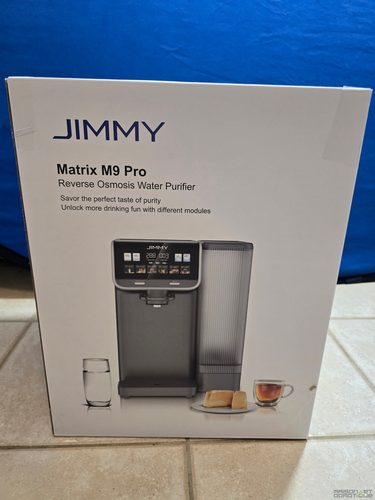
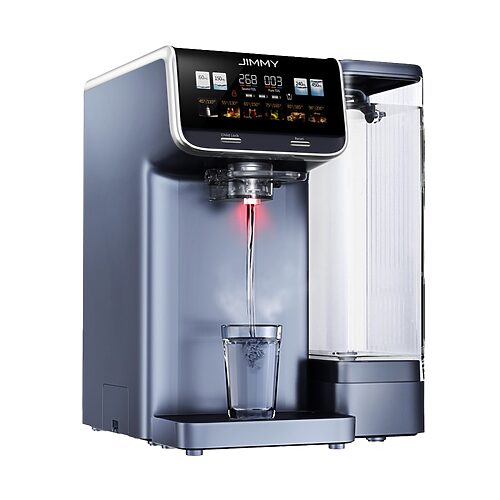
The M9 Pro is the heart of the system. Pour in tap water, and it filters it through reverse osmosis, remineralizes it, then dispenses it at room temperature or heats it on demand. On its own, it works very well.
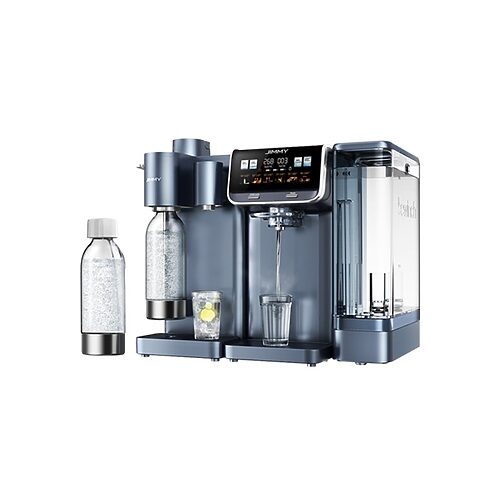
The Matrix S9 attaches to its left side. It draws purified water directly from the M9 Pro, chills it to between 10 and 15°C, and can also carbonate it.

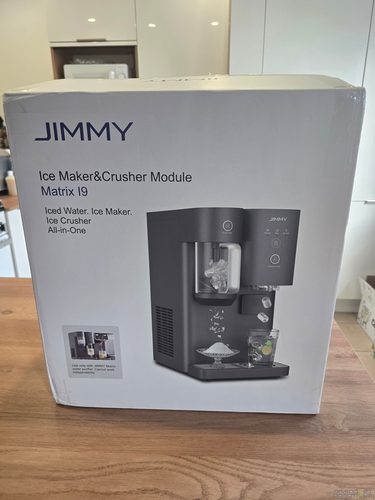
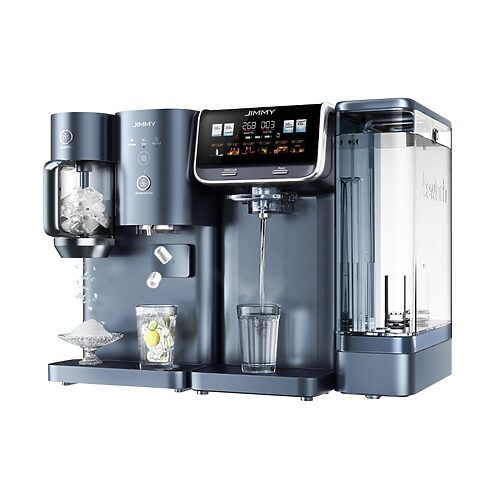
The Matrix I9 also uses purified water from the M9 Pro, but to dispense chilled water, ice cubes and crushed ice.
The advantage is obvious: you only pay for the features you use. If you mostly drink still water and tea, the M9 Pro is enough. Sparkling water fans can add the S9, while those who enjoy cocktails, iced coffee or smoothies can go all the way with the I9.
Unboxing and getting to know the Matrix M9 Pro
The M9 Pro looks more like a modern automatic coffee machine than a water treatment device. That’s a good thing, since it’s going to live on the countertop permanently.
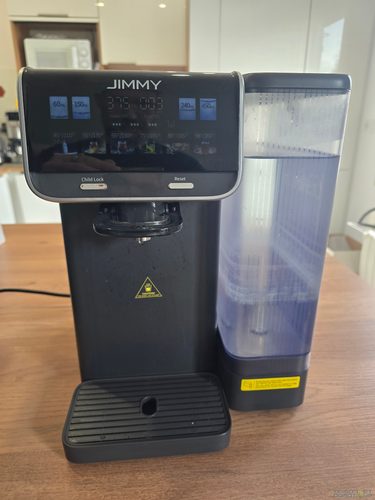
It measures 278 x 310 x 366 mm and weighs 7.5 kg, which is still compact given everything it contains.
At the front, there’s the water outlet and its light. The upper section houses a large touchscreen for choosing the temperature and volume of water, and checking the filtration status.

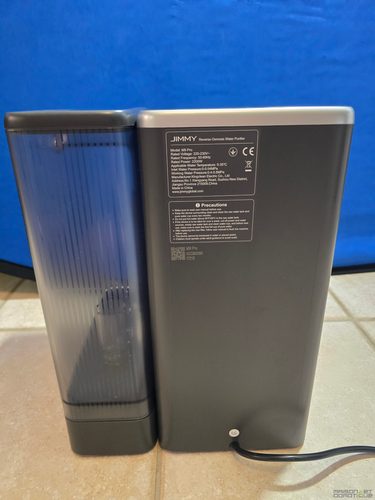
The 5-liter main tank sits on the side. It may seem like a small detail, but it matters in daily use. With a tank at the back, you have to pull the whole machine forward to remove it, especially when it’s tucked under wall cabinets. Here, I just pull it toward me and that’s it.
Inside, a one-liter buffer tank stores already-purified water. Reverse osmosis takes time, and this reserve means you get a good flow rate straight away. When it’s empty, the machine keeps filtering, but the flow rate drops.

Most importantly, there are no hoses coming out of the device. Fill the tank, plug it in, and you’re done. No drilling a hole in the sink, no plumbing to modify, and no drain to install. That’s a real plus for renters, offices, or anyone who doesn’t want to mess around with fittings under the sink.
Don’t cut corners on the initial setup
The three cartridges come pre-installed: the M2S composite filter, the RO-2.0S reverse osmosis membrane and the Q2S remineralization filter. So you might be tempted to fill the tank and pour yourself a glass straight away.


That would be a mistake. When setting it up for the first time, you need to run several rinse cycles, and I’m emphasizing this because the first glass can be alarming: the water comes out almost white. It happened to me. There’s nothing to worry about; it’s mainly microbubbles caused by air still trapped in the new cartridges.
Here’s what to do: fill the tank to the maximum, place a large container under the outlet, then start the rinse cycle by holding down the corresponding button for a few seconds. The indicator turns green.
I ran three full cycles, after which the water was perfectly clear. I also dispensed water at 98°C to rinse the hot-water circuit. Remember to repeat this after every cartridge change.
Seven-stage reverse osmosis filtration
Let’s move on to what matters most: water quality.
Jimmy says the water goes through seven filtration stages across three cartridges.
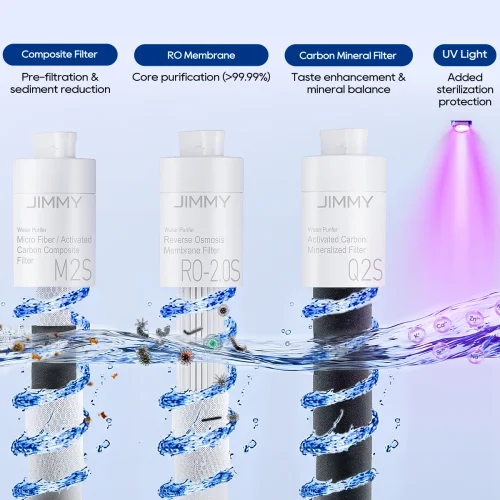
The M2S composite filter does the initial screening. It traps sediment, particles and rust, as well as some of the substances responsible for unpleasant odors or a chlorine taste.
The RO-2.0S membrane then handles reverse osmosis and drastically reduces the amount of dissolved substances.
Jimmy claims it removes 99.9 to 99.99% of certain tested substances, including heavy metals, PFAS and chlorine. As always with figures like these, don’t interpret that as “99.99% of everything, whatever the water.” The results depend on the contaminant, the source water and the condition of the filters. Even so, this is in a different league from a water filter jug.
The downside of reverse osmosis is that it also removes a large proportion of the minerals. The water then passes through the Q2S cartridge, which provides alkaline remineralization. I really like this approach: you get the effectiveness of osmosis without drinking water that tastes completely “flat” (which, incidentally, doesn’t taste very good).
The TDS reading shows the effect of filtration straight away
The screen displays the TDS of both the source water and the purified water at the same time.
TDS (Total Dissolved Solids) measures the overall amount of dissolved conductive substances in water. It isn’t a health analysis: a low TDS reading alone doesn’t guarantee that water is free of contaminants, and a high TDS reading doesn’t mean the water is dangerous. However, it’s a very clear way to see reverse osmosis at work.
After filtration, the drop is dramatic. During my tests, the TDS after osmosis fell to just a few ppm, before remineralization did its job.

You can taste the difference too. The water is very neutral, with no chlorine aftertaste. I also use it in the coffee machine: less limescale and fewer dissolved solids also mean less buildup in appliances. The same goes for a kettle… except that with the M9 Pro, it’s not much use anymore.
UV-C protection for the purified water tank
Purifiers that store clean water have a weak point: once filtered, the water can sit in the tank for several hours.
Jimmy has therefore added a UV-C lamp to limit microbial growth and secondary contamination in the tank. It’s a welcome safeguard, but it doesn’t replace cleaning. UV doesn’t make a tank self-cleaning, so you still need to rinse it regularly.
A 3:1 ratio helps reduce water waste
Reverse osmosis has a trade-off: it inevitably produces wastewater.
For the M9 Pro, Jimmy claims a 3:1 ratio, meaning about one liter of concentrate for every three liters of purified water. That’s a good figure for a household reverse osmosis system.
This water doesn’t necessarily have to go down the sink. I use it for cleaning or to water plants that can tolerate water with a higher mineral content.
The tank requires a small adjustment to your routine. When it reaches its minimum level, I empty out the remaining concentrate, quickly rinse the tank and refill it with fresh water. It’s better to do that than to keep topping it up, otherwise the minerals become increasingly concentrated in the remaining water. You can see this happen quite quickly, as the source water TDS reading can then exceed 400 to 500 ppm.
Hot water in three seconds: the kettle can go in the cupboard
After filtration, this is the feature I use most.
The M9 Pro heats water on demand in three seconds, according to Jimmy. On the screen, you choose the temperature (room temperature, 45, 55, 65, 75, 85 or 98°C), then the volume (60, 150, 240 or 450 ml), and press start. A few seconds later, water flows out at the selected temperature.
It’s perfect for tea and herbal infusions, and it’s also handy for all sorts of cooking preparations. No more heating 500 ml in a kettle when you only need 150.
I was pleasantly surprised by its accuracy. Set to 75°C, I measured 75–76°C. At 98°C, the water in the container is closer to 94°C, depending on the conditions, which is perfectly normal.
The outlet LED changes color with the temperature and turns red for very hot water, so you can tell straight away what’s coming out. With children at home, I also appreciate the safety lock.

Matrix S9: chilled water on tap
The S9 is where you start to see what AquaLink brings to the table.
The S9 measures 198 x 310 x 402 mm and weighs 3.33 kg. It doesn’t work on its own: it needs to be connected to the M9 Pro.

Setup takes just a few minutes. Remove the cover from the AquaLink connector on the side of the M9 Pro, position the S9 next to it, and the two devices connect, both for power and water.


No extra hoses, no second tank to fill.

The S9 stores 0.75 liters of purified water, kept between 10 and 15°C. When you first switch it on, it takes a good half an hour to cool down, then it keeps its reserve chilled automatically.
Let’s just say its button got a lot of use at home this summer!
One limitation to be aware of: 750 ml is a reserve, not an endless supply of cold water. After several large glasses in a row, the temperature rises and you have to give the module time to cool the water again. With two or three people, you won’t notice. For a large gathering, it’s best to plan ahead.
And one less SodaStream on the countertop
The S9 can also carbonate water.
It uses standard screw-in CO₂ cylinders. That’s a real plus: you’re not dependent on a proprietary consumable that might be impossible to find six months later.

Note that the CO₂ cylinder is not included. Jimmy says each cylinder can carbonate up to 60 liters of water, a figure that of course depends on how much gas is injected each time.
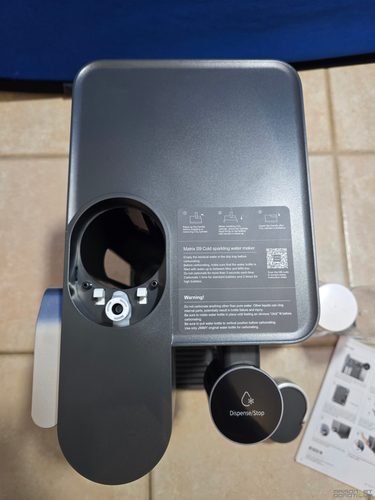
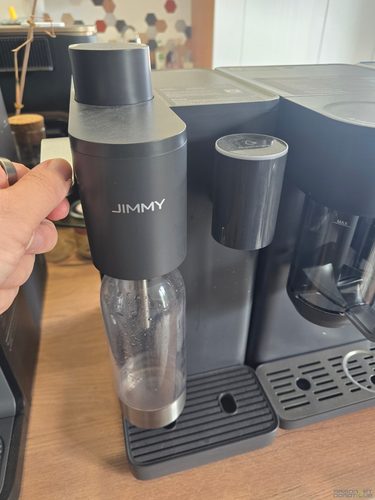
Two reusable 500 ml bottles are included with the S9. Fill them with chilled water directly from the module, without going past the maximum fill line, then attach them to the carbonation system. Press once to inject CO₂, and press a second time for more bubbles. That way, everyone can adjust the fizz to their taste.
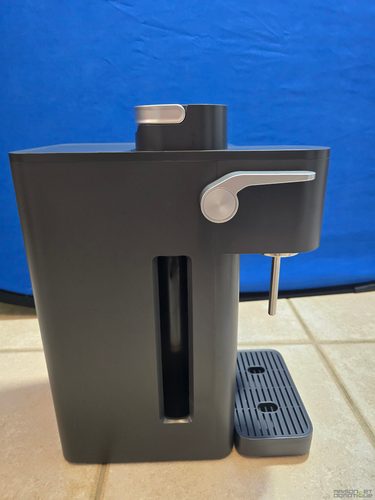
The result is impressive. It easily matches the fizz level of a SodaStream, with the added benefit of water that’s already purified and chilled—and CO₂ dissolves better in cold water, too.
One precaution: never add syrup before carbonating. Carbonate the water on its own, then add syrup, juice or flavoring. Otherwise, you might discover a new way to redecorate your kitchen ;-)
The S9’s little drawback: you can hear it
The cooling system isn’t silent, though. The S9 kicks in from time to time to keep its reserve between 10 and 15°C. In a closed kitchen, it’s not a problem. In an open-plan kitchen, you notice it more. It doesn’t run continuously, and you eventually stop paying attention to it, but I thought it was worth mentioning.
Another limitation: if you like your water almost ice-cold, at 4 or 5°C, the S9 won’t get that cold. At 10 to 15°C, the water is pleasantly chilled, but not as cold as a bottle taken from the back of the fridge.
Matrix I9: and now, ice cubes
The third module is the most surprising member of the family.
The I9 measures 210 x 310 x 364 mm and weighs 8.4 kg. Like the S9, it relies on the M9 Pro and can’t be used on its own. It turns water into ice: regular clear ice cubes, as well as “snowflake”-style crushed ice, thanks to a removable electric grinder.
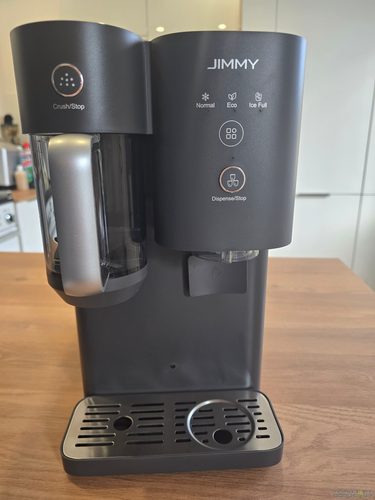
Since the ice cubes are made with water that has passed through reverse osmosis, they don’t pick up freezer odors or flavors, and they look noticeably cleaner.

The module also has its own 0.5-liter chilled water tank. So you can use it as a cold water dispenser without making any ice.
Ice cubes dispensed straight into your glass
Automatic dispensing is what really changes the experience. There’s no rummaging around in a bin with a scoop: just place your glass under the outlet and the machine drops the ice into it. It’s more convenient and more hygienic, since nobody has to put their fingers into a shared ice bin.

Regular ice cubes are ideal for whisky or cocktails. They’re fairly clear and melt slowly.

For smoothies, frappés, slushies or certain cocktails, the grinder produces crushed ice in an instant.

I have to admit, this is the kind of feature you scoff at before you have it… and then use far more often than expected. In summer, you can make an iced coffee with crushed ice in seconds.
That said, don’t expect it to supply a bar for a party of fifty. It stores around 40 to 50 g of ice at a time and needs to replenish its supply regularly. It takes about 8 minutes to make another batch of 8 ice cubes. For a family and a few guests, it’s more than convenient.
And when it crushes ice, it makes noise. You can’t crush ice with a motor in silence.

The Matrix system changes your daily routine
You see the benefits once you start using it.
None of these features is new in itself. A jug filters water, a kettle heats it, the fridge chills it, a SodaStream carbonates it and the freezer makes ice cubes. The difference is that you have to juggle four or five appliances. With the Matrix range, everything comes from the same tank and the same purified water.
In the morning, I pour myself 240 ml at 85°C for an herbal tea. During the day, the kids get a glass of chilled water. In the evening, a bottle goes on the S9 for sparkling water, and at aperitif time, the I9 fills glasses with ice cubes or crushed ice. After a few days, the whole setup had become our little family drinks station.
I also noticed the same thing I’d observed with the Hydrofast: when good-quality water is available straight away, chilled or sparkling, you drink more of it. And multipacks of bottled water from the supermarket quickly lose their appeal.
Maintenance and filter prices
You don’t buy a reverse osmosis system to forget about it for ten years, unlike the Berkey we looked at here.
Jimmy recommends replacing the M2S composite filter and the Q2S remineralization filter every 12 months, and the RO-2.0S membrane about every 24 months. These are guidelines: a family that drinks a lot of water, especially with a heavily mineralized water supply, will wear out its cartridges more quickly. The screen shows their status, so you can plan ahead for replacements.
Replacing them is easy: the cartridges are under the top cover and can be removed in a few seconds.
Day-to-day maintenance mainly involves rinsing the 5-liter tank and the drip tray. Jimmy also includes sachets for descaling and cleaning the tank from time to time.
The S9 doesn’t need much more: wash the bottles and replace the CO₂ cylinder. The I9 requires a little more attention to the parts that come into contact with the ice, but its grinder can be taken apart, which makes cleaning much easier.
Power consumption in context
The M9 Pro’s specifications list a maximum power of 2,200 W. That figure is impressive, but it refers to instant heating: the machine doesn’t consume 2,200 W continuously. That’s actually the point of this system: rather than keeping several liters of water hot all the time, it only heats the amount you need.
The S9 has a rated power of 100 W, and the I9 150 W. These two modules run intermittently to produce chilled water or ice. Total consumption will therefore depend a lot on how you use them.
The downside: it takes up space
The idea of a system that avoids cluttering your counter with multiple appliances is appealing, but it’s important to be honest about the dimensions.

The M9 Pro alone is a reasonable size at 27.8 cm wide. With the S9, the total width is close to 48 cm. Add the I9, and the whole setup takes up considerably more room. Get out the tape measure before ordering the full configuration.
Another important point to note: the two modules can’t be used together. You have to choose between the I9 and the S9. That’s a bit of a shame, and it’s my main criticism. In practice, I personally opted for the I9, which dispenses chilled water and makes ice cubes that can then be crushed if you like. That means the S9 can sit beside it for sparkling water, since it works independently. However, the S9 won’t be able to dispense chilled water in this setup, because it isn’t connected to the M9.
On the other hand, you need to consider what you no longer need. At my place, the kettle and sparkling water maker are no longer used, I don’t need to keep bottles of water in the fridge, and I can get ice cubes in a few minutes for aperitif time—or for an unexpected visit from friends :) It all depends on how your kitchen is set up.
Jimmy Matrix M9 Pro or Hydrofast C300?
Having used both, I couldn’t avoid comparing them. They’re based on different approaches, though.
The Hydrofast C300 is an all-in-one unit. For around €600, it combines reverse osmosis, UV, hot, cold and sparkling water in a single unit. It has a 5-liter raw water tank and a 1.5-liter purified water reserve. During my test, my water went from 248 ppm to 26 ppm after filtration. Its compressor delivers genuinely cold water, between 8 and 10°C according to my measurements.
The Jimmy M9 Pro focuses on modularity. At €399, it costs less on its own and is more than enough if you don’t need chilled or sparkling water. It’s also much more compact: 278 x 310 x 366 mm and 7.5 kg, compared with 450 x 270 x 445 mm and nearly 13 kg for the Hydrofast.
With the S9, the price rises to €598, and you get roughly the same features as the C300: reverse-osmosis water, remineralized, hot, chilled and sparkling. At that point, the choice becomes closer.
The Hydrofast retains the advantage of being an integrated unit: a single housing, a larger purified water reserve (1.5 liters) and colder water. If you know from the outset that you want all these features, it’s very convenient to live with. I also really like the Hydrofast’s built-in carafe, which you can bring to the table at mealtimes.
The Jimmy, on the other hand, can grow with you. Start with the M9 Pro, add the S9 six months later, or perhaps the I9. Its side-mounted tank is also more convenient than the C300’s rear tank when the appliance is installed under wall cabinets.
With the I9, Jimmy goes a clear step further: the C300 doesn’t make ice cubes or crushed ice. But that comes at a price. The M9 Pro + S9 + I9 bundle is listed at the official price of €947. At that point, you’re talking about a complete drinks station rather than a water purifier.
In short, the C300 is probably the most practical choice if you want hot, cold and sparkling water straight away in a single appliance. The Matrix is better suited to those who want to expand their setup over time, and especially to those who want the option of making ice.
So, does the Jimmy Matrix M9 Pro deserve a place in your kitchen?
After several weeks, AquaLink is the concept that stands out to me.
On its own, the M9 Pro is already a very good countertop purifier. No installation, a convenient side-mounted tank, effective reverse osmosis and remineralization that avoids the feeling of “empty” water. Instant heating quickly becomes part of your routine: once you get used to asking for 150 ml at 85°C, pulling out the kettle feels like something from another era.
In my opinion, the S9 is the most useful add-on. Chilled water comes in handy every day, and making sparkling water with water that’s already been through reverse osmosis is a real pleasure.
The I9 is more of a luxury. Nobody really needs a machine that dispenses ice cubes and crushed ice in their kitchen. But if you enjoy cocktails, smoothies or iced coffee, or you often have people over, the convenience is real.
The downsides are the overall price and the space it takes up: three modules side by side occupy a good stretch of countertop. But there’s no need to buy all three, and that’s what I like most about this range. You can start by buying a good countertop reverse osmosis purifier, then decide how far you want to go.
As for me, after hot water in three seconds, sparkling water that’s already chilled, and ice cubes dropping straight into my glass, going back to bottled water, the kettle and ice cube trays is out of the question.
JIMMY Matrix M9 Pro



Please remain courteous: a hello and a thank you cost nothing! We're here to exchange ideas in a constructive way. Trolls will be deleted.