



Résumer cet article :
We turn on the tap several times a day without really thinking about it. Drinking, making coffee, cooking pasta, filling a bottle before heading out: tap water is everywhere in a normal day, yet we rarely question what it really contains. Chlorine, limescale, nitrates, sometimes a strange taste depending on the neighborhood or the town. Everyone deals with what they have at home. This is what drove me to buy a Berkey a few years ago, to filter this tap water. Then this year, water purifiers are becoming more popular, like the Hydrofast C300 that I invite you to discover today. Most purifiers simply filter the tap water. Some heat the water. A few cool it down. The Hydrofast C300, however, aims to do everything at once.
This countertop device indeed claims to replace a water filter, a kettle, a fresh water dispenser, and even a sparkling water machine, without any plumbing connection. On paper, that makes a lot of promises for a single device, and I was quite skeptical at first. After several weeks of daily use by the whole family, it’s time to give you my honest opinion.
Unboxing the Hydrofast C300
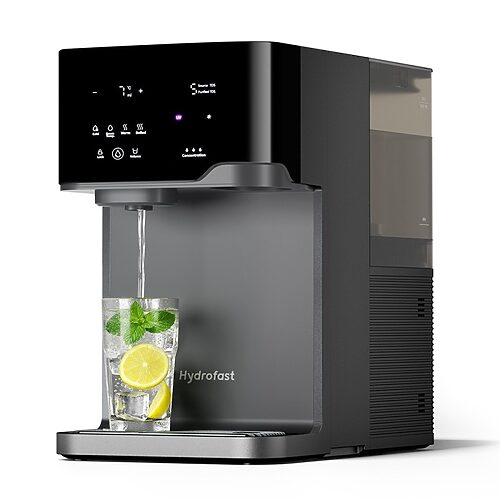
So be careful, the Hydrofast C300 makes an impression as soon as you take it out of the box: 450 x 270 x 445 mm, almost 13 kg on the scale: it’s not a small countertop device, it’s a block that takes up space.

The glossy black finish gives an impression of quality. The assembly is neat, nothing feels plastic to the touch. Quite a good point!

Except for the electrical supply, the operation is fully autonomous. At the back, a 5-liter raw water tank, which can be removed for filling or cleaning:


Once filtered, the water passes into a second 1.5-liter tank that serves as a buffer reserve.

No connection required. This is the obvious advantage of this system: you can place it almost anywhere. Kitchen, office, vacation rental, camper van.
Reverse osmosis filtration in six stages
The system relies on a six-stage RO (reverse osmosis) filtration.


First, a mechanical filtration to retain sand, rust, and sediments. Then several layers of activated carbon that eliminate chlorine and odors. Next comes the reverse osmosis membrane, the heart of the system: 0.0001 micron in fineness according to the manufacturer, enough to retain heavy metals, nitrates, PFAS, bacteria, and viruses.

Unlike traditional RO systems, which produce water that is a bit too “empty,” Hydrofast has added a remineralization step to rebalance the pH. A permanent UV sterilization then seals the device, to prevent the tanks from becoming a breeding ground for bacteria.
Filtration results that are visible
The device directly displays its TDS level on the screen: before filtration, then after filtration.
TDS (Total Dissolved Solids) is an indicator that measures the amount of dissolved substances in water, expressed in ppm (parts per million) or mg/L. It does not allow for precise identification of the contaminants present but provides a good indication of the overall mineralization of the water. In France, tap water typically shows a TDS between 100 and 500 ppm depending on the regions, with values sometimes exceeding 700 ppm in heavily limestone areas. Bottled mineral water often falls between 200 and 1,500 ppm depending on its composition. In contrast, water from a reverse osmosis system often drops below 50 ppm, or between 10 and 30 ppm for the most efficient installations.

To check this, I got a TDS meter. And the measurements are telling. 248 ppm before filtration, 26 ppm after. Even the Berkey was around 200 ppm. The filtration of the Hydrofast C300 is therefore quite effective.
The difference is clear, and it shows in the taste: the water is softer, without the chlorinated aftertaste that we sometimes have depending on the regions.
Cold water at 7 °C, without ice
New feature of the C300: it cools the water. Not with a simple thermoelectric module like some competitors, but with a real compressor. Hydrofast claims a range of 7 to 15 °C, and my tests confirm actual temperatures between 8 and 10 °C. Perfect for summer.


The dedicated reservoir holds about 0.8 liters, enough to serve several glasses without waiting for it to cool down again. With the current heat, having fresh water on demand is particularly appreciated!
Hot water, almost instant
The heating is provided by a 1900 to 2200 W heater. Hot water comes in a few seconds, without permanent preheating, and the temperature can be set from 40 to 100 °C, to the degree.

Enough to prepare a bottle at 45 °C, green tea at 75 °C, filter coffee at 90 °C, or boiling water for instant noodles. It’s quite impressive to see hot water come out almost instantly, and you quickly get used to it!
A real sparkling water machine
This is the function that surprised me the most. On the side, a compartment holds a standard CO₂ bottle in TR21x4 format (the same as SodaStream, bottles that screw on).

Three levels of carbonation, a dedicated PET bottle, a button on top.

The carbonation is strong, sometimes more than on some classic SodaStreams. A CO₂ bottle lasts about 60 liters of sparkling water. The only downside is the provided PET bottle, a bit small at 400 ml. But since space is limited, a standard 1-liter bottle doesn’t seem to fit.
A well-thought-out touchscreen
A sensor detects the glass under the spout and lights up the screen. It displays the TDS of the raw water, that of the filtered water, the level of the tanks, the status of the filter, the chosen temperature, and the delivered volume.

The volumes can be pre-set (150, 250, 400, 500 ml) or customized up to 999 ml. Handy when you know exactly the amount you need, it avoids having to wait to press the button again to stop the water.

Maintenance: what you need to know
The main filter is rated for about 2000 liters. For a family of four, at 5 liters per day, that represents more than a year of use. The replacement is tool-free, by removing the old cartridge. You’ll need to count about a hundred euros for the replacement filter.
One point to monitor: the raw water tank needs to be emptied regularly. The water rejected by the osmosis partly returns there, which gradually concentrates the minerals. It’s better not to just top it up indefinitely.
Finally, a word on electricity consumption. Because unlike a Berkey filter that works by gravity, electricity is needed here. The filtration system requires between 85 and 100w, but only for a few minutes. The filtration of the 1.5 liters necessary for the buffer tank is done very quickly. It’s a one-time need.
The refreshing of the water runs a bit more regularly, to keep the water fresh thanks to the compressor. Here you need to count around 65w. A little more frequently, knowing that this also causes some blowing noise. By default, the fresh water mode is off, so when used “normally,” the Hydrofast C300 is very quiet and consumes little energy.
My opinion
As we have seen, the Hydrofast C300 is not just a simple purifier. It replaces on its own a reverse osmosis system, a kettle, a fresh water dispenser, and a sparkling water machine. Few devices make this promise today.
Its price of nearly €600 does make me hesitate, as it is a real investment. If you are used to consuming bottled water, the cost of the device will be recouped in about 2 years (based on 1.5 liters of water per person per day, knowing that we are five here). This is a factor to consider: tap water is much cheaper than bottled water, without the burden of transporting packs of water.

Another point: it also takes up space on a countertop. This is not a detail if your kitchen is small. But on the other hand, I have gained space elsewhere by removing the kettle and the Sodastream, which have become unnecessary.
But once installed, you quickly forget these reservations: I struggled to find a device that meets so many water needs without a single pipe to connect. And in use, it quickly becomes indispensable.



Please remain courteous: a hello and a thank you cost nothing! We're here to exchange ideas in a constructive way. Trolls will be deleted.