


Résumer cet article :
We drink tap water every day without really wondering what happens between the water network and our glass. And yet water purifiers have been making their way into kitchens for a while now.
I’ve tested several, including the Hydrofast C300 and, more recently, the Jimmy M9 . Both work in much the same way: a very fine reverse osmosis membrane that removes a large part of what is dissolved in the water.
The OVI II takes a different approach. It doesn’t use reverse osmosis: it combines mechanical filtration, activated carbon, 0.01 µm ultrafiltration and UV-C treatment. The goal is to remove certain specific contaminants while allowing the minerals in the water to pass through. This choice has practical consequences: no wastewater, no tank to fill, and a very slim appliance.
After spending several months with reverse osmosis systems on my countertop, I was curious to see how this one would perform.
OVI II: a very compact water dispenser
The OVI II is 42.5 cm deep, 38 cm high and just 18 cm wide, and weighs 6.3 kg. Its width is what stands out: at 18 cm, it’s easy to find a spot for it between two appliances. The specifications list 2100 W for heating, 125 W for cooling and 2.5 W for the UV-C LED.
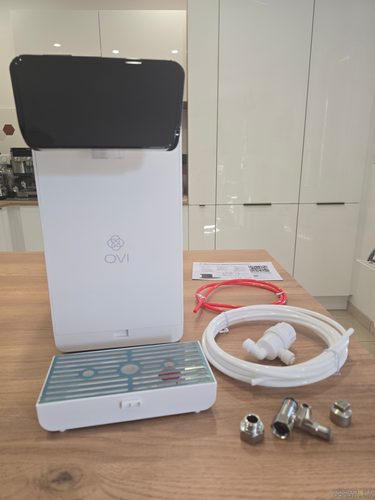
The box contains the dispenser, its filters, a pre-filter, 4 metres of tubing, the T-valve for connecting it and maintenance accessories.

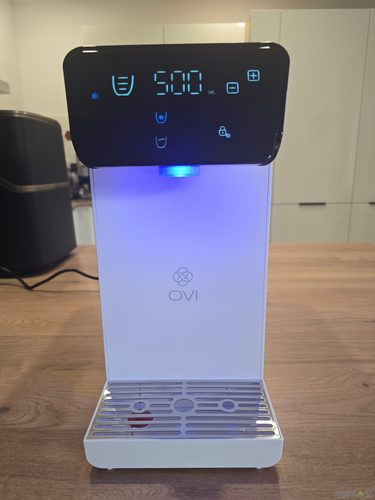
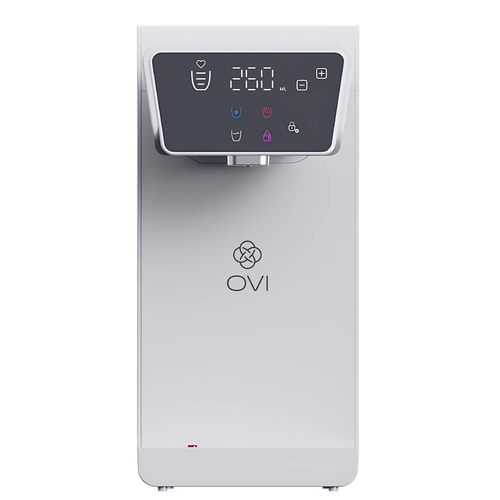
The design is understated. The front panel is vertical, and the control screen at the top is angled towards the user.

The machine is available in white or black, and the front panel is interchangeable. OVI sells several covers for €39.90 (Wood, Leaf, Waves, Purple Gradient…). You can do without one, but for an appliance that will stay on your kitchen counter all the time, it’s a good idea.
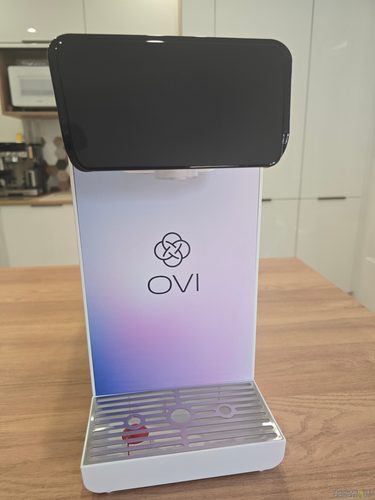
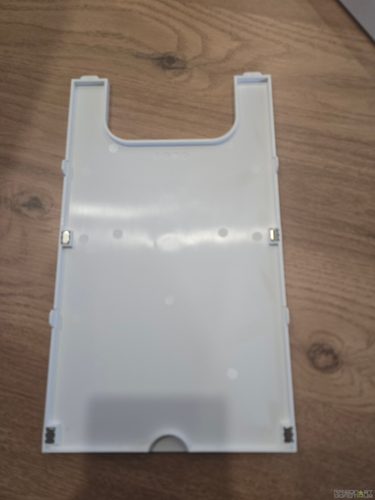
And since the front panel is magnetic, you could even imagine creating your own with a 3D printer if you like customising things down to the last detail ;-)
No tank to fill: the OVI II connects to the water supply
The two reverse osmosis systems I tested have one big advantage: you set them down, fill the tank, and they’re ready to go. No plumbing required.
The OVI II requires a little more work at first, since it connects directly to the cold water supply.
Turn off the water supply, unscrew the kitchen tap hose and install the supplied T-fitting.

A 6.3 mm hose then connects this fitting to the machine. Depending on your kitchen, you may need to drill a hole in the countertop to route it through. The instructions explain everything clearly, and the manufacturer even provides a video explaining the installation from start to finish.
The pre-filter is fitted to this water supply, in the direction of water flow. Once the connection is made, turn the water supply and the small tap on the T-fitting back on, then plug in the OVI II.

When using it for the first time, you need to fill the 1.5-litre cold water tank and run about 3 litres of room-temperature water through it to prime the filters.
It’s less “plug & play” than a Jimmy M9 or Hydrofast C300, but you only have to do it once. After that, you no longer have to take out a tank holding several litres, carry it to the sink, fill it and put it back in place. The OVI II has a continuous water supply: just place your glass under it and fill it. It’s a real convenience for everyday use. With five of us at home, a 5-litre tank (which holds about 3 litres of purified water) needs to be refilled regularly…
Ultrafiltration or reverse osmosis: two different approaches
This is what really sets the OVI II apart from the others, and understanding it requires a brief technical detour.
The Jimmy M9 uses a reverse osmosis membrane rated at 0.0001 µm, as part of a seven-stage filtration system. Jimmy claims it greatly reduces PFAS, nitrates, heavy metals and other contaminants.
The Hydrofast C300 also uses a 0.0001 µm RO membrane. During my test, the water went from 248 ppm TDS before filtration to 26 ppm afterwards.
At the time, that figure impressed me. However, it should be interpreted with caution.
TDS (Total Dissolved Solids) measures the total amount of dissolved substances in water. A very low TDS clearly shows how effective reverse osmosis is, but on its own, it doesn’t tell us that the water is healthier. There’s no way to know whether what has been removed was calcium, magnesium or a contaminant. The WHO also treats dissolved solids as one water-quality parameter among others, not as an indicator of whether water is safe to drink.
OVI takes a different approach.
How the OVI II filters water
OVI’s starting point is simple: in France, the appliance is connected to mains water, which is already safe to drink.
This matters. Tap water is monitored continuously by the ARS (regional health agencies) and water suppliers, from the source to the tap, and the Ministry of Health describes it as one of the most closely monitored food products in the country. I’m actually in a pretty good position to know: my house is at the entrance to the village, and since I’m fairly available because I work from home, someone comes by almost every year to collect lots of little bottles from me to test the municipal water :p
The OVI II is therefore not designed to make any water safe to drink. Its specifications state that it accepts potable mains water. From there, the water passes through several stages.
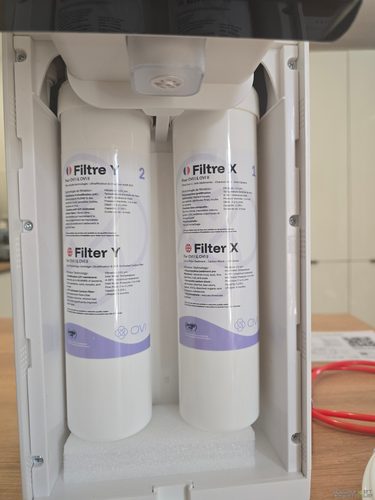
First, a sediment pre-filter catches the larger particles: dust, sludge, debris and rust.
Next, a composite carbon block combined with polyphosphate. It acts on chlorine, odours, unpleasant tastes, certain volatile organic compounds and other contaminants. It also helps limit limescale buildup.
Next comes the main component: a 0.01 µm ultrafiltration membrane, which is 100 times larger than the 0.0001 µm RO membranes in the Jimmy and Hydrofast. This is intentional. This membrane allows a good portion of dissolved mineral salts to pass through, whereas reverse osmosis removes most of them. OVI thus promises water that better retains its mineral content and original taste.
Finally, a 2.5 W UV-C LED treats microorganisms. OVI claims that this stage eliminates up to 99.9% of bacteria and viruses.
The complete process: potable mains water → pre-filter → carbon → ultrafiltration → UV-C → filtered water.
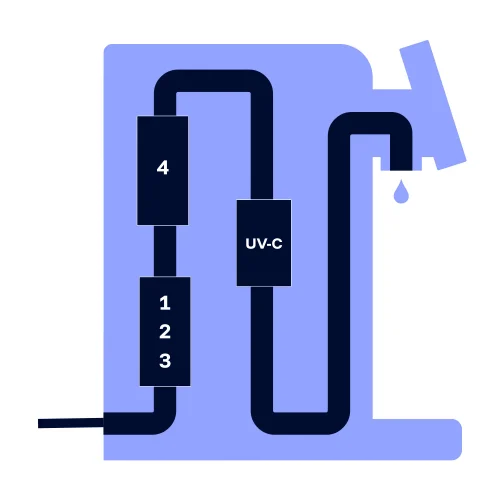
There’s no reverse osmosis membrane, so there’s no concentrated water to drain away.
What about PFAS, heavy metals, nitrates and bacteria?
You might think that with a less fine membrane, the OVI II must retain far fewer contaminants than a reverse osmosis system. It’s not that simple.
OVI has published test results for its system, carried out in particular by the Alpes-Maritimes Departmental Laboratory. The brand says it deliberately contaminated samples to measure what remained after filtration.
Of the six PFAS listed, OVI reports a 100% reduction in PFBS, PFOS, PFOA, PFNA and PFDA under the test conditions, and a 95.3% reduction in PFBA. It also reports a 98% reduction in nitrates, 90% in arsenic and lead, 99.9% in copper and 93% in uranium.
As for microbiology, the published analyses found no coliforms, E. coli or enterococci in the volumes tested after filtration.
These figures apply to the conditions of those tests. They don’t mean that a household appliance will make any contaminated water safe to drink. I would therefore use the OVI II only for what it’s designed for: public mains water that is already potable.
For water from a borehole, well or spring, whose composition is unknown or varies considerably, reverse osmosis has a clear advantage thanks to its much more thorough separation process.
OVI doesn’t claim otherwise. The person in charge of the brand explained to me that OVI also sells a reverse osmosis version in some markets, where ultrafiltration isn’t enough to retain certain contaminants. Each technology has its place.
The big advantage: almost no water wasted
Reverse osmosis has a physical trade-off: to produce highly purified water, some of the water is used to carry away what the membrane has retained.
The Jimmy M9 claims a pure water-to-wastewater ratio of 3:1, while the Hydrofast C300 is around 2.5:1.
With these countertop appliances, this water doesn’t go straight down the drain: it remains concentrated in the raw water tank, which needs to be emptied regularly.
The OVI II doesn’t have this issue. Water passes through the filters and ends up in your glass. You don’t pour several litres into the machine only to retrieve some of it, and there’s no concentrated water to throw away.
For everyday use with French mains water, this is one of its best selling points in my view.
Cold, room-temperature, warm or hot water
The OVI II does more than filter water: it also replaces a refrigerated water dispenser and a kettle.

The top panel offers four temperature settings (cold, room temperature, warm, hot) and several volumes: 140, 250 or 500 ml, a custom volume or continuous dispensing.

It’s really handy for everyday use. I set it to 110 ml for a glass, another volume for a cup or water bottle, and continuous mode for an unusual container.
Cold water produced using the Peltier effect
The OVI II doesn’t have a compressor. Cooling comes from a 125 W Peltier module, an electronic solution that helps keep the appliance compact.
The internal tank holds 1.5 litres of cold water. OVI claims a capacity of around 1.5 l/h at 6 °C, or 3 l/h at 10 °C. The temperature can be adjusted from 4 to 15 °C, and OVI recommends 10 °C.
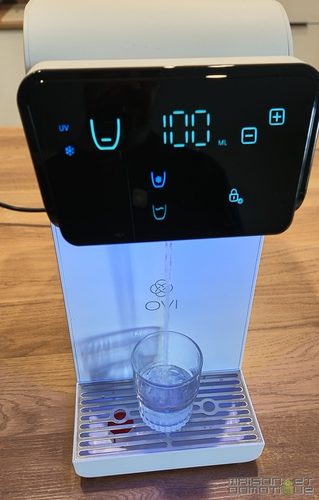
If you drink a lot of water, bear in mind that the supply of cold water isn’t unlimited, unlike hot water. A family filling several large bottles with chilled water one after another may exceed the system’s cooling capacity.
For a few glasses throughout the day, though, it’s very well suited to how a household water dispenser is used.
Almost instant hot water
There’s no hot water tank kept at a constant temperature. The OVI II heats water as it flows through a 2100 W Thermoblock. This means hot water is available on demand, without keeping several litres at 85 or 90 °C all day.
The manual specifies an adjustable temperature range of 45 to 95 °C, with 85 °C recommended.

It’s really handy for tea, herbal infusions or quick food preparation.
Child lock is enabled by default to prevent a child from accidentally dispensing hot water.
A 40 °C baby bottle setting
OVI has also included warm water, designed for preparing baby bottles. It can be set between 30 and 45 °C (40 °C recommended). The machine heats the water directly to this temperature instead of mixing cold water with very hot water.
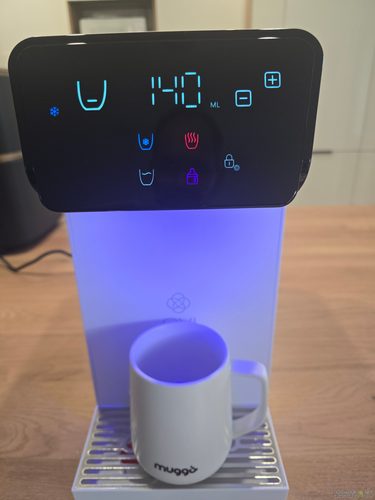
This kind of feature seems like a minor thing until you have your first baby bottle to prepare at three in the morning. I would have loved to have this 15 years ago :p
What about sparkling water?
If you enjoy sparkling water, Sodastream-style, the OVI II doesn’t come with this feature as standard. This keeps the machine as compact as possible. However, the manufacturer offers its Ovibul, a fairly conventional but rather stylish sparkling water maker that matches the OVI II.
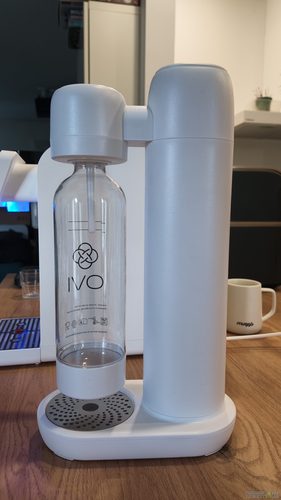
It works with a screw-in CO2 bottle, a very standard setup (I use my usual Sodastream bottle).
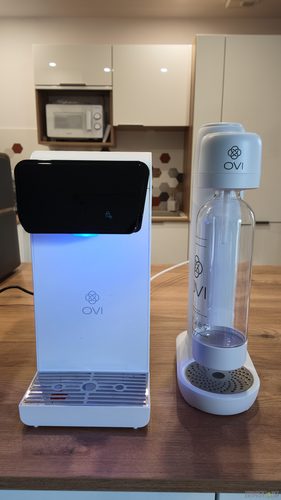
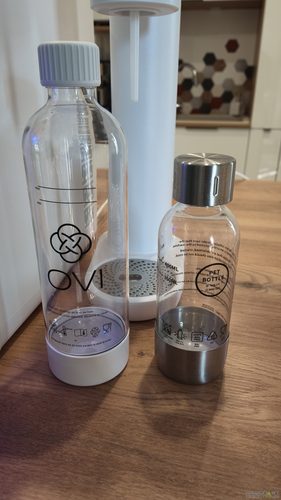
It does mean having one more appliance, but the Ovibul has the advantage of using a 1-litre bottle. With Jimmy or Hydrofast, the sparkling water function is integrated, but you can only use 500 ml bottles. Once again, with five of us at home, that doesn’t go very far, so you need to have several bottles ready if, for example, you want soda for a pizza night.
A simple interface, but more comprehensive than it looks
The screen looks minimalist, but it hides quite a few settings. Press and hold the Menu button for five seconds to access the temperature settings, child lock, heating and cooling controls, button sounds, Eco mode, night lighting, cleaning and filter status. In fact, it’s the most comprehensive screen I’ve seen on this type of machine.

I like being able to switch off heating or cooling when they’re not needed: there’s no point keeping water cold when you’re away for a long time. There’s also an Eco mode.
However, you won’t find the TDS indicator from the Jimmy M9 and Hydrofast C300, with its prominent “250 ppm → 20 ppm” display. OVI doesn’t show one, which makes sense: since ultrafiltration lets dissolved minerals pass through, TDS doesn’t plummet as it does with an RO membrane. So there wouldn’t be much point in using it as a selling point.
Maintenance: two filters every six months
The filters are rated for 2100 litres or six months, whichever comes first.
The machine tracks their wear and warns you as the replacement date approaches. The indicator flashes white when there’s less than a month or less than 150 litres remaining, then turns red below 50 litres.
A set of filters currently costs €75, which works out to about €150 a year at the recommended replacement rate. OVI also offers a subscription.
Replacing them is easy: remove the tray and front panel to access both cartridges.
There is, however, one step you mustn’t forget.
Descaling every time you change the filters
Keeping the minerals in the water also means keeping some of the limescale. OVI has therefore included a descaling programme, which should be run every time you change the filters, or about every six months.
You need to turn off the water supply, connect the supplied hose to the CLEAN/DRAIN inlet and prepare 1.5 litres of water with a liquid descaler. OVI advises against using white vinegar.
The programme then runs four cycles, each separated by ten minutes, and uses about one litre of solution.
So the OVI II does require a little maintenance, but twice a year is still reasonable.
OVI II, Jimmy M9 or Hydrofast C300: which one should you choose?
Having used all three, I find that they don’t quite meet the same needs.
The Hydrofast C300 is the easiest to install: fill its 5-litre tank, plug it in, and you’re done. Its 0.0001 µm RO membrane purifies water very thoroughly, and its seven stages include UV disinfection. It heats water to several temperatures, dispenses cold water and even makes sparkling water. It replaces a water dispenser, a kettle and a SodaStream all by itself. Its main drawback comes from the very nature of a countertop reverse osmosis system: you have to refill the tank regularly and empty the concentrated water.
The Jimmy M9 takes the all-in-one concept even further: depending on the module you add, you can get chilled water, sparkling water, ice cubes or even crushed ice. On the other hand, the machine is bulky, its tank has to be filled by hand, and the reverse osmosis process also produces concentrated water.
The OVI II takes the opposite approach. It doesn’t use reverse osmosis, has no raw water tank or concentrated water to empty, and doesn’t need to remineralise the water because most of the minerals pass through the system. In return, you need a potable water supply nearby and have to be willing to do a little plumbing.
For a permanent installation in a kitchen connected to the mains, I think it’s the most logical choice. If you’re renting and don’t want to touch any pipes, the Jimmy or Hydrofast will be a better fit.
For borehole water or water of uncertain quality, I’d opt for a suitably sized reverse osmosis system, and above all, have the water tested before buying anything. The OVI II isn’t designed to make water that isn’t potable safe to drink.
Ultrafiltration or reverse osmosis: there’s no one-size-fits-all winner
After discovering countertop reverse osmosis systems, I tended to think that filtration down to 0.0001 µm was necessarily better. It is finer, that’s true. But it isn’t always what you need.
For French mains water that’s already safe to drink, OVI’s approach makes sense to me: it removes sediment, chlorine, a good portion of contaminants and microorganisms, while leaving the minerals in. You avoid the wastewater produced by reverse osmosis and keep the machine very compact.
When the source or composition of the water calls for much more thorough purification, reverse osmosis remains the right solution. That’s why it’s used for desalination and for water with very high contaminant levels.
So the right choice depends more on the water coming out of your tap than on the advertised fineness of the membrane.
My verdict on the OVI II
Testing this appliance introduced me to a different way of filtering water at home. The OVI II doesn’t try to remove everything. It starts with mains water that is already safe to drink and filters it further, while allowing its minerals to pass through. Since it doesn’t use a reverse osmosis membrane, it doesn’t waste water, and for me that’s one of its best everyday selling points.
Once installed, it’s very pleasant to use. It connects directly to the mains, so there’s no tank to fill: just place your glass or cup under it, choose the quantity and temperature, and that’s it. Cold, room-temperature, warm or hot water all come from the same appliance.
Its size also matters a lot. At 18 cm wide, it fits easily on a countertop without taking up all the space. Its design is understated, and it has one feature I really like: interchangeable front panels, so you can change its look without replacing the machine.
It does come with a few trade-offs. The initial connection requires a little installation, and the appliance is no longer as easy to move around. The filters need to be changed every six months, which works out to about €150 a year at the current price. And at €599 (€549 with our exclusive code MAISON-DOMO50), the OVI II is an investment. That said, OVI offers subscriptions at €23/month for 36 months or €30/month for 24 months under the current terms. It’s worth noting that the code MAISON-DOMOABO50 also gets you a €50 discount (€10 off immediately and €10 off each of the first four monthly subscription payments once your subscription is approved).
For a permanent installation in a kitchen supplied by mains water, I think it’s a really sensible choice. You no longer have to carry packs of bottled water, fill a tank or waste water, and you have cold or hot water whenever you need it.
It’s a different way to purify water, and above all, an appliance you’ll enjoy using every day.




Please remain courteous: a hello and a thank you cost nothing! We're here to exchange ideas in a constructive way. Trolls will be deleted.