


Résumer cet article :
It’s taken long enough. A very long time. Apple is finally launching something that looks like a real push into the smart home: a central display called HomeView, a new Apple TV 4K, a HomePod mini 2, and a whole range of accessories developed with LG and Schneider Electric. On paper, the Home app is finally more than just an iPhone accessory.
In France, the enthusiasm fades pretty quickly. The most interesting product? We won’t get it. The new AI-powered Siri? Neither will we. A good chunk of Apple Home accessories? Not at launch, anyway.
What we will get, however, is the Apple TV 4K for €349 and the HomePod mini 2 for €169. That’s a relief: Apple hasn’t forgotten our credit cards.
Apple and me: still waiting
A quick personal aside. I used Apple products for years before moving on to something else. I didn’t leave because I’d turned against the brand, but because I was tired of waiting.
Back then, it was NFC and wireless charging by induction. Apple always eventually got around to it, often with flawless integration, but several years behind the competition.
Today, I’m getting a serious sense of déjà vu. Apple is launching its first foldable, the iPhone Duo, while Samsung is already on generation after generation of Galaxy Z Fold and Flip. And now the smart home: Amazon and Google have been selling smart displays for years, Home Assistant enthusiasts have been sticking tablets on their walls for even longer, Matter came out in 2022… and Apple is arriving at the end of 2026 with HomeView.
There’s nothing wrong with arriving after everyone else if you show up with a product that resets the playing field. That’s where things start to go wrong.
HomeView: the dashboard Apple’s smart home has been waiting for
Let’s start with the least frustrating part.
The HomeView is a 7-inch square Liquid Retina touchscreen, designed to sit on a piece of furniture or be mounted on a wall. Apple wants it to be the family’s command center, and some of its ideas are genuinely clever.
The display recognizes who’s standing in front of it and adapts accordingly. Up to six household members can each access their own calendar, reminders, messages, FaceTime calls, and located devices. You can easily picture it in a kitchen: you walk by in the morning and your appointments pop up; your partner comes in five minutes later and the screen switches to theirs. The 12MP camera also handles FaceTime calls, with Center Stage.
For smart home controls, you can manage lighting, heating, locks, cameras, scenes, and Apple Home automations directly from the display. Mounted on the wall, it becomes the interface for the whole house.
Apple offers several Schneider Home mounting options: USB-C power, recessed mains power, and even a PoE version planned for early 2027. I like that one: a single Ethernet cable for both network and power is exactly what you want for a clean installation.
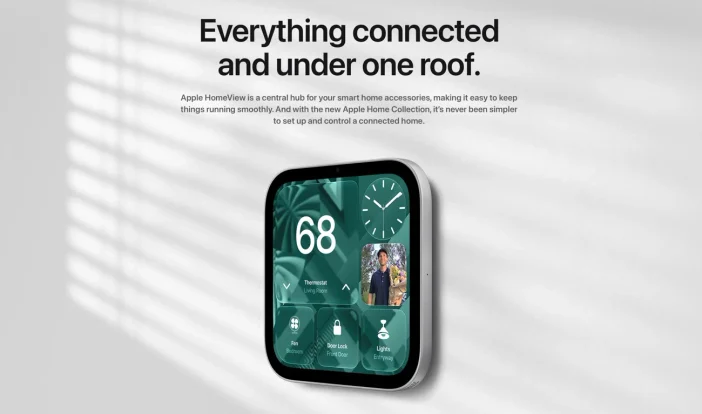
One small snag: the wall-mounted HomeView costs $299, the same as the tabletop version. But it loses the base’s woofer, and it ships… without a wall mount. Add another $59.95 to $129.95, depending on the model. Selling a wall-mounted product without anything to attach it to the wall—you have to hand it to them.
Siri AI, the star… that’s missing
The brain behind HomeView is Siri AI, the next generation of Siri powered by Apple Intelligence. In theory, goodbye to the Siri that misses the point as soon as a question goes beyond “what time is it?”, and hello to a modern conversational assistant.
Siri AI draws on each person’s personal context: it searches Messages or Calendar, understands what’s on the screen, and takes action in apps. For example, someone sent you a recipe in a message three days ago. From the kitchen, you ask Siri to find it, and it appears neatly on HomeView. It’s what I’ve wanted from a home assistant for years.
Requests are processed on the device or through Private Cloud Compute. Naturally, Apple is keen to remind us about privacy.
There’s just one problem, and it’s a big one: Siri AI isn’t available on iOS in the European Union. And since HomeView relies on Siri AI and the iPhone, Apple has simply decided not to sell it in the EU.
And that’s that.
Europe misses out on the best product in the lineup
Apple says it’s working “actively” with Brussels to find a solution that would bring Siri AI, and perhaps HomeView, to our shores. In the meantime, the situation is pretty absurd.
HomeView launches on November 13 in the United States, Canada, the United Kingdom, Australia, India, New Zealand, and a few other markets, with Siri AI starting out in English. In France: nothing.
Apple cites European regulations, particularly the Digital Markets Act and its interoperability requirements. It’s more complicated than simply saying “it’s Brussels’ fault”: Apple defends its closed model in the name of security and privacy, while the EU wants to prevent major platforms from locking users in. Caught in the middle, it’s the user who pays the price.
One detail does bother me, though. HomeView is a new product; it’s not a dominant platform targeted by the DMA. What’s holding it back is its dependence on the iPhone and Siri AI. Apple could probably have designed a European version that was less tied to the iPhone, but that would run counter to the vertical integration that makes its ecosystem so powerful. And apparently, so limiting.
Apple and Europe are squabbling, while we watch the new products go by.
Apple TV 4K: four years of waiting for an A19 at €349
Good news: the new Apple TV 4K is coming to France.
The set-top box hadn’t changed since 2022. Four years. And under the hood, we find… an A19 chip. The one from the previous iPhone generation.
Let’s be honest: an A19 is more than enough for Netflix or Plex, no one would argue otherwise. But for a device Apple only updates every four years, using the latest chip would have been the bare minimum to give it room to breathe over the long term. At €349, I think that’s a fair point, and I’m not the only one saying it: even among brand loyalists, the grumbling is starting.
A real Apple home theater, at last
To be fair, this Apple TV does bring some real new features.
It has long-range microphones, so you can talk to Siri without hunting for the remote. And speaking of the remote, the Siri Remote finally fixes an absurdity that had gone on far too long: you can finally find it with Find My and make it play a sound. About time.
For connectivity, there’s Wi-Fi 7 and Gigabit Ethernet. 2.5Gbps would have been welcome at this price, even if Gigabit is more than enough for today’s video.

The big new feature is sound. The Apple TV can now control four HomePods in surround sound: two at the front, two at the back. The speakers automatically detect their positions and adjust sync and levels to suit the room.
For someone already invested in Apple, it’s an excellent idea. For your wallet, not so much: an Apple TV plus four speakers, and you’re quickly over €1,000. At that price, competing soundbars and home theater kits have a lot to offer.
HomePod mini 2: six years for this?
Another returning product is the HomePod mini 2. The first one came out in 2020: six years of waiting.
The design has barely changed. Inside, there’s an S10 chip, updated connectivity, and improved sound. Two new colors, pink and green, join blue, white, and midnight. A feature called Sound Illumination makes the top of the speaker light up in time with the music. It looks nice, and will probably be fun for the first five minutes.
More usefully, the HomePod mini 2 can serve as the default audio output for a Mac that supports Wi-Fi 6E. And as we’ve just seen, four of them can create a surround sound system with the Apple TV.
And Siri AI? It’s planned. Just not in France.
The price, on the other hand, is definitely coming here: €169. The first HomePod mini launched at €99. Inflation, newer hardware, fair enough, but this is starting to sting.
The bill is getting steep
This is probably the hardest part to defend.
The HomePod mini started at €99 in 2020, then went up to €109, then €139 last June, and now it’s €169. That’s around a 70% increase in six years.
Same story with the Apple TV: launched at €169 in 2022, raised to €229 this summer, and now the new generation is coming in at €349. More than double in four years.
And this is where the European situation becomes downright frustrating. Apple is raising its prices while selling us products stripped of their flagship feature, Siri AI. We’re paying more to get less than people in other countries. I’ve heard easier sales pitches to get behind.
Apple Home Collection: now this is getting really interesting
One announcement carries more weight than it might seem: the Apple Home Collection, developed with LG Electronics and Schneider Electric.
LG is handling indoor and outdoor cameras (including one with floodlights), a video doorbell, a smart lock, a thermostat, and temperature sensors. Several of the technical choices are very well thought out.

Setup follows the AirPods approach: bring your iPhone close and the accessory joins Apple Home. No manufacturer account to create, no extra app to install. That’s exactly what mainstream smart home tech is missing.
Data is end-to-end encrypted in Apple Home. LG cameras record in 2.5K, with color night vision, recognition of people, animals, and vehicles, privacy zones, and local storage. The doorbell has two cameras: a 2.5K one facing the visitor and a Full HD one looking down to keep an eye on packages.
The lock uses Ultra Wideband and Apple Home Key to unlock the door hands-free with an iPhone or Apple Watch, while still supporting NFC, a PIN code, and a physical key.
These are products I’d love to see arrive here. You can guess what’s coming next.
The new Apple home? Not for France
The LG range launches in the United States and Canada starting in December 2026, then rolls out gradually in early 2027. A few cameras and the doorbell will also arrive in the United Kingdom. France doesn’t appear anywhere on the schedule.
That pretty much sums up the presentation. Apple finally has a coherent vision for the smart home: HomeView on the wall, Apple TV in the living room, a HomePod in every room, cameras around the house, plus the doorbell, lock, thermostat, and sensors. Everything communicates and everything is well integrated. Matter and Thread are part of the picture: the thermostat and its sensors work over Matter over Thread.
On paper, Apple finally has a proper smart home ecosystem. Here, we’ll have to make do with the paper version.
Late to the game, but genuinely talented
I don’t want to resort to easy criticism, because Apple has a talent few manufacturers can match: taking technology that already exists and making it simple enough for millions of people to want to use it.
Apple didn’t invent the MP3 player, the smartphone, the smartwatch, Bluetooth earbuds, or contactless payments. And it certainly didn’t invent the smart home in 2026. Home Assistant, Jeedom, Google Home, Alexa, SmartThings, Homey, Aqara… all these players have been around for a long time. Even HomeView isn’t anything new: smart home enthusiasts have been using tablets on the wall to manage lights, heating, and cameras for years.
But Apple could succeed where many others have stumbled: making all of this seamless for everyday people. Bring an accessory close to your iPhone, press a button, and find it available everywhere in your home, with no extra account or app—that could really bring certain uses to the mainstream. I’m genuinely curious to see how it turns out.
Being late is one thing
This is where I’m of two minds.
Once again, Apple is arriving years late, but honestly, that’s no longer what bothers me most. In 2026, the brand is late, very expensive, and offering Europeans a stripped-down version: a €349 Apple TV, a €169 HomePod mini, no Siri AI, no HomeView, and no French launch date for most of the smart home range. Meanwhile, the competition hasn’t been standing still.
The parallel with the other big announcement of the moment is almost comical: Apple’s first foldable is arriving when Samsung is already on its seventh generation.
The strategy of “we’re not first, but we’ll do it better” works when the result really is better. It falls apart when the product is neither new, affordable, nor even available everywhere.
A beautiful show home
Honestly, this launch could have made me take another serious look at Apple for the home. HomeView is appealing, family profiles are clever, the four-HomePod home theater is a good idea, the Apple Home Collection setup is a step in the right direction, and the focus on privacy remains a real selling point.
But I’m still left wanting more. Apple is proudly unveiling an AI-powered home when its AI isn’t even available on iPhone in Europe. It’s showing off its first smart home display but refusing to sell it to us. The Apple TV is back after four years with a chip already outclassed by current iPhones, at €349. And the HomePod mini has gone from €99 to €169 in six years.
Maybe it will all arrive eventually. Apple says it’s in talks with the EU about Siri AI, and once the ecosystem is complete, it could become a very coherent solution for households already fully invested in Apple.
For now, this new Apple home looks more like a beautiful show home. You can tour it, and even imagine living there. But in Europe, we don’t have the keys.


Please remain courteous: a hello and a thank you cost nothing! We're here to exchange ideas in a constructive way. Trolls will be deleted.