


'/%3E%3Cpath%20fill='%23b2b2b2'%20d='M241%20382q0%2016%2017%2026%2017%2011%2042%2011t42-11q16-11%2017-26V269H241'/%3E%3Cpath%20fill='%239f7e00'%20d='M241%20379q0%2014%208%2023%209%209%2021%209%2014%200%2021-9%209-9%209-23V269h-59'/%3E%3Cpath%20d='M241%20339v-70h59v110q0%2014-9%2023l-6%205v-68h-15v72q-8%200-14-4v-68zm59%2040c0%2022%2015%2032%2029%2032%2021%200%2030-18%2030-32v-40h-59'/%3E%3Cpath%20fill='%239f7e00'%20d='M266%20277v5h2v12h-3v-5h2v-5h-9v5h2v5h-4v9h3v18h-5v10h34v-10h-5v-18h3v-9h-4v-5h2v-5h-9v5h2v5h-3v-12h2v-5zm42%20101q0%2010%206%2017%206%206%2015%207%2010-1%2016-7%206-7%206-17v-29h-43'/%3E%3Ccircle%20fill='%230044ad'%20cx='329.5'%20cy='372'%20r='6'/%3E%3Cellipse%20fill='%230044ad'%20cx='300'%20cy='340'%20rx='16'%20ry='21'/%3E%3C/svg%3E)

'/%3E%3C/g%3E%3Cuse%20href='%23c'%20transform='matrix(-1%200%200%201%20720%200)'/%3E%3C/svg%3E)


'%3E%3Cpath%20stroke='%23000'%20stroke-width='4'%20d='m-35-37-13%2020m5%203%2013-20m5%203-13%2020m63%2042%206-9m1-2%206-9m5%203-6%209m-1%202-6%209m5%203%206-9m1-2%206-9m-96%200%2013%2020m5-3-6-9m-1-2-6-9m5-3%2013%2020m63-42-6-9m-1-2-6-9m5-3%2013%2020m5-3-6-9m-1-2-6-9'/%3E%3Ccircle%20r='24'%20fill='%23cd2e3a'/%3E%3Cpath%20fill='%230047a0'%20d='M0%200a12%2012%200%201%201%2020%2013%2024%2024%200%201%201-40-26A12%2012%200%201%200%200%200'/%3E%3C/g%3E%3C/svg%3E)


Résumer cet article :
Berlin, IFA 2026. Upon arriving at the EZVIZ booth, I naturally thought I would start with the cameras. After all, it’s mainly for them that I know the brand, and I have already tested several over the years. Except this time, it took me a few minutes to understand that the playground had seriously expanded. Three-lens cameras, video intercoms, biometric locks, gate motors, sensors, local AI, NAS-style storage, pet devices, and even watches and small lifestyle cameras… We are now quite far from being just a Wi-Fi camera manufacturer.
And amidst all this, there is especially one change that I find particularly interesting: EZVIZ wants to bring intelligence and data home, instead of systematically sending it to the cloud. For someone who has been interested in home automation for a few years, that speaks volumes!
EZVIZ now wants to connect the entire home
The IFA booth already set the tone. EZVIZ organized its space around five major interconnected universes, ranging from video surveillance to smart access, cleaning, and artificial intelligence. The slogan chosen for the occasion, “Accelerating Innovation,” was quite fitting given the number of new products on display.
But behind the communication, I mainly noted a fundamental evolution. EZVIZ clearly no longer wants to sell one camera here, a doorbell there, and possibly a robot vacuum in another room. The goal is to have all these devices communicate around the same environment.
And the most interesting part of this strategy has a name: AI CoreX.
AI CoreX: EZVIZ’s AI moves home
Artificial intelligence in a surveillance camera is obviously no longer exceptional. Recognizing a person, a vehicle, or an animal has become relatively common. But generally, part of that intelligence still heavily depends on the cloud.
With its EZVIZ MIRA system and especially the AI CoreX station, the manufacturer pushes a “local-first” philosophy: to carry out more processing directly at the user’s location. And that becomes much more interesting.
AI CoreX acts somewhat like the brain of the EZVIZ installation. It centralizes compatible devices, stores their data, and provides the artificial intelligence functions of MIRA. It can operate without a constant internet connection and keep files stored right at home. Thus, the cloud is not eliminated, but it ceases to be a mandatory passage.
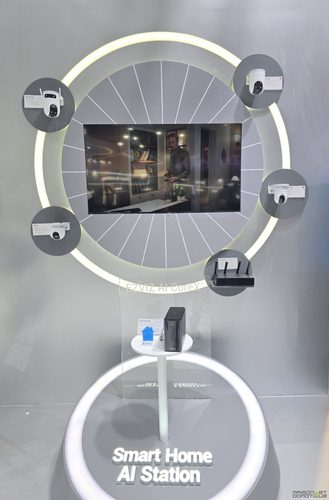
At the booth, I was able to see intelligent search in action. Instead of scrolling through a camera’s timeline for twenty minutes while searching for the moment someone walked in front of the house, you can perform a much more natural search. For example, asking to find a man wearing a blue jacket. The system then analyzes the recorded videos and retrieves the corresponding sequences.
Same principle with known individuals. Several photos can be provided to enhance their recognition, and then the AI is capable of finding their appearances in the videos. It can also generate a summary of the day from the recorded events.
Imagine a house equipped with several cameras: instead of checking all notifications received since morning separately, you could simply ask what happened during our absence. This is concretely where AI is genuinely useful in daily life.
A NAS that does not only store cameras
The demonstration at the booth went even further than one might imagine from a simple NVR.
AI CoreX can also host personal files: photos, videos, documents, or backups from a smartphone. The AI can then work on this content to facilitate searches. We are getting closer to an intelligent home NAS rather than just a camera recorder.

This positioning surprised me. After recently seeing NAS devices gradually integrate AI to categorize photos, recognize individuals, or facilitate document searches, here we see the opposite movement: a video surveillance specialist transforms local storage into a family data center.

During the demonstration, a maximum capacity of about 60 TB was mentioned, with disks to be added separately via two available slots.
The same intelligence, fundamentally, serves both cameras and personal data. That’s the whole strategy.
H90f and HB90f: why put three lenses on a camera?
Of course, EZVIZ has not forgotten its historical business. After dual-lens cameras, the brand is moving to… three!
The new H90f and HB90f each have three lenses capable of simultaneously observing an area at different scales. The goal is not simply to be able to write “triple camera” on the box.

Let’s take a very concrete case: a large property in the countryside.
One lens allows for a general view of the property while the others can more precisely track what is happening in the distance. The ensemble offers a mixed zoom of up to 12x, without completely losing the context of the scene.
This is exactly the kind of configuration where multiplying viewpoints makes sense. A classic camera often forces a choice between framing wide or zooming in on a specific area. Here, we want both.
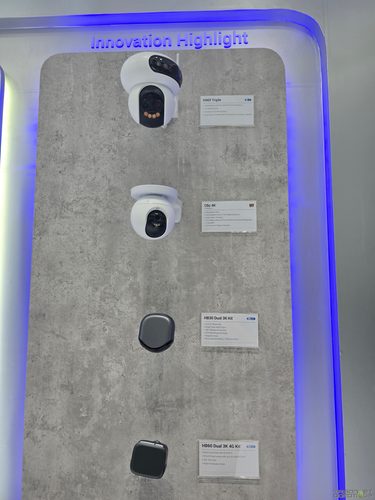
The H90f is designed for fixed installation with wired power, while the HB90f operates on battery. The latter will be much easier to install at the back of a property, on an outbuilding, or in a place where running a power supply would be complicated.
The announced prices are €199 for the H90f and €289.99 for the HB90f.
HB30 and HB60: cameras that can be installed almost anywhere
Another new product that caught my attention at the booth: the HB30 and HB60. This time, EZVIZ prioritizes mobility. They operate on battery and use a magnetic mount. A camera can therefore easily change location according to needs.
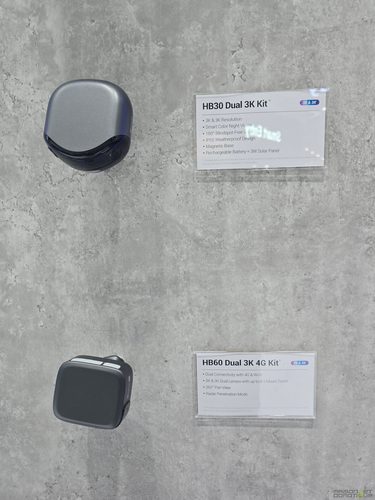
The HB60 adds primarily a dual Wi-Fi and 4G connection. This makes perfect sense as soon as you step out of the classic apartment case in the city.
An outbuilding at the back of the garden, a distant garage, a chalet, a plot without Wi-Fi… as long as mobile coverage is available, the camera can continue to communicate. During our presentation, EZVIZ confirmed the use of a SIM card and the ability to switch between Wi-Fi and mobile network.
For anyone with a large property, this especially avoids having to install Wi-Fi repeaters every 30 meters.

The HB60 also features a zoom that can reach 8x.
The pricing and availability dates for the HB30 and HB60 are still to be specified.
Night vision continues to improve
Another demonstration that caught my attention at the booth: that of color night vision.
EZVIZ has been working for several generations to improve images when lighting becomes very low. In the demonstration, the difference with earlier generations was clearly visible, with an image retaining much more color information in an extremely dark environment.
The H80x Dual 4K was one of the models used to showcase this technology.
On a security camera, this is not just an aesthetic detail. Identifying the color of an outfit or a vehicle can be much more useful than a perfectly clear monochrome image.
The indoor camera that can also call family
Among all the demonstrations, there was also a small product that was technically much less spectacular, but that I found particularly clever. An indoor camera that directly features a call button.

An elderly person living alone can press it to call a loved one. The notification arrives on their smartphone, and a conversation can be established directly through the camera.
The same principle applies to a child temporarily left alone at home.
It’s quite simple, but it’s precisely the kind of feature that transforms a surveillance camera into a true home device.
And for those who feel uncomfortable with the idea of having a camera pointed at them in the living room (which I completely understand), it can be placed on standby from the app to preserve privacy when occupants are present.
From the door to the gate, EZVIZ wants to control all access
The other big part of the booth concerned access. And here too, the brand has rolled out heavy artillery.
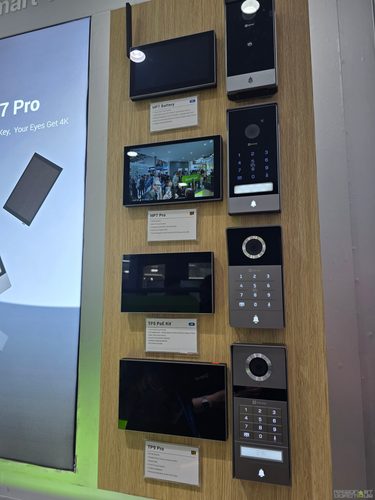
The new DL50FVX combines facial recognition and the recognition of the vein network of the palm. In plain terms, you present your face or hand, and the lock determines whether access is allowed. Palm recognition is particularly interesting because it does not simply rely on the outer shape of the hand: the system analyzes the vein network. Two cameras and a screen are also integrated into the lock to visualize what is happening outside the door.
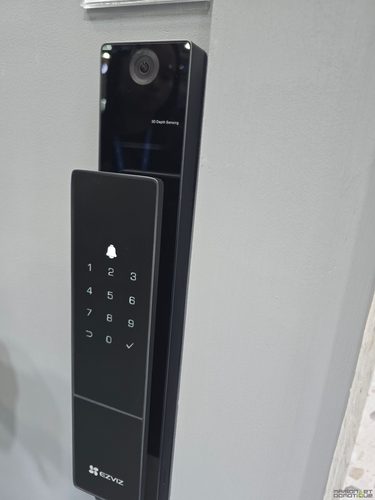
I was able to try the recognition directly at the booth, and during the demonstration conducted in Berlin, the identification was very quick.
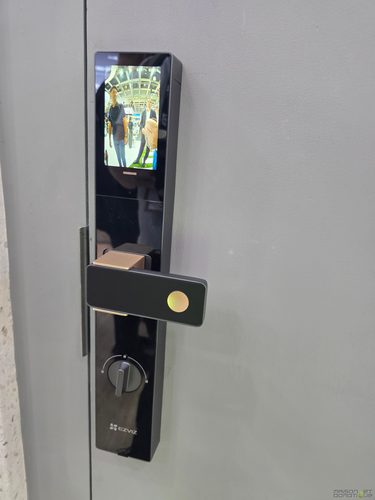
A more down-to-earth problem remains: European doors.
During our exchange, EZVIZ representatives indeed acknowledged that some locks presented still posed adaptation problems to the French market, particularly due to our different locking systems and multi-point doors. The brand therefore prefers not to market certain models until a satisfactory solution has been found.
A caution I appreciate: a beautiful smart lock on a booth is of little use if it cannot be mounted on half of the French doors…
HP7 Pro: up to seven ways to open access
The HP7 Pro also pushes access management very far. During the demonstration, EZVIZ presented different means of identification: biometric recognition depending on the configuration, codes, badges, QR codes, and naturally access from the app.

You can especially create temporary accesses. For an Airbnb rental, for example, a code or a QR code can be created for a visitor and only be valid for two days, three days, or a week. At the end of the defined period, access is automatically disabled.
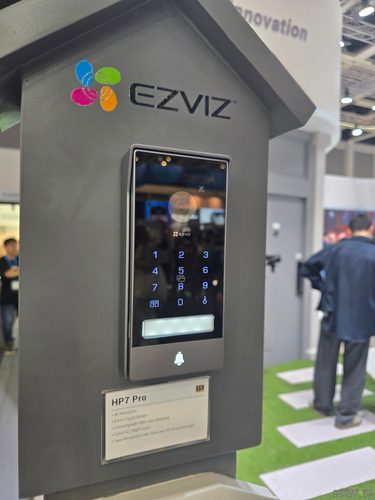
This is much more convenient than handing over a physical key, and especially simpler to revoke.
The HP7 Pro also combines 4K video and management of different accesses from a single interface. Its announced retail price is €369.99.
EP8 Ultra: the doorbell also monitors your packages
The EP8 Ultra also deserves attention. The doorbell features a second lens oriented downward. The interest is obvious: to monitor packages left in front of the door.
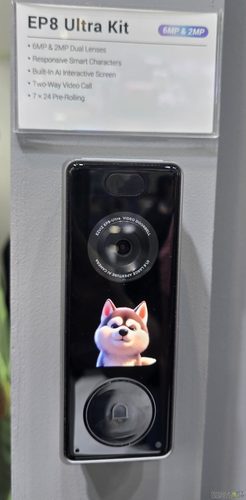
This way, you can see your visitor while keeping an eye on what has been left on the ground. During our visit, EZVIZ specifically highlighted this package detection. It also includes an interactive screen and features reliant on local artificial intelligence.
The EP8 Ultra is already available for a recommended price of €149.99.
EZVIZ even automates the gate
The Smart Entry strategy no longer stops at the front door. With the HG2 600 Pro, EZVIZ is directly targeting the gate to automate vehicle access. Thus, the system joins intercoms, locks, doorbells, and motors within the same connected environment.
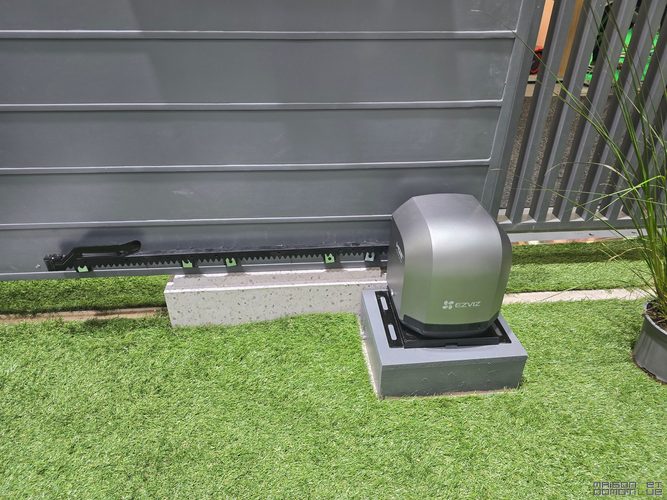
The HG2 600 Pro is priced at €699.99.

On paper, the idea of having the entire chain integrated is appealing: someone arrives in front of the property, rings the gate, you see who is present and can manage access from the same ecosystem.
EZVIZ even steps outside the home with Akiitu
This is a part I frankly did not expect to talk about upon arriving at EZVIZ.
The brand also showcased Akiitu, a new range more focused on lifestyle: small portable cameras, smartwatches, chargers, and other accessories.

I was able to handle a small portable camera that inevitably reminds one of some current miniature action cams. It can be worn on oneself through various accessories, and a 4K version is announced for January 2027, according to the information provided on site.
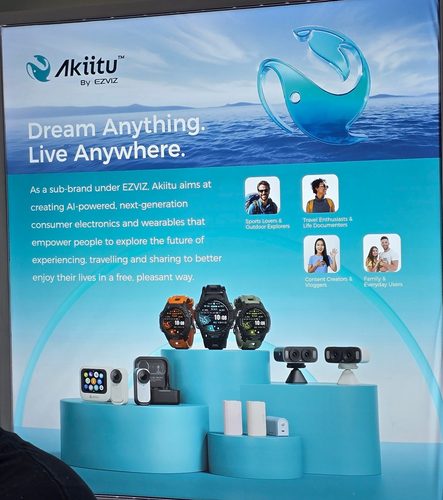
Even more surprising, a smartwatch equipped with a camera was also presented.
We are clearly moving away from home automation, but this range particularly shows that EZVIZ is looking to significantly expand its territory.
EZVIZ is definitely no longer just a camera brand
This is ultimately what I take away from this visit to IFA 2026.
Of course, the H90f and HB90f with triple lenses immediately attract attention. Technically, being able to maintain a general view while zooming in on a detail with a 12x mixed zoom is very appealing for monitoring large properties.
But in my eyes, the most important innovation lies elsewhere. AI CoreX and the local-first approach could mark a significant change in the EZVIZ ecosystem.
The ability to store videos at home, perform intelligent local searches, recognize individuals, generate summaries, and gradually connect more devices around this intelligence is, in my opinion, more crucial than a simple definition enhancement.
Especially if some of these functions remain accessible without a mandatory subscription, as EZVIZ announced for certain local detections.
Now, we will have to see how this entire ecosystem performs once installed in a real home. Compatibility with third-party home automation systems, the final pricing for AI CoreX, its exact storage capabilities, and the features that will be truly available locally will need close monitoring.
But one thing is for sure: after this visit to Berlin, I will no longer view EZVIZ simply as “the brand that makes cameras.” Its ambitions clearly go well beyond that.



Please remain courteous: a hello and a thank you cost nothing! We're here to exchange ideas in a constructive way. Trolls will be deleted.