


'/%3E%3Cpath%20fill='%23b2b2b2'%20d='M241%20382q0%2016%2017%2026%2017%2011%2042%2011t42-11q16-11%2017-26V269H241'/%3E%3Cpath%20fill='%239f7e00'%20d='M241%20379q0%2014%208%2023%209%209%2021%209%2014%200%2021-9%209-9%209-23V269h-59'/%3E%3Cpath%20d='M241%20339v-70h59v110q0%2014-9%2023l-6%205v-68h-15v72q-8%200-14-4v-68zm59%2040c0%2022%2015%2032%2029%2032%2021%200%2030-18%2030-32v-40h-59'/%3E%3Cpath%20fill='%239f7e00'%20d='M266%20277v5h2v12h-3v-5h2v-5h-9v5h2v5h-4v9h3v18h-5v10h34v-10h-5v-18h3v-9h-4v-5h2v-5h-9v5h2v5h-3v-12h2v-5zm42%20101q0%2010%206%2017%206%206%2015%207%2010-1%2016-7%206-7%206-17v-29h-43'/%3E%3Ccircle%20fill='%230044ad'%20cx='329.5'%20cy='372'%20r='6'/%3E%3Cellipse%20fill='%230044ad'%20cx='300'%20cy='340'%20rx='16'%20ry='21'/%3E%3C/svg%3E)

'/%3E%3C/g%3E%3Cuse%20href='%23c'%20transform='matrix(-1%200%200%201%20720%200)'/%3E%3C/svg%3E)


'%3E%3Cpath%20stroke='%23000'%20stroke-width='4'%20d='m-35-37-13%2020m5%203%2013-20m5%203-13%2020m63%2042%206-9m1-2%206-9m5%203-6%209m-1%202-6%209m5%203%206-9m1-2%206-9m-96%200%2013%2020m5-3-6-9m-1-2-6-9m5-3%2013%2020m63-42-6-9m-1-2-6-9m5-3%2013%2020m5-3-6-9m-1-2-6-9'/%3E%3Ccircle%20r='24'%20fill='%23cd2e3a'/%3E%3Cpath%20fill='%230047a0'%20d='M0%200a12%2012%200%201%201%2020%2013%2024%2024%200%201%201-40-26A12%2012%200%201%200%200%200'/%3E%3C/g%3E%3C/svg%3E)


Résumer cet article :
Robot lawn mowers have made quite spectacular progress in recent years. No more need for peripheral cables, automatic mapping, LiDAR, RTK, camera vision, multi-zone management… But there are still a few little things that regularly remind you that automation is not quite complete. Among them, one often comes back: the darn edges that need to be finished with a trimmer.
Back from IFA in Berlin, I was able to discover at the MAMMOTION booth what strongly resembles one of the most interesting responses to this problem. The manufacturer presented its upcoming LUBA 4 AWD, scheduled for the 2027 generation, with a trimmer module installed at the back. But this is ultimately just one of the new features of this robot: steerable front wheels, bi-directional driving, four cameras, 360° LiDAR, NetRTK, adaptive charging… MAMMOTION has revamped a lot.
And the manufacturer is no longer limiting itself to private gardens. A few meters away stood Maston, a huge robotic platform intended this time for professionals, capable of working on several hectares and being managed within a fleet. Two very different machines that clearly show where MAMMOTION wants to go after ten years dedicated to outdoor robotics.
The LUBA 4 AWD is already preparing for the 2027 season
The new MAMMOTION LUBA 4 AWD is undoubtedly the one that will appeal to the largest number of people.
I have already had the opportunity to follow the different evolutions of the LUBA family. Its uniqueness remains its all-wheel drive: where many robots quickly struggle on uneven or steep terrain, the four-wheel drive of the LUBA allows it to tackle much more complicated landscapes.
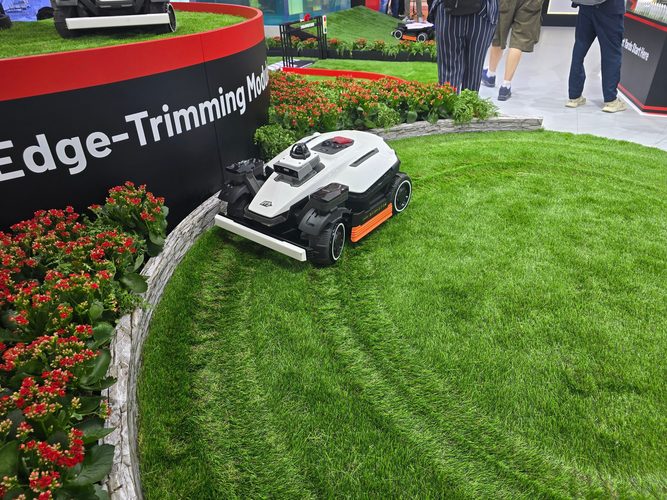
The LUBA 4 AWD obviously retains this DNA. MAMMOTION still claims a capacity to climb slopes of 80%, which is about 38.6°, to overcome obstacles reaching 60 mm, and to mow at speeds of up to 1 m/s. Each cutting disk has its own 165 W motor and six small rotating blades.
But in Berlin, it wasn’t really these figures that caught my attention. It was rather what was happening at the front of the robot.
Steerable wheels to stop digging up the lawn
The omnidirectional front wheels disappear in favor of true independent steerable wheels.
In the demonstration carried out at the booth, the operation was particularly telling: when the robot turns, the inner wheel and the outer wheel do not adopt the same angle or the same speed. Each wheel thus describes its own arc. The LUBA can therefore perform a tight maneuver without simply skidding its wheels in place.
This may seem like a mechanical detail, but on a lawn, it changes a lot of things.
Robot mowers work regularly and inevitably pass over the same spots often, especially near their station or at the ends of mowing lines. A repeated rotation in place can sometimes end up marking the grass, or even creating small bare patches.
With the LUBA 4, the wheels roll more than they scrape. MAMMOTION adds to this a bi-directional driving capability: with cameras located at the front and back, the robot no longer needs to make a half-turn to head in the opposite direction. It can simply reverse its movement.
On a large lawn mowed several times a week, this evolution could be much more significant than it appears.
Four cameras, LiDAR and NetRTK: the LUBA now looks all around it
Another major evolution: environmental perception.
MAMMOTION retains its Tri-Fusion principle, but the LUBA 4 AWD now combines three complementary technologies: 360° LiDAR, NetRTK, and four wide-angle cameras. The latter monitor the front, sides, and also the back of the robot.
This makes sense given its new ability to work in both directions: a robot that truly reverses must obviously know what is behind it!
But the interest goes further. The three systems are not simply juxtaposed. They form a redundant architecture where one technology can take over from another. The goal is to maintain precise location when conditions become difficult, for example under trees where satellite reception may be less favorable. MAMMOTION claims positioning accuracy to within centimeters.
The four cameras also serve for obstacle recognition. According to MAMMOTION, the system is capable of identifying over 300 types of objects and recalculating its trajectory in real-time.
On paper, we are starting to have something quite robust: the satellite when conditions are good, the LiDAR to precisely reconstruct the environment, and vision to understand what is happening around the robot.
And above all… a real trimmer!
This is probably THE new feature I am most looking forward to testing.
Because manufacturers can announce all the artificial intelligence feats they want, if I still have to pull out the Rotofil behind the robot, there is still work to do ;-)
MAMMOTION thus installs a trimmer module at the back of the LUBA 4 AWD.
And I was able to see it work directly at the Berlin booth. The robot was moving along an edge, including in a rounded part, while the offset module came to cut the grass much closer to the obstacle. The solution uses a cutting wire here, following the principle of a classic trimmer.
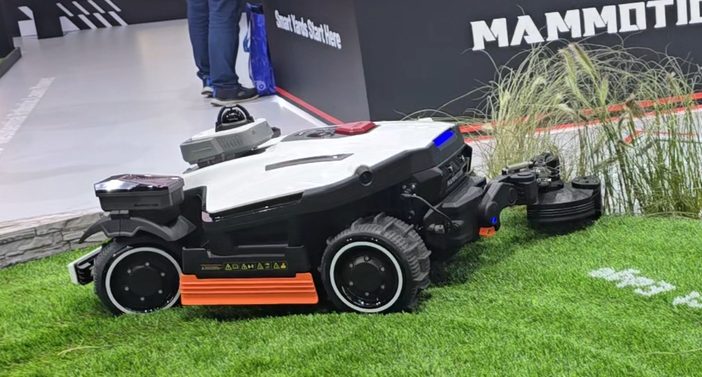
Its rear placement seems particularly interesting to me. With bi-directional driving and the new steerable wheels, MAMMOTION theoretically has many possibilities to reach grass in hard-to-access places.
Of course, it remains to confront all this with a real garden. A demonstration at a show and a perfectly defined edge is one thing. A flowerbed with stones, a fence, roots, awkward angles, and damp grass in Sologne is another! So I hope to have the opportunity to put this system to the test.
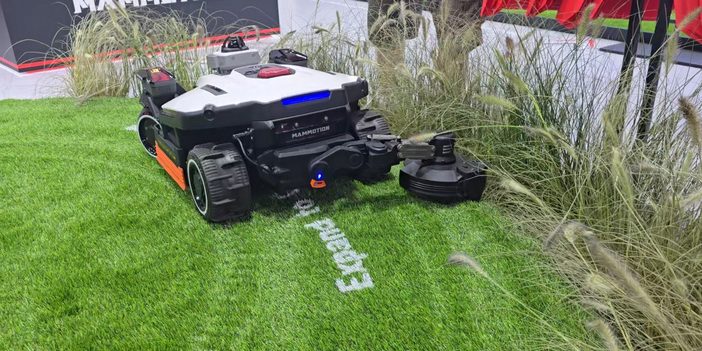
An important note: the trimmer will be an optional accessory. It will therefore need to be purchased in addition to the robot.
Three LUBA 4 AWD for areas up to 12,000 m²
The family will be available in three capacities: LUBA 4 AWD 3000F, 6000F, and 12000F, corresponding respectively to areas of up to 3,000, 6,000, and 12,000 m².
The first two remain quite close in their cutting architecture, with two disks offering a total width of 440 mm. The gigantic 12000F, on the other hand, moves to three disks, giving a cutting width of 530 mm.
And here, we are clearly moving out of the traditional garden. With a capacity of 12,000 m², or 1.2 hectares, MAMMOTION is already stepping into the territory of some semi-professional solutions.
Another detail seen at the booth that I like very much: the battery becomes accessible at the back of the LUBA 4. On the displayed prototypes, a cover allowed direct access to the battery block. This is a simple but significant evolution, as a battery is a wear part and being able to replace it without dismantling half of the machine is quite good news.
However, it is important to keep in mind that the machines presented at IFA are prototypes for the 2027 lineup. Some details may still evolve before the final commercial versions, which we will likely see at CES in January.
A charge that adapts to the remaining work
MAMMOTION has also looked into a point that really matters when we talk about several thousand square meters: the time spent at the station.
The LUBA 4 AWD has fast charging of 210 W, but more importantly, adaptive charging.
Rather than returning to the station and always waiting for a complete charge, the robot evaluates the area it has left to mow. If it only lacks a few dozen square meters, it charges only the necessary energy to finish its job before setting off again.
This is exactly the kind of intelligence that seems useful to me. No need for a spectacular function: saving time by avoiding an hour of unnecessary charging brings a very concrete benefit, especially over 6,000 or 12,000 m².
Maston: here, we are completely changing categories
Moving on to the professional section of the MAMMOTION booth, the atmosphere changes.
The MAMMOTION Maston is clearly not intended to mow the 800 m² behind your house. We are talking here about parks, golf courses, sports fields, campuses, hotels, private estates, farms, or companies specialized in maintaining green spaces.

MAMMOTION offers its platform in Maston Rotary and Maston Flail, in order to meet quite different needs.
The first prioritizes power and yield on large areas or more difficult vegetation. Information presented at IFA indicated three 500 W cutting motors, a working width of 62 cm, and an announced capacity of up to 24,000 m² per day.

The Maston Flail is more aimed at surfaces requiring very precise finishing, particularly sports fields and golf courses. Its cutting width reaches 68 cm and its height can go down to 10 mm. The announced capacity can then reach up to 40,000 m² per day.
Four hectares in a day: we better understand why MAMMOTION describes this as a professional solution.
Tri-Fusion 2.0 and all-wheel drive for Maston
The technology developed for domestic robots is naturally found in this professional range, but with some extra muscle.
The Tri-Fusion 2.0 system combines 360° LiDAR, three cameras using AI, NetRTK, and four ultrasonic sensors. Again, the goal is centimeter-level positioning and continuous awareness of the environment around the machine.
Maston also benefits from all-wheel drive, independent suspension, and a front steering system allowing very tight maneuvers. The maximum announced slope reaches 70%, or about 35°.
A hill-holding function also prevents this large machine from gently rolling back when it stops. On this type of robot, it is not exactly a luxury!
A fleet of robots managed from a single screen
This is probably where Maston shows best that it is not just a LUBA XXL.
I was able to see the MAMMOTION Fleet Management platform at the booth. A manager can find their various sites, their work areas, and the robots assigned to them from a centralized interface.
It then becomes possible to control their location and progress, monitor their battery or maintenance status, and even deploy updates remotely to a specific machine. The demonstration allowed, for example, to select a Maston and directly launch its update and follow its progress.
Several robots can also collaborate in the same large area. The system can guide them to the nearest available charging station, which allows one to imagine a park maintained almost continuously by several machines.
On the energy side, MAMMOTION utilizes a 58 V platform with quickly interchangeable battery and a 500 W charging station. The main components are also modular so that a technician can quickly replace wheels, sensors, cutting elements, or battery on-site rather than immobilizing the machine completely.
For a company where every hour of downtime costs money, this changes everything.
MAMMOTION no longer just wants to automate mowing
What I particularly take away from this visit to IFA is the change in the market’s maturity.
A few years ago, the challenge was to eliminate the peripheral cable and convince that a robot could truly find its way on its own. Today, this battle is practically behind us with high-end models.
The new problems are much more subtle: avoiding marking the grass, continuing to locate under trees, leaving no strips of grass against a wall, reducing charging times. And, for professionals, managing ten robots as easily as one.
The LUBA 4 AWD specifically addresses several of these questions. And that is ultimately what makes it interesting. The four cameras or the steerable wheels certainly create a beautiful technical specification, but their true interest lies elsewhere: to make the presence of the robot a little less noticeable.
As for the trimmer module, I really look forward to being able to confront it with real terrain. If MAMMOTION keeps its promise and succeeds in actually eliminating the manual trimming behind the robot, we will have taken another step towards truly autonomous mowing.
Maston shows meanwhile the other direction taken by the manufacturer. After ten years of existence, MAMMOTION clearly no longer wants to be limited to private gardens. Robotic mowing of parks, estates, and sports fields could well become its next big playground.
And given the size of some machines displayed in Berlin, “big” is a pretty good description!




Please remain courteous: a hello and a thank you cost nothing! We're here to exchange ideas in a constructive way. Trolls will be deleted.