


'/%3E%3Cpath%20fill='%23b2b2b2'%20d='M241%20382q0%2016%2017%2026%2017%2011%2042%2011t42-11q16-11%2017-26V269H241'/%3E%3Cpath%20fill='%239f7e00'%20d='M241%20379q0%2014%208%2023%209%209%2021%209%2014%200%2021-9%209-9%209-23V269h-59'/%3E%3Cpath%20d='M241%20339v-70h59v110q0%2014-9%2023l-6%205v-68h-15v72q-8%200-14-4v-68zm59%2040c0%2022%2015%2032%2029%2032%2021%200%2030-18%2030-32v-40h-59'/%3E%3Cpath%20fill='%239f7e00'%20d='M266%20277v5h2v12h-3v-5h2v-5h-9v5h2v5h-4v9h3v18h-5v10h34v-10h-5v-18h3v-9h-4v-5h2v-5h-9v5h2v5h-3v-12h2v-5zm42%20101q0%2010%206%2017%206%206%2015%207%2010-1%2016-7%206-7%206-17v-29h-43'/%3E%3Ccircle%20fill='%230044ad'%20cx='329.5'%20cy='372'%20r='6'/%3E%3Cellipse%20fill='%230044ad'%20cx='300'%20cy='340'%20rx='16'%20ry='21'/%3E%3C/svg%3E)

'/%3E%3C/g%3E%3Cuse%20href='%23c'%20transform='matrix(-1%200%200%201%20720%200)'/%3E%3C/svg%3E)


'%3E%3Cpath%20stroke='%23000'%20stroke-width='4'%20d='m-35-37-13%2020m5%203%2013-20m5%203-13%2020m63%2042%206-9m1-2%206-9m5%203-6%209m-1%202-6%209m5%203%206-9m1-2%206-9m-96%200%2013%2020m5-3-6-9m-1-2-6-9m5-3%2013%2020m63-42-6-9m-1-2-6-9m5-3%2013%2020m5-3-6-9m-1-2-6-9'/%3E%3Ccircle%20r='24'%20fill='%23cd2e3a'/%3E%3Cpath%20fill='%230047a0'%20d='M0%200a12%2012%200%201%201%2020%2013%2024%2024%200%201%201-40-26A12%2012%200%201%200%200%200'/%3E%3C/g%3E%3C/svg%3E)


Résumer cet article :
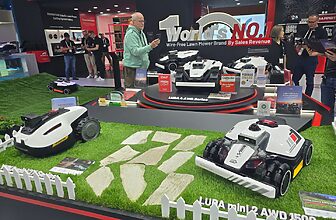
Navimow had already played a good part of its cards at the beginning of the year. I had attended the presentation of its 2026 range in Paris, before being able to test two quite different models this summer: the large X4 designed for big yards and the much more compact i2 AWD. Therefore, I thought I had a pretty good idea of what Navimow would showcase at the IFA in Berlin.
Well, there was a surprise left. During the conference I attended here in Berlin, Navimow unveiled for the first time the H5 Pro. And there is one detail that is immediately noticeable: this funny mechanism that sticks out on its side. Its name is EdgeMaestro. It is an articulated arm capable of extending the cutting disc to reach the grass closer to the edges.
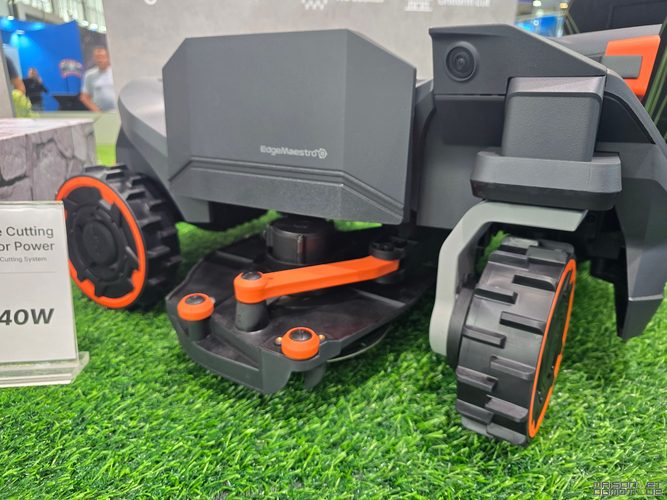
On paper, it seems almost trivial. After all, we are talking about a few centimeters of grass. But when you actually use a lawnmower robot, you know that those few centimeters are precisely the ones that force you to bring out the trimmer. And there, of course, the H5 Pro becomes much more interesting.
Navimow has come a long way in five years
The Berlin conference started with some numbers. Navimow was born in 2021 and only sold 3,000 robots in its first year. Last year, the brand sold 300,000. And in April 2026, it crossed the milestone of a million robots produced.
Behind these numbers, there is mainly an evolution that I have been able to follow in recent years: the gradual disappearance of installation constraints.
The first lawnmower robots required a peripheral cable that needed to be buried all around the garden. Then RTK came along, with its antenna that needed to be installed properly. Today, Navimow combines RTK, cameras, and LiDAR, with one idea in mind: to achieve a robot that you place in the garden and that manages almost on its own.
This is already what I noticed with the 2026 range.

The X4 had especially struck me with its mobility. Despite its imposing size, its four-wheel drive and steering give it quite astonishing agility. The i2 AWD plays in another category, but the addition of a third driving wheel completely changes its behavior as soon as the terrain gets complicated.
The H5 Pro retains several of these gains. But Navimow has clearly wondered what else could be automated.
Answer: the finishing touches.
EdgeMaestro reaches for the grass that other robots leave behind
The problem is quite simple. The blades of a lawnmower robot are placed under its chassis, recessed from the edges for safety reasons. The robot can follow its virtual boundary with remarkable precision; however, it will still leave a strip of grass behind.
On a terrace or a path located exactly at the level of the lawn, this is usually not bothersome. The robot can extend part of its chassis and cut properly.
With a wall, a high edge, or certain flowerbeds, it’s a different story.
Navimow chose quite an astonishing solution: to make the cutting disc extend out of the robot.
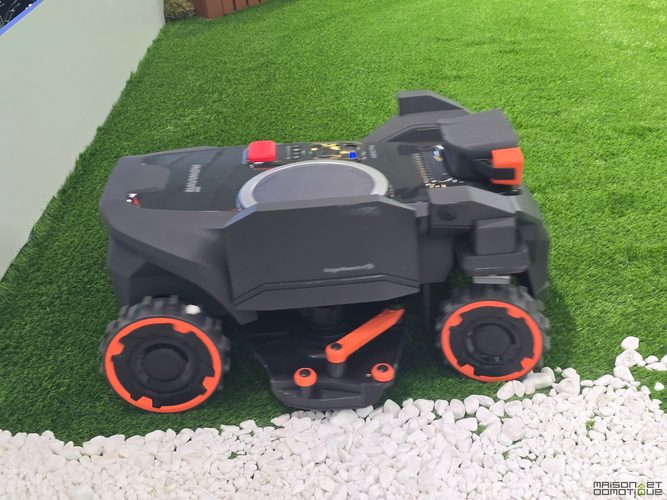
The EdgeMaestro system can offset the cutting deck by 7.7 cm to the side. Thus, the main disc comes to reach the grass at the edge, maintaining the same cutting height as the rest of the lawn.
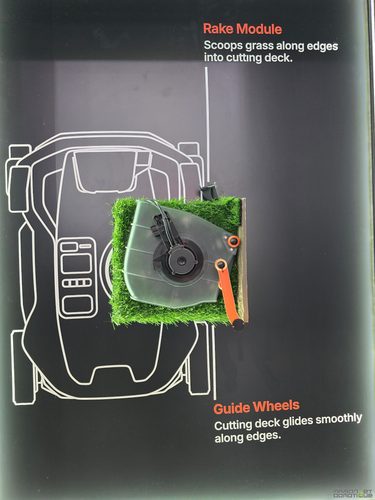
I must admit this is the kind of mechanism I like to see appearing on a product. It’s much more tangible than a new version of an algorithm whose effects we sometimes struggle to measure. Here, one can immediately see its purpose.
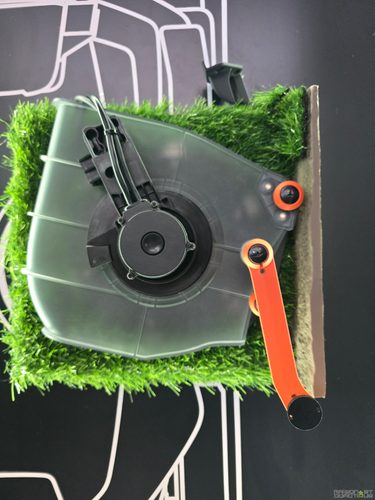
And the mechanism is more sophisticated than it appears. The arm can accommodate height differences in the terrain. If it encounters an obstacle laterally, it can retract. There are also two small guide wheels and a kind of rake designed to bring the grass towards the blades.
Navimow announces a noise level that can drop to 58 dB(A) during this finishing work.
One question remains that the demonstration at a fair obviously cannot answer: how will all this little world age after months spent in the grass, dust, soil, and humidity?
This is typically the point I would like to monitor in a long-term test.
The robot must know when to extend its arm
A disc equipped with blades that extend to the side obviously demands some precautions.
For this, Navimow uses EdgeSense 2.0. The robot analyzes the boundary it follows and adapts the behavior of EdgeMaestro. A terrace edge, the contour of a flowerbed, and a more irregular boundary are not treated exactly the same way. The robot must determine how far it can go before deploying its disc. It is undoubtedly here that a significant part of the system’s interest will be played out.
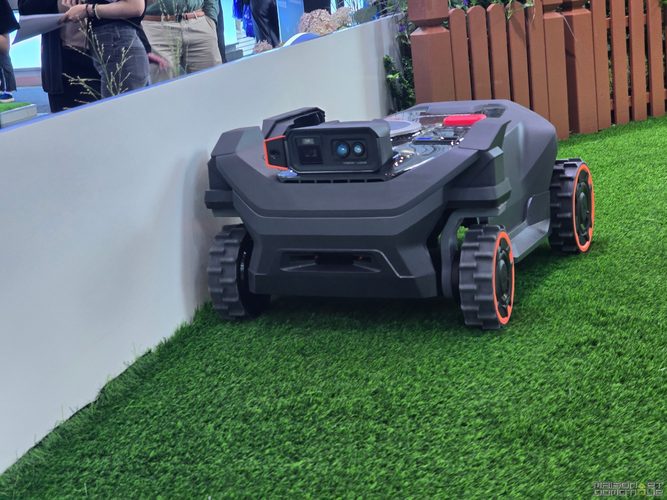
A perfectly straight edge on a demonstration lawn is easy. In my garden, between roots, flowerbeds, edges that have been disturbed over time, and places where grass grows absolutely where we didn’t want it to, the challenge is already much more fun!
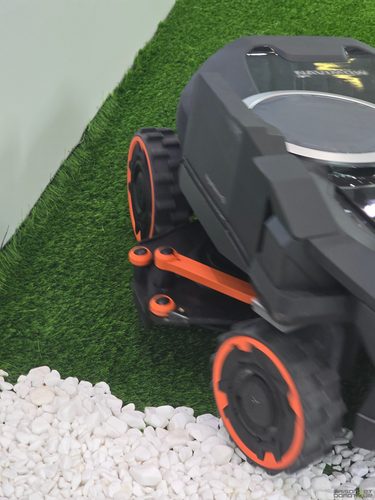
If EdgeMaestro works as well under these conditions, then yes, the trimmer is likely to gather dust.
Four-wheel drive and up to 80% slope
For the rest, we find an architecture that closely resembles what Navimow developed with the X4.
The H5 Pro uses a Xero-Turn AWD transmission, with four independently driven wheels. The robot can pivot in place or adopt a more progressive trajectory depending on the situation.
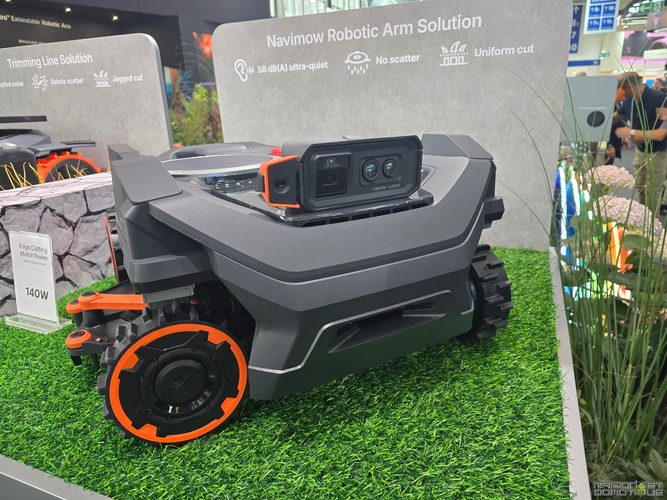
Having used the X4, I understand the interest.
A heavy robot that pivots clumsily on its wheels can quickly mark a lawn, especially when the terrain is wet. The X4 had precisely surprised me with the cleanliness of its maneuvers despite its size. Navimow carries this same philosophy forward.
The manufacturer announces a capacity to work on slopes reaching 80%, or 38.6°, as well as the ability to cross obstacles up to 6 cm.
The rear wheels are also suspended to maximize their contact with the ground.
The numbers are impressive, but I am always a bit cautious about the slope percentages announced for lawnmower robots. A regular, dry slope is nothing like the same slope covered with wet grass, with a few holes and roots along the way. Again, only a test in real terrain will reveal how far we can truly push the H5 Pro.
RTK, LiDAR, and cameras: the H5 Pro no longer chooses between technologies
The navigation relies on the EFLS Tri-Fusion system already highlighted by Navimow in its 2026 generation. It combines NRTK, LiDAR, and vision.

The interest is quite easy to understand. RTK works very well when satellite reception conditions are good. Get close to a house or pass under trees, and things can get complicated. LiDAR and cameras then provide additional reference points.
The technologies complement each other rather than relying on a single positioning system.
This is an evolution that I really appreciate in recent robots. For a long time, choosing a wireless robot almost meant choosing a side: RTK or camera, then RTK or LiDAR. The current trend is more about providing the robot with multiple sensors and letting it use the one that best suits the situation.
And the H5 Pro adds another sense. It can now see heat.
A thermal camera to spot hedgehogs
This is the other part of the presentation that particularly interested me in Berlin.
The VisionFence 360° system combines traditional cameras with a thermal camera. Navimow announces the recognition of over 300 types of obstacles and, in certain conditions, objects measuring about 1 cm.
The thermal camera mainly targets animals. The case of the hedgehog is well known. When faced with danger, it tends to curl up rather than flee. Against a fox, why not. Against the blades of a lawnmower robot, the technique is significantly less effective.
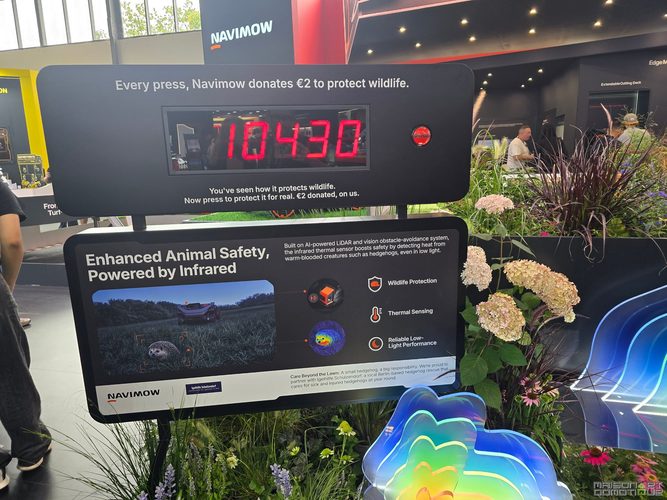
The problem mainly arises in the evening and at night when hedgehogs are active and the robot’s conventional cameras have less light. The thermal camera provides completely different information. It looks for a source of heat. When an animal is detected, the H5 Pro stops cutting and adjusts its trajectory.
On this point, I prefer to remain cautious until I see the system operate in various situations. Recognizing a hedgehog in a controlled demonstration and spotting it among tall grasses, leaves, and branches is not quite the same exercise. Navimow also seems to be aware that an algorithm cannot be validated solely in a laboratory.
Navimow will work with an association that rescues hedgehogs
The brand announced in Berlin a one-year partnership with the German association Igelhilfe Schulzendorf e.V., which rescues and cares for hedgehogs.
And I appreciated the speech of its representative during the conference.
She explained that she had welcomed Navimow with some suspicion at first. I find the reaction rather reassuring. An association confronted with truly injured animals does not necessarily want to applaud immediately when a lawnmower manufacturer arrives with a technological promise.
She will indeed participate in evaluating the animal detection capabilities of the H5 Pro. Feedback from the field can then be used to improve the system.
The association also reminded us of something that’s easily forgotten when talking about connected gardens: the best way to help small wildlife is sometimes to… do nothing. Leaving an area with taller grass, some leaves, and places where animals can hide is excellent for biodiversity.
Not all problems need a LiDAR and artificial intelligence to be solved :)
The H5 Pro arrives at the top of an already very complete Navimow range
I will not redo the entire presentation of the 2026 range here. I detailed it during its announcement, and I have since had the opportunity to test the X4 and the i2 AWD.
The IFA ultimately provides something more interesting than just a simple catalog update. The H5 Pro shows where Navimow wants to go.
Cable-free navigation is now a given. Mapping is becoming simpler and simpler. Mobility issues are being addressed with AWD systems. Robots are learning to recognize an increasing number of obstacles.
Those pesky borders remained. And it is probably for this reason that EdgeMaestro is the new feature that I take away from this conference.
Now, I especially want to put EdgeMaestro to the test
When I started testing lawnmower robots years ago, the simple fact of no longer having to push a mower was already quite magical. In return, I had to run a cable around the entire garden, manage the islands, install a base properly, and accept a few areas where the robot didn’t manage as well.
The models I’m testing today have little in common anymore. With the X4 and the i2 AWD, I have already been able to see the progress made in navigation and especially in mobility. The H5 Pro is now tackling a chore that still resisted: taking care of the borders manually after the robot has passed.
At the IFA stand, EdgeMaestro is undoubtedly appealing. The arm extends, neatly follows the boundary, and retracts into the robot. Clean, neat, efficient.
But my garden is not an IFA stand. There are roots, holes, edges not always straight, flowerbeds, weeds, and probably two or three obstacles that I myself have forgotten about. In short, exactly what’s needed to see if EdgeMaestro is a good idea on a technical sheet… or a feature we won’t want to live without after trying it.
After testing the X4 and the i2 AWD this summer, you probably suspect what comes next: I would really like to give the same treatment to this H5 Pro. And especially see if I can finally put the trimmer away for good. We will talk about it again next year!



Please remain courteous: a hello and a thank you cost nothing! We're here to exchange ideas in a constructive way. Trolls will be deleted.