


'/%3E%3Cpath%20fill='%23b2b2b2'%20d='M241%20382q0%2016%2017%2026%2017%2011%2042%2011t42-11q16-11%2017-26V269H241'/%3E%3Cpath%20fill='%239f7e00'%20d='M241%20379q0%2014%208%2023%209%209%2021%209%2014%200%2021-9%209-9%209-23V269h-59'/%3E%3Cpath%20d='M241%20339v-70h59v110q0%2014-9%2023l-6%205v-68h-15v72q-8%200-14-4v-68zm59%2040c0%2022%2015%2032%2029%2032%2021%200%2030-18%2030-32v-40h-59'/%3E%3Cpath%20fill='%239f7e00'%20d='M266%20277v5h2v12h-3v-5h2v-5h-9v5h2v5h-4v9h3v18h-5v10h34v-10h-5v-18h3v-9h-4v-5h2v-5h-9v5h2v5h-3v-12h2v-5zm42%20101q0%2010%206%2017%206%206%2015%207%2010-1%2016-7%206-7%206-17v-29h-43'/%3E%3Ccircle%20fill='%230044ad'%20cx='329.5'%20cy='372'%20r='6'/%3E%3Cellipse%20fill='%230044ad'%20cx='300'%20cy='340'%20rx='16'%20ry='21'/%3E%3C/svg%3E)

'/%3E%3C/g%3E%3Cuse%20href='%23c'%20transform='matrix(-1%200%200%201%20720%200)'/%3E%3C/svg%3E)


'%3E%3Cpath%20stroke='%23000'%20stroke-width='4'%20d='m-35-37-13%2020m5%203%2013-20m5%203-13%2020m63%2042%206-9m1-2%206-9m5%203-6%209m-1%202-6%209m5%203%206-9m1-2%206-9m-96%200%2013%2020m5-3-6-9m-1-2-6-9m5-3%2013%2020m63-42-6-9m-1-2-6-9m5-3%2013%2020m5-3-6-9m-1-2-6-9'/%3E%3Ccircle%20r='24'%20fill='%23cd2e3a'/%3E%3Cpath%20fill='%230047a0'%20d='M0%200a12%2012%200%201%201%2020%2013%2024%2024%200%201%201-40-26A12%2012%200%201%200%200%200'/%3E%3C/g%3E%3C/svg%3E)


Résumer cet article :
We’ve already seen it with several models now: robotic mowers without peripheral wires truly change life. No more cables to bury around the lawn, no more weekends lost pulling wires, and no more having to bring out the mower every Saturday once the grass has grown two centimeters. In theory, it’s perfect. In practice, it depends on your garden. Because a garden isn’t always a catalog lawn. There are bumps, dips, narrow passages, not perfectly straight borders, wet areas, roots, slopes, and sometimes that little cursed corner where all robots end up spinning with a sheepish look.
This is exactly where the Navimow i2 AWD aims to make a difference. The range takes the spirit of the small Navimow series i, already very convincing for their simplicity, but adds a concrete innovation: a third driving wheel at the back. The robot no longer relies solely on two large driving wheels and wobbly casters. It gains additional traction to better handle slopes, inclines, U-turns, and somewhat capricious terrain.
I tested the Navimow i208 AWD, rated for 800 m² of lawn. The other models in the i2 AWD family share the same technical base, with differences in mowing surfaces depending on the versions. This test is mainly to understand the behavior of this new AWD generation, focusing on the i208, the model that corresponds to my test area.
And let’s say it right away: this little driving wheel really changes the game.
Unboxing the Navimow i208 AWD
At Navimow, the unboxing is meticulous. Everything is well secured, the elements are clearly identified, and the QR codes lead directly to the app.

No hunting for parts or unreadable instructions. The brand has clearly understood that a robotic mower needs to be simple right from the moment the box is opened.
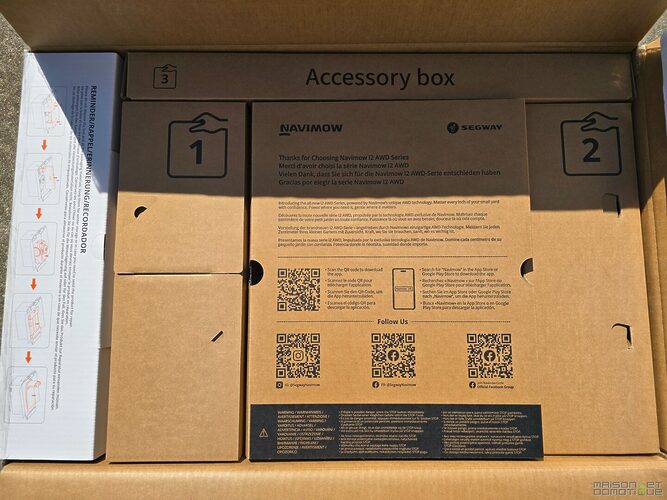
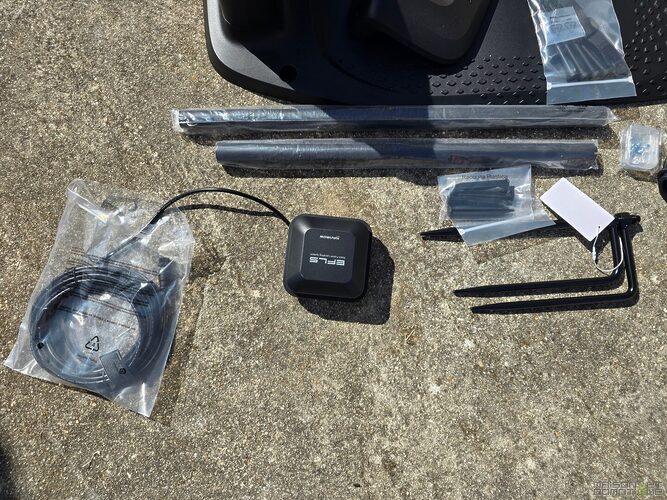
In the box: the robot, the charging station, the power supply, mounting screws, spare blades, a quick start guide, and an RTK antenna with its installation kit. This antenna is provided even if the i2 AWD can work without it thanks to the NRTK, in case reception is complicated on your terrain. That’s clever.
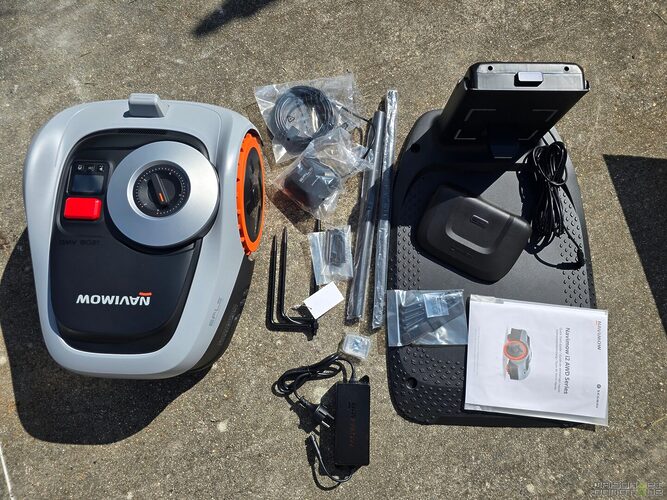
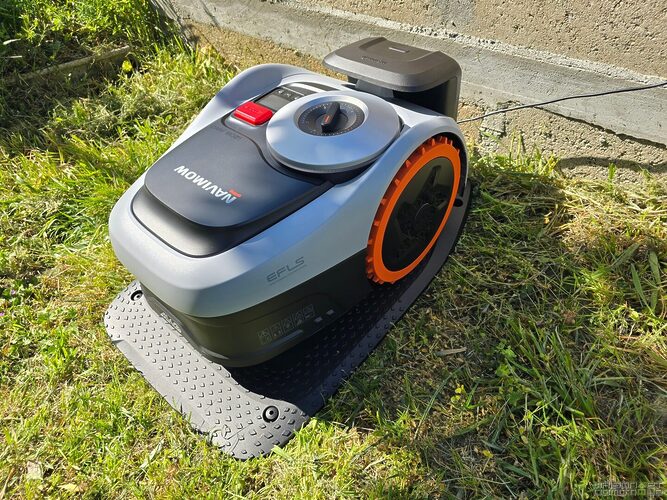
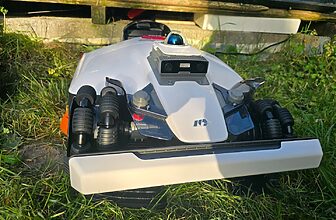
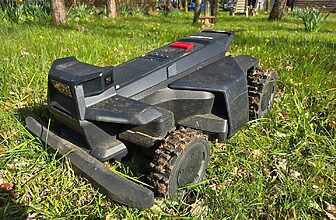
The robot remains compact. The design recalls previous models in the i series, but the matte black finish is more understated than the old shiny shells, and the underside immediately reveals the innovation: the third driving wheel.

Under the chassis: two large all-terrain wheels at the front, a directional driving wheel at the back, and a cutting disc equipped with five small pivoting blades.
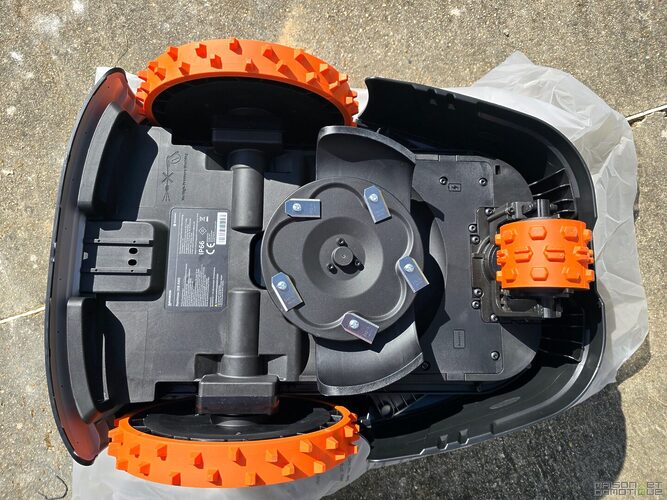
The old series i models had three. Navimow moves to five, which improves the cut, especially when the robot works often.

On top, the large red Stop button is clearly visible. There is also a small screen, buttons to start mowing or send the robot back to its base, and a mechanical height adjustment wheel, from 20 to 60 mm.
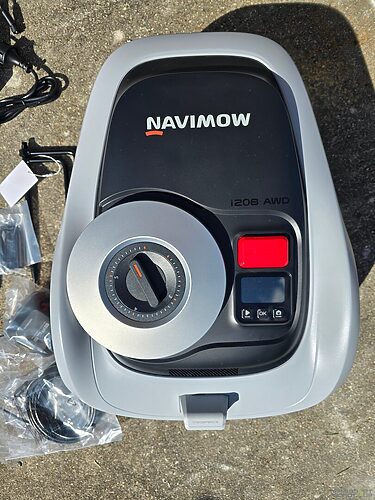
No motorized adjustment from the app, but it’s reliable and quick. For this type of product, that’s sufficient, as you don’t change the height every day.

At the front, the VisionFence camera detects obstacles. Navimow claims recognition of many common objects: ball, pot, pipe, animal, furniture. On a cable-free robot, vision plays a real role, both for safety and navigation.

Certified IP66, the robot withstands dust and water splashes. You can leave it outside without worry and clean it after a wet mowing. I still advise against high-pressure cleaners. A gentle spray, a brush, and a cloth are enough.
A real all-wheel drive for small complicated terrain
The strong point of the Navimow i2 AWD is its Xero-Turn AWD system. Behind the marketing name, the idea is simple: to provide better traction and better U-turns, without disturbing the lawn.
On a classic robot, there are two driving wheels and one or two wobbly wheels. On flat terrain, that works very well. As soon as things get complicated, the wobbly wheels can slip in a slope, get stuck in a small irregularity, or cause a slight shift when following a border.
Here, the third wheel is motorized. It helps the robot in three situations: slopes, slanted borders, and U-turns.

On my terrain, some passages are easy, others much less so. There are areas where the ground slopes towards a border, causing a classic robot to veer, sometimes even touching a fence. The i208 AWD remains more stable. It keeps its trajectory better, even on uneven terrain.
The same observation applies to small climbs. The robot doesn’t seem to struggle. It climbs, corrects its trajectory, turns cleanly, and then continues. There’s no dramatic moment where you stand by wondering if you’ll need to rescue it. And that, when you’ve already tested several robotic mowers, is appreciated.
Navimow announces a slope capacity of up to 45%, or approximately 24°. This should be adjusted according to the condition of the terrain, humidity, grass height, and soil nature. But in practice, the i208 AWD is clearly more comfortable than a small two-wheel-drive robot.
Installation: no cable, and often no antenna
No perimeter wire to bury. You install the charging station, plug in the power supply, place the robot on its base, and follow the steps in the app.

The station must be in an open area. As with any satellite-positioned robot, avoid placing it under a dense tree, against a tall wall, or in a very hidden corner. The more open the sky, the more comfortable the robot will be.
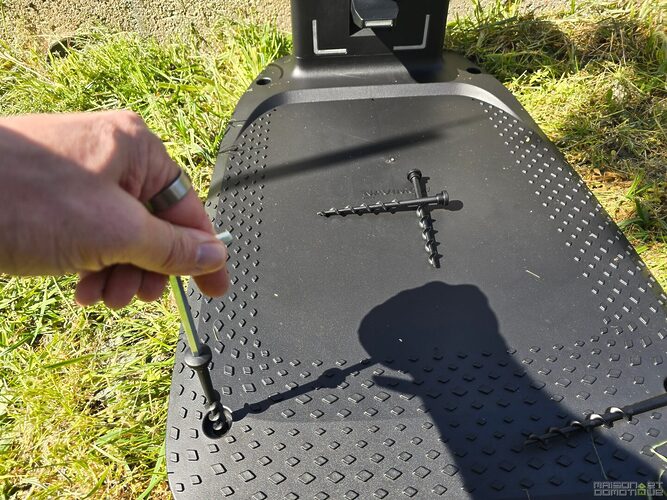
The main novelty is the NRTK operation. The robot positions itself without an RTK antenna. It uses a correction service via the mobile network to obtain precise localization. On well-covered terrain, it’s a real comfort: less equipment, fewer cables.

The antenna is still provided. If your terrain is poorly covered or reception is complicated, it will improve accuracy. In my case, the operation without an antenna is very convincing.
The app guides you to connect the robot, initiate updates, check signals, and then create the map. Bluetooth at the start, then Wi-Fi and 4G according to usage.

The 4G is used to control the robot remotely, track its position, benefit from the GPS anti-theft system, and maintain certain functions when the garden Wi-Fi is too weak. The first year is included, then about €29.99 per year. The NRTK access is announced as included.
Mapping: automatic or manual, but manual remains king
The i208 AWD offers automatic mapping. On well-defined terrain with clear borders, it’s practical. The robot analyzes the area and creates its map without needing to be piloted.

But in a real country garden – areas not always separated, flower beds, transitions between grass, gravel, bark, or soil – manual mapping often remains the best option.

It is done from the app, piloting the robot like a small remote-controlled car. You follow the edges of the lawn, validate the area, and the robot memorizes the perimeter. It’s quite fun and very accurate if you take your time. The longest part isn’t making the map, it’s thinking about what you really want to mow.
Once the map is created, you can add no-go zones, create multiple mowing zones, plan passages between them, modify boundaries, define mowing direction, activate or not the mowing of borders, and schedule passages. The Navimow app is clear, complete, and never feels like it’s reserved for geeks.

It is also possible to adjust the behavior of the camera in specific zones. If a passage is narrow or bordered by low branches, the robot might misinterpret certain elements as obstacles and refuse to pass. These small adjustments make a difference in less tidily kept gardens.
Navimow App: simple, but already very comprehensive
The app is one of the strengths of the range. It supports the user from pairing to fine mowing adjustments. Updates are easy to initiate, the maps are readable, and options are not hidden in fifteen submenus.

From the app: launching a full mow, selecting a precise zone, returning to base, real-time tracking, task history, scheduling settings, border mowing, passage direction, manual piloting.
Scheduling is flexible. You can program multiple mows per week, adjust timings by zone, avoid certain times, or take weather into account. Practical if you don’t want the robot working at night (hedgehogs appreciate this too).

One regret: the rain management relies solely on weather data. On a terrain like mine, where it can rain 300 meters away without a drop falling in the garden, it’s not always accurate. The robot goes back or stays at base because the weather forecasts rain, while the lawn is dry. A physical sensor on the robot would be more reliable. It’s not a dealbreaker, but it’s good to know.
In use: fast, precise, and surprisingly confident
Once started, the i208 AWD gives a different impression than some more hesitant robots. It moves forward assertively. The first passes can be surprising, especially along edges or near an obstacle. You sometimes want to tell it, “easy there, champ!”. But it knows where it’s going.
The navigation is methodical, with clean mowing lines: no random movement like older robots. The result is neater, more regular. You quickly have a lawn continuously maintained, without forgotten areas.
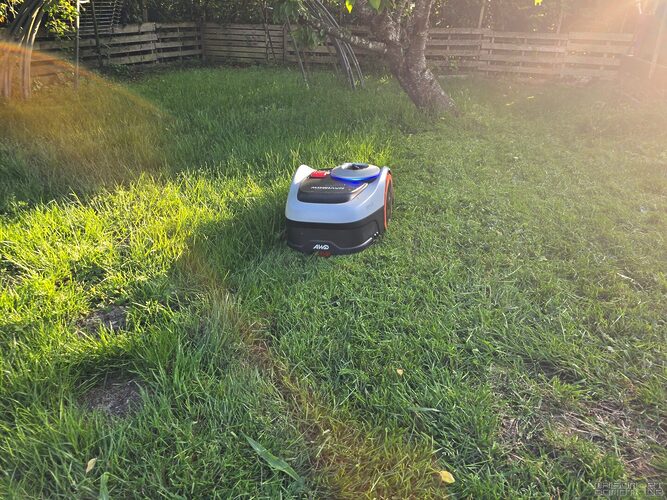
The cutting quality is good, as long as you respect the mulching logic. You shouldn’t expect it to collect a 20 cm tall meadow overnight. Before the first use, it’s better to do a standard mow to bring the grass to a reasonable height. Afterwards, the robot maintains by cutting very little with each pass. That’s how it works.
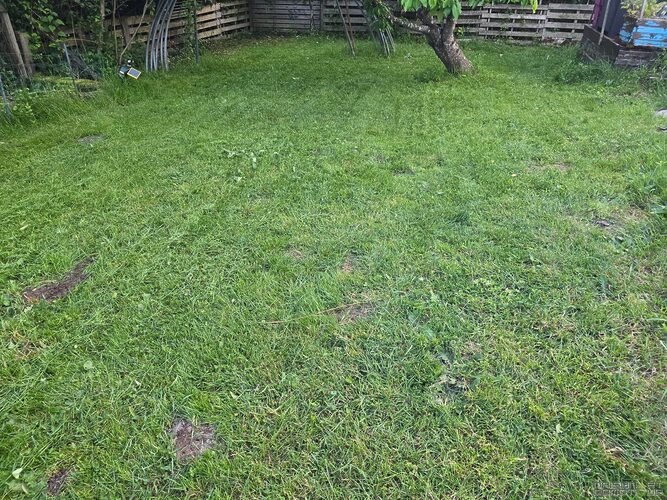
With its five blades, the cutting disc does a good job. The grass is cut cleanly, and the underside of the robot remains relatively clean, even after mowing on wet grass. You’ll still need to clean it from time to time, as grass always ends up getting stuck around the blades. That’s the fate of all robots.
The sound level is contained. 59 dB(A) announced, and in practice, the robot quickly fades into the background. You can stay in the garden while it works without being disturbed. It’s even a bit strange at first: it mows while you sip your coffee. You quickly get used to this detail.
Obstacle management: VisionFence does its job well
The VisionFence camera at the front identifies and avoids many obstacles. During testing, the robot correctly detected common objects: pot, ball, branch, toy, furniture, person, or animal.

When faced with an obstacle, it slows down, goes around, or backs up. The behavior is reassuring. No perfect intelligence either: a very low small object, a fine string, or an element lying in the grass can still cause issues. But for normal use, detection works.
This is a real advantage for families. In a garden with children, animals, trampoline, hose, or garden furniture, the robot needs to adapt. The i208 AWD performs well and avoids turning each mowing start into a military inspection of the terrain.
However, it’s still better to keep a somewhat clear lawn. But you don’t have to rush outside for every forgotten ball. And that is already a lot.
Slopes, inclines, and wet terrain: the true interest of the AWD
It’s on complicated terrains that the i2 AWD makes a difference. The third wheel provides better stability on slopes, but also in less spectacular situations: slanted borders, slightly muddy areas, compacted ground, traversing gravel or bark, small dips, U-turns on inclines.
The difference with a classic robot is mostly felt in terms of confidence. It keeps its course better, veers less, slips less, and damages the lawn less while turning. And in a somewhat tricky zone, it has more leeway to manage on its own.
On perfectly flat terrain, this technology will be less useful. But on actual terrain, with its small imperfections, it changes things. It’s a bit like moving to a vehicle with enhanced traction: you don’t need it every minute, but on a slippery day, you’re glad to have it.
It’s not an extreme robot either. Don’t confuse it with heavy-duty four-wheel-drive models for very large terrains or truly steep slopes, like its big brother Navimow X4, recently tested here as well. The i208 AWD remains compact, designed for medium gardens, but handles difficulties much better than classic small models.
Mowing borders: better, but not magical
Mowing the borders remains the point to watch. The i208 AWD can follow edges and mow borders, but it will not eliminate the need for an edge trimmer.
The cutting disc is located under the robot, not extended outside the chassis. Therefore, there will always be a small strip of grass along walls, fences, high edges, or flower beds. This is the limit for all robots of this format.

On open borders, the result is better since the robot can overlap. Against a physical obstacle, a small touch-up with an edge trimmer will be necessary from time to time. Nothing dramatic, but it’s good to know before purchasing. The robot replaces regular mowing, not the meticulous gardener’s finishing touches.
Autonomy and recharge
5.1 Ah battery. Navimow announces 120 minutes of autonomy, 120 minutes to recharge, and up to 250 m² mowed per charge, depending on conditions. Over 800 m², the robot won’t do everything in one charge. It mows, returns if needed, recharges, and resumes.
This is the normal operation of a robotic mower. We don’t ask it to do everything at once but to manage the lawn regularly without needing intervention. With good planning, you no longer worry about whether it has finished in one or three sessions.
On terrain with slopes, dense grass, or complex zones, real autonomy decreases. But the robot manages its cycles well, and the task resumption functions effectively. For a terrain around 800 m², you need to allocate sufficiently long time slots.
Maintenance: simple, but not to be neglected
Maintenance is straightforward. Regularly clean underneath, remove clumps of grass around the cutting disc, check the wheels, wipe the camera, clean the charging contacts, replace the blades when they are dull.
Spare blades are provided in the box. A supplementary kit is inexpensive and readily available. The replacement frequency depends on the terrain: a clean lawn wears less quickly on the blades than a terrain with small branches, pine cones, or pebbles.
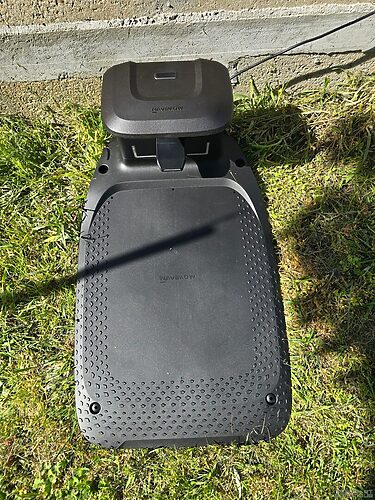
IP66 simplifies cleaning but doesn’t exempt from a minimum of care. The robot works outside, in humidity, dust, grass, and sometimes mud. Regular cleaning avoids many issues. By the way, you’ll appreciate the station that protects the entire underside of the robot, unlike other more compact stations that let moisture under the robot every night.
The three-year warranty is a good point on a motorized product that lives outside for much of the year.
Safety and anti-theft
The i208 AWD integrates several levels of security. Stop button for immediate shutdown. PIN code to lock access to the robot. Alerts in case of lifting or leaving the designated area. And 4G for GPS anti-theft tracking.

This is reassuring: a robot costing over 1,000 € in a garden is indeed a tempting object. Remote tracking doesn’t guarantee that a thief will turn back, but it complicates things significantly.
The safety of operation is good. The robot detects obstacles, stops if lifted, and the pivoting blades limit risks. As always, caution should be exercised with children and pets. It’s best to schedule mowing when the garden is used less.
For what type of garden?
The i208 AWD is aimed at owners of a medium garden, up to 800 m² of lawn, who want to avoid the peripheral cable and whose terrain isn’t perfectly flat.
It will be particularly interesting if your lawn has moderate slopes, slanted borders, wet areas, passages between several spaces, or small irregularities that complicate things for classic robots.
On a perfectly flat lawn, a less advanced model may suffice. For a very large terrain or a really extreme garden, it’s best to look towards higher-end ranges. But for family gardens between 400 and 800 m² with some difficulties, the i208 AWD is well positioned.
Conclusion
The Navimow i208 AWD provides a concrete response to a real problem: small robotic mowers are often very good on simple terrain, but much less convincing as soon as the garden becomes a bit twisted.
Here, the robot keeps its course better on slopes, veers less on inclines, slips less, and inspires more confidence. The installation without cable is a joy, the NRTK avoids in most cases the need to place an antenna, the app is user-friendly, and the cut is at the required level.
Not everything is perfect. The borders will still require a little finishing touch, and the weather management could better match the reality of the terrain. But in practice, the i208 AWD mainly gives the impression of a mature, practical, well-thought-out robot capable of adapting to a real garden.
For a terrain up to 800 m² with some slopes or tricky passages, it’s one of the most interesting models on the market. Available from €899 on the official site or Amazon.

Please remain courteous: a hello and a thank you cost nothing! We're here to exchange ideas in a constructive way. Trolls will be deleted.