



Résumer cet article :
Wireless perimeter robotic mowers have greatly evolved in recent years. Mapping is simpler, applications are better designed, obstacles are better detected, and high-end models now mow in clean straight lines. But on the ground, the real question remains the same: does the robot really manage on its own, without getting stuck, without ruining the lawn during turns, and without requiring intervention every two days? The Navimow X4 aims to address this precisely. I tested the X430, the mid-range model in the X4 series. The other X4 models share the same base: same chassis, same navigation system, same double cutting deck, and the same drive and steering wheels. The differences lie in the maximum mowing area (thus the battery) and sometimes the color of the housing.
Unboxing the Navimow X4: A massive robotic mower, but designed to work quickly
Upon unboxing, the X4 does not hold back. The box is heavy, the robot is too: around 30 kg depending on the versions.
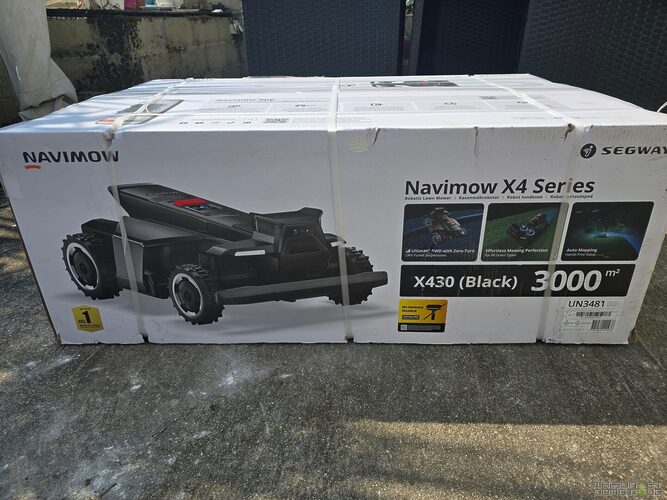
It’s better to have two people to take it out properly. It’s not the type of device you lift with outstretched arms. Fortunately, the app allows you to move it manually, which is much more convenient for bringing it to its installation area.

The contents of the box are complete: robot, charging station, power supply, extension cord, fixing stakes, GNSS/RTK antenna kit, documentation, spare blades, and screws. Navimow provides everything needed to ensure the first blade replacements, which is not insignificant for a dual-disk robot.
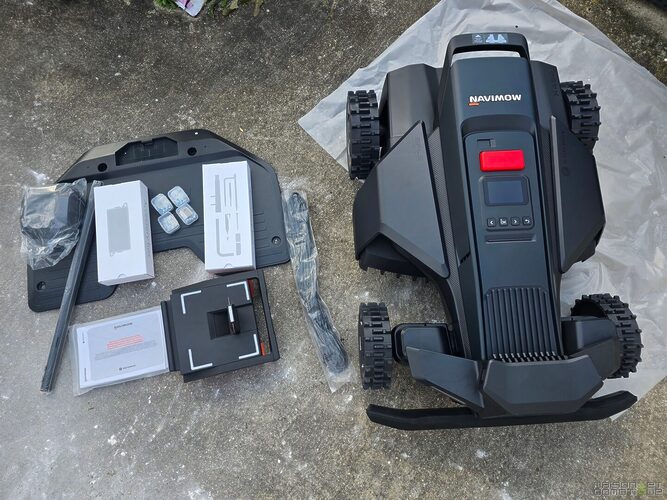
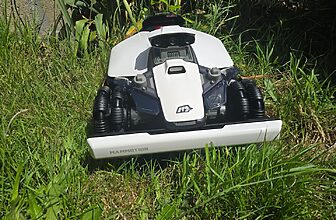
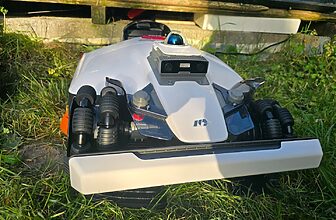
The design is spectacular. The X4 looks more like a small all-terrain vehicle than a classic robotic mower.

The large wheels, the front equipped with cameras, the light bar, the color screen, and the clearly visible Stop button immediately give the impression of a premium machine.

Navimow clearly wanted to create something different from a round little robot sitting on four wheels.
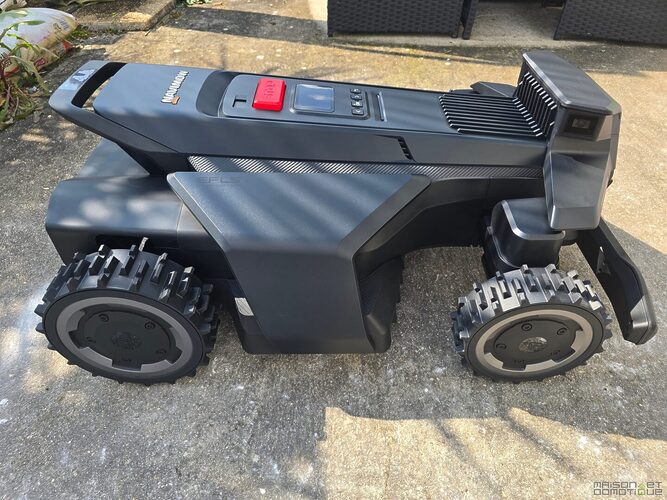
Under the chassis, we discover one of the major features of the X4: its double cutting deck. Two independent disks, each equipped with several blades, for a cutting width of about 43 to 44 cm.

This is huge for a robotic mower. In practice: fewer trips back and forth, faster mowing, less time spent moving on the lawn.

The cutting height is adjusted electrically from the app, from about 20 to 95 mm. Convenient for adjusting the mowing according to the season: shorter in spring if you like a neat lawn, taller in summer to limit water stress.
The real innovation: directional front wheels
The Navimow X4 is an AWD robot, meaning four-wheel drive.

This is not exclusive: several manufacturers now offer robots capable of better managing slopes, wet grass, or uneven terrain through all-wheel drive.

But Navimow goes further with directional front wheels capable of pivoting sharply. The robot can perform very tight maneuvers, almost like a vehicle with a zero turning radius. And honestly, this is where it really changes.
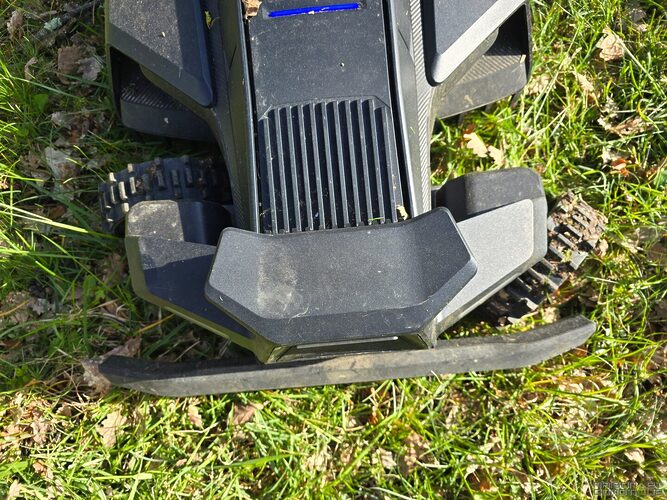
On many robotic mowers, turns are abrupt. The rear wheels force, while the small front wheels follow as best as they can, and through repeated same maneuvers, marks appear in the lawn. In wet weather, it’s even worse: the robot can completely uproot grass or dig into the ground.
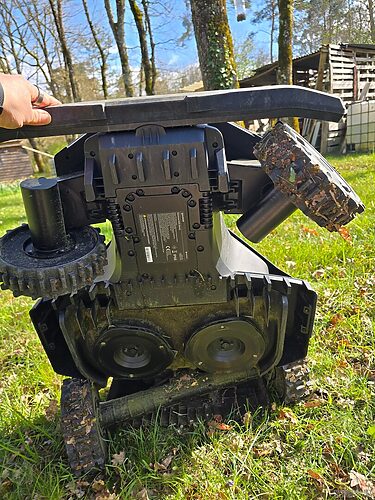
The X4 turns differently. Its front wheels orient according to the maneuver. It can make a wide turn, pivot tightly, realign, and spin around without scraping. Visually, it’s quite impressive. But above all, in practice, it’s useful: the lawn suffers less, the robot hesitates less, and the maneuvers seem more natural.
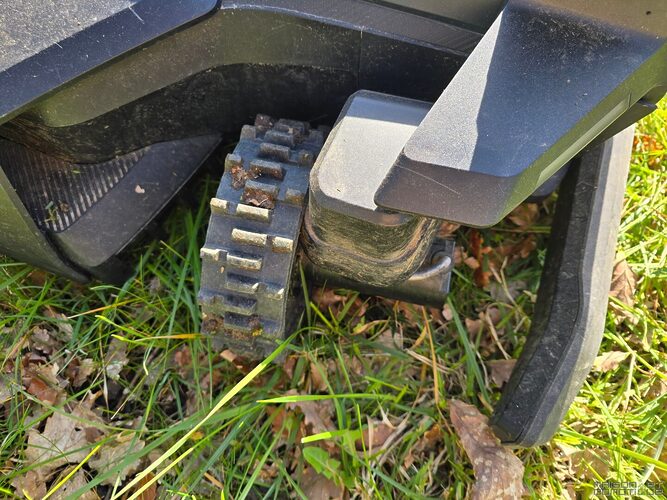
We often talk about AI, cameras, and algorithms, but sometimes a good mechanical solution does more work than a line of code. Navimow has clearly bet on this with the X4.
Installation: without cable, and even without antenna if the RTK network is available
Like all high-end robotic mowers, the X4 operates without a perimeter cable. No wire to bury around the garden. The delimitation is made by virtual mapping via the app.

The X4 uses EFLS Net RTK navigation, which combines RTK positioning, onboard vision, and the robot’s sensors. It can operate with Navimow’s Network RTK without installing the provided physical antenna. If your area is covered, you set up the station, connect the robot, and that’s pretty much it.
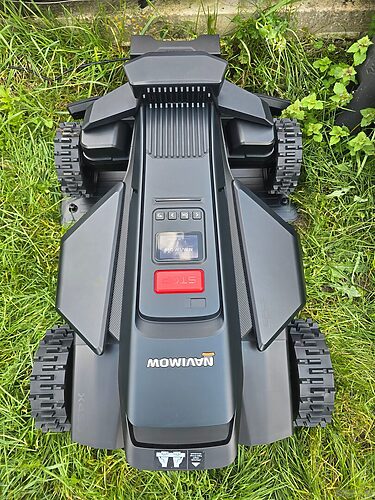
In my case, the setup followed the classic path: downloading the Navimow app, detecting the robot via Bluetooth, pairing via the OK button on the mower, creating the PIN code, connecting to Wi-Fi, and then updates.


The robot also includes 4G connectivity for remote control and anti-theft functions, with a service period included depending on the model, and then an annual subscription to extend.

The placement of the station, however, is not to be taken lightly. The robot needs a good satellite reception, especially without the RTK antenna (which is still provided if needed). A station placed under a shelter, under a roof overhang, under dense trees or too close to a wall can cause localization problems: inconsistent trajectories, shifted mapping, starting off in the wrong direction. It is better to spend ten minutes finding the right location than two hours redoing the map.

In a well-cleared garden, the Network RTK greatly simplifies things. In a more complicated garden, the provided antenna remains a real safety net: it can be placed in a better-exposed area while keeping the base in a more practical location.

Mapping: automatic or manual, but accuracy remains crucial
The app offers automatic mapping. The robot can start exploring the limits of the terrain on its own. Attractive on paper, especially for large gardens. But I prefer manual mapping as soon as the terrain has edges, flower beds, solar panels, a vegetable garden, narrow passages, or areas to avoid.

In manual mode, you pilot the robot from your smartphone with two joysticks. You take it to the edge of the lawn, then follow the boundaries of the terrain to teach it the area. The very responsive steering of the front wheels requires a little adjustment time: at first, you tend to overcorrect. Then you get used to it, and the robot becomes pleasant to guide.

The app then allows you to create several zones, restricted zones, passages between zones, independent zones. Convenient if you have a lawn in front, another behind, a slab passage between the two, or a part accessible only by carrying the robot. Be careful: carrying a X430 of nearly 30 kg is not a game of pétanque.

The “real scene” map is really useful. The robot uses its cameras to produce a visual representation of the terrain, much more readable than an abstract outline. You can see areas, borders, obstacles better, and you can correct certain limits directly from the app without taking the robot back to redo the entire mapping. On a large terrain, this is appreciated.

The X4 manages a significant number of zones. For a residential garden, even if very fragmented, there is plenty of leeway.
Navimow app: comprehensive, clear, but still improvable
The app has matured well. The main screen displays the map, the robot’s status, the battery, the connection, the created zones, the mowed area, and quick access to start mowing or send the robot back to base.
You can start mowing in all zones or only certain ones and choose the mowing order. If a zone near the terrace is occupied during the day, you can program the robot to start elsewhere.

Each zone has its own settings: cutting height, mowing direction, border mowing, borders around restricted zones, merging or splitting zones. You can also define several mowing angles for a cross-cut look like a golf course – aesthetic, and useful for not always laying the grass in the same direction.
Three mowing modes: silent (the robot slows down), standard (the most balanced), and efficient (accelerated movements to quickly cover large areas). On a large and well-maintained terrain, the efficient mode makes sense.
The safety features are there: child lock, PIN code, lift alarm, geofence, localization, GPS tracking, compatibility with Apple Find My depending on options. For a robot at this price, it’s reassuring.

In terms of weather, the robot can avoid mowing in the rain, during strong winds, or in freezing conditions. I advise against mowing at night and mowing in the rain even though the robot can handle it. The lawn will fare better, and the small garden animals will too.

What’s still lacking: the mowing reports are still a bit sparse. You can consult statistics by day, week, or month, but there’s no view of mowing by mowing with the exact path, precise time, and covered zones. Several competitors do better in this regard.
Navigation: the X4 impresses mainly with its calm
Once the map is created, the X4 starts methodically. It usually begins with the borders, then works in parallel lines. Its method may surprise: it doesn’t always do the lines in the expected order, sometimes skips a strip to return to it later, or widens its turn to spare the lawn. The area is well covered in the end.
The robot does not only look for the shortest route. It also seeks to limit aggressive maneuvers. And the directional wheels really help with that.
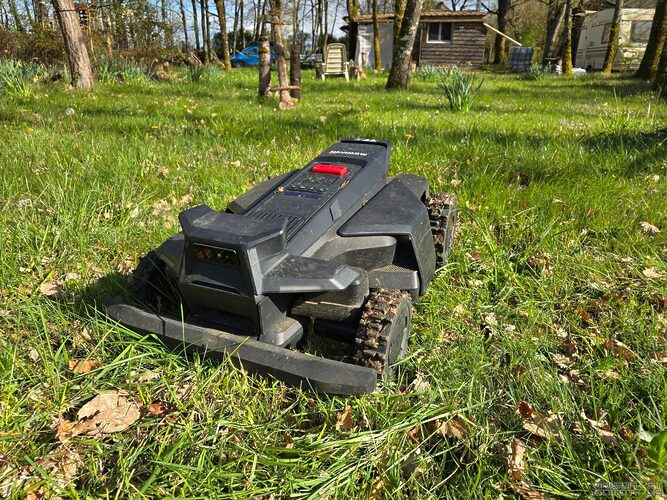
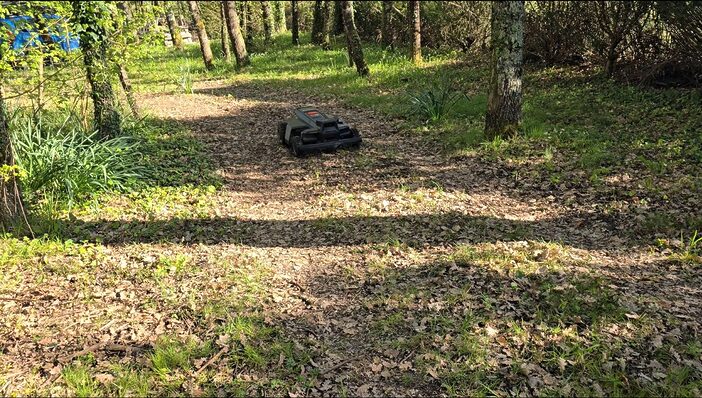
I tested the Navimow X430 on two terrains: at home, a residential area of 800m2; and on my recreational land, which is nearly a hectare, significantly more complicated (numerous trees, holes, etc.). The X430 convinced me. The trajectories are clean, the robot does not give the impression of searching for its route, and the turns are much sharper than on most robots I have tested so far. With its size, it remains surprisingly agile.
The cutting width also changes the game. With 43 to 44 cm of cutting, the robot moves quickly through the work. Whereas a model with a single deck multiplies the passes, the X4 covers more width and finishes faster. On a small terrain, this would be a luxury. On 2,000, 3,000, or 5,000 m², it’s what is expected.
Cutting quality: fast, clean, and suitable for large areas
The double deck does its job well. On a lawn that is regularly maintained, the result is clean, uniform, with beautiful lines. The robot slightly overlaps its passes to avoid missed strips.
The MowMentum system adjusts the cutting according to the grass density. In thicker areas, the robot adjusts the power to avoid clogging. It’s not a brush cutter (don’t expect it to tackle a field left unattended for six months) but it handles dense grass better than many more modest robots.
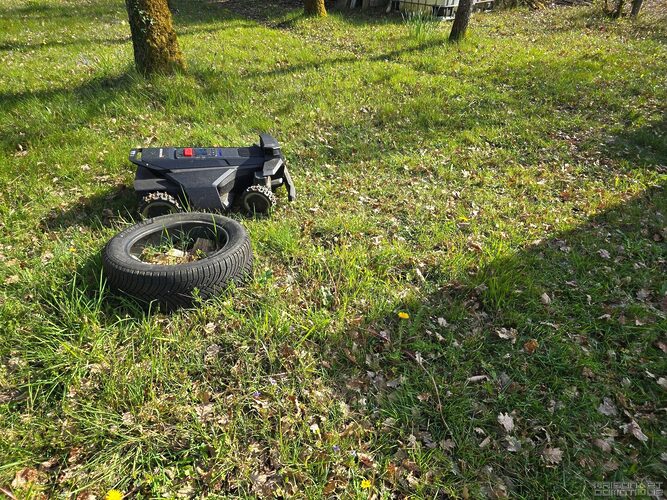
The height range is a real asset. Raising high is important on large areas in summer. A lawn cut too short suffers more from the heat, and the X4 provides a real adjustment margin.
Borders remain an issue, as with all robotic mowers. Even though the Edge Sense mode helps to get closer, there will always be a strip to resume with a trimmer near walls, interior corners, fence posts, or fixed obstacles. The double deck is wide, but the blades remain centered under the chassis with a safety margin. It’s logical, but it’s important to know.
Obstacles: very good, but not magical
The X4 includes the Vision Fence 360° system: front camera, side cameras, ToF sensors and soft bumpers with contact detection. Double objective: help with navigation when GPS signal is weaker and detect obstacles on the lawn.

In practice, it works well. The robot detects large objects: pots, balls, humans, shrubs, garden furniture, tall toys, laundry fallen on the ground. It slows down, goes around, and resumes. The behavior is natural.

The side cameras are genuinely useful. During turns or tight maneuvers, the robot does not rely solely on what it sees in front of it. It understands its immediate environment better, which partly explains its fluidity.
But limits exist. Very flat, very low, or poorly contrasted objects can pose problems: frisbee, small dog toy, low box, or items buried in the grass. This is a common limitation for many robots with onboard vision. The X4 performs well, but the garden must be prepared: hoses stored, small toys removed, cables absent from the lawn.
Slopes and uneven terrain: the X4’s playground
The X4 is announced to handle slopes up to 84%, around 40°. In real life, few residential gardens go that far, but it gives an idea of the level of mobility aimed for.
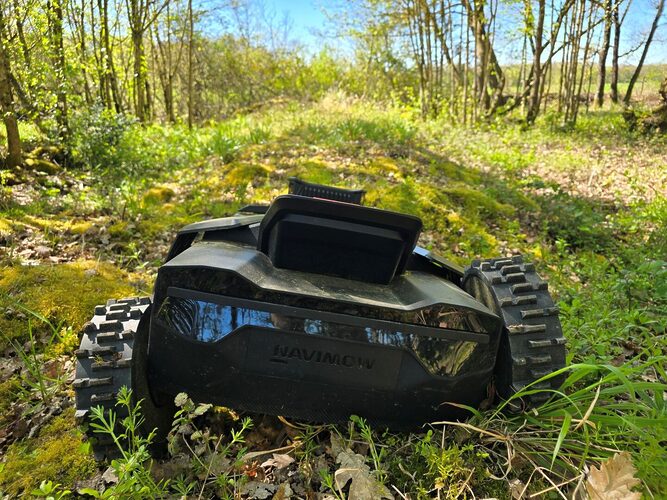
The four-wheel drive makes a difference on uneven terrain. Bumps, dips, small roots, imperfect ground, mounds, soft areas: the robot maintains contact with the ground much better than a conventional model. The wheel travel and suspension system help it to maintain traction.
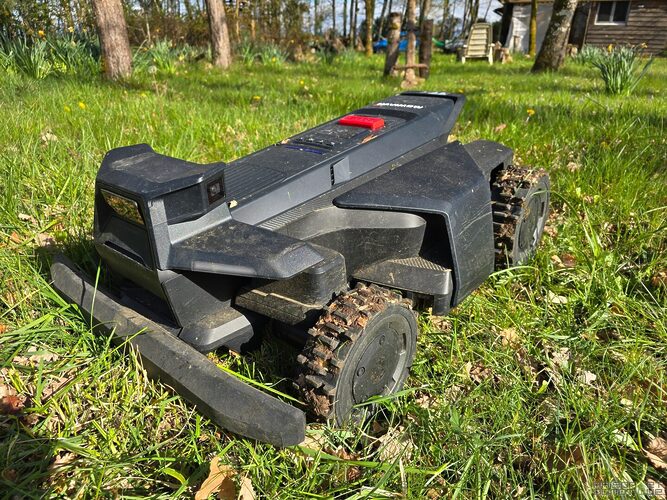
Overcoming obstacles up to 7 cm is also an asset. There’s no question of making it climb onto borders on purpose, but in a real garden, this margin avoids many blockages. A small step, an irregularity, a root, a slightly higher slab: the X4 handles it better than average.
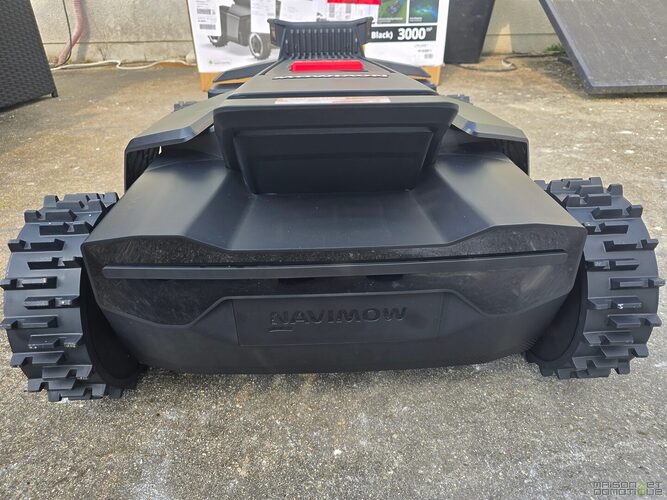
One point to watch out for: the rear chassis can scrape on certain sharp reliefs. Deep holes or abrupt slope breaks can cause the robot to touch under the chassis. Not common on a normal lawn, but on a very rugged terrain, it’s worth monitoring during the first mowings.
Narrow passages: the downside
The X4 is wide. Very wide. Excellent for mowing quickly, much less so for squeezing through everywhere.
Large open areas: no problem. Several spaces connected by narrow passages: you need to be careful. In fact, it’s better to aim for at least 1 m of minimum passage.
Below that, it might work, but it’s no longer guaranteed. On a passage of 80 to 90 cm, the robot may succeed if the path is clean and clear. But if a plant protrudes, if a slab is misaligned, if a fence is too close, or if the camera interprets something as an obstacle, the robot may hesitate, back up, or ask for help.
This is not a disqualifying flaw: the X4 specifically targets large areas. But it’s a serious buying criterion. Before buying, you should honestly assess your garden: large open spaces? Perfect. A small labyrinth with gates, tight passages, borders, and flower beds everywhere? This may not be the right model.
RTK reception: very good, provided the base is well installed
The X4 can operate without a local antenna thanks to Network RTK, provided your area is covered and the base is well-placed. When everything comes together: no RTK mast to install, fewer cables, fewer visual constraints in the garden. That’s what I did on both my terrains, even though the recreational land is in the middle of nowhere.

But RTK remains RTK. If the robot receives poorly, it loses accuracy. Areas between a tall hedge and a wall, under trees, or near an overhang can complicate navigation. In these cases, the cameras compensate. During tests in low reception areas, the X4 maintains a reasonably clean trajectory and avoids the absurd behaviors sometimes observed in certain RTK robots. It may leave a little more margin near the edges, but nothing alarming.
The provided antenna remains useful. It secures installation in complicated gardens and allows placing the base in a convenient location even if satellite reception is limited there.
Maintenance: simple, but not to be overlooked
The X4 requires minimal maintenance, like any robotic mower: regularly clean the underside of the chassis, check the blades, remove accumulated grass, monitor the wheels’ condition.
Cleaning is done with a water jet, without a pressure washer. A robotic mower can withstand rain and gentle washing, but not a Kärcher blasted into the joints and bearings.
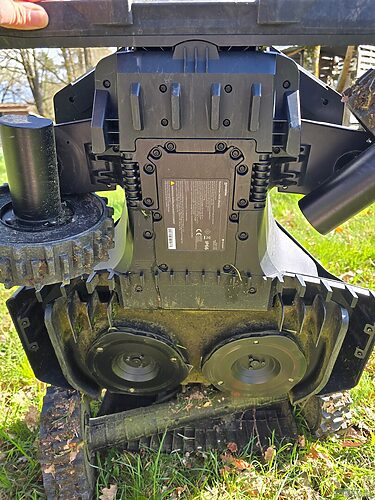
The app tracks blade wear and warns when a replacement is necessary. With two decks and 12 blades in total, the operation takes a little longer than on a small robot with a single disk but remains straightforward. On a robot that covers large surfaces, serious tracking is normal.
In winter, bring the robot indoors and, if possible, the base. The battery will thank you.
Who is the Navimow X4 for?
For owners of large properties who want to automate mowing without a perimeter cable, especially those whose garden has slopes, bumps, uneven areas, or those who have already been disappointed by a lighter robot that skidded, got stuck, or uprooted the lawn during turns. The X430 targets large surfaces; if your terrain is smaller, the Navimow i range or the LiDAR models will be more suitable.
You have to accept the price. But the equipment is sufficient: AWD, directional wheels, double disk, advanced navigation, Vision Fence 360°, RTK without antenna possible, comprehensive app, anti-theft security. This is not a garden gadget.
Conclusion: a robot that relies as much on mechanics as on intelligence
The Navimow X4 is the robotic mower that convinced me the most on large terrain. Not just because it mows well; many high-end robots can now do that. Its strength lies in the way it moves.
The directional front wheels really change the behavior. Turns are sharper, maneuvers are smoother, and the lawn is better respected. Add the four-wheel drive, double deck, and RTK-assisted 360° vision, and you have a machine whose different parts complement each other.
Not everything is perfect: its size imposes wide passages, borders still require a trimmer, small flat objects sometimes slip through, and the station must be installed carefully. But overall, the X4 inspires confidence.
If you have a large garden and are looking for a robot capable of working fast and clean with very few interventions, the Navimow X4 is definitely worth considering.
The Nawimow X4 is available starting from €2499 on Amazon or the official website.

Please remain courteous: a hello and a thank you cost nothing! We're here to exchange ideas in a constructive way. Trolls will be deleted.