


Résumer cet article :
A few years ago, choosing a robotic lawn mower often required bringing out a spade, unrolling a perimeter cable, and crossing your fingers that the robot wouldn’t get lost on the first complicated pass. Since then, wireless models have changed the game. But they don’t all have the same talent when the garden isn’t perfectly flat, perfectly clear, perfectly rectangular… in short, when it looks like a real garden. That’s precisely where the Mammotion Luba Mini 2 AWD 1000 wants to make a name for itself. This wireless robotic lawn mower is designed for lawns up to 1000 m², and it brings back the fundamentals of the Luba range: four-wheel drive, large knobby wheels, cable-free navigation, slope management, and a look like a little all-terrain vehicle. A kind of mini garden buggy, with blades underneath.
This Mini 2 version brings several new features compared to the earlier Luba Mini models. The most visible is its second offset cutting disc, designed to mow closer to the edges. This is a real issue, as even the best robots often leave a strip of grass along walls. And when you buy a robotic lawn mower at this price, it’s not to pull out the string trimmer every three days.
It also doesn’t need a physical RTK antenna installed in the garden. It combines NetRTK navigation with AI vision from three cameras, which promises centimeter-level precision, automatic mapping, and better obstacle management. In practice, it’s very convincing. But let’s discover this right away in detail…
Unboxing the Luba Mini 2 AWD 1000
The cardboard box quickly sets the tone. This is not a lightweight and frail little robotic lawn mower.

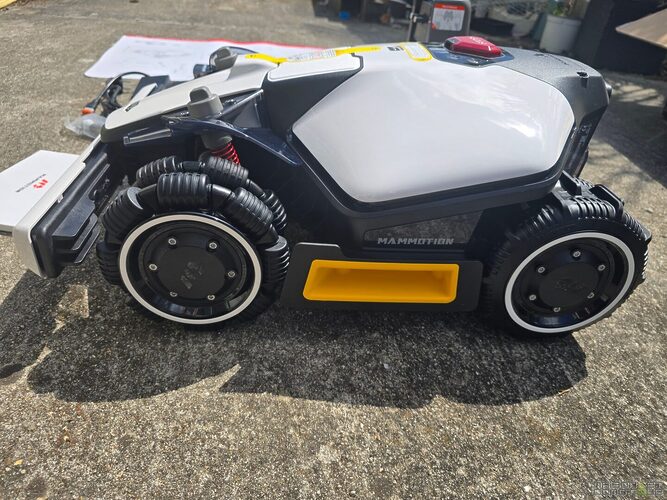
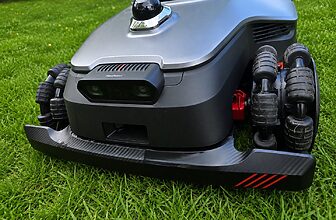
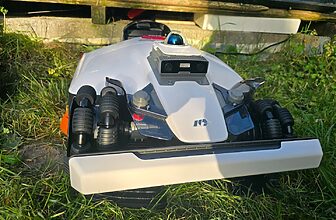
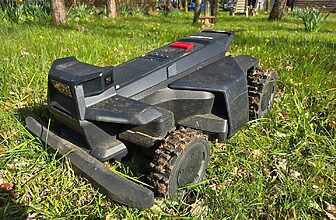
The robot weighs about 15 kg, with a massive body, large rear wheels, and omnidirectional front wheels. It has a real presence. Mammotion maintains this very specific style, somewhere between lawn Formula 1 and a little lunar rover. You either love it or you don’t, but it’s impossible to mistake it for another robot.
In the box: the robot, the charging station, the power supply, a protective cover for the charging contacts, fixing stakes, a cleaning brush, a screwdriver, a spare safety key, documentation in French, and a set of 12 additional blades. Mammotion provides everything needed to get started without having to order accessories in the first week.
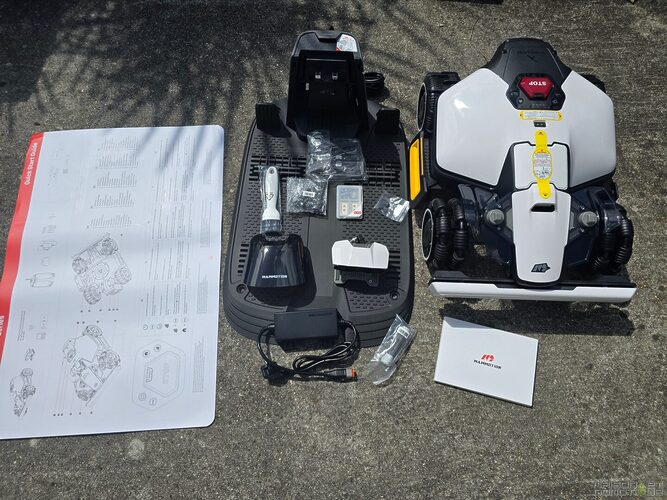
The only element to assemble is the vision module. It attaches to the top of the robot after connecting three connectors: the plugs are different, making it hard to get it wrong. You screw it, and it’s done. A few minutes.

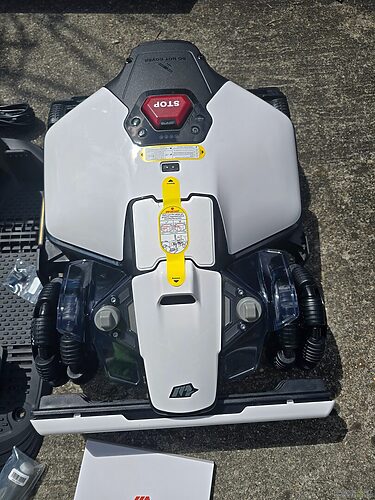
On the top of the robot, we find the large red Stop button (always reassuring), the safety key, the physical control buttons, the rain sensor, the status LEDs, and the GNSS reception area that should not be covered.
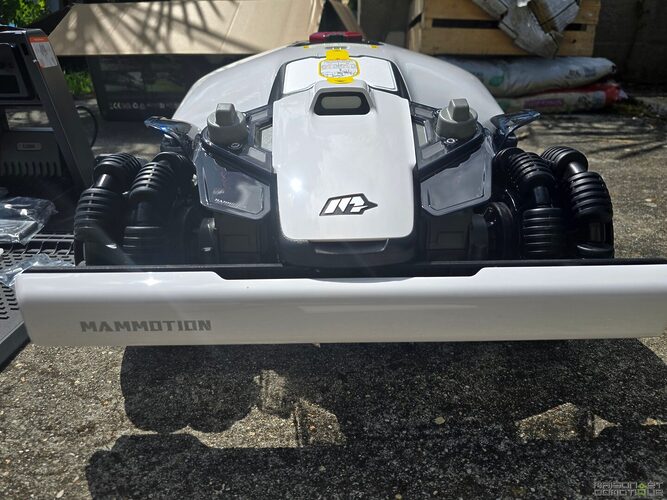
At the front, a spring-mounted bumper detects physical contact.
At the rear, the charging contacts and, importantly, a removable battery: this is great news for the product’s lifespan.
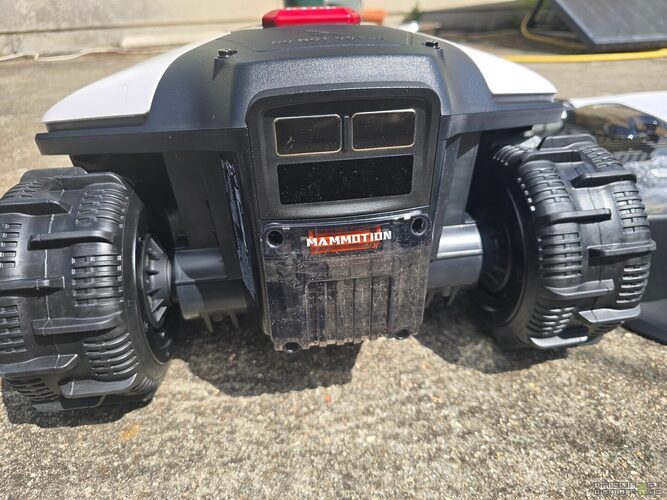
This 6.1 Ah battery is removed by opening a screwed hatch. This isn’t a change you would make every morning, but it’s reassuring. In a few years, if it weakens, replacing it will be much simpler than with models where everything is integrated.
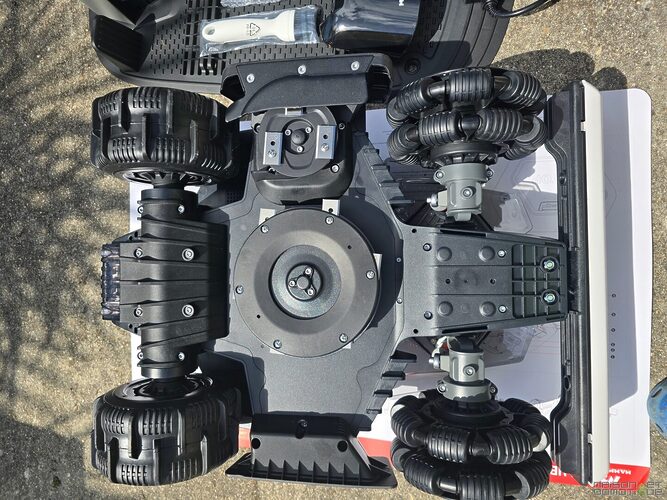
Under the robot, the serious stuff begins. The main disc measures 200 mm and accommodates six rotating blades.
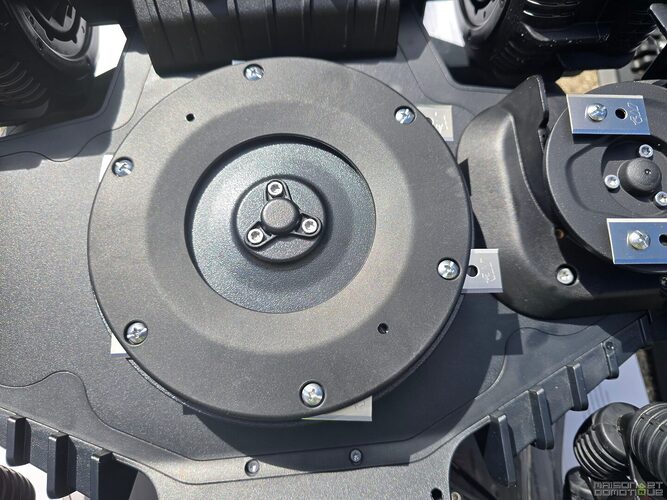
Next to it, a second disc of 120 mm with three blades, placed on the side, improves edge mowing. This side disc is only activated during perimeter work, which limits wear and unnecessary noise.

The cutting height of the main disc can be adjusted in the app between 20 and 65 mm. The edge disc operates at a fixed height around 50 mm, which is something to keep in mind if you like cutting very short. Personally, for healthy grass, especially in summer, staying around 50 to 60 mm is often much more relevant than a golf course style shave.
A cable-free and RTK antenna-free installation
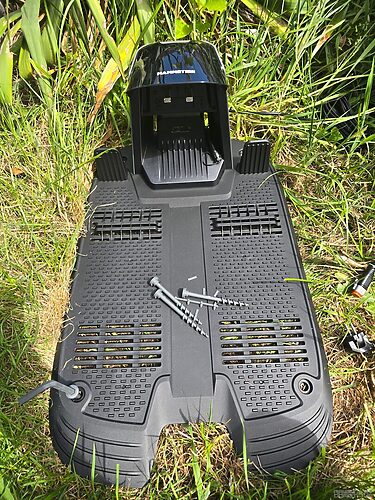
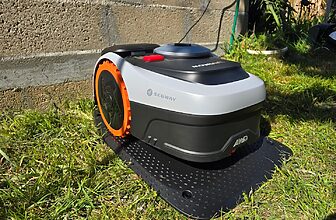
The physical installation is simple. Place the charging station on a stable area, fix it, plug it in, and place the robot on top. No antenna on a mast, no perimeter cable to bury, no headache to find the right location for an external beacon.
The Luba Mini 2 AWD 1000 uses the Mammotion iNavi service, based on NetRTK via Wi-Fi or 4G: a precise positioning without a physical RTK station. The iNavi service is free for life, and 4G connectivity is included for three years. After this period, a subscription will be required for remote control outside of Wi-Fi.

In a garden well covered by Wi-Fi, the robot can operate without a 4G subscription for standard tasks. But 4G is still useful for remote tracking, theft alerts, or monitoring the robot when it’s working behind a hedge. This is the kind of feature that initially seems gimmicky but is appreciated on the day when the robot strays from home.
The first setup goes through the Mammotion app. We add the robot, connect it to Wi-Fi, and an update is generally offered.

As often with this type of very software-oriented product, this step is crucial: updates correct navigation behaviors, mapping issues, or obstacle detection adjustments.

Automatic or manual mapping: two approaches depending on the terrain
The Luba Mini 2 AWD 1000 can create a map automatically. It explores the lawn, detects boundaries, identifies obstacles, and generates a map without manual control. On a simple lawn, with clear contours and not too tall grass, this is very practical. It doesn’t just circle the area: it also analyzes the interior of the zone.

For a more complex garden, with irregular edges, flowerbeds, narrow passages, walls, manual mapping is often preferable.

The robot is controlled from a smartphone with two virtual joysticks, somewhat like a remote-controlled car. You make it go around the area precisely, and you confirm.

The neater the map, the better the result. For the edges, in particular, you need to take your time and follow the walls as closely as possible without rubbing against the body. The robot will then follow this limit during its mowings. A mapping done too broadly will result in a larger strip of uncut grass along the walls. It’s not magic, even if marketing might sometimes like us to believe that.

The application allows for managing multiple zones, corridors, restricted areas, virtual fences, and even patterns on the lawn. The Luba Mini 2 AWD 1000 handles up to 10 mowing zones, which is more than enough for most family gardens, even with a lawn in front, another in the back, a gravel path, or a driveway.

There is also a Drop Mow mode: place the robot in a non-mapped area and ask it to mow temporarily, without affecting the main map. Handy for a forgotten corner or to help a neighbor ;-) Well, at least the neighbor can offer drinks in return :p

A complete app, sometimes needing improvement
The Mammotion app covers a lot of grounds. You can start a mowing, choose the areas to treat, adjust the cutting height, speed, spacing between trajectories, mowing angle, number of passes on the perimeter, the order of borders and interior, or the obstacle detection level.

The spacing of the trajectories can go down to 8 cm or up to 12 cm. The closer the spacing, the cleaner the result, but the longer the robot takes. For regular maintenance, an intermediate setting suffices. The random mode is also interesting: it prevents always marking the lawn in the same direction.
You can choose how to deal with obstacles: disabled, standard, or sensitive. In sensitive mode, the robot avoids more, which is reassuring if toys or animals are lying around in the garden. But it might confuse tall grass, clumps, or plant borders with obstacles. In disabled mode, it gets closer to walls, and the finishing improves (provided the area is clean).

This is one of the real limitations of the app: we would like to define different detections for the interior and for the borders. Mowing the interior in standard mode, then doing the borders in disabled detection. Today, you have to launch two separate operations. It’s not dramatic, but it would be a nice improvement.
Another limitation: modifying an existing map could be more flexible. When a border has been poorly defined or a flowerbed changes, sometimes you would like to adjust a segment without remapping entirely. Mammotion is making regular progress, but there are still a few points to refine.
NetRTK navigation and triple camera: very effective, but not universal
The Luba Mini 2 AWD 1000 combines NetRTK and AI vision with three cameras. In theory, this combination provides centimeter-level precision and better reliability in partially obscured areas: under trees, close to a wall, near a canopy.
In practice, the robot is very precise when the station is well placed and the garden is not completely enclosed. It follows its lines cleanly, works in regular bands, and returns to its base gently. The result is much more pleasant than a robot that wanders randomly. You can clearly see where it has been, and the lawn quickly takes on a maintained appearance.
However, NetRTK depends on good reception conditions. If the station is stuck against a house, oriented towards the north, under a metal shelter, or in a corridor between two walls, problems may arise. This isn’t specific to Mammotion; it’s a constraint of this type of navigation.

The vision by cameras helps when the signal is less reliable. It allows the robot to understand its environment, avoid obstacles, and continue working in slightly tricky passages. But if your land is heavily wooded, very enclosed, with large trees everywhere, a version with LiDAR might be more suitable.
For the majority of open gardens, even with a few trees and complex passages, this Luba Mini 2 AWD 1000 does very well. For an undergrowth turned into lawn, it’s better to be cautious.
Impressive all-terrain performance
The major strong point of the Luba range is traction. And this Mini 2 AWD 1000 does not disappoint. AWD stands for All-Wheel Drive, meaning four-wheel drive: and all four truly contribute to traction; it’s not just a technical specification.
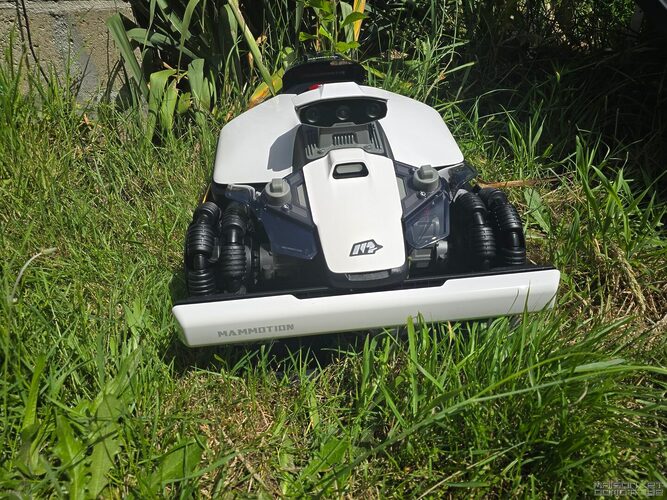
The rear wheels are wide, knobby, and have real traction capacity.

The front wheels are omnidirectional, with small rollers that allow the robot to pivot almost on the spot without churning up the lawn. This is important, as some robots damage the grass with repeated turns in the same spot. Here, the rotations are cleaner, smoother, and less aggressive.

The robot can handle slopes up to 80%, which is about 38.6°. This is massive for a robotic lawn mower. In real-life situations, it climbs slopes, goes over bumps, crosses uneven areas, rolls over rocky paths, and gets out of holes where many two-wheel-drive models would be stuck like a hen in front of a USB socket.
For country gardens, older terrain, not perfectly leveled lawns, areas with roots or slopes behind the house, this is where the difference is tangible.
That said, crossing capability and everyday use are two different things. Yes, it can traverse tall grass of 20 cm, push a small branch, or climb an impressive slope. But it’s not a brush cutter. For a lawn abandoned for two months, it’s better to perform a first classic cut before entrusting it with maintenance. Once the area is back in shape, it will do its job very well.
Cutting quality: clean, regular, and truly serious
The main 200 mm disc with six blades cuts cleanly. The robot exerts little force in maintained grass, and the visual result is satisfactory. Six blades rather than three indeed help with regularity and slightly denser grass.

The adjustable height of 20 to 65 mm allows adaptation to the seasons. Shorter in spring if the lawn is in shape, higher in summer to prevent the grass from yellowing too quickly. Between 45 and 60 mm is often the right compromise for domestic use.
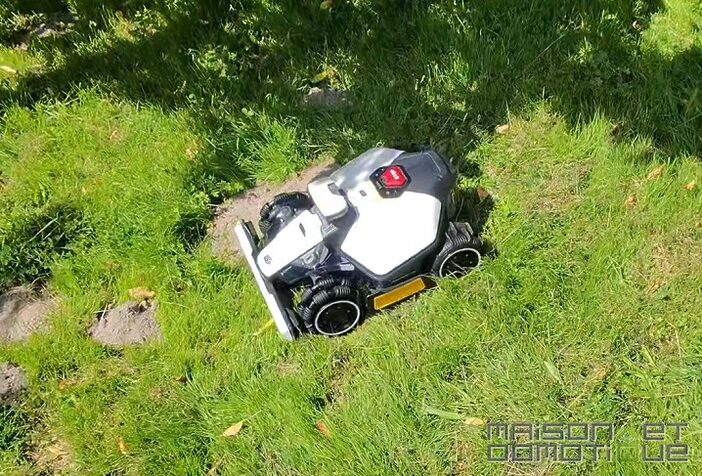
The robot works in parallel lines. It’s more efficient, faster, and this shows on the lawn. Depending on the settings, it can start with the perimeter or the interior. For a clean result, you can ask it for several border passes, then an interior pass with a different angle on the next mow.
The noise level is contained. Mammotion reports 58 dB, while measurements hover around 55 dB. It’s quiet enough to work without turning the garden into an airport. You can hear it, especially when the side disc activates, but it’s nothing bothersome.
The famous edge disc: better, but not magic
This is one of the novelties of the Luba Mini 2 AWD 1000: its lateral cutting disc dedicated to edges. And yes, it makes a difference. In previous generations or in many competing robots with a central disc, the distance between the blade and the edge of the robot mechanically imposes an uncut strip along the walls. Depending on models, this can be 10 to 15 cm of easily missed grass.

With its side disc, the Luba Mini 2 AWD 1000 reduces this band. Mammotion claims a cut up to around 5.5 cm from walls. In open borders, along a patio at the same level as the lawn, the result is excellent: the robot encroaches on the hard surface and cuts very close. This is where it is most impressive.
Along a wall or a low wall, it’s more nuanced. The robot will not hug its body against the wall. Depending on the quality of the mapping, the detection mode chosen, and the shape of the edge, it may leave a few centimeters of margin, sometimes more. By remapping carefully and disabling obstacle detection on the perimeter, the result improves significantly. With ivy, tall grass, or an uneven edge, the robot maintains more distance.
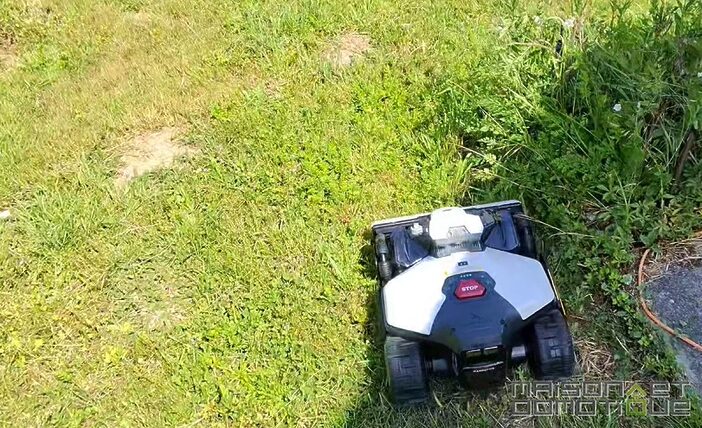
It significantly reduces the finishing work. It doesn’t completely eliminate the string trimmer if you are finicky about perfectly neat edges. You will still have to go over from time to time along walls, corners, recesses, or vertical obstacles. But you go from a regular chore to an occasional finishing task. And that changes everything in everyday life.
Obstacle detection: very reassuring, but not infallible
The front triple camera detects obstacles. Mammotion claims object detection starting from 2.5 × 2.5 cm. In real usage, the robot avoids common objects very well: balls, dog toys, pots, hoses, large plush toys, shoes, visible branches. It slows down, goes around, or turns back.
Objects with volume or contrast are well identified. A colored ball, a hose lying in the grass, or a small shovel are typically recognized. The video feedback in the app is also practical to see what the robot sees, check an area, or understand why it stopped.
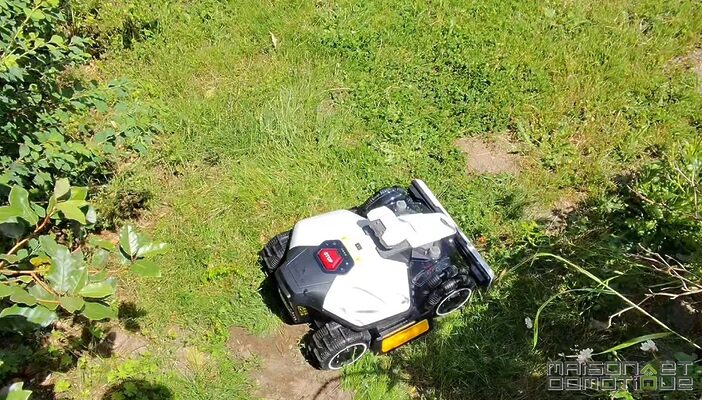
There are a few limitations. Very flat, transparent, very small objects, or those the same color as the grass can pass through undetected. A glass bottle, a small flat green object, or a barely visible pruner may cause problems depending on the angle, lighting, and grass height.
The detection doesn’t eliminate the need to tidy up the garden before mowing. Small toys, tools, cables, fragile decorations, or transparent objects: it’s better to pick them up. For animals, especially hedgehogs, the wildlife safety mode and nighttime mowing prohibition remain advisable. Even with good AI, the best safety lies in not mowing at night.
Rain management, security, and theft prevention
The Luba Mini 2 AWD 1000 has a rain sensor. When it detects water, it interrupts mowing and returns to its base. Mowing in the rain is bad for cutting, the robot, and the grass, so this is a good feature.
The sensitivity is adjustable in the app. In Sologne, for example, between morning dew, light rain, and wet grass, it’s best to avoid mowing too early if you want to keep the robot clean.

On the security side: Stop button, physical safety key, collision sensors, tilt detection, zone exit monitoring, and notifications in the app. The robot can be located via 4G, during the included period or with a subscription afterwards. For a device costing over €1000, this is not a detail.
Battery life: good, but terrain-dependent
Mammotion claims up to 150 minutes of battery life and 430 m² per charge. Charging time: about 150 minutes. This is consistent for a robot designed for up to 1000 m².
In real conditions, it’s less. The area mowed per charge heavily depends on the terrain. A large rectangular lawn, clear, with long straight lines, will be much more efficient than a garden broken into several zones, with corridors, trees, flowerbeds, narrow passages, and frequent turns.
On a complex area of about 800 m², we are more around 250 m² mowed per charge, with about two hours of operation. This isn’t bad, but it’s far from the theoretical numbers. Nothing unusual: robots lose a lot of time in corners, narrow passages, and maneuvering.
The robot resumes its tasks after recharging. For a 1000 m² lawn, it will work in several cycles; it’s not a one-off outing. For regular maintenance, that’s not a problem: you schedule several passes per week, and the lawn stays clean without you thinking about it.
Intelligent battery management allows setting charging limits or prioritizing off-peak hours. Useful for those who like to optimize their connected home, although the consumption of a robotic lawn mower remains low compared to that of a water heater or a charging station.
What type of garden is it really made for?
The Luba Mini 2 AWD 1000 is particularly relevant for gardens up to 1000 m² that aren’t perfectly flat. Slopes, bumps, difficult passages, separate areas, paths, mixed borders, stones, lawns that resemble more a living terrain than a showroom carpet: this is where it shows what it can do.
It’s also interesting if you want to avoid the perimeter cable and the physical RTK antenna. You place the base, configure it, map it, and you’re off. A few minutes are enough to get started.
However, if your terrain is small, flat, rectangular, and perfectly clear, this robot is oversized. A cheaper model, with LiDAR or simpler navigation, may suffice. The Luba Mini 2 AWD 1000 is worth its price when its four-wheel drive, crossing capacity, and edge cutting are genuinely utilized.
If your garden is heavily wooded or very enclosed, NetRTK may show its limits. In that case, consider the Luba Mini 2 AWD 1500 with LiDAR, or another robot that doesn’t depend as much on the sky.
Limited home automation integration, but real potential
Mammotion offers a comprehensive app, but advanced home automation integration remains a subject to monitor. Can it be effectively integrated into Home Assistant?
Currently, there are community initiatives around Mammotion robots, but no official integration as straightforward as a Matter device or an established robotic vacuum cleaner. Depending on the software versions, available APIs, and Mammotion’s developments, possibilities change. We had already seen how to integrate your Mammotion robotic lawn mower into Home Assistant.
The potential is obvious. A Home Assistant automation that suspends mowing if a garden gate remains open, if a camera detects children in the area, if the weather forecast predicts rain, or if the robot needs to avoid a scheduled irrigation period. One could also synchronize mowing with off-peak hours, solar production, or presence at home.
The Mammotion app suffices for standard use. But for tinkerers, it’s a ground to monitor. A robot this connected deserves better than an isolated app.
Maintenance: simple, but not to be neglected
A robotic lawn mower works outdoors, in humidity, dust, cut grass, and sometimes mud. Even an IPX6 model requires maintenance. The Luba Mini 2 AWD 1000 can be cleaned quite easily thanks to its access under the casing, its included brush, and its resistance to water splashes.
It’s essential to regularly check the blades, remove grass clumps, ensure the blades pivot freely, clean the wheels, and wipe the cameras. The main disc benefits from an improved design, with better protection to limit grass accumulation around the screws and blades: this is a useful evolution, as blocked blades by residues are common in robotic lawn mowers.
The blades are consumables. They are replaced depending on the area, mowing frequency, and terrain conditions. Pine cones, twigs, stones, or molehills wear the blades out faster than a clean and regular lawn.
The removable battery is a significant advantage for repairability. Mammotion offers a three-year warranty, which is reassuring for a product so exposed to outdoor conditions.
Conclusion
On complicated terrain, the Luba Mini 2 AWD 1000 performs really well. The four-wheel drive isn’t just there for decoration in the technical specifications: the robot climbs, crosses over, pivots cleanly, and maintains excellent traction where many other models would start to spin.
The secondary cutting disc is a good idea. It doesn’t turn the robot into an edge magic machine, but it reduces finishing work, especially along patios, paths, and walkable edges.
The cable-free and RTK antenna-free mapping simplifies installation. The app is comprehensive, the cutting quality is clean, the removable battery is reassuring, and the video feedback adds a practical garden surveillance aspect.
NetRTK depends on the environment. In a heavily enclosed garden, heavily wooded, or with a poorly placed station, it may show its limits. The base’s location deserves consideration before fixing anything.
The Mammotion Luba Mini 2 AWD 1000 is one of the most interesting wireless robotic lawn mowers for medium to complex gardens. It brings real traction, modern navigation, clean cutting, and significantly better edge management than average.
Its “Mini” format is a bit misleading: it behaves like a real all-terrain robot. Slopes, bumps, irregular passages, or separate areas don’t intimidate it.
The NetRTK isn’t ideal for all terrains, edges won’t always be perfect, and the app still needs some adjustments. But overall, Mammotion delivers a robot that you genuinely use, not just one you place in a corner hoping it works.
Flat, simple, and small garden? Look for a less ambitious model. Living, hilly, broken terrain, a bit troublesome to maintain? The Luba Mini 2 AWD 1000 deserves its place in your selection. It doesn’t completely replace the gardener, but it comes dangerously close.
Please remain courteous: a hello and a thank you cost nothing! We're here to exchange ideas in a constructive way. Trolls will be deleted.