


Résumer cet article :
Home batteries are getting easier and easier to install, but we generally still hide them away. Garage, utility room, plant room… With their industrial-equipment look, you don’t exactly want to put one next to the sofa. SAMDUO wants to change that with the Nex E6000, a 6 kWh battery that’s just 11.9 cm thick.
The manufacturer is highlighting an issue that still rarely comes up when people talk about residential storage: where to put the battery in the home. And once you start storing several kilowatt-hours at home, it quickly becomes a question worth asking.
6 kWh in just 11.9 cm of thickness
The first thing that strikes you about the Nex E6000 is how little space it takes up.
It packs 6,028 Wh of LiFePO4 cells into a vertical enclosure measuring 842.5 x 500 x 119.5 mm. It still weighs 59 kg: slim, yes, but not light.
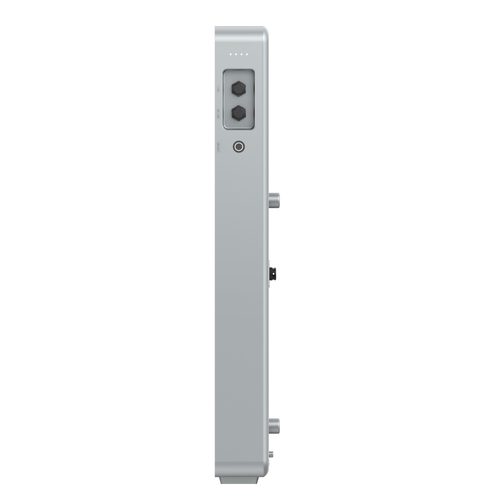
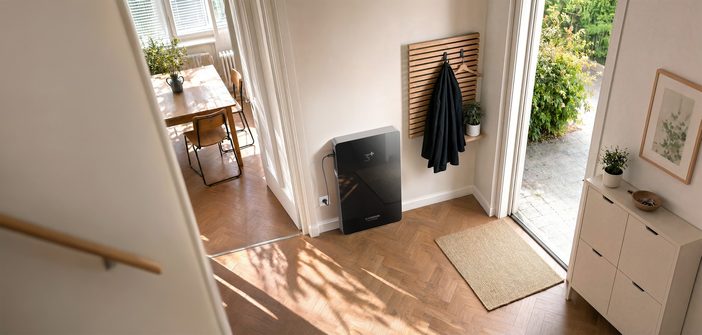
SAMDUO presents it as the world’s thinnest 6 kWh plug-and-play home battery. It can sit flush against a wall, where a conventional battery wouldn’t fit, and the manufacturer has hallways and living spaces in mind in particular.

The manufacturer’s visuals make the point: the Nex E6000 is shown in a living room or entryway, against the wall, a bit like a small radiator. The product specifications confirm its dimensions, 59 kg weight, IP65 certification and 10-year warranty.
This design earned it a 2026 Red Dot Design Award in the “Tools, Industrial Equipment and Machinery” category.
A battery designed to be seen… without drawing attention
SAMDUO took the idea all the way. The tempered-glass front has no screen: all information and settings are accessed through the mobile app.
For a device installed in the living room, that makes sense. Nobody wants a row of LEDs blinking in the dark at 11 p.m.
As for noise, the manufacturer quotes 25 dB. If that figure holds up, you can keep it near living spaces without feeling like you’re living in a boiler room.
You can also put it in the garage or outdoors. It’s IP65-certified (dust and water jets) and operates from -20 to 55 °C.
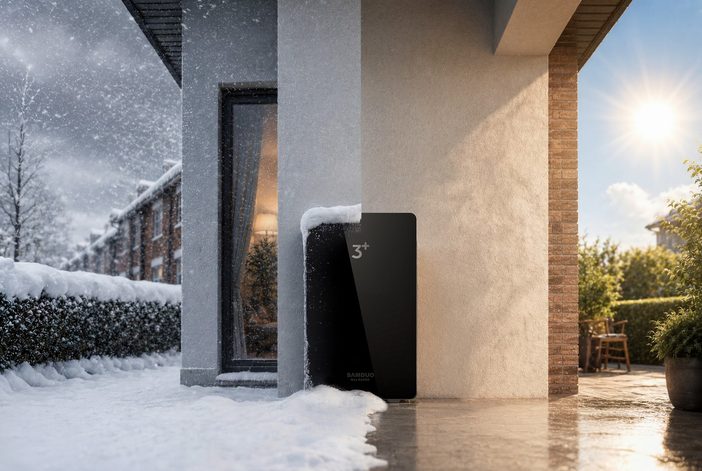
SAMDUO has also incorporated a heating film to help it withstand the cold, along with valves to release any internal overpressure. The manufacturer lists an unheated garage or a sheltered outdoor spot, such as under a carport, among the possible locations.
A true plug-and-play battery that plugs into a standard outlet
The other key feature of the Nex E6000 is its AC coupling.
The cells, BMS and inverter are all housed in a single enclosure. In its standard configuration, according to SAMDUO, all you have to do is plug it into a standard outlet. There’s no need to rework the photovoltaic wiring or call in an electrician.
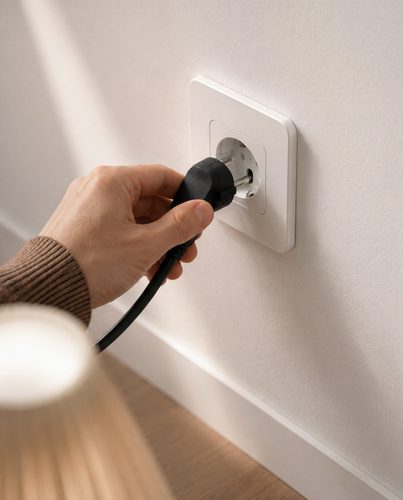
That’s a real advantage for an existing solar installation: you can add a battery without touching the inverter or microinverters.
The Nex E6000 stores surplus energy generated during the day and supplies it when production drops. It can also charge from the grid.
With an off-peak electricity plan or a dynamic tariff, you can charge it when electricity is cheap and use that energy a few hours later, when prices rise.
Up to 2,600 W to charge 6 kWh in a few hours
Charging power is one of its strong points. SAMDUO quotes up to 2,600 W, enough to charge the full 6 kWh in around 2 to 5 hours, depending on conditions and available power.
When feeding power back into the home grid, output is 800 W in the standard plug-and-play configuration.
That may seem low compared with 6 kWh of stored energy, but it’s important to consider what those 800 W are for. They can easily cover a home’s baseload: Internet router, refrigerator, freezer, standby devices, computers, lighting, ventilation, home automation… This is precisely the background consumption you want to cover with the day’s solar surplus. For the oven or induction cooktop, however, you’ll still need to rely on the grid.
2,600 W available during a power outage
Off-grid, the Nex E6000 has more power to offer.
It has two dedicated outlets that deliver up to 2,600 W in total. Each can supply 2,600 W, but the power is shared between the two. SAMDUO also quotes a peak output of 3,640 VA for 10 seconds.
That’s enough to run some fairly power-hungry appliances: the manufacturer mentions a washing machine or an air fryer.
It’s especially useful during a power outage. With 6 kWh in reserve, you can keep the essentials running for several hours: refrigerator, freezer, Internet router, lighting, alarm system and some home automation devices.
What if 6 kWh isn’t enough? Up to 90 kWh!
You don’t have to choose your final capacity right from the start. Begin with one Nex E6000 and its 6 kWh, then add compatible units. SAMDUO says you can connect up to 15 batteries together, for a total of 90 kWh.
At 90 kWh, you’re a long way from just keeping a little solar surplus for the evening!
For a typical household, the standard 6 kWh is already more than enough. With nighttime consumption of a few hundred watts, the energy generated during the day can cover a good part of the evening and night.
A claimed lifespan of 15 years and more than 10,000 cycles
A home battery is a long-term purchase. SAMDUO uses 314 Ah LiFePO4 cells, claims a 15-year lifespan and provides a 10-year product warranty.
According to the manufacturer, the cells retain 70% of their capacity after more than 10,000 cycles under its own test conditions.
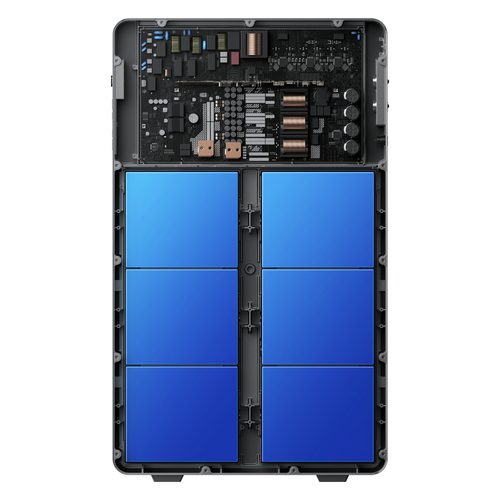
The choice of LiFePO4 is no surprise: it’s currently the most common chemistry in residential energy storage, thanks to its longevity and thermal stability.
For safety, SAMDUO relies on its DuoShield system, which continuously monitors the battery’s current, voltage, temperature and status. If a problem occurs, it can reduce power, isolate the fault or shut the battery down. It also activates the internal heater when it gets too cold.
Energy management that takes the weather and electricity prices into account
Storing 6 kWh is all well and good. But you also need to know when to charge and when to draw on it.
That’s the job of SAMDUO Intelligence. The system continuously calculates a rolling 24-hour schedule. To decide when to charge or discharge, it combines several data points: dynamic tariffs or peak/off-peak periods, solar production forecasts based on the weather, household consumption habits and battery status.

The aim is to spare users from tweaking the settings every day just to save a few cents.
SAMDUO says it integrates with more than 800 energy providers and platforms, including Octopus Energy, Tibber, EDF Energy, Eneco and E.ON. The system retrieves prices and tariff forecasts so it can charge when electricity is cheapest.
And good news: Home Assistant is supported!
For Maison et Domotique readers, this is probably the most important news: SAMDUO plans to offer an open API.
According to the documentation provided to testers, this official API will allow the Nex E6000 to connect to Home Assistant, Homey and other programmable home automation hubs. It will provide access to battery data as well as charging and discharging controls.
There are plenty of possible scenarios. Home Assistant could start charging as soon as solar production exceeds household consumption. It could keep 30% in reserve when a storm is forecast, or prevent discharging ahead of a peak-rate period. It could also start certain appliances once the battery is sufficiently charged.
For anyone who likes to fine-tune their energy management, this API matters almost as much as the specifications.
Of course, testing will have to confirm what it can actually do, how good its documentation is, when it will be available, and, above all, whether control works locally or through the cloud.
A Nex E6000H for those who prefer a more conventional format
Not everyone needs a battery this slim. SAMDUO also offers the Nex E6000H.
The principle is the same; only the form factor changes. The Nex E6000 is designed to sit along a wall in a living space. The E6000H is more compact and deeper, making it better suited to a cabinet, garage or laundry room.
We like the idea: the battery adapts to the home, not the other way around.
Home energy storage is starting to look good, too
Residential batteries are becoming more affordable and easier to install. That means the space they take up and the way they look matter more. Not everyone has a garage or utility room where they can stash a 59 kg battery.
At 11.9 cm thick, the Nex E6000 offers an original solution. And its design doesn’t come at the expense of its specifications—not by a long shot.
The open API and promised Home Assistant compatibility interest us just as much as the rest. On paper, it’s a well-designed battery for a home equipped with solar and home automation.
We’ll have to see how it performs in practice: round-trip efficiency, control responsiveness, app quality, Home Assistant integration, solar surplus measurement, actual noise levels, standby consumption and backup-mode behavior.
We hope to test it soon at Maison et Domotique. On paper, this Nex E6000 looks very promising!



Please remain courteous: a hello and a thank you cost nothing! We're here to exchange ideas in a constructive way. Trolls will be deleted.