



Résumer cet article :
I spent a good part of Intersolar covering the announcements from the fair, but I still managed to sit down with the teams from Jackery to see what they were preparing. The manufacturer has been known for a long time for its portable stations: the kind of product you take camping or slide into the trunk of a van, like the Explorer 1000 Plus that we tested. But the discourse has frankly changed. What they presented in Munich was clearly aimed at something else: energy management at home.
This isn’t a total surprise. A few weeks ago, I thoroughly tested the SolarVault 3 Pro Max, and I came away convinced. What attracted me was that this battery installs without breaking everything: it connects to an existing photovoltaic installation, the inverter remains in place. In Munich, the SolarVault was still prominently displayed at the booth, but it was no longer alone. Jackery has begun surrounding it with complementary products, and the ambition is really starting to take shape.
Jackery no longer wants to be just a battery manufacturer
This is the first message the teams wanted to convey. The range of portable stations continues to evolve. It remains important, and they care about it. But the residential market has become the priority. Jackery is now structuring its catalog around two distinct families: nomadic stations on one side, and domestic storage solutions on the other.
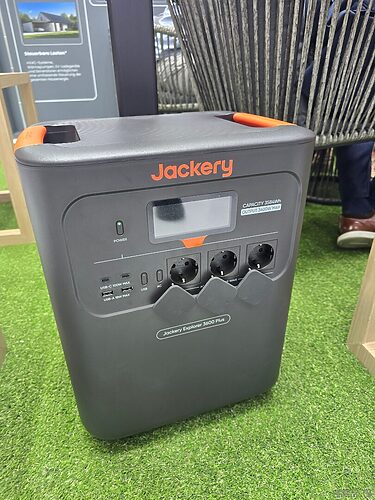


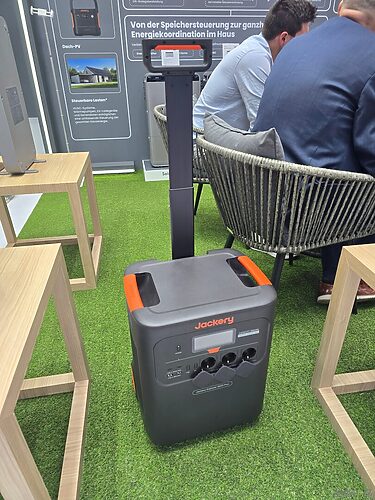

This positioning responds to something real. Solar self-consumption is progressing everywhere in Europe, and homeowners who already have panels are now looking to better utilize what they produce. Storing energy is no longer enough: it is also necessary to decide when to use it, and for what. This is where Jackery tries to carve out a place, with equipment capable of analyzing household consumption and automatically directing energy flows.
The SolarVault 3 Pro Max remains the foundation
It is difficult to talk about the booth without returning to the SolarVault, which Jackery continues to highlight as its main residential solution – and rightly so.

If you want all the details, my complete test of the SolarVault 3 Pro Max is available on Maison & Domotique. I covered the installation, configuration, and everyday performance there.
In summary: the AC-coupled architecture of this battery is its main asset. It connects to the existing installation without replacing the inverter, which really changes the game for those who already have photovoltaic systems and simply want to add storage. The modules are stackable, the capacity adapts to the needs of the household, and the application tracks solar production and consumption in real time.

But what Jackery came to show in Munich this year is mostly what surrounds it.
The Hub Box: the conductor of the installation
The novelty that intrigued me the most was not a battery. It was a box.

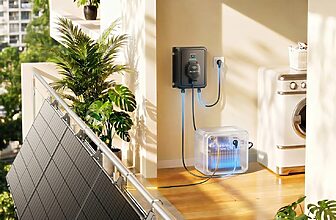
Jackery was showcasing the Hub Box, which is set to launch in Europe in the coming months. The equipment is physically discreet, but it is supposed to play a central role: coordinating all Jackery devices at the same time (batteries, measurement systems, connected plugs) and continuously deciding where to send the available energy.
The teams explained that the Hub Box will be able to manage three different operating modes within the same household, where a classic installation typically limits itself to one. In practice: prioritizing the consumption of what the panels produce, avoiding purchasing from the grid when prices are high, and keeping a reserve for emergencies in case of a power cut.
Other players in the residential storage market are already doing this. But seeing Jackery commit to this area with a dedicated product is a clear signal about the direction they are taking.
Smart Meter, TIC Reader, Smart Plug: the sensors that make the system useful
To optimize energy flows, you first need to know what is happening in the house. Jackery presents three accessories for this.
The Smart Meter measures in real time the exchanges with the electrical grid: the house consumes or injects, it knows. Specifically for France, Jackery is launching a TIC Reader designed to read the data from the Linky meter via the Customer Tele-Information. This interface has existed for a long time, but it is not necessarily exploited by foreign manufacturers. This is therefore good news for French users who want accurate consumption tracking.

The Smart Plugs, on the other hand, provide individual control over devices. The washing machine, water heater, and dehumidifier can be triggered automatically when solar production exceeds the household consumption, instead of sending that surplus back to the grid for nothing.
Taken individually, these devices exist with other brands. The difference here is that they are designed to work together, driven by the same system, without needing to tinker with third-party integrations.
A HEMS, even if Jackery doesn’t like the term much
Jackery doesn’t use the term HEMS (Home Energy Management System) much in its presentations, but that’s exactly what they are building. The panels produce when the sun shines, rarely at the precise moment when the house consumes. Without smart management, some of that production goes onto the grid at rock-bottom prices when it could be stored or used directly. The SolarVault, the Hub Box, and the sensors aim to fill this gap.
What I appreciate is that all this remains invisible to the user. No complex interface to master, no settings to fine-tune every week. The system adjusts itself, and the impact is visible on the bill. This is exactly the right angle to convince homeowners who are not electronics enthusiasts but simply want to get more from their solar installation.
The refrigerator battery: a simple idea that meets a real need
Among the new products presented, one particularly caught my attention because it stands apart from the rest: a battery designed solely to keep a refrigerator running during a power outage.
No question of powering the whole house. The goal is unique: to keep the fridge and freezer operating. Jackery announces up to 15 hours of autonomy.


I find the idea well thought out. Not everyone can afford to invest in a complete residential battery. But many people remember a power outage of several hours that cost them the entire contents of their freezer. This product addresses that specific frustration, at a likely much more accessible price than a SolarVault installation. It fills a gap between the small Explorer stations and residential solutions, without trying to do more than it promises.
The concepts: solar backpack and photovoltaic pergola
The booth also presented prototypes, clearly there to test the reactions of the European public.
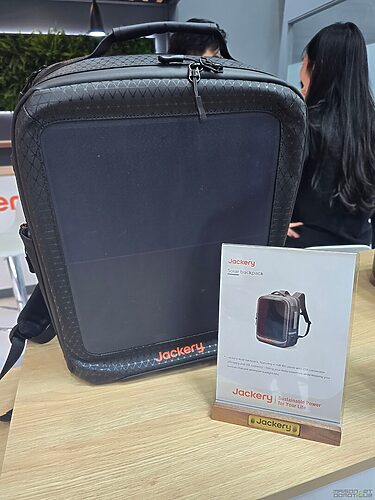
The most original: a backpack with an integrated solar panel. You know how much I love bags :p The level of finish was frankly advanced for a prototype – not the kind of hastily thrown together thing pulled from a drawer for communication purposes. The idea is in Jackery’s DNA: to recharge a portable battery while hiking or traveling, without having to search for a plug.

The other demonstrator was a pergola equipped with photovoltaic panels. Producing electricity from an outdoor structure while creating shade – the concept already exists, but the fact that Jackery is interested in it says something about their vision. The brand no longer thinks solely in terms of batteries. It is beginning to think about all the surfaces from which energy can be captured, including the terrace.

These products may not all arrive as is. But they show where Jackery is looking.

A transition taking shape
As I left the booth, I had a fairly clear impression: Jackery is in the process of achieving something that is not easy to do: changing its positioning without losing what made its identity.
The brand was born with portable stations, and that has built its reputation over ten years. Today, this expertise becomes a foundation for something broader. With the SolarVault, the Hub Box, the sensors, and the smart plugs, the whole begins to resemble a real system rather than a collection of products.
The approach reassures me as well. Jackery is not trying to completely reinvent the photovoltaic installation. They are integrating into what already exists, simplifying user engagement, and automating the decisions that the user neither has the time nor the desire to make themselves. It’s a philosophy that has worked with the Explorer stations. And the solutions are now MQTT compatible, which allows them to be relatively easily integrated into third-party systems, such as Home Assistant for example.
The Hub Box will be the concrete test in the coming months. If its launch in Europe lives up to the promises of the demonstrations in Munich, and if the rest of the ecosystem follows suit, Jackery will have the arguments to attract customers who are currently looking at Tesla Powerwall, Enphase, or the integrated solutions offered by major solar installers. It’s not set in stone, but the foundations are there, and as we saw, the SolarVault 3 is an excellent solution that just needs to grow thanks to the surrounding peripherals.



Please remain courteous: a hello and a thank you cost nothing! We're here to exchange ideas in a constructive way. Trolls will be deleted.