



Résumer cet article :
At Intersolar Europe 2026, it was impossible to overlook home batteries. All the big names in the industry made the trip to Munich with the same goal: to make energy storage simpler, more efficient, and cheaper. Among them, Marstek had a prominent presence with an animated booth, where the manufacturer showcased a new generation of products covering virtually all residential needs.
For my part, this was not a discovery. I had already met the teams from Marstek during the EnerGaïa show in Montpellier, where they presented the Wirelite solution and the first evolutions of their plug & play range. A few weeks later, I had carried out a complete test of the Marstek Venus E 3, a battery that had left me with an excellent impression due to its ease of installation and daily efficiency.
This good impression was further confirmed in considerably less pleasant conditions… Last spring, a major power outage left our area without electricity for almost two days. In Sologne, in the countryside, this type of outage quickly becomes a concrete problem: freezers, refrigerators, Internet connection, lighting, smartphone charging… everything stops. Or almost. Thanks to the backup power function of the Venus E, I was able to continue powering essential equipment throughout the outage. This kind of experience is worth far more than any laboratory tests – and it has definitely convinced me of the value of this type of solution.
It was with curiosity (and some expectations) that I returned to see Marstek in Munich. And what I found surprised me: the manufacturer is no longer looking to improve a product. They are building something broader.
Founded in 2009, Marstek now operates four production sites, employs over 1,500 people including more than 400 engineers, and masters both R&D and manufacturing in-house. It is no longer a brand that simply assembles components purchased elsewhere.
This is reflected in the coherence of the range. The central idea is quite simple: to enable any household to add a battery to an existing photovoltaic installation, without major works, without replacing the inverter, and without a week of construction. This philosophy of “Plug-in Battery” is now the brand’s identity. The principle: limit electrical work, reduce installation costs, and improve self-consumption rates without altering the existing solar installation. This aligns well with the European market, where millions of households already have panels but now want to store what they produce.
Representatives from Marstek emphasized this during our exchange at the booth: their goal is no longer just to sell a battery, but to support both someone installing their first panel and someone looking to upgrade an already substantial system. This is probably the main announcement of this show.
Until now, the Venus E was the core of Marstek’s offering for the general public. Now, the manufacturer is leveraging its expertise across four models, each targeted at a specific profile.
Venus E Mini: the battery for those just starting out
This is probably the product that will reach the most people. With the Venus E Mini, Marstek targets people who are discovering self-consumption or those who simply do not have much space. Wall-mounted, 10.5 cm thick, 22 kg: Marstek claims to make the thinnest plug & play battery on the market. You attach it, connect it, and it’s operational in a few minutes.

The technical specifications are honest for this format:
- 2 kWh capacity;
- 1.5 kW bidirectional power;
- 1.5 kW backup power, peak at 1.8 kW;
- automatic switching in less than 15 ms;
- LiFePO₄ cells, over 10,000 cycles promised;
- IP65, usable indoors and outdoors.

What I appreciated: Marstek has not software-limited it. It has the same functions as the larger models – self-consumption, scheduled programming, real-time monitoring, off-peak hours, in-house artificial intelligence. Features that were previously expensive, reserved for much larger systems.
For a household that consumes between 6 and 10 kWh per day, this is a good first step. It is already available on the manufacturer’s website at the price of €699.
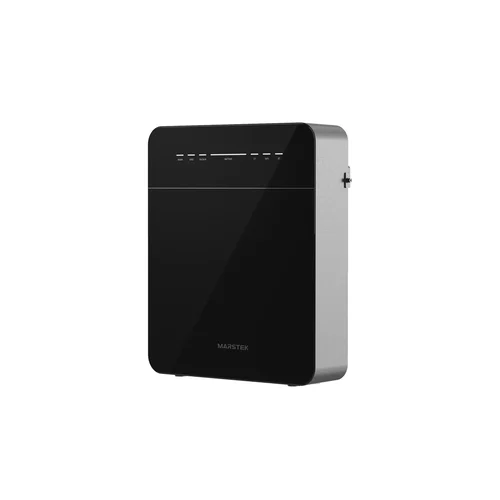
Marstek – Venus E MINI
Venus E 4.0: the model I was waiting for
This one, I was really looking forward to. I’ve been using the Venus E 3 for several months. It powered my home for two days during the outage. I know its limitations, and I was curious to see what Marstek had changed.
The 4.0 is not a cosmetic update. The power rises to 3 kW in charge and discharge (up from 2.5 kW before), with a capacity of 5 kWh. The casing is 21% lighter, the footprint reduced by about 7%, all while offering greater capacity.

The screen has been redesigned, and it now incorporates presence detection through millimeter radar: it lights up when you approach. A small detail, but one that speaks volumes about the attention given to daily use.

In terms of durability, Marstek is moving from first-generation 100 Ah cells to LFP cells with 314 Ah, announced for over 10,000 cycles, compared to around 6,000 before.

And the 4.0 integrates into the SmartBox. Multiple batteries in parallel, up to 9 kW and 15 kWh, with backup power that covers the entire house, not just a few priority devices. For those who want to gradually expand their system, this is an important evolution.
Venus E Max: 10 kWh in a single unit
With the Venus E Max, we switch categories. 10 kWh in a single device, 3.6 kW bidirectional, 3.6 kW backup with switching in less than 10 ms. Marstek claims 44% more power than the industry average and says it is the first to offer a plug & play all-in-one battery at this capacity.

For homes with heat pumps, thermodynamic tanks, or electric vehicles, 10 kWh provides a different level of comfort, both at night and during a network outage.
Three units can be coupled through the SmartBox: up to 30 kWh and 10.8 kW, in single or three-phase.

Also to note: the Venus E Max is compatible with Marstek’s portable electric vehicle charger. The battery can then manage the vehicle’s charging based on solar production or off-peak hours.

The Venus E Max is already available for pre-order on the manufacturer’s website at the price of €2499.
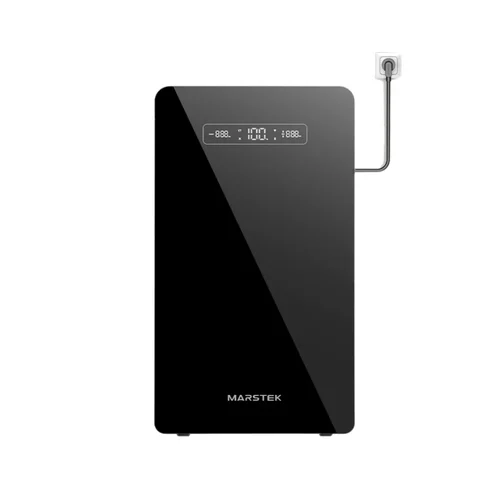
Marstek – Venus E MAX
Venus E Pro: the announcement that truly changes something
If I had to remember just one thing from this Intersolar, it would be the Venus E Pro.

Not because it adds capacity or power. Because it simplifies the photovoltaic installation itself.

Most residential systems require a dedicated photovoltaic inverter, several DC cables, wiring that is not always easy to implement. The Venus E Pro directly integrates a high-voltage MPPT of 3 kW (50-500 V), with 2 to 8 panels connected in series on a single input. The result: two cables between the panels and the battery. That’s it.

The Marstek teams emphasized the concrete implications: reduced installation time, fewer cables, overall cost reduction. And for the individual who wants to install it themselves, it’s also more accessible.
The battery starts at 2.08 kWh, expandable up to 12.48 kWh with additional modules. It also includes:
- AC coupling of 2 kW;
- backup of 2 kW, switching in less than 10 ms;
- active balancing of cells;
- LFP, over 10,000 cycles;
- operating from -20 to +60 °C;
- IP65.
What I see in this Venus E Pro is the direction in which residential storage is heading: production, conversion, and storage in a single device, which grows with the needs. The first plug & play batteries were designed to complement an existing installation. This one begins to replace components, and that is not the same thing.
And there is already a follow-up announced: the Venus E Pro Max, planned for Q3 2026, with a dual MPPT of 4.8 kW, 3 kW bidirectional, 3 kW backup, and expandable capacity up to 30.72 kWh.
This model particularly interests me because I have solar panels on my roof installed under a resale contract with EDF. A 20-year contract, which ends in 3 years. At the time, there was no micro inverter, the panels were installed in series and connected to a large inverter. With 8 panels in series, let’s just say that the output voltage is high. And few solutions accept such a voltage. At the end of my contract with EDF, this Venus E Pro Max could very well replace my large inverter to allow self-consumption and storage of these panels, which have been somewhat set aside until now. This installation dedicated only to reselling will therefore complement my self-consumption system by adding 2 kWc to the other panels :)
More than just hardware: software is becoming prominent
What probably surprised me the most in Munich was the change in focus at Marstek.
When I met them at EnerGaïa, and then when I tested the Venus E 3, the brand was primarily known for its easy-to-install batteries. A year later, the narrative has changed.
It is no longer just about storing photovoltaic surpluses. The stated goal is to manage all the energy of the home. The battery becomes the control center of the housing. And the manufacturers present in Munich, in general, now speak as much about software as they do about kilowatt-hours.
MARSTEK Intelligence: AI replacing scheduled programming
The manufacturer presented MARSTEK Intelligence, a software platform that automatically optimizes battery operation.
Instead of a simple scheduled programming, the system cross-references weather forecasts, expected photovoltaic production, household consumption history, user habits, and, when available, dynamic electricity rates.
The battery adapts its strategy in real time. It can decide to keep available capacity if a sunny day is forecasted, or recharge at night based on an advantageous off-peak rate.
Excellent news, because while Marstek offers excellent products, the software side was still somewhat lagging behind compared to competitors. The manufacturer seems to have listened to user feedback!
The VPP: your battery works for the grid when you are not using it
Another topic present at the booth: VPPs, or Virtual Power Plants.
The idea is simple. Instead of each battery working in isolation, thousands of installations are grouped together and controlled by grid operators. When the grid needs power, it injects. When there is a surplus of production, the batteries recharge. And the individual is compensated for participating.
This is already functioning in several European countries. In France, it is not yet a decisive argument for buying a battery, but the devices that are being released now already integrate the interfaces to connect when it becomes available. Something to follow closely!
Home automation compatibility: finally
This is the point that particularly interests us. The classic criticism of home batteries: they operate in a vacuum. Each has its app, but almost none really communicate with the rest of the house.
Marstek announces compatibility with Home Assistant, Shelly, Alexa, Clever-PV, EverHome, SENEC, and Octopus Energy – with more integrations planned in upcoming updates.
For someone who already has a Shelly Pro 3EM to monitor their consumption, or who manages their home from Home Assistant, this is tangible: the battery can adapt its strategy based on the real data from the house, the weather reported in HA, the charge level of the vehicle. We move from a battery that stores to a battery that reasons based on what it knows about the house. It’s a real difference.
The SmartBox: the module that evolves the system
The SmartBox deserves separate mention because it changes what batteries can do.
It is not just there to connect multiple batteries. It transforms the system from “a plug & play battery” to “a residential energy installation”: multiple batteries in parallel, single or three-phase, backup power for the entire house.

Depending on the model:
- Venus E 4.0: up to 9 kW and 15 kWh;
- Venus E Max: up to 10.8 kW and 30 kWh;
- Pro Max (coming soon): even more.
What is well thought out is the gradual approach. You start with 2 kWh, you add modules over the years, without starting from scratch when the electric car or heat pump arrives.
My opinion after Munich
Leaving Munich, I had a fairly clear impression: Marstek has changed scale.
It is no longer a manufacturer fine-tuning its flagship battery. The range now covers very different profiles, from the small apartment wanting to store 2 kWh to the house seeking 30 kWh and a system capable of operating autonomously. The brand even offers a small B2500D inverter to power certain devices (office corner, fridge, etc.).


What I appreciate is that they have not sacrificed what has already made their products strong. The plug & play philosophy is still there, and the features that are coming (AI, optimization, home automation compatibility, whole house backup, additional modules, VPP) do not burden the system on the user’s side.
After several months with the Venus E 3, I know that Marstek’s technical specifications hold up in real life. The outage in Sologne showed this well, and it is this type of real-world test that speaks to me more than any benchmark.
What I saw in Munich was a brand that understood that the market would not be won solely on kilowatt-hours or watts. It will be determined by the ability to integrate the battery within the entire installation, to make it work intelligently, and to connect it with what the user already has. Other manufacturers present in Munich seem to have understood this too. Marstek, however, already has the products.



Please remain courteous: a hello and a thank you cost nothing! We're here to exchange ideas in a constructive way. Trolls will be deleted.