



Résumer cet article :
The first French owners of photovoltaic panels will find themselves in a somewhat strange situation in the coming months. Their installation is still working, the panels are still producing… but the contract that allowed them to sell this electricity at a premium price is coming to the end of its 20 years.
And “premium price” is no exaggeration. Residential installations set up in the 2000s and early 2010s sometimes had buyback rates well above 50 cents per kilowatt-hour. From today’s perspective, it seems almost unreal!
I myself am concerned. I installed my panels in 2011: 8 modules integrated into the roof, about 2 kWp, connected to a central inverter. Since then, all the production has gone to EDF under a 20-year contract. My buyback rate is currently around €0.62/kWh, and the panels still bring me more than €1,000 each year. The installations were very expensive back then, but the operation was largely profitable.
Except that it doesn’t last forever. What is happening now to installations from 2006 will gradually happen to all those who signed these old contracts.
Why did older solar panels earn so much?
We must go back about fifteen to twenty years. To kickstart photovoltaics in France, the public authorities put in place very generous purchase rates, guaranteed for 20 years.
The decree of August 31, 2010, set, for example, 58 cents per kilowatt-hour for certain installations integrated into buildings, for a dwelling, up to 3 kWp. This rate was then indexed according to a formula that takes into account, among other things, indices related to labor costs and industrial prices. This explains why my installation from 2011 is now around 62 cents. The buyback rate increased slightly each year.
To give an idea, my panels produced 2,231 kWh in the first full year. The second year was poor, due to the weather and a malfunction of the inverter, but they still produced 1,720 kWh, resulting in a bill of €1,008 sent to EDF.
At that time, no one was looking to consume their solar energy. The kWh produced was sold for much more than the kWh purchased for the house: using it oneself would have been absurd. So everything was sold. And it is this choice that complicates things today.
After 20 years, the EDF OA contract ends
A photovoltaic purchase obligation contract has a fixed duration, generally 20 years. Upon expiry, EDF Purchase Obligation does not offer you to extend for another 20 years.
EDF OA indicates three options: sign a commercial contract with another buyer, move to self-consumption, or stop the installation.
It is sometimes stated that at the end of the contract, electricity becomes “unsellable.” This is false. Enedis does indeed provide for the possibility of continuing to sell all its production on the market: one must sign with a buyer and transmit to Enedis the agreement linking the installation to the corresponding balance perimeter.
The problem is the price. Between a historic contract at €0.55 or €0.60/kWh and a commercial contract under current conditions, there is no comparison. As I write these lines, in September 2026, the commercial buyback offers for surplus energy available in the market are around €0.04 to €0.07/kWh. In other words, a kilowatt-hour that was once sold for 60 cents may now only bring in 4 to 7! At this level, self-consumption becomes much more interesting to consider.
And it’s best not to let things drag on. Enedis specifies that if no balance manager is declared at the end of the OA contract, the network access contract can be suspended for three months and then terminated. So decisions will need to be made a few months before the deadline.
The real problem with old installations: they are wired to sell everything
This is likely to surprise owners the most.
In a recent self-consumption installation, the panels feed directly into the house’s electrical network. The devices consume the available solar electricity, and only the excess goes to the public grid.
Historical total sale installations do not work this way. The photovoltaic system has its own circuit and its own production connection (its own Linky meter), and all the energy produced is sent to the grid to be counted and paid.
This is exactly the case for me. The eight panels on the roof are connected to a large central inverter, which converts direct current to alternating current. This current then joins the dedicated circuit for sale.
For this energy to finally power the house, the connection needs to be modified. And this isn’t resolved by simply checking a box on the EDF site.
Shifting from total sale to self-consumption requires work
Enedis has anticipated this case. A total sale installation that shifts to self-consumption with surplus injection must have its connection adapted, and a new connection request must be submitted.
Depending on the work, a Consuel certificate may be required. According to Enedis, it is required when the existing electrical circuit is modified or a battery is added, except in special cases provided for compliant assembled equipment.
In short, get the installation evaluated by a professional well in advance, rather than calling an electrician the day before the contract ends!
Once the connection is modified, the panels will power the house, and the economic calculation will no longer be the same.
An old solar panel can still have a lot of value
A 20-year-old installation is not necessarily destined for the junkyard. The panels lose some power over the years, but they can produce well beyond the end of the contract.
For 20 years, the installation generated money by selling its electricity. Once the contract is finished, it can begin a second career: reducing the house’s electricity bill.
A kWh produced and consumed on-site is one kWh that is not purchased from the supplier. In many cases, it is therefore worth more than a kWh resold for a few cents on the market. It just needs to be consumed at the right time.
Water heaters, heat pumps, washing machines, dishwashers, pool filtration, air conditioning, or charging an electric car: all of these can operate during production hours. With Home Assistant, Jeedom, or a dedicated energy manager, we can go further: automatically starting certain devices as soon as there is surplus, modulating the car charging, increasing water heating when the sun is shining.
There remains one problem that no automation can solve: the sun rarely produces when the house consumes. Hence the interest in having a battery.
And if the end of the EDF contract was the ideal time to add a battery?
This is probably the route I will take for my own installation.
My eight panels from 2011, about 2 kWp, are wired in series to a central inverter, as was very common back then. Micro-inverters existed already, but they were much less common than today.
So I do not have eight separate outputs, one for each panel. In my office, where the inverter is located, I only have the two DC conductors coming from the entire string. Switching to eight micro-inverters would mean starting the installation over from the roof. Not very enticing.
A new generation of batteries, however, opens another possibility: directly replacing the old inverter with a device that combines high-voltage MPPT, storage, and AC conversion.
A high-voltage battery can replace the old inverter
I discovered this type of product at Intersolar Europe 2026, which I covered in June: the Marstek Venus E Pro.
It integrates a high-voltage photovoltaic MPPT that accepts up to 3,000 W of panels, with an input range announced from 50 to 500 V. Therefore, several panels can be connected in series.

You can probably see where I’m going with this. In an installation like mine, the two DC cables currently arriving at the inverter could theoretically be connected to this kind of device. The old inverter disappears, replaced by a box that manages both photovoltaics and storage.
On the technical sheet side, the Venus E Pro starts at 2.08 kWh of capacity, expandable up to 12.48 kWh, with an AC coupling of 2 kW and backup power of 2 kW. The cells are LiFePO4, rated for over 10,000 cycles.
For an old installation of 2 or 3 kWp, I really like the idea. If we are going to change an aging inverter, we might as well not replace it with… another inverter and take the opportunity to add storage. The panels produce during the day, the battery stores what the house does not consume right away and releases it in the evening.
We are shifting from an installation designed in 2010 to sell kWh to an installation designed to manage the house’s energy in 2030. Quite a philosophical change!
Caution: 500 V does not mean that all old installations are compatible
That said, it is not advisable to blindly connect an old photovoltaic string to a battery because the label says “500 V.”
It is necessary to know the open-circuit voltage (Voc) of each panel, the operating voltage (Vmp), the current of the string, and the exact configuration of the modules.
The maximum voltage deserves attention: the Voc of the panels increases when it is cold. A string that remains comfortably under 500 V in summer can exceed this on a frosty January morning. Therefore, it is necessary to calculate the maximum Voc of the string using the temperature coefficient provided by the manufacturer.
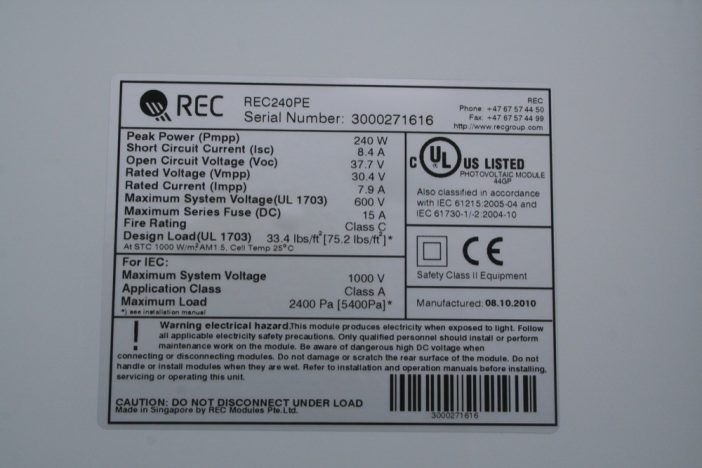
Also to check: the actually exploitable MPPT range, the maximum accepted current, the condition of DC cables and connectors, protections, grounding… For a 20-year-old installation, I would still get a complete electrical inspection done before touching anything. Panels that still produce well do not indicate the condition of what is around them.
Old inverters, the Achilles’ heel of these installations
I know something about this. My installation was not two years old when the inverter failed. The model apparently had a known defect, and it needed to be replaced.
To make matters worse, the original installer had encountered difficulties in the meantime. I eventually managed to get an identical inverter, incurring €250 in processing fees.
This is one of the limitations of this generation of installations: the panels can last several decades, but the power electronics tend to last much less. An installation coming to the end of its contract can therefore accumulate both the end of the purchase rate and an inverter that has reached the end of its life. Before replacing it with an identical one, I would seriously consider a hybrid system with storage.
Self-consumption without selling surplus is also possible
Not everyone wants to look for a buyer for a few hundred kilowatt-hours injected each year, especially at current buyback rates.
Enedis also allows for total self-consumption, meaning an installation that injects nothing into the grid. For an old total sale installation, it requires modifying the connection, requesting termination of the grid access contract for production, and signing a Self-Consumption Without Injection Agreement (CACSI). A regulation system then prevents any injection.
With a properly sized battery and well-controlled devices, it can work. But aiming for 100% self-consumption at all costs is not always cost-effective: a large battery purchased to absorb a few production peaks in summer will probably cost significantly more than the energy recovered. A battery should be sized based on the actual consumption of the home, not on the production of the best day in July.
One can also continue to sell electricity
The last option, which should not be ruled out: change almost nothing.
Enedis allows for total sale after the end of the OA contract, provided you find a buyer and attach the installation to the corresponding balance perimeter. If the installation operates well and you do not want work, this is a valid choice.
However, it will still be necessary to compare the proposed price with what self-consumption would save. Let’s take an installation that produces 2,000 kWh per year. Sold for a few cents each, they do not bring much back. Just a hundred euros in my case. If they largely replace the electricity that the household would have purchased, they are worth significantly more. The calculation is done on a case-by-case basis.
Often, the best solution will blend self-consumption, home automation, and storage
A battery alone does not do everything; it needs to work with the rest of the house.
Let’s take a spring day. The panels start up around 8 a.m. The house consumes 300 W, while the roof provides 1,500. The energy manager sends 300 W to the house and part of the surplus to the battery.
At noon, production is high: we start the hot water tank, and the car plugged into the garage gradually increases its charging power.
In the late afternoon, production falls. The battery takes over for the fridge, lighting, TV, computers—in short, all the consumption spikes. The next morning, it still has enough to provide a few hundred watts until the sun returns.
This is how a 20-year-old installation finds its place in a connected house today.
Do not dismantle your panels at the end of the contract
If I had to remember just one thing, it would be this: the end of the purchase contract does not signal the end of the installation.
Panels in good condition that produce properly remain a perfectly exploitable source of energy. What changes is how to capitalize on what they produce.
For 20 years, we’ve tried to produce as much as possible to sell everything. After that, we try to consume as much of our own production as possible and buy as little as possible from the grid. Two very different lives for the same panels.
In my case, I have five more years to think about it
My installation was commissioned in 2011: the deadline will be around 2031, depending on the exact effective date noted in the contract.
Five years, in residential storage, is an eternity. Given how domestic batteries have evolved in just two or three years, I would be cautious about buying today the equipment that will replace my inverter in 2031!
The Marstek Venus E Pro nonetheless exemplifies the type of solution I have in mind: a high-voltage MPPT that directly accepts my string of eight panels, a modular battery, an integrated inverter, and intelligent energy management. This is the direction I see for the second life of my 2 kWp. By 2031, capacities will have further advanced, prices will have changed, and other manufacturers will surely offer similar architectures.
For those whose contracts end in 2026 or 2027, however, now is the time to start.
What to do concretely if your photovoltaic contract is ending soon?
Start by digging out your EDF OA contract and identifying its exact effective date. The year on the installation invoice is not sufficient: it is the contract expiry date that counts.
Next, look at your latest years of production. They will tell you what the panels are still really producing, hence how much energy you can self-consume.
Also note the references of the panels and the inverter. The electrical characteristics of the modules will assist you if you are considering a hybrid system or a battery with a high-voltage photovoltaic input.
Consider the connection as well. A total sale installation cannot switch to self-consumption by simply moving two wires in the panel.
Contact Enedis early enough to know the procedure corresponding to your choice: total sale with a commercial buyer, self-consumption with surplus injection, self-consumption without injection, or stopping the installation.
Finally, have several scenarios evaluated by an installer or electrician who really understands photovoltaics. Instead of asking him “how much does a battery cost?”, ask him how to get the most out of the 1,500, 2,000, or 3,000 kWh that your panels will still produce each year. The answer will not be the same from one house to another.
A second life for the panels
I have a certain nostalgia for these old installations. They come from a different era of residential solar: panels integrated into the roof, a large central inverter, a separate production meter, and each kilowatt-hour sold. Everything was designed around the purchase price.
Twenty years later, the landscape has completely changed. Affordable LiFePO4 batteries, electric cars capable of consuming several tens of kilowatt-hours, heat pumps, controllable water heaters, smart meters, and home automation systems that track production and consumption almost in real-time are now available.
Losing the historic rate is going to hurt when you have become accustomed to receiving €1,000 or €1,500 per year. But the panels, however, are still on the roof.
Rather than nostalgically looking at the last payment from EDF OA, it is better to prepare for the future: power the house, charge a battery, heat the water, charge the car, and buy less electricity from the grid.
After 20 years of selling their electricity, these panels will finally work for the house.




Please remain courteous: a hello and a thank you cost nothing! We're here to exchange ideas in a constructive way. Trolls will be deleted.