


'/%3E%3Cpath%20fill='%23b2b2b2'%20d='M241%20382q0%2016%2017%2026%2017%2011%2042%2011t42-11q16-11%2017-26V269H241'/%3E%3Cpath%20fill='%239f7e00'%20d='M241%20379q0%2014%208%2023%209%209%2021%209%2014%200%2021-9%209-9%209-23V269h-59'/%3E%3Cpath%20d='M241%20339v-70h59v110q0%2014-9%2023l-6%205v-68h-15v72q-8%200-14-4v-68zm59%2040c0%2022%2015%2032%2029%2032%2021%200%2030-18%2030-32v-40h-59'/%3E%3Cpath%20fill='%239f7e00'%20d='M266%20277v5h2v12h-3v-5h2v-5h-9v5h2v5h-4v9h3v18h-5v10h34v-10h-5v-18h3v-9h-4v-5h2v-5h-9v5h2v5h-3v-12h2v-5zm42%20101q0%2010%206%2017%206%206%2015%207%2010-1%2016-7%206-7%206-17v-29h-43'/%3E%3Ccircle%20fill='%230044ad'%20cx='329.5'%20cy='372'%20r='6'/%3E%3Cellipse%20fill='%230044ad'%20cx='300'%20cy='340'%20rx='16'%20ry='21'/%3E%3C/svg%3E)

'/%3E%3C/g%3E%3Cuse%20href='%23c'%20transform='matrix(-1%200%200%201%20720%200)'/%3E%3C/svg%3E)


'%3E%3Cpath%20stroke='%23000'%20stroke-width='4'%20d='m-35-37-13%2020m5%203%2013-20m5%203-13%2020m63%2042%206-9m1-2%206-9m5%203-6%209m-1%202-6%209m5%203%206-9m1-2%206-9m-96%200%2013%2020m5-3-6-9m-1-2-6-9m5-3%2013%2020m63-42-6-9m-1-2-6-9m5-3%2013%2020m5-3-6-9m-1-2-6-9'/%3E%3Ccircle%20r='24'%20fill='%23cd2e3a'/%3E%3Cpath%20fill='%230047a0'%20d='M0%200a12%2012%200%201%201%2020%2013%2024%2024%200%201%201-40-26A12%2012%200%201%200%200%200'/%3E%3C/g%3E%3C/svg%3E)


Résumer cet article :
For years, the philosophy of robotic lawn mowers could be summed up in one sentence: maintain what is already clean. Grass too tall, steep slope, complicated terrain? We would pull out the traditional mower.
The Lymow One Plus starts from a different idea: a robot capable of tackling difficult terrains, not just maintaining an already pristine lawn. Large areas, sloped zones, tall meadows – this is exactly what the Chinese manufacturer aims for.
Numbers speak for themselves: 40 cm cutting width, two 20 cm steel blades, tracks, a 528 Wh LiFePO4 battery, climbing height of 7 cm, up to 60,000 m² manageable. We’re far from a robot for 300 m² of lawn behind the house.
After several weeks of use and a lot of field feedback, here’s what I think – the good and the less good.
In short
Two 20 cm mower blades, tracks, RTK + VSLAM + ultrasonic navigation. It maps up to 60,000 m² and can cover 7,000 m² per day. It’s the kind of robot that takes an interest in places where others give up: slopes up to 45°, tall grass, rough terrain. If you have a small flat garden, look elsewhere. If you have a large difficult property, read on.
Unboxing the Lymow One Plus: an extraordinary robot right out of the box
The package arrives on a pallet. More than 50 kg.
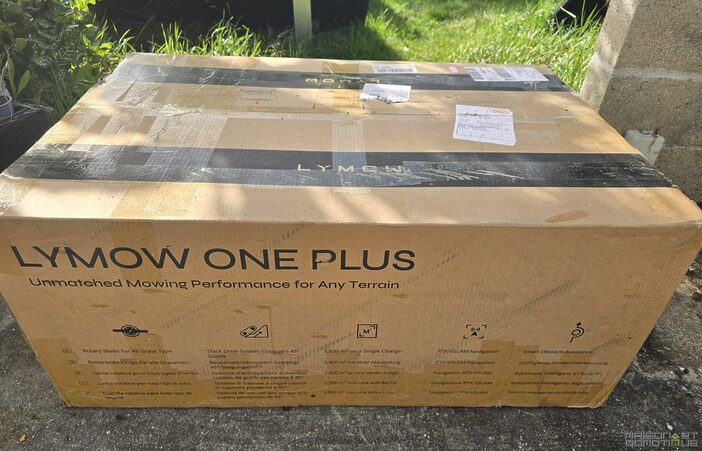
It’s very heavy. But the manufacturer was smart, and planned an opening from underneath:
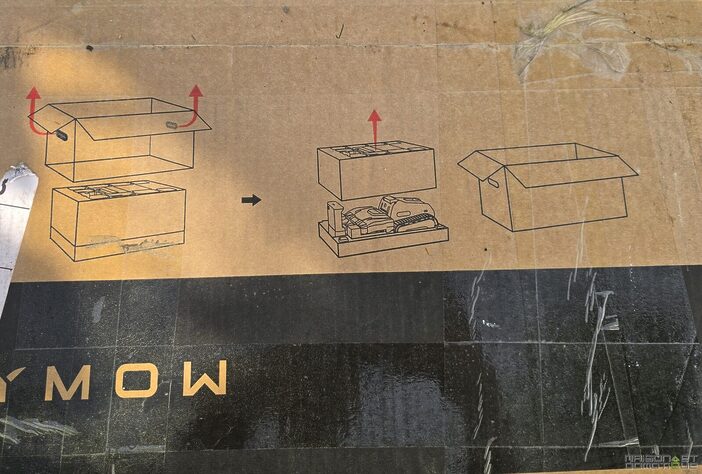
So we won’t have to lift the robot to get it out of the box, that’s good news :p
Upon opening, the first thing that strikes is the weight of the robot itself: about 35 kg, two to three times what many high-end models weigh.

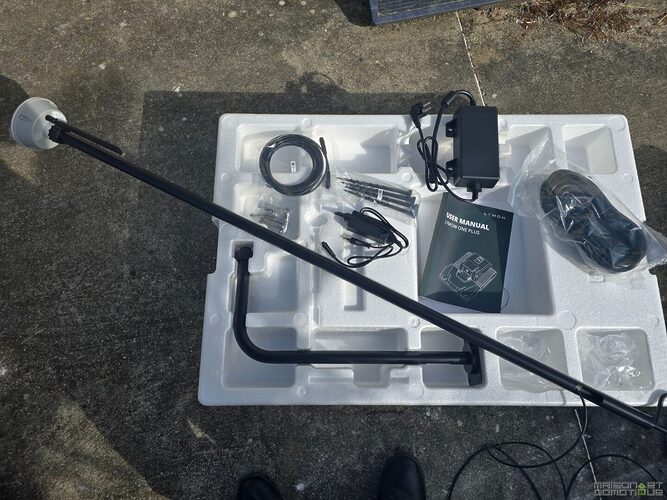
The box contains everything needed: robot, charging station, RTK antenna, extensions, wall mount to relocate the antenna, ground mount, screws, fast charger, quick start guide, and manual in French.

The manufacturing is serious – aluminium chassis, thick plastics, solid assemblies. You don’t often see this level of finish in consumer products.
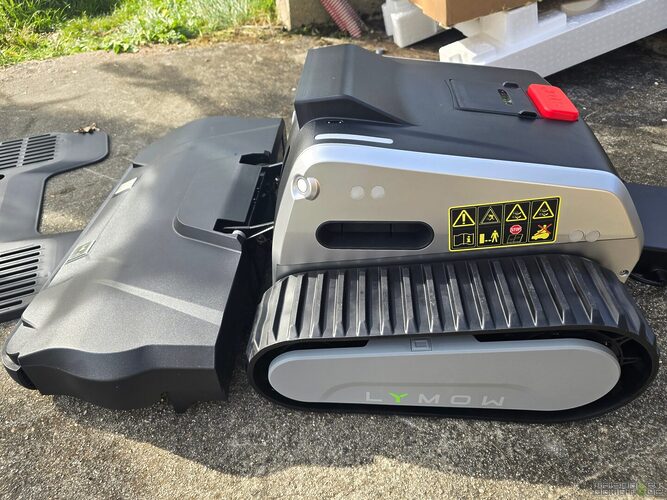
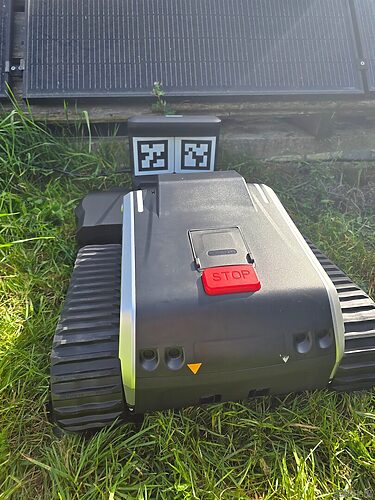
But it’s especially the rear tracks that stand out. Where nearly all robots use driving wheels, the Lymow resembles a small construction vehicle. Think of a tank. But it’s not a question of appearance.
What the tracks change
The idea behind these tracks: distribute the robot’s weight over a larger surface than standard wheels, to reduce slipping and improve mobility on difficult terrains.

The manufacturer claims up to 45° of slope, or 100% incline. Few gardens reach that. But this margin translates into stable behavior in slopes and rugged terrains, where a wheeled robot would hesitate or get stuck.
In crossing: curbs, exposed roots, small sidewalks, gravel areas, ruts, obstacles up to 7 cm. When a wheeled robot finds itself with one wheel in the void and gets stuck, the tracks maintain contact. In large rural areas, orchards or gardens with elevation changes, this is a difference that matters.
The mechanics of the Lymow One Plus
Most robotic lawn mowers use several small pivoting blades, like razors. The Lymow One Plus features two 20 cm blades, giving a total width of 40 cm, which is about double that of many residential robots.

SK5 steel, common in professional cutting tools. Two independent brushless motors, up to 6,000 rpm. In practice, the cutting is more decisive, the robot struggles less in dense grass, and thick stems pass through better.
Practical detail: the cutting deck lifts from the app or directly on the robot to access the blades, without needing to flip the 35 kg machine. It looks like someone thought about maintenance!
The battery
The 528 Wh LiFePO4 battery weighs about 6 kg and is removable via slides, through a hatch located at the back of the robot.
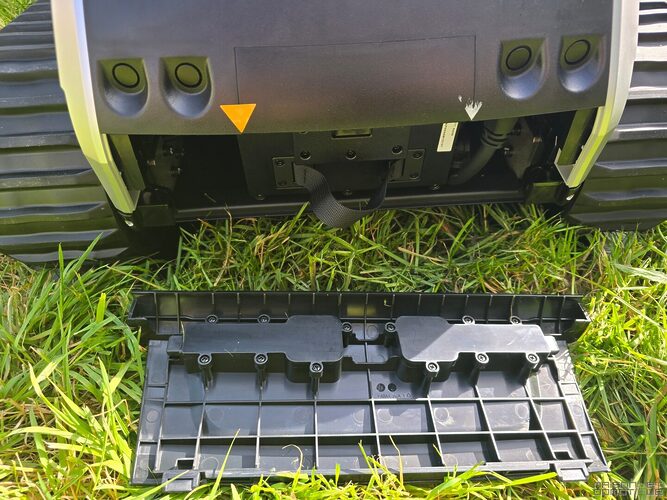
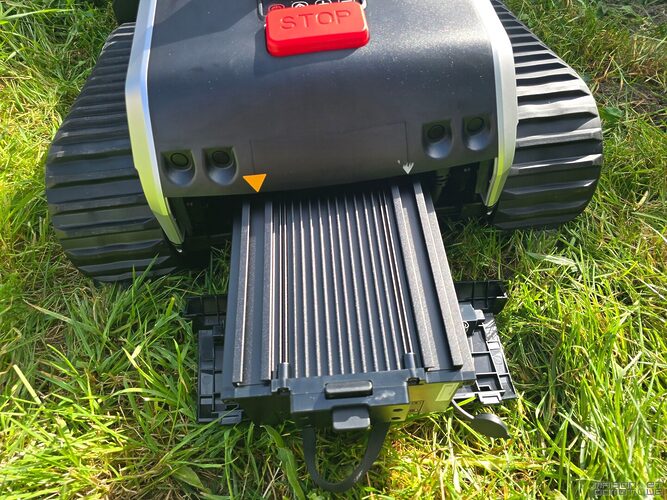
The LiFePO4 technology is known for its durability – 2,000 charge cycles claimed. And since it’s removable, replacing it won’t be a problem in five years.
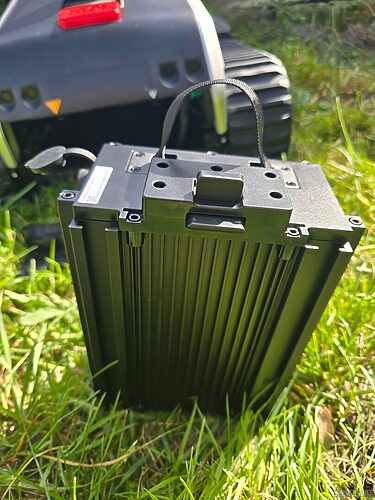
Announced autonomy: 2,300 m² per charge. With the 10 A fast charger, it goes from 10 to 90% in about 90 minutes. By chaining charge cycles, the manufacturer claims up to 7,000 m² mowed per day!
Navigation
Here, no peripheral wire, of course (that’s outdated!). The navigation combines RTK for centimeter-level geolocation, VSLAM cameras and ultrasonic sensors for obstacle detection.

The RTK antenna can be placed near the charging station or relocated on a wall via the provided bracket.
The app manages up to 80 distinct zones and a total area of 60,000 m².
Installation of the Lymow One Plus
Despite its size, installing the Lymow One Plus doesn’t take hours. The charging station must be placed on a stable, flat surface.
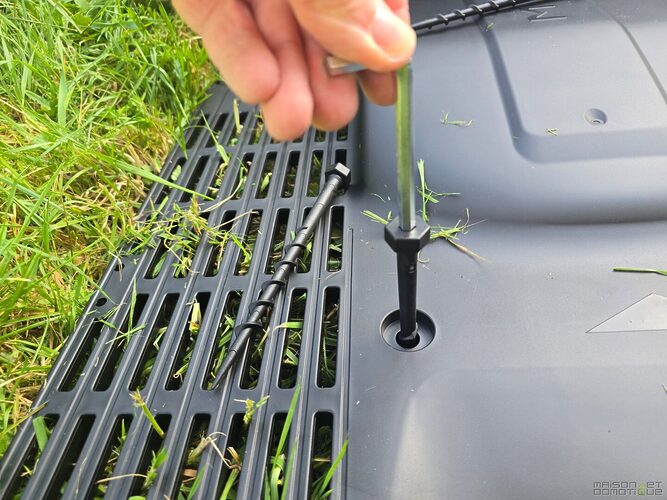
The robot uses its QR codes for automatic return, and a poorly positioned base can create hesitations during docking.

The RTK antenna requires a bit more attention. Two options: ground mounting or high installation on a wall via the extended arm. The second is generally better: the clearer the antenna’s view of the sky, the better the satellite reception. On large wooded terrains, this makes a real difference.

Next: connect the battery (not connected upon delivery), pair via Bluetooth in the app, connect to Wi-Fi, scan the QR code of the RTK antenna.


About ten minutes in total. An update is proposed upon the first connection – do it right away, as updates generally bring welcome improvements.
Mapping
The map is created by manually driving the robot from the app, like a remote-controlled car. Despite its 35 kg, the Lymow One Plus is maneuverable, and the virtual joysticks allow for precise contour tracing even on complex plots.

Once the first zone is recorded, you can add whatever you want: no-go zones, flower beds, trees, drains, ponds, connecting corridors, secondary zones. 80 zones total.

The connecting corridors deserve special mention. They allow the robot to move automatically between zones and reach its station. On large terrains with narrow passages or multiple separated plots, we couldn’t do without them.

The application
The interface is not the most modern on the market. But it is comprehensive, and that’s what matters. Per zone, you can adjust speed, cutting height, blade speed, spacing between passes, mowing orientation, cross patterns, number of peripheral passes, behavior against obstacles, rain management, and schedules.
Speed from 0.3 to 1 m/s. Cutting height from 30 to 100 mm: 40 mm for an ornamental lawn, higher for a meadow or an orchard.
It’s very, very comprehensive. Of course, it is possible to program the days and times for mowing, with specific zones and parameters if desired.

The onboard camera is accessible live from the app – useful for checking an alert or inspecting an area from a distance. A feature I always appreciate on this type of device.
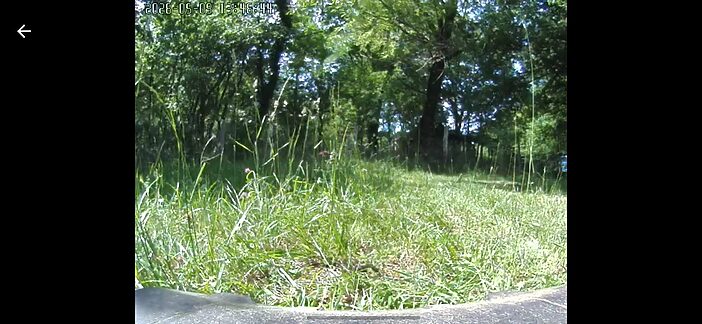
The anti-theft system works by geofencing: the robot locks itself if it leaves its perimeter. Simple and effective.
Cutting quality
Most robotic lawn mowers operate on the same principle: mow often, cutting only a few millimeters each pass. The Lymow does it differently. With its two blades and the Cyclone Airflow system (an airflow created by the blades that stands the blades upright before cutting), it can handle significantly larger volumes of grass.
On a normally maintained lawn, the cut holds up against the best RTK robots on the market. Regular stripes, few missed spots, even on slightly laydown or damp lawns. The 40 cm width also helps.
As with all robotic lawn mowers, there is no grass collection. The mulching technique is indeed used: the tiny cut grass pieces serve as fertilizer for the lawn.
Tall grass
This is where it gets interesting. I tested the robot in conditions that are usually not recommended: areas not mowed for three weeks, grass well beyond usual heights, meadows with dock, couch grass, and hay residues.
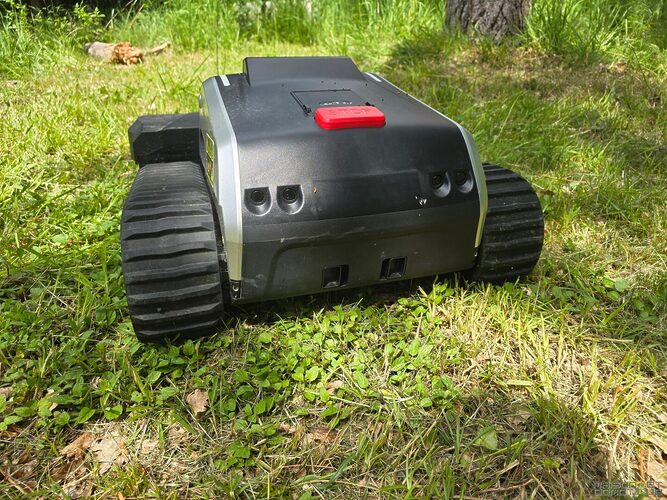
The Lymow One Plus manages well. But don’t expect it to turn a wasteland into a lawn in one pass. No one can do that. In these conditions, a first pass significantly reduces the height, the second improves the result, and the third gives a neat finish. The method that works: start at 100 mm and gradually go down. This avoids clogs. A standard robot wouldn’t even try.
When the AI sees obstacles where there are none
In heavily overgrown areas, the vision system may interpret large clumps of grass as obstacles. The robot slows down or unnecessarily detours.
The app allows switching to contact detection mode only. In very tall grass, the robot progresses better in this configuration. But it becomes less attentive to small animals and objects left on the ground. For regular maintenance, the intelligent mode remains the best choice.
Crossing and slopes
The tracks make a clear difference. Curbs, beams, stones, gravel, holes, bumps, obstacles close to 7 cm. In the vast majority of domestic situations, the Lymow does not stop. Even on wet or loose ground, it retains its mobility. The omnidirectional wheels at the front facilitate direction changes.

On slopes, the claimed 45° is not just marketing. Few gardens reach these angles, but this margin gives a serene behavior on all common banks. Where other robots slip or get stuck, the Lymow continues its passage.
Noise
Let’s be direct: between 73 and 78 dB depending on the settings. That’s much more than a traditional robotic lawn mower. Two high-speed steel blades obviously make more noise than small pivoting blades. It’s not pleasant up close, but it’s less noisy than a gas mower, and a few meters away, it becomes acceptable. On a large property, this is generally not an issue.
Maintenance
The motorized cutting deck allows access to the blades without flipping the machine.
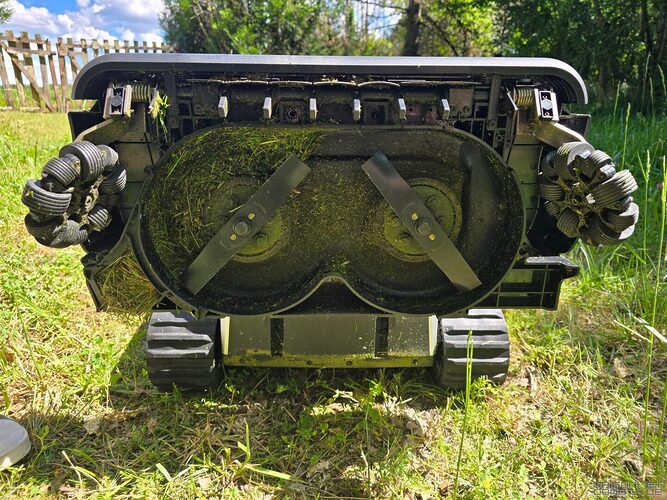
The tracks have removable covers.
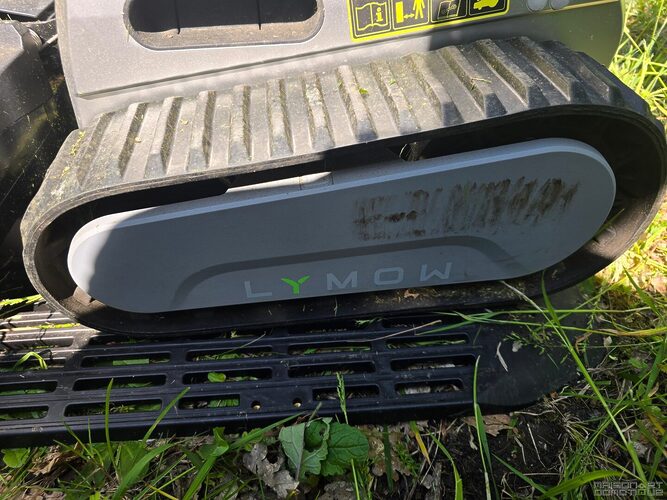
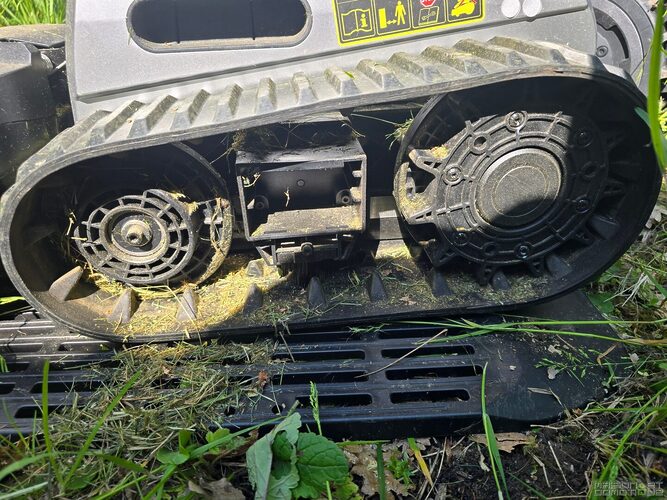
Self-cleaning brushes limit debris buildup.

After intensive use (especially in tall grass) regular cleaning remains useful. Fortunately, the manufacturer has thought of everything to facilitate this task as much as possible.
Always remove the battery before any maintenance!
Should you buy it?
On a flat 300 or 500 m² garden, this robot makes no sense. Its size, its price that flirts with €3000, and its power are oversized for that.
On a large property, an orchard, a well-maintained meadow, or a garden with serious constraints, it’s a different story. It does something that few robotic lawn mowers can do: handle difficult situations. Not just maintaining what is already clean, but recovering what is no longer so.
I’ve actually installed it on my recreational land deep in the woods. Quite a bit of grass over nearly an acre, with exposed tree roots, branches that occasionally fall, holes. It’s simple: it’s the only model capable of managing that without getting stuck somewhere. But what a joy to not have to mow when I go there occasionally for the weekend :)
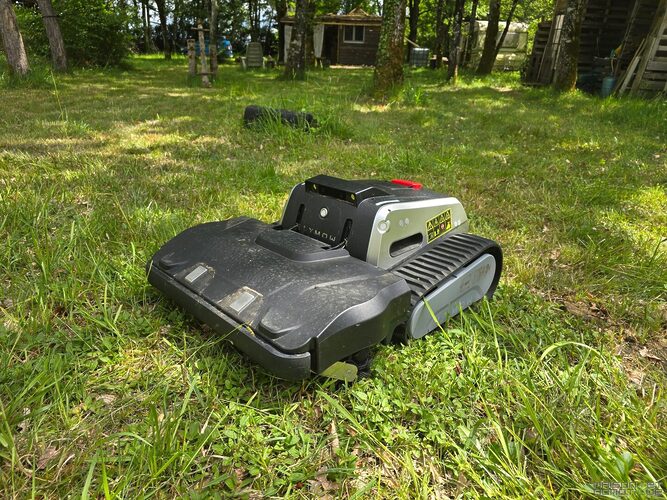
Just one detail to take into account. Which will only interest those who have land like mine, without electrical connection: the power supply requires power (depending on the chosen model, 5 or 10A). If you’re powered only by solar panels, this is an important detail ;-)
On the downside, it has them. The noise, first. It’s the most visible in daily life. Some settings may be necessary before achieving the desired behavior. And the AI can be overly cautious in very tall grass. But these criticisms remain minor compared to what the robot brings in situations where others give up.
If you need an autonomous lawn tractor to maintain your large, somewhat difficult garden, this is probably it!
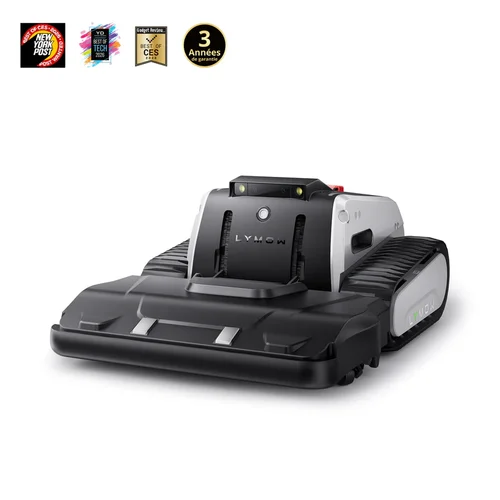
Lymow One Plus
FAQ: everything you need to know about the Lymow One Plus
Does the Lymow One Plus work without peripheral wiring?
Yes. No cable. Navigation relies on RTK, VSLAM cameras, and ultrasonic sensors.
What area can the Lymow One Plus cover?
Up to 2,300 m² per charge, up to 7,000 m² per day by chaining recharge cycles. It remembers up to 60,000 m² of maps.
What is the cutting width of the Lymow One Plus?
40 cm, with two blades of 20 cm each. Significantly wider than most consumer robots.
Can it mow tall grass?
Yes, and it’s one of its strong points. The blades rotate up to 6,000 rpm and the Cyclone Airflow system manages large volumes of grass. For the first mows on very tall grass, it’s better to gradually reduce the cutting height.
Can the Lymow One Plus replace a traditional mower?
On large properties, orchards, and complex gardens, yes, for the vast majority of the work.
What is the maximum slope it can climb?
45° (100% incline) according to the manufacturer, thanks to the tracks.
Do the tracks provide a real advantage?
Yes. Better grip, better stability, crossing up to about 7 cm. In terrains where wheeled robots struggle, the Lymow passes.
Is the robot noisy?
More than a traditional lawn mower: 73 to 78 dB. Less noisy than a gas mower.
What battery does the Lymow One Plus use?
LiFePO4 of 528 Wh, removable, announced for 2,000 charge cycles.
How long does it take to recharge the battery?
From 10 to 90% in about 90 minutes with the 10 A fast charger.
Can you manage multiple mowing zones?
Up to 80 distinct zones, each with its own settings.
Does it work without a Wi-Fi connection?
Yes. Once configured, it operates on 4G via the RTK station. Wi-Fi is used for initial setup and updates.
Can you monitor the garden remotely?
Yes, via the onboard camera in the app.
Is the Lymow One Plus suitable for a 300 m² garden?
No. It is oversized for a small area. It makes sense on properties of several thousand square meters or with specific constraints.
Who are its main competitors?
The Mammotion Luba 2, the Segway Navimow X3, and some professional Husqvarna models. But the Lymow stands out with its tracks and lawn mower blades – making it more akin to an autonomous riding mower than a maintenance robot.





Please remain courteous: a hello and a thank you cost nothing! We're here to exchange ideas in a constructive way. Trolls will be deleted.