


'/%3E%3Cpath%20fill='%23b2b2b2'%20d='M241%20382q0%2016%2017%2026%2017%2011%2042%2011t42-11q16-11%2017-26V269H241'/%3E%3Cpath%20fill='%239f7e00'%20d='M241%20379q0%2014%208%2023%209%209%2021%209%2014%200%2021-9%209-9%209-23V269h-59'/%3E%3Cpath%20d='M241%20339v-70h59v110q0%2014-9%2023l-6%205v-68h-15v72q-8%200-14-4v-68zm59%2040c0%2022%2015%2032%2029%2032%2021%200%2030-18%2030-32v-40h-59'/%3E%3Cpath%20fill='%239f7e00'%20d='M266%20277v5h2v12h-3v-5h2v-5h-9v5h2v5h-4v9h3v18h-5v10h34v-10h-5v-18h3v-9h-4v-5h2v-5h-9v5h2v5h-3v-12h2v-5zm42%20101q0%2010%206%2017%206%206%2015%207%2010-1%2016-7%206-7%206-17v-29h-43'/%3E%3Ccircle%20fill='%230044ad'%20cx='329.5'%20cy='372'%20r='6'/%3E%3Cellipse%20fill='%230044ad'%20cx='300'%20cy='340'%20rx='16'%20ry='21'/%3E%3C/svg%3E)

'/%3E%3C/g%3E%3Cuse%20href='%23c'%20transform='matrix(-1%200%200%201%20720%200)'/%3E%3C/svg%3E)


'%3E%3Cpath%20stroke='%23000'%20stroke-width='4'%20d='m-35-37-13%2020m5%203%2013-20m5%203-13%2020m63%2042%206-9m1-2%206-9m5%203-6%209m-1%202-6%209m5%203%206-9m1-2%206-9m-96%200%2013%2020m5-3-6-9m-1-2-6-9m5-3%2013%2020m63-42-6-9m-1-2-6-9m5-3%2013%2020m5-3-6-9m-1-2-6-9'/%3E%3Ccircle%20r='24'%20fill='%23cd2e3a'/%3E%3Cpath%20fill='%230047a0'%20d='M0%200a12%2012%200%201%201%2020%2013%2024%2024%200%201%201-40-26A12%2012%200%201%200%200%200'/%3E%3C/g%3E%3C/svg%3E)


Résumer cet article :
I am currently in Berlin for IFA 2026, and I was able to attend the press conference of BLUETTI. I was quite curious to see what the brand would announce, as a few months earlier, during a presentation in Paris, it had already unveiled a significant part of its new strategy around the Balco range.
Since then, I have had the opportunity to test the BLUETTI Balco 260 at home, with a BC260 battery. I also dedicated several articles to the Balco and the Transfer Hub. So, it is safe to say that I am starting to know the subject well. And yet, this conference in Berlin allowed me to better understand where BLUETTI wants to go.

The message is quite simple: the brand no longer wants to just sell batteries. It wants to manage energy as a whole. BLUETTI explains that it is transitioning from a manufacturer of storage equipment to a company offering complete energy solutions, with hardware, of course, but also software, intelligent management, and services. Put this way, it sounds a bit like a marketing formula. But when you put together the products presented at IFA, the logic becomes much clearer.
A battery at home, then in the van on weekends
During its presentation, BLUETTI emphasized one idea: a battery should not be confined to a single use. It can be used to store solar surplus from home during the week, then be unplugged to go camping or power equipment outside on the weekend.
This is an approach I find quite interesting, as many power stations end up being unused for a good part of their time. BLUETTI specifically wants to make them work more.
The brand is now looking to cover the different energy needs of a user: home, electrical backup, mobility, leisure, but also professional construction sites. This was one of the concluding messages of the conference: identify the energy problem before trying to sell a product.
The Balco range is probably the best example of this evolution.
The Balco 260 had already laid the groundwork
I discovered the Balco 260 during its presentation in Paris and I have since tested it on my photovoltaic installation.
For the record, this battery has a capacity of 2.56 kWh and can receive several BC260 modules to reach up to 15.36 kWh. In my case, I use a Balco 260 paired with a BC260, giving me 5.12 kWh.
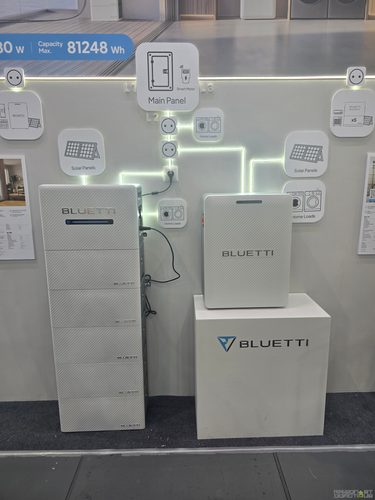
The main advantage is that it can recover the solar surplus from an existing installation. With a compatible meter, such as a Shelly, it detects when the house starts injecting electricity into the grid and uses that energy to charge the battery.
At night, it does the opposite. I detailed all this in my test.
In Berlin, BLUETTI presented the next step.
Balco 500: slowly moving away from simple “balcony solar”
The major residential novelty at this IFA is the BLUETTI Balco 500.
And the name “Balco” can be somewhat misleading, as we are starting to talk about a system capable of going much further than two panels hanging on a balcony.
The integrated battery boasts 5,024 Wh of LFP capacity. It accepts up to 4,600 W of solar panels and delivers up to 3,680 W output.
With such power, we are no longer just there to offset the 200 or 300 W of the electrical load of a home. The Balco 500 can power much more demanding devices: washers, microwaves, refrigerators, etc.
Its technical sheet also mentions a high-voltage photovoltaic input ranging between 70 and 470 V.

Another interesting point: BLUETTI plans to connect three Balco 500 units to the electrical panel to achieve about 11 kW of cumulative power. However, the final specifications for this three-unit mode still need to be clarified.
At this point, we are getting quite close to traditional residential storage.
And BLUETTI is also thinking about three-phase
This is a rather technical detail, but important in Europe.
On a three-phase installation, solar can produce on one phase while consumption is on another. Depending on how the system is designed, one can find themselves injecting electricity on one side while buying from another.
BLUETTI wants to correct this with its S Meter. The meter tracks consumption across the different phases, and the system adjusts its operation to better match the actual consumption of the home.
What particularly interests me is that BLUETTI does not seem to want to confine the user to its own equipment. The Balco 500 is announced to be compatible with the Shelly Pro 3EM, for example, as well as with Everhome.
Having already used a Shelly with my Balco 260, I much prefer this approach to one that forces you to add yet another meter in the electrical panel.
EnergyFlex: recycling your power station into a home battery
This is also where the Balco Transfer comes in, which I had already presented during its announcement.
The principle is clever. You take an existing BLUETTI power station, add the Balco Transfer, and it can then inject up to 800 W into the home network.
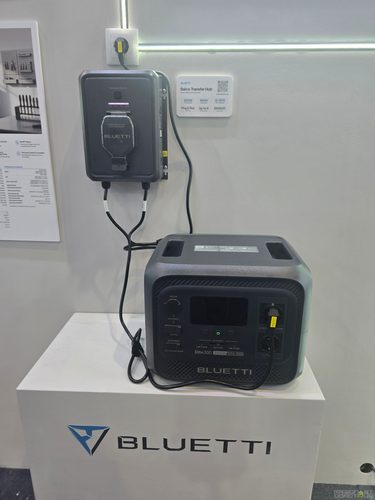
This creates something very simple:
Solar panels → power station → Balco Transfer → wall socket → home
And if you need the battery elsewhere, you unplug it. This is what BLUETTI now calls EnergyFlex.
I find this approach more interesting than multiplying specialized batteries. A large power station is expensive; it should also serve to reduce the electricity bill when it stays at home.
BLUETTI goes even further with Space, which can make up to six units work together on a distributed energy network.
BlueBot: talking to your energy system
And then there’s obviously AI.
I’ll be honest: when a brand announces a new “AI” function in 2026, I generally wait to see what’s actually behind it before getting excited. But here, the use could make sense.

BLUETTI presented BlueBot, an energy assistant with which you should be able to converse in natural language. The idea is to avoid digging into the app settings to modify schedules, charge thresholds, or different modes.
You could simply tell it what you want. BlueBot takes into account the household’s consumption, solar production, electricity rates, battery states, and even weather forecasts. BLUETTI speaks of a “One Home, One Model” logic: the system gradually learns the habits of each home.
During the demonstration in Berlin, a weather alert, for example, came through on the system. BlueBot then decided to charge the batteries more to prepare the house for a potential outage. The app also explained why this strategy had been chosen. And that, I find much more interesting than the simple word “AI” slapped onto an app.
During my test of the Balco 260, I found that the smart mode sometimes lacked explanations. The system made its choices, but it wasn’t always clear why. If BlueBot can actually make these decisions comprehensible, it will be a real advancement.
Now we need to see how this works in a house over several weeks, and not just during a well-prepared demonstration at the IFA stand ;-)
Pioneer 5000: BLUETTI arrives on construction sites
The conference then took a rather different direction with the Pioneer 5000 E-Generator.

This time, BLUETTI is clearly targeting professionals. Construction, maintenance, telecommunications, event management, agriculture, and emergency services: the Pioneer 5000 aims to replace part of the uses typically covered by a generator.
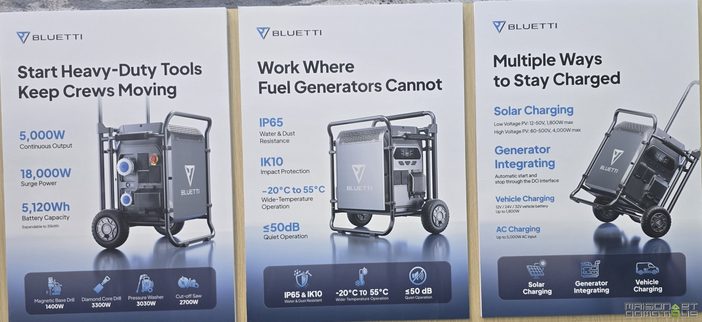
And the numbers are quite substantial. It delivers 5,000 W continuously, but can also reach 18,000 W peak to handle the startup of certain motors, pumps, or compressors. This is precisely a classic issue with electric stations: they can sometimes provide the nominal power needed for a machine but fail during startup.
The Pioneer has an LFP battery of 5.12 kWh, expandable to about 35 kWh. It can also accept up to 4,000 W of photovoltaic input on its high-voltage connection.
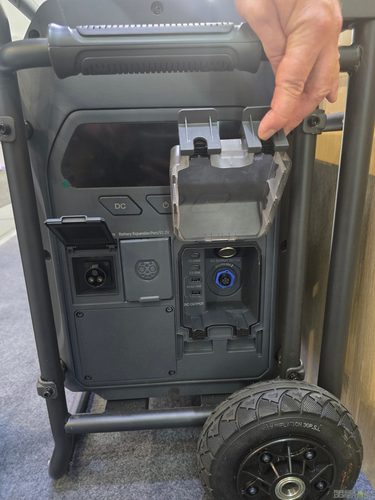
BLUETTI also announces a IP65 protection rating, shock resistance IK10, and a noise level of no more than 50 dB.


In an indoor construction site or in an area where noise is regulated, this can make a big difference.
It can even work with a generator
And BLUETTI is not necessarily looking to eliminate thermal power overnight. The Pioneer 5000 can also be used with a conventional generator. The idea is to run the generator for a short time to quickly recharge the battery, then operate for several hours in silence.
During the conference, BLUETTI gave the example of a generator that would normally run for eight hours and could now run for only about an hour to recharge the Pioneer. In the field, this type of hybrid operation seems much more credible than a narrative claiming that a battery can immediately replace all generators.
A GPS to prevent the battery from “changing jobs” ;-)
BLUETTI also considered another real problem: equipment theft. Some versions of the Pioneer 5000 therefore integrate a 4G connection and a GPS.
A company can track the position of the device, consult its energy statistics, turn it on or off remotely, monitor faults, and apply OTA updates.
For a rental company or a business with multiple machines spread across different sites, this is far from trivial. At this level, we are no longer really just looking at a large camping battery mounted on wheels.
Elite Mini: power stations go compact
BLUETTI hasn’t forgotten traditional portable batteries either. The brand presented three models:
Elite 30 Mini, Elite 100 Mini, and Elite 200 Mini.
Here, there is no revolution in principle. BLUETTI has mainly worked on energy density. The new models are announced to be up to 42% more compact and 25% lighter than previous generations.

During the conference, BLUETTI explained that it had significantly reduced the volume while maintaining capacities close to those of current models. For those who regularly transport their battery in a camper or in a car trunk, a few kilos and several centimeters saved make a big difference.
The Balco ultimately becomes a gateway to the entire home
When BLUETTI presented the Balco range in Paris, it was clear that the brand was preparing something broader. After this conference in Berlin, the strategy is much easier to read.
You can start quite simply with a Balco 260.
Then add a battery.
Then several.
Reuse an existing power station thanks to the Transfer.
Install a Balco 500 later if needs increase.
And gradually let the software intelligence manage all this little world.
This is where BLUETTI seems to want to go.
The hardware ultimately becomes the easiest part
This is perhaps what I take away most from this conference.
Manufacturing a good battery is still obviously essential, but many manufacturers now know how to offer LiFePO4, powerful MPPTs, several kilowatts of output, and a decent mobile app.
The next big challenge will be elsewhere: knowing what to do with energy at the right time.
Should we charge the battery now because electricity is cheap?
Discharge it tonight because the sun is expected tomorrow?
Keep 40% in reserve because a storm is approaching?
Power a water heater because the panels are producing more than expected?
This is exactly the kind of decisions an intelligent energy system will need to make.
During the round table that followed the conference, BLUETTI talked a lot about energy systems capable of becoming progressively predictive and autonomous.
For my part, this is the part I will follow with the most attention.
The Balco 260 that I am currently using already knows how to store my photovoltaic surplus well and return it when the house needs it. The hardware works.
Now, I’m mostly eager to see how far BLUETTI can go in the intelligent management of this energy. Because between a battery that stores kWh and a home that knows what to do with it, there is still a significant margin for improvement.
It should also be noted that for the start of the school year, BLUETTI is offering some very interesting promotions, applicable directly on its official store:
- MEDBLUETTI : 5% discount
- BALMED : €510 off on the Balco 260 and its packs valid until 30/09



Please remain courteous: a hello and a thank you cost nothing! We're here to exchange ideas in a constructive way. Trolls will be deleted.