


Résumer cet article :
I discovered the BLUETTI Balco 260 last May in a rather unusual setting: on the first floor of the Eiffel Tower. BLUETTI unveiled its new strategy for the home there, with a Balco range designed to gradually transition from small plug & play solar storage to true energy management for the home. The presentation was enticing. But you know the saying: between a well-oiled demonstration and an installation at home, there can be a world of difference.
I was therefore eagerly waiting to get my hands on the Balco 260. BLUETTI finally sent me the main unit, accompanied by an extension battery BC260. My setup thus has 5.12 kWh of storage, enough to start seriously shifting electrical consumption between day and evening.
This Balco 260 has an asset that I had been looking forward to: unlike some systems that require connecting photovoltaic panels directly to their battery, this one can work in two ways, with panels connected to its four MPPTs, or in AC coupling with an already existing solar installation. This versatility caught my attention during the launch. It was time to see how it performs in practice.

A solar battery, but not just that
Let’s first put the Balco 260 into context. BLUETTI is mainly known to the general public for its portable power stations. I have actually tested several over the years. With the Balco range, the manufacturer is changing dimension: it is now tackling residential energy storage.
The principle remains easy to understand. A photovoltaic installation typically produces a lot of energy in the middle of the day, precisely when a good part of the family is absent. The refrigerator, the Internet box, the home automation, and some permanent devices consume a few hundred watts, but rarely enough to absorb all the solar production. The surplus goes back to the grid.
A battery like the Balco 260 captures these precious kWh and returns them a few hours later, when the panels are no longer producing but the home is waking up: preparing meals, watching television, lighting, computing, and household appliances.
Nothing new in the principle. What changes with BLUETTI is the way of implementing it.
The BLUETTI Balco 260 combines in one device the LiFePO4 battery, the inverter, four MPPT controllers, the management electronics, and all the connected components. Its native capacity reaches 2560 Wh, and it accepts up to 2400 W of photovoltaic panels, distributed over four independent 600 W MPPTs.
And above all, it is not at all necessary to connect solar panels directly to it. This changes a lot of things, as we will see.
Unboxing the BLUETTI Balco 260: it can stay in the living room!
The first surprise comes from the design. BLUETTI could have perfectly served us a big grey box good for the bottom of the garage. The manufacturer has clearly done the opposite.
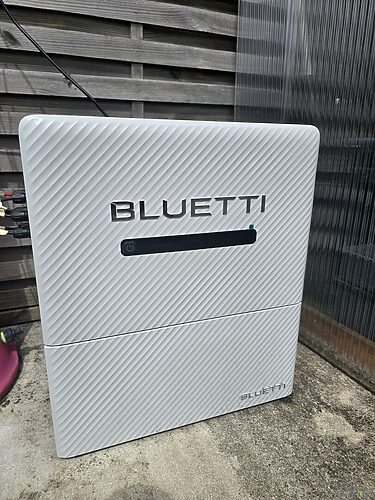
The BLUETTI Balco 260 features a well-designed white front, grey sides, and an elegant grooved finish. An integrated light strip on the front quickly provides information about its operating status and charge level.

It’s understated and quite successful, to the point that it’s not out of place to install it in a visible room of the house. A laundry room or garage will obviously suit it very well, but it would not look out of place in an office or a corner of the living room either.

On the sides, two handles make it easier to handle. However, don’t imagine taking it on a hike: it’s a domestic battery, not a XXL power bank.

At the back, the impressive heat sink immediately reminds us that a power electronics is hidden under this nice casing.

One side hosts the four pairs of MC4 connectors for the four MPPTs. Each channel accepts up to 600 W, or 2400 W of photovoltaics in total.

This architecture with four independent MPPTs is an excellent choice. Let’s take a concrete example: two panels oriented due south, a third to the east, the last to the west. Each group works independently. A shadow on one panel does not cause a drop in the entire chain, as could happen with a poorly thought-out series installation. This is particularly useful on a balcony, terrace, façade, or somewhat atypical solar installation.
On the other side, there is also a power outlet that can serve as emergency power. The BLUETTI Balco 260 can thus continue to directly power certain equipment when the grid disappears.

BLUETTI also announces an IP65 protection rating. The Balco can therefore be installed outside in a suitable location, without panicking at the first shower. An internal heating system is even provided so that the battery continues to work when temperatures drop.
I still appreciate, when possible, to install this kind of equipment sheltered. A battery costing several hundred euros will always be better in a garage or outbuilding than under rain and full sun for fifteen years.
A LiFePO4 battery built to last
Inside, BLUETTI uses a LiFePO4 chemistry, which has become essential in modern solar batteries. The manufacturer claims over 6000 cycles. Even with a daily cycle, we are talking about over 15 years of use.
This is important because the profitability of a solar battery is not judged over two or three years. It must accumulate cycles for long enough to amortize its initial cost and then continue to generate savings.
The conversion electronics also use silicon carbide (SiC) components. BLUETTI claims an efficiency of up to 96.11%. This is not just a flattering number on a technical sheet: each conversion entails losses, and the lower they are, the more significant a portion of the energy produced by the panels effectively ends up in your devices. Independent tests have also measured around 95% in certain configurations in direct photovoltaic load, placing the BLUETTI Balco 260 at a very good level.
Another positive point: the system operates quietly. Cooling relies largely on the large rear heat sink, an appreciated quality for a device that may end up in a living room.
The BC260 easily transforms 2.56 kWh into 5.12 kWh
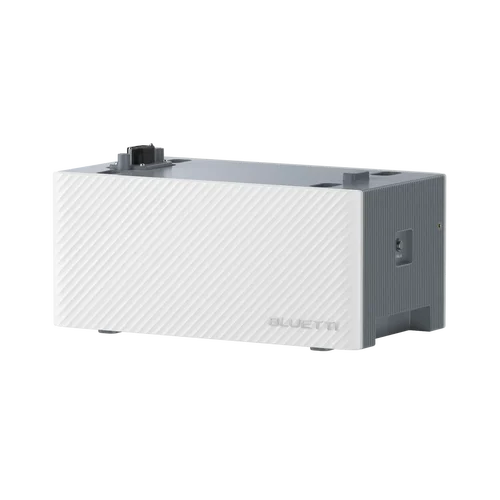
I received with the Balco 260 an BC260 extension battery, probably the setup that will interest most users.

The Balco alone has 2.56 kWh. By adding a BC260 of the same capacity, my total becomes 2.56 + 2.56 = 5.12 kWh.

And the extension is particularly neat: no need to pull a new cable across the room or to tinker with an electric mikado behind the battery. The BC260 simply slips under the main unit. The modules stack up in a storage column.

Up to five BC260 extensions can be added to a main unit, bringing the maximum capacity to 15.36 kWh.
This modularity is, in my opinion, much more relevant than buying a huge battery right away. Imagine that your daily photovoltaic surplus only reaches 2 or 3 kWh: installing 10 kWh of storage doesn’t necessarily make sense, as a large portion of that capacity would remain unused and prolong the time needed to amortize the installation.
You can therefore start with 2.56 kWh. If the battery regularly reaches 100% while there is still solar surplus, you add a BC260. Then possibly another one. It’s simple, scalable, and economically more rational. And it’s also easier to handle than a big 80kg battery…
With my 5.12 kWh, we are already entering a comfortable capacity: enough to absorb the surplus from several panels during the day, but also to cover a good part of a home’s electrical demand during the evening and night.
Two entirely different ways to use the BLUETTI Balco 260
This is probably the most interesting part.
The BLUETTI Balco 260 can be installed in two very different ways.
The first involves connecting the photovoltaic panels directly to the MC4 inputs. In this configuration, there is no need to use external micro-inverters: the panels feed directly into the Balco’s MPPTs, which then manage the battery charge and conversion to the domestic grid.
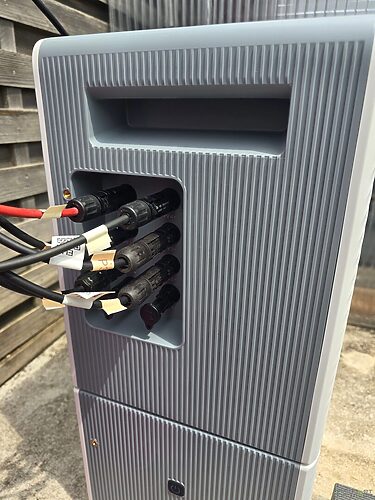
This is the ideal solution for someone starting from scratch. You can, for example, buy two or four panels, install them in the garden, on a terrace or balcony, connect them to the Balco, and thus start your photovoltaic installation.
But there is a second possibility, even more interesting for those who already own solar panels: AC coupling.
In this case, no panel is directly connected to the Balco. Your existing panels continue to operate exactly as before, with their micro-inverters or inverter. The Balco is simply connected to the home’s electrical grid.

With a compatible energy meter, it can then determine whether your home is importing or exporting electricity. For example, if it detects that your panels are producing 1800 W while the house is consuming only 500, it understands that about 1300 W are going to the grid and can use this surplus to charge the battery. Later, when solar production falls to 200 W and the house requires 600, the reasoning reverses: the Balco delivers the necessary energy to reduce the draw from the grid.
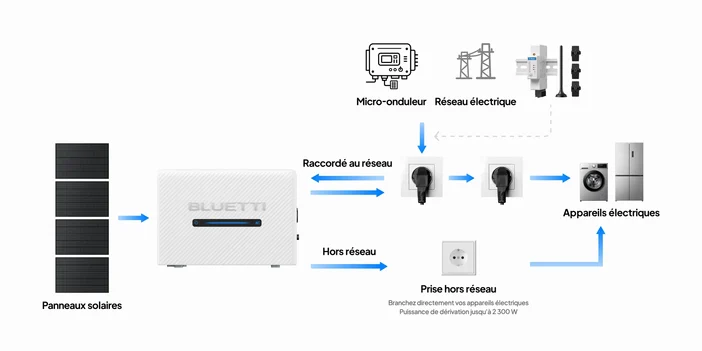
Everything happens on the existing AC network, which is incredibly convenient for modernizing an already existing photovoltaic installation without having to redo all the wiring.
The smart meter becomes the brain of the installation
To operate intelligently in self-consumption, the battery obviously needs to know the energy flows of the home.
For this, BLUETTI offers its own Smart Meter, which measures the exchanges with the grid and transmits the information to the Balco.

Its installation has been particularly well thought out: measurement clamps surround the conductors, while a magnetic contact system simplifies the power supply of the module.

The goal is clearly to avoid as much as possible traditional electrical manipulations.

The system is compatible with either a single-phase or three-phase installation.

Once the Smart Meter is paired with the BLUETTI app, the battery has the information it needs to continuously adjust its charge or discharge.
Good news: BLUETTI hasn’t completely locked its ecosystem. The Balco 260 can also work with a Shelly Pro 3EM, a device you probably already know if you are used to reading me. This is great news for those who already have a Shelly energy monitoring system in their electrical panel.

The goal remains the same: to get as close as possible to 0 W on the meter. With a solar surplus, the battery charges. With a deficit, it discharges.
In practice, there will inevitably be small fluctuations around zero: consumption variations can sometimes be very quick. Turn on a kettle or a microwave, and it takes a moment for the meter to measure the change, transmit the information, and then for the Balco to adjust its power. Nothing unusual in this type of system.
A deliberately limited injection
We now need to talk about a feature that may come off as a flaw depending on your profile: the power sent by a Balco 260 unit to the domestic grid.
The system is designed around a reasonable power for a plug-in installation. The different firmware and modes allow for up to approximately 1200 W, although European configurations are generally much more conservative by default.

Compared to some residential batteries capable of sending 2 or 3 kW, this may seem small. But it’s important to keep the context in mind.
The BLUETTI Balco 260 is not intended to fully power an all-electric house in the middle of winter. Its role is rather to smooth out the electrical demand and the intermediate consumptions. A refrigerator consumes 70 W, the box and the IT network 50 W, some home automation devices 30 W, the television 100 W, the computer 150 W: it quickly adds up to several hundred watts that the Balco can absorb without difficulty.
However, if the oven, induction plates, water heater, heat pump, and electric vehicle charging station all start at the same time, a single Balco unit will obviously not eliminate the grid consumption. That is not its role in any case.
It is also important to remain cautious with the powers reinjected by a socket and to respect the characteristics of the electrical installation. A dedicated and properly protected line should be favored.
The emergency outlet changes the game a bit
The AC outlet located directly on the Balco offers another use: it allows directly powering a device from the battery, especially in the event of a power outage. Refrigerators, freezers, Internet boxes, lighting, televisions, or computers can continue to function.
The system can provide up to 2300 W in total in bypass mode, with power being shared according to the operation of the battery and the grid.
An UPS function also ensures a very quick recovery in case of power loss. During my tests, notably in my office with the networking cabinet plugged into it, the devices tested continued to operate without noticeable interruption.
However, be careful not to confuse this emergency outlet with a backup system for the entire house. If the grid goes down, the Balco plugged into a wall socket will obviously not continue to inject into the general installation. To maintain certain devices, they must be connected to the output specifically designed for that purpose.
And incidentally, another BLUETTI solution takes this logic much further: I will come back to that later.
Another point to mention: this “emergency” socket can also accommodate a micro inverter plug. The BLUETTI Balco 260 can then charge itself via its 4 MPPT inputs, its AC socket, but also another photovoltaic installation directly connected to this AC outlet.
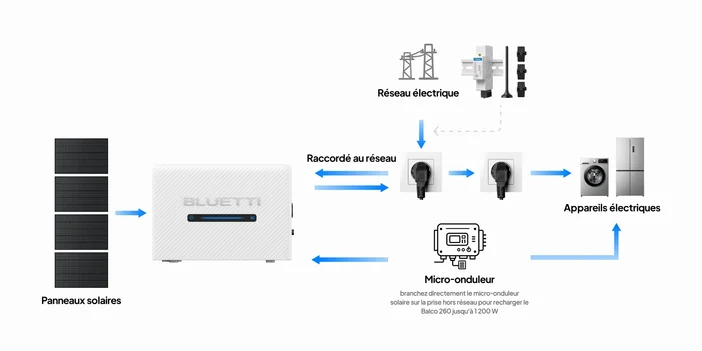
This may seem like just a detail, and it won’t be the most used function, but it’s the kind of feature that saved my situation during the electric blackout I had at home for 48 hours:p
The BLUETTI app, a real energy dashboard
Everything then goes through the BLUETTI app.
Those who already own a power station from the brand will not feel lost: the same app centralizes all devices.

In the Balco interface, you can visualize the charge level, solar power, home consumption, exchanges with the grid, and charge or discharge powers. The flow diagram allows you to quickly understand what is happening: when the sun generates more than the home consumes, the energy goes to the battery; when consumption exceeds production, the arrows change direction and the Balco comes in to support the house.

Several operating modes are available.
The most logical for a photovoltaic installation remains self-consumption. Associated with the BLUETTI Smart Meter or a compatible meter, the Balco then seeks to continuously reduce exchanges with the grid.

A custom mode allows you to set charge and discharge periods, and this is where things get interesting even without solar panels. With a peak/off-peak subscription, for example, nothing prevents charging the battery when the kWh is cheaper and then using it during the more expensive tariff periods. Tempo subscribers can push this logic even further by keeping energy for peak hours of red days.
There is also a backup mode, designed to maintain an energy reserve available for outages.
Finally, BLUETTI offers AI-assisted management, intended to take into account the weather, energy habits, and electricity pricing to automatically optimize operation. On paper, it’s appealing. In practice, it’s mainly the self-consumption mode that I find relevant: it directly addresses the problem we aim to solve, and its operation remains perfectly understandable. With the AI mode, one doesn’t always understand clearly what is happening backstage. But this is a problem that applies to all manufacturers of storage solutions offering an AI mode. We will have to wait to refine this mode of operation. However, there will be a real interest when France transitions to dynamic pricing for consumers. Wait & see :p
And what about Home Assistant enthusiasts?
This is certainly a question of interest to me.
During the presentation of the Balco range in Paris, BLUETTI announced compatibilities with Shelly, EverHome, Google Home, Alexa, and Home Assistant. A promising opening.
A Home Assistant integration would allow, for example, to cross-reference the charge status of the Balco with photovoltaic forecasts, tomorrow’s Tempo rate, the consumption of the water heater, or the presence of an electric vehicle. One could imagine maintaining 40% of battery when a red Tempo day is announced, prioritizing charging the vehicle when the home battery is already full, or triggering certain devices when solar production exceeds a specific threshold.
The potential is real. The Balco is then no longer just a battery: it becomes one of the bricks in the overall energy management of the home.
The manufacturer offers an official plugin for Home Assistant on GitHub, or HACS.

It installs in 2 minutes and instantly retrieves various information from the battery. We will discuss this in more detail in a future guide. But know that the Balco 260 integrates smoothly into Home Assistant, with an official plugin. This is a great point!
5.12 kWh with the BC260: is it really useful?
It all depends on the profile of the home.
With a single unit of 2.56 kWh, there is already sufficient capacity to absorb a small photovoltaic surplus and then erase several hours of electrical demand.
With my BLUETTI Balco 260 + BC260 configuration, the capacity reaches 5.12 kWh. Let’s take a household that consumes a constant 300 W in the evening and overnight: over ten hours, that represents 3 kWh. Thus, a configuration of 5.12 kWh is theoretically capable of covering this need, taking into account conversion losses and the battery reserve configured.
However, we must not fall into the trap of “always more.” If your photovoltaic installation never produces enough surplus to fill 5 kWh, the BC260 may not be profitable. Conversely, if your Balco reaches 100% every day at noon and several kWh still go back to the grid in the afternoon, adding storage makes logical sense.
This is precisely where the modularity of the system makes perfect sense.
What return on investment can be expected?
It is impossible to give a universal figure. Profitability depends on solar production, the orientation of the panels, the place of residence, the price paid for electricity, the possible buyback rate for surplus, and especially your consumption profile.
The mechanism remains easy to understand. Suppose the Balco allows you to recover 2.5 kWh daily that would otherwise go back to the grid for free. At €0.20 per kWh purchased, that represents about 2.5 × 0.20 × 365 = €182.50 per year.
This calculation is deliberately theoretical: it is unlikely that a full cycle will be achieved 365 days a year solely through photovoltaics in France. Conversely, a subscription with off-peak hours or dynamic pricing can help value the battery during periods when solar is insufficient.
The best method is therefore to observe your own solar surplus for several weeks before sizing the storage. This is why I really like the Balco’s modular approach: no need to immediately pay for 10 or 15 kWh when you don’t know if you will really need it.
An excellent candidate for an existing solar installation
This is probably the profile I would most willingly recommend the BLUETTI Balco 260 to.
You already have some photovoltaic panels with micro-inverters. Everything works correctly, but you notice that a good part of your production goes back to the grid when no one is at home.
Modifying the entire installation to integrate a battery can quickly become complicated. With the Balco, the existing panels don’t move: we add the battery, the energy meter, configure the AC coupling, and the storage integrates into the installation. It’s much more flexible.
The ability to directly use four MPPT inputs remains valuable for a new installation or to add a few additional panels dedicated solely to storage. And nothing prevents a hybrid configuration according to needs.
The limits to know before buying
The BLUETTI Balco 260 is not without its flaws.
Its first limitation concerns power. While approximately 1200 W can already eliminate a large part of the usual consumption, those looking for several kilowatts of instantaneous power will have to look at larger solutions or multiply units.
The second concerns the software side. BLUETTI is quickly improving its app and firmware, but as the product is recent, some adjustments are still desirable. The experience is already much better than with the first versions tested at launch, but the energy interface could still gain in readability.
It should also be kept in mind that a truly automatic installation requires a compatible energy meter. Without it, the battery can operate according to time schedules, but it cannot precisely guess whether your home is exporting 600 W or importing 400.
Finally, as always with a battery ecosystem, it is better to think long-term before equipping yourself. Buying a Balco today and then adding a battery from another brand tomorrow with its own energy meter can lead to some amusing behaviors: one battery sees the other injecting, decides to charge, the second then detects a consumption and starts discharging… In short, two brains controlling the same house may not make for a good match. The coherence of the ecosystem therefore counts for a lot.
And soon the BLUETTI Balco Transfer Hub…
The Balco 260 is ultimately just part of BLUETTI’s new energy strategy.
During the Paris presentation, I was particularly intrigued by the Balco Transfer Hub. Its concept is different: it aims to integrate portable power stations into the domestic energy ecosystem.
The idea is rather clever: a portable battery can serve for solar storage at home most of the time, then be disconnected to go camping, during renovations, for a weekend in a van, or as mobile power. Upon returning home, it resumes its role in the energy installation. This way, you avoid having a large domestic battery immobilized 365 days a year on one side and a portable power station sitting in a cupboard on the other.
The Balco Transfer Hub deserves much more than a few lines here: I have it planned for the program and it will receive a dedicated test. It will be an opportunity to see how far BLUETTI has truly succeeded in unifying its portable batteries and its new residential energy ecosystem.
Conclusion: the BLUETTI Balco 260 succeeds mainly due to its versatility
After the Paris presentation, the BLUETTI Balco 260 left me with a very positive impression on paper. This hands-on experience mainly confirms the relevance of the concept.
It is not the most powerful home battery on the market, and that is not what it seeks to be. Its strength lies elsewhere: the Balco 260 can start with 2.56 kWh and have four panels directly connected, couple in AC to an existing photovoltaic installation, upgrade to 5.12 kWh with a BC260 as in my configuration, and then progressively rise to 15.36 kWh. And all this without turning the house into a technical cache.
I particularly appreciate the four independent MPPTs, the LiFePO4 cells, the claimed efficiency, the silent operation, the design being sufficiently successful for an indoor installation, and above all this possibility of using the surplus from an already existing solar installation. Compatibility with solutions like Shelly, and more broadly the announced openness towards Home Assistant, are also solid arguments for home automation enthusiasts :)
There are still some points to improve: the injection power of a unit might seem lacking in a very energy-intensive home, and the BLUETTI app needs to mature further to become a true energy management tool.
But to capture some solar kWh wasted during the day and move them to the evening or night, the BLUETTI Balco 260 fulfills exactly the mission we expect of it. And with a BC260 underneath, its 5.12 kWh already offer a particularly comfortable reserve, without veering into heavy solar installation.
Ultimately, this is what I appreciate the most about this product: you can start reasonably and decide later how far you want to go.
Note: Bluetti offers two very interesting discount codes:
- MEDBLUETTI : 5% discount on the entire site.
- BALMED : €510 discount on the Balco 260 and its packs, valid until September 30.
The two codes cannot be combined. The Balco 260 + BC260 pack thus becomes particularly interesting!
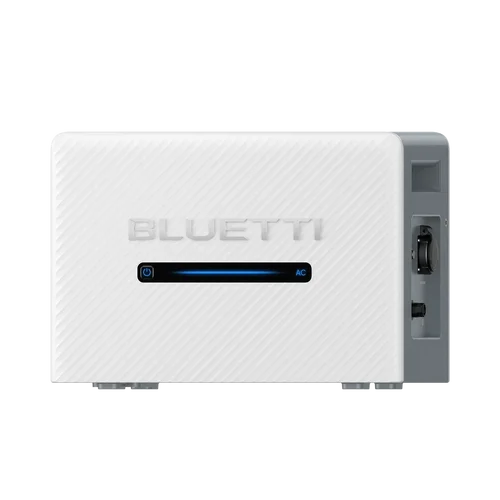
Bluetti Balco 260
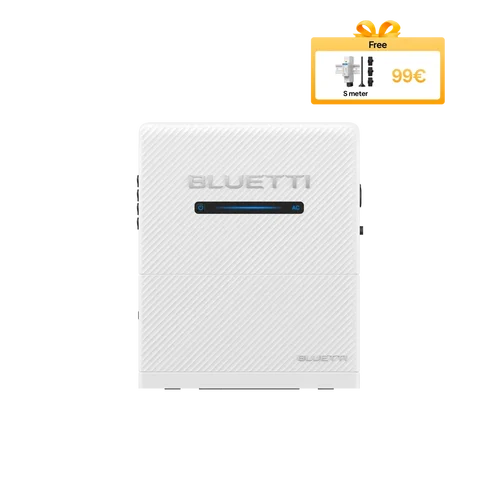
Balco 260 + BC260


Please remain courteous: a hello and a thank you cost nothing! We're here to exchange ideas in a constructive way. Trolls will be deleted.