


'/%3E%3Cpath%20fill='%23b2b2b2'%20d='M241%20382q0%2016%2017%2026%2017%2011%2042%2011t42-11q16-11%2017-26V269H241'/%3E%3Cpath%20fill='%239f7e00'%20d='M241%20379q0%2014%208%2023%209%209%2021%209%2014%200%2021-9%209-9%209-23V269h-59'/%3E%3Cpath%20d='M241%20339v-70h59v110q0%2014-9%2023l-6%205v-68h-15v72q-8%200-14-4v-68zm59%2040c0%2022%2015%2032%2029%2032%2021%200%2030-18%2030-32v-40h-59'/%3E%3Cpath%20fill='%239f7e00'%20d='M266%20277v5h2v12h-3v-5h2v-5h-9v5h2v5h-4v9h3v18h-5v10h34v-10h-5v-18h3v-9h-4v-5h2v-5h-9v5h2v5h-3v-12h2v-5zm42%20101q0%2010%206%2017%206%206%2015%207%2010-1%2016-7%206-7%206-17v-29h-43'/%3E%3Ccircle%20fill='%230044ad'%20cx='329.5'%20cy='372'%20r='6'/%3E%3Cellipse%20fill='%230044ad'%20cx='300'%20cy='340'%20rx='16'%20ry='21'/%3E%3C/svg%3E)

'/%3E%3C/g%3E%3Cuse%20href='%23c'%20transform='matrix(-1%200%200%201%20720%200)'/%3E%3C/svg%3E)


'%3E%3Cpath%20stroke='%23000'%20stroke-width='4'%20d='m-35-37-13%2020m5%203%2013-20m5%203-13%2020m63%2042%206-9m1-2%206-9m5%203-6%209m-1%202-6%209m5%203%206-9m1-2%206-9m-96%200%2013%2020m5-3-6-9m-1-2-6-9m5-3%2013%2020m63-42-6-9m-1-2-6-9m5-3%2013%2020m5-3-6-9m-1-2-6-9'/%3E%3Ccircle%20r='24'%20fill='%23cd2e3a'/%3E%3Cpath%20fill='%230047a0'%20d='M0%200a12%2012%200%201%201%2020%2013%2024%2024%200%201%201-40-26A12%2012%200%201%200%200%200'/%3E%3C/g%3E%3C/svg%3E)


Résumer cet article :
Three years ago, almost to the day, I discovered Zendure at the IFA in Berlin. The brand was presenting a product that immediately intrigued me: SolarFlow. The idea seems almost mundane today. It was much less so in 2023: capturing the surplus generated by a few photovoltaic panels, storing it in a battery, and then returning it later to the home. Three years later, here I am again at the Zendure booth in Berlin. And while discussing with the team, I realized how far they have come.
Now we’re talking about HEMS, PowerHub, heat pumps, electric vehicle charging, weather forecasts, electricity tariffs, and certainly in 2026, artificial intelligence. A lot has changed. However, tracing back from the first SolarFlow, the evolution is quite logical. Zendure started by learning to store solar energy intelligently. Then managing exchanges with the grid. Then several batteries. And now the whole house.
I was fortunate enough to follow a good part of this story, with several tests, launches, and many discussions with the Zendure teams. So back to Berlin, where it all started for me.
In 2023, SolarFlow simply wanted to avoid wasting sunlight
A little backward look.
At IFA 2023, Zendure presents SolarFlow around the Smart PVHub 1200 and AB1000 batteries.
The principle immediately appeals to me. The system installs between the photovoltaic panels and the micro-inverter. When the house needs energy, solar production is used. When it produces too much, the surplus goes into the battery instead of being fed freely into the grid. A few hours later, this energy can be reused.
I quickly wanted to verify all this at home. After two months of testing, the conclusion was quite good: SolarFlow was much better at utilizing the output from a small photovoltaic installation.
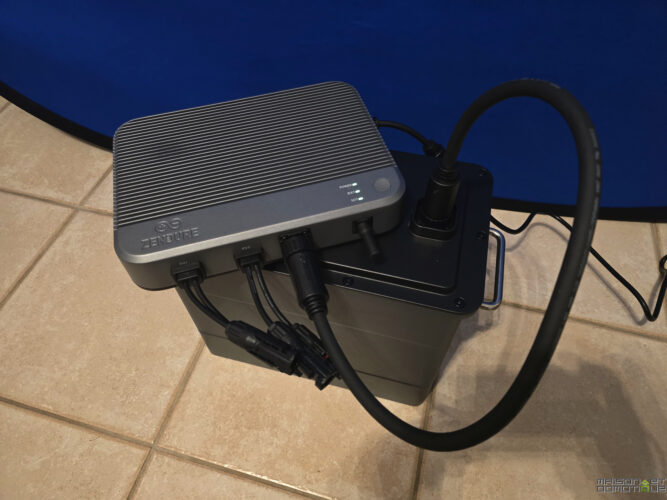
In retrospect, we already found some ideas that are still present at Zendure today. Modular batteries, a relatively accessible installation, and above all the desire to automate energy exchanges.
The system could notably work with a Shelly counter to know what the house was actually consuming.
The capacities still remained modest compared to current products. The PVHub 1200 accepted up to 800 W of panels and storage hovered around 4 kWh with several batteries.
Back then, it already seemed very interesting to me. Three years later, the figures are almost laughable.
With the Hyper 2000, the battery starts to interact with the grid
The following year, Zendure accelerates.
At the CES 2024, the PVHub 2000 arrives. The photovoltaic power increases up to 2340 W and the new AB2000 batteries near 2 kWh each. With four batteries, we reach around 7.7 kWh. We are already starting to move away from the small solar kit installed on a balcony.
Then comes the Hyper 2000, which I also had the chance to test.
And here, one detail changes a lot of things: the system becomes bidirectional in terms of the grid. The battery can still recover solar surplus, but it can also be charged from the grid.
This is particularly interesting for me in winter. In November or December, even with quite a few photovoltaic panels, some days produce almost nothing. Instead of letting the batteries go empty, it becomes possible to charge them during the hours when electricity is cheaper, then retrieve that energy when the price goes up.
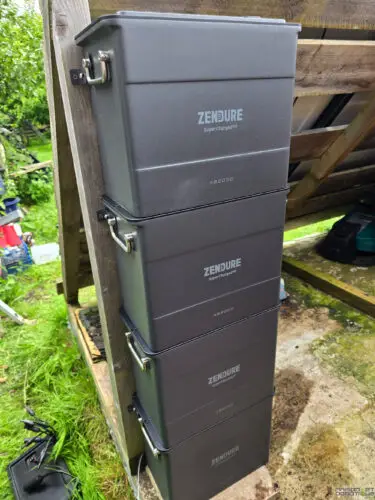
With Tempo or a peak/off-peak pricing structure, there is already plenty to play with.
The battery therefore no longer serves solely to store the kWh produced on the roof. It begins to decide when it is better to take or return energy.
Zendure also launches the ACE 1500, which transforms AB1000 and AB2000 batteries into autonomous power supplies with 230 V and USB outlets. The same batteries can then serve the house or become a kind of portable electric station.
Little by little, the products start to talk to each other and share the same bricks.
The SolarFlow 2400 AC+ clearly shows the change in philosophy
I recently encountered this evolution with the SolarFlow 2400 AC+, which I tested at home.
The installation is quite astonishing for a storage system: you place the battery, plug it into a 230 V outlet, and add it to the app. That’s it.
Once associated with an energy meter, the SolarFlow monitors the exchanges of the house and adjusts its power.
The panels produce 1200 W too much? The battery recovers this surplus. A few hours later, the house draws 400 W from the grid? It supplies 400 W.
An appliance starts? It adjusts its power again.
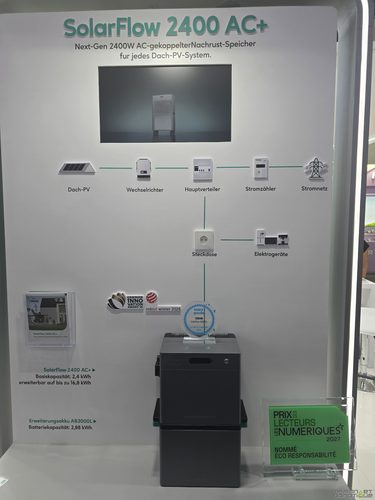
In my case, I was able to directly use my already installed Shelly Pro 3EM. This is a detail I appreciate a lot: when you already have a well-equipped home automation setup, you don’t necessarily want to add another proprietary meter to the electrical panel.
But the most fun part is elsewhere.
I have several Zendure devices at home. One battery can be directly connected to the photovoltaic panels while another is simply plugged into an outlet elsewhere in the house.
When the first battery is full and starts injecting its surplus, the second can recover it.
There are no cables between the two systems. The electricity simply passes through the house’s network, and the HEMS coordinates the exchanges.
That’s the kind of scenario I would have probably set up myself with Home Assistant a few years ago. Here, the user no longer needs to tinker with their own automations.
ZEN+ HOME wants to bring all big consumers to the same table
The strategy has become much clearer during my previous meetings with Zendure, particularly in Lille and then at Intersolar Munich this year.
It now has a name: ZEN+ HOME.

The idea is to manage solar production, batteries, and the main energy-consuming equipment in the home together.
The PowerHub then plays a significant role. It can centralize multiple SolarFlow systems, manage storage and electrical backup, while exchanging information with other devices. Zendure is particularly working on heat pumps, charging stations, and various photovoltaic inverters.

The openness to Home Assistant, Homey, and MQTT interests me obviously much more than another closed application.
A connected home rarely ends with a single brand. At my place, it’s quite the opposite. Shelly coexists with Home Assistant, different solar systems, and a plethora of devices that initially had no reason to communicate together.
An energy manager must deal with this reality.
At IFA 2026, Zendure adds a layer of forecasting
Back to Berlin. This year, Zendure presents what it calls its “Agentic HEMS.” I admit the term made me raise an eyebrow.
I actually spent quite some time discussing this with the team at the booth, because “AI” has become the word that must absolutely be placed everywhere. Robot mowers, vacuum cleaners, cars, appliances… everything becomes AI. However, what interests me is much more down-to-earth: what is it actually going to do in my home?
Zendure’s answer lies in three names: ZenPulse, ZENKI AI Agents, and Zen+OS.
Behind these marketing labels, there is a concept quite easy to understand.
The system must no longer only look at what the house consumes right now. It must try to anticipate what will happen a few hours later.
ZenPulse looks at the weather before filling the battery
ZenPulse is in charge of the forecasts. It can take into account the weather, expected photovoltaic production, consumption habits, and electricity prices.
Let’s take a concrete example.
It’s 11 PM, the battery is almost empty, and the forecasts predict rain all day the next day. There is little chance the panels will produce enough to recharge it. The system can then decide it’s better to buy some kWh during the off-peak hours.
Same situation with a big sunny day forecasted for the next day: filling the battery overnight would be foolish since we would then lack capacity to store free solar energy.
This type of automation is not new for readers who use Home Assistant. With the right integrations and some automations, we can already do quite advanced things.
Only here’s the thing: not everyone wants to spend their Sunday afternoon writing scenarios to charge a battery at 2:17 AM.
And that’s where Zendure’s approach makes a lot of sense.
ZENKI must decide what to do with these forecasts
ZENKI then retrieves this information to establish a strategy.
When should it charge? How much should it keep in the battery? Is it better to use electricity now or save it for later? Should the car wait before starting its charge?
The user indicates their preferences and the system then tries to manage the rest.
On paper, this is exactly what I expect from a good energy manager.
During my interview at IFA, the Zendure team asked me what I was looking for primarily after testing so many storage systems. My answer was quite simple: I want to be able to forget about them.
I have no desire to open the app three times a day to check that the battery is still communicating with the meter, that automatic mode is working, or that the programming hasn’t skipped.
I like to check the statistics, of course. Looking at the end of the month how much I have produced, stored, or saved is interesting.
But in daily life? The system must work on its own. And if there’s a problem, it should send me a notification.
Zen+OS must primarily succeed in communicating with the rest of the house
The third piece is Zen+OS. This is what must connect the decisions made by ZENKI to the devices.
Zendure announces an open architecture via APIs, including Home Assistant, Homey, and MQTT, but also photovoltaic inverters, charging stations, and thousands of heat pump models. This is probably the part I will monitor most closely.
Weather forecasts are interesting. An algorithm capable of determining when to charge a battery is too. But if the system remains locked in its own ecosystem, we lose a good part of the interest.
If, on the contrary, it can know that my car needs to be charged tomorrow morning, ask the heat pump to slightly adjust its operation, and keep enough energy in the batteries to pass through an expensive tariff period, then we start to talk about a house that really manages its energy.
And what about my old Hyper 2000?
This is a question I absolutely wanted to ask at the booth.
Zendure has launched an enormous number of products in three years. Naturally, some users are starting to wonder if their equipment purchased the previous year will be forgotten with the release of the next.
So I took a very concrete example: the Hyper 2000. Will it also benefit from this new management?
The answer I was given at IFA is yes. Zendure plans to extend these functions to existing products, and the Hyper 2000 was explicitly confirmed to be compatible.
This is a reassuring answer for me, even though we will obviously have to see how all this will be deployed in practice.
A home battery is not a smartphone that you change every two years. When someone invests several hundred or thousands of euros in their energy installation, they expect to keep it for a long time. And moreover, they expect the manufacturer not to forget it at the first range change.
Before AI, I mainly want a system that works every day
The discussion actually took quite an interesting turn when Zendure asked me about the other energy systems I had tested.
What matters most?
Security, first.
Reliability, right behind.
It seems less sexy than a big AI logo at an IFA booth, I agree.
But a battery installed in a house must work 24/7. If it depends on a connected meter, that meter must not regularly disappear from the network. A firmware update should not immobilize the system. And when something goes wrong, the user must know about it.
I have already encountered this kind of problem with some competing products: meters losing their connection, updates going wrong, forced fixes remotely after contacting the manufacturer…
When testing a product, you monitor everything. A regular user, however, will not open their app every morning to check that everything is fine. Therefore, the system must be reliable without supervision.
And the more autonomy Zendure gives it, the more important this point will become.
The hardware continues to grow as well
While we talk about AI, Zendure has obviously not stopped making batteries and inverters.
The difference with 2023 is quite spectacular.
The SolarFlow 2400 AC+ easily adds AC storage to an existing installation. The SolarFlow 2400 Pro goes further with its photovoltaic inputs and four MPPTs.
Then comes the SolarFlow Mix family, including the Mix 3000 and 4000.

During our previous meeting, I also discovered the PowerHub, which must coordinate much larger installations.
We are far, very far, from the 800 W photovoltaic of the first PVHub 1200.
I hope to be able to offer you a test of the Pro version soon. Because a nice demonstration at IFA is good. But a battery that spends a few weeks at home with panels, a Shelly, Home Assistant, and my real consumption is certainly much more telling :)
Three years later, I no longer view Zendure the same way
As I left the booth, I mentally replayed my first encounter with Zendure.
2023. SolarFlow. A PVHub 1200. A few stacked batteries and a very simple idea: why send my solar surplus to the grid for free when I could keep it for tonight?
Today, the discussion revolves around tomorrow’s weather, the future price of electricity, the heat pump, the car, Home Assistant, and agents meant to coordinate all of that.
The leap is quite dizzying.
Not everything is ready yet. I particularly want to see what the Agentic HEMS will actually deliver once deployed to users, and how far its openness to third-party devices will go. The support for older generations will also need to be closely monitored.
But the path followed over the past three years is coherent.
SolarFlow has taught Zendure to store solar surplus. The Hyper 2000 has added bidirectional exchanges with the grid. The following generations have begun to get multiple systems working together. The PowerHub is now extending management on a home scale.
ZENKI must learn to anticipate.
If Zendure successfully completes this last step, the best sign may be that we gradually stop opening its app.
The battery will charge at the right moment, the house will consume available energy, and the system will adapt on its own to the conditions of the next day.
And we, we can take care of other things.
Ultimately, this is what I have long awaited from a truly intelligent home.




Please remain courteous: a hello and a thank you cost nothing! We're here to exchange ideas in a constructive way. Trolls will be deleted.