


Résumer cet article :
The pilot wire is our French exception in home automation. It can be found behind a good portion of the country’s electric radiators. It does a very good job of controlling the heating… but it quickly becomes a pain as soon as you want to integrate it properly into a connected home. Shelly is tackling the issue with a product designed for the French market: the Shelly Pilot Wire Gen4.
On paper, the specs are impressive. A compact design, the six pilot wire commands, energy monitoring, and the Gen4 platform, which in principle combines Wi-Fi, Zigbee, Bluetooth, and Matter. If all this is confirmed, it will undoubtedly be one of the most useful Shelly products for us. And with winter approaching, the timing is pretty good.
The pilot wire, a French peculiarity that complicates home automation
To understand why this announcement matters, we need to look at our electrical installations. The pilot wire is a feature found almost exclusively in France. It is used to control radiators without cutting off their power supply.
The principle is clever. The radiator remains powered, while an additional wire, usually black, sends it commands. The radiator’s electronics take care of the rest.

A six-command installation offers Comfort, Eco, Frost Protection, Off, Comfort -1 °C, and Comfort -2 °C.
Everything works fine until the day you want to connect it to a home automation hub.
Relay-and-diode setups for generating these commands have been around for a long time. They work, but they’re still a bit of electrical tinkering, best left to people who know what they’re doing. You can count the purpose-built home automation modules on one hand.
Some time ago, we tested the Nodon SIN-4-FP-21. It’s a Zigbee module that handles all six commands and monitors the radiator’s energy consumption. It fits behind the radiator or in the electrical panel and integrates with Jeedom and Home Assistant, among others, via Zigbee2MQTT. It received a very high score thanks to its compact size, six commands, and energy monitoring.
Shelly is now taking an approach that could open things up much more widely.
A Shelly designed for France
Shelly presents this module as being specifically designed for the French market. When an international brand develops a product around something as local as our pilot wire, it says a lot about how important the French smart home market has become (and Shelly is joining Schneider Electric, which could help with what comes next).
Unsurprisingly, it’s called the Shelly Pilot Wire Gen4.
During the presentation, the manufacturer mainly emphasized its compact size. The module has the same small form factor as Shelly’s micromodules. It should therefore fit easily behind many radiators, inside a flush-mounting box.
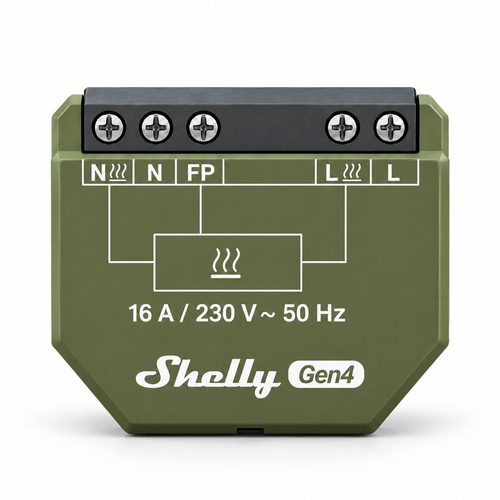
A small visual detail: Shelly is introducing a dark green color to identify its heating range. That’s useful when modules start piling up in the electrical panel.
All six commands, not just On/Off
Shelly hasn’t settled for a simple Comfort/Off setup. The Pilot Wire Gen4 handles all six standard commands:
- Comfort: the radiator follows its normal setpoint.
- Eco: the setpoint is lowered, generally by around 3.5 °C.
- Frost Protection: the radiator maintains a minimum temperature to prevent the home from freezing.
- Off: heating stops, but the radiator remains powered.
- Comfort -1 °C and Comfort -2 °C: the setpoint is lowered by a little less.
This is much more precise than a relay that would abruptly cut power to the radiator. You can keep the living room at 19 °C during the day and switch to Eco when everyone has left. You can also use Comfort -1 °C during certain electricity tariff periods, then switch to Frost Protection while you’re away on vacation. With a fairly advanced home automation hub, the possibilities are numerous.
Energy monitoring is included too
Shelly also mentioned energy monitoring, a welcome feature on a module dedicated to heating.
And it’s no gimmick. Electric heating can quickly account for a large part of your bill. Knowing how much each radiator consumes lets you identify the room that uses the most energy and compare different ways of heating. You can also check whether your new scenarios really are lowering your bill.
In fact, that was what we liked most about the Nodon. In Home Assistant, we could see the room temperature, the current pilot wire command, and the radiator’s power consumption side by side. With Shelly, this data should join the rest of the brand’s energy ecosystem. If you already have Shelly meters in your electrical panel, everything will be in one place.
Gen4: Wi-Fi, Zigbee, Bluetooth, and Matter in one enclosure
The word that’s bound to get people talking is, of course, “Gen4.” Shelly’s current generation supports multiple protocols. The Gen4 models already on sale offer Wi-Fi, Zigbee, Bluetooth, and Matter. For a pilot wire module, that changes a lot: until now, choosing a module meant choosing a protocol.
Users already equipped with Shelly devices can stick with Wi-Fi, using the Shelly Smart Control app and the brand’s usual local features. With Home Assistant or another hub equipped with a Zigbee coordinator, you can use Zigbee. Matter opens the door to the major ecosystems. We’ll have to see how Shelly exposes the pilot wire-specific features through Matter, and we’ll make that a priority during our test. Bluetooth is mainly used for configuration.
Depending on the model, Gen4 devices also offer MQTT, an HTTP API, webhooks, or scripts. If you use Home Assistant or Jeedom, or enjoy local automations, there’s plenty to work with.

What it could look like in Home Assistant
Let’s take a radiator fitted with this module and integrated into Home Assistant. The temperature comes from a sensor placed in the right spot in the room, rather than the radiator’s built-in sensor. The system knows whether anyone is home and detects an open window. It also knows the family’s schedule and, potentially, the electricity rates.
At 7 a.m., the bathroom switches to Comfort. At 8:30 a.m., the house is empty and the bedrooms switch to Eco. A window stays open for five minutes? The radiator in that room receives the Off command. If no one is coming home before 6 p.m., there’s no need to heat the house to full temperature from 4 p.m. And if you’re away for a few days, the whole house switches to Frost Protection.
Energy monitoring then shows how much each zone has consumed. You can manage the home’s energy room by room, which isn’t possible with a smart radiator on its own.
Shelly versus Nodon
Shelly’s arrival doesn’t make the Nodon SIN-4-FP-21 obsolete. I’ve been using them for several winters now. The Zigbee integration works very well, and the unit is compact. It also handles all six commands and energy monitoring, and can even act as a Zigbee router because it’s mains-powered.
Shelly’s advantage will be the choice of protocol, precisely what most pilot wire modules lack. The same enclosure could suit a Shelly installation using Wi-Fi, a Zigbee network, or a Matter-focused smart home. Advanced users who appreciate Shelly for its local operation, APIs, and MQTT will also feel at home. If the module lives up to its promises, it could appeal to a lot of people.
And the price?
That’s the big question. The final price is not yet known, but Shelly has made it clear that it will be attractive.
Price matters all the more because a home rarely has just one radiator. With eight units, a €10 difference per module already adds up to €80 overall. Shelly owes much of its success to affordable micromodules. If it sticks to that approach, its Pilot Wire Gen4 could quickly become very popular in France.
For comparison, the Nodon SIN-4-FP-21 cost around €40 when we tested it. Shelly knows what price it should aim for.
A December release, or early 2027?
As for the release date, Shelly is talking about late 2026 or early 2027. We’ll have to wait for the commercial launch announcement.
In the meantime, we’ll be keeping a close eye on this module. Pilot wire systems are installed in a huge number of French homes, yet international home automation manufacturers have shown little interest in them. Seeing Shelly release a micromodule just for our market is very good news.
Six commands, energy monitoring, a compact design, and the flexibility of the Gen4 platform: on paper, it has almost everything. There’s just one big unknown left: the price.
As soon as we get our hands on one, it’ll go behind our radiators… right next to the Nodon already installed at home.





Please remain courteous: a hello and a thank you cost nothing! We're here to exchange ideas in a constructive way. Trolls will be deleted.