


Résumer cet article :
DJI is mainly known for its drones, cameras, or stabilizers. However, the Chinese manufacturer is also making a nice place for itself in another market: that of portable power stations. After the Power 500, Power 1000, Power 1000 V2, and the impressive Power 2000, the brand is now tackling a problem that everyone who regularly transports a battery knows well: how to carry about 1 kWh of energy without sacrificing a good part of the trunk? The answer lies in a small cubic block measuring 31 cm wide: the DJI Power 1000 Mini.
And the term “Mini” is not just there to decorate the box. With its 1,008 Wh, 11.5 kg, and dimensions of 314 x 212 x 216 mm, this station boasts an impressive capacity-to-size ratio. It is almost twice as small as the original DJI Power 1000 while offering practically the same amount of energy.
There’s bound to be a catch somewhere. DJI has not discovered a new law of physics allowing it to double energy density without trade-offs. The main compromise concerns power: the Power 1000 Mini delivers 800 W continuously, with a maximum power of 1,000 W. So we are far from the 2,600 W that a Power 1000 V2 can provide.
But is this really a concern? It all depends on what you plan to plug into it. And that’s precisely what makes this DJI Power 1000 Mini interesting.
Unboxing and Discovering the DJI Power 1000 Mini
The box does not hold many surprises.
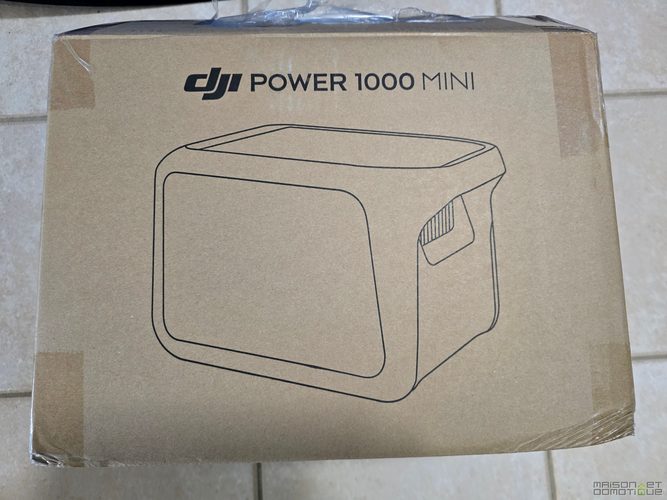
It mainly contains the DJI Power 1000 Mini, its AC power cable, and documentation.

No solar panel, no MC4 cable, nor cable for recharging from a car battery. These accessories are available separately or in various bundles offered by DJI.
Once out of the packaging, the first reaction: it is really small for a 1 kWh station!

The DJI Power 1000 Mini measures exactly 314 x 212 x 216 mm and weighs about 11.5 kg. It is still too heavy to carry in the bottom of a bag for several kilometers, obviously, but it is extremely easy to move from one room to another or to slide into a trunk.
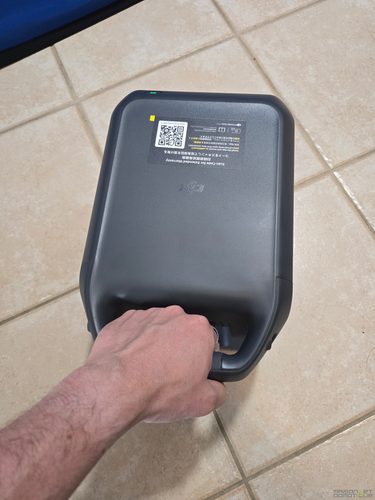
Its large integrated handle allows for easy one-handed carrying.
The design remains very DJI: dark grey plastic, clean lines, serious assembly. It looks more like professional electronic equipment than a construction site generator.

And thanks to its almost cubic shape, it can be easily stored on a shelf, under a desk, or between two crates in a trunk. A detail that seems trivial until the day one has to go on vacation with children, luggage, a cooler, and everything else…
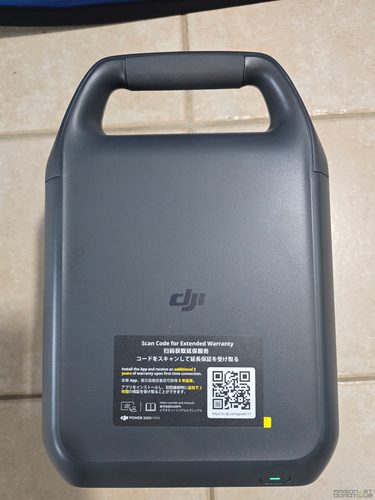
To measure the work done by DJI, one just needs to compare it to the original Power 1000. The latter measures 448 x 225 x 230 mm and weighs about 13 kg for a capacity of 1,024 Wh. The Power 1000 Mini drops to 314 mm in length for 1,008 Wh. The gain in volume is considerable.
The battery uses LFP (LiFePO4, lithium-iron-phosphate) cells, which have become the standard on good portable power stations due to their thermal stability and especially their longevity.
DJI announces more than 80% of remaining capacity after 4,000 complete charge and discharge cycles. Even with almost a daily cycle, we are talking about a theoretical usage of about ten years. It’s safe to say that before wearing it out, it will need to travel a bit.
A Particularly Well-Designed Front Panel
All the important connectivity is located on the front panel. It is much more practical than stations where one has to search for a socket on the side then a solar input at the back.

In the upper left corner is a screen that displays the remaining battery percentage, the current power consumption, the recharge power, and an estimate of the time of autonomy or recharge. The information is immediately legible and is sufficient for everyday use without needing to pull out a smartphone.
The European version has two 230 V AC outlets.
Next to it, DJI offers a USB-C port capable of delivering up to 100 W, two USB-A of 12 W each, and above all an excellent idea: a retractable USB-C cable directly integrated into the station. This also delivers up to 100 W.
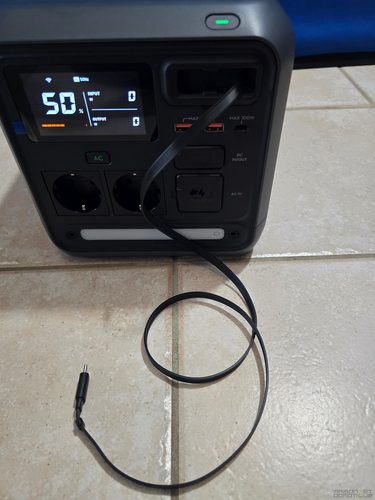
You just need to pull it to the desired length and then let it lock into place. A new pull triggers its automatic retraction. It’s very simple, but it’s probably one of the functions I appreciate most about this Power 1000 Mini. A portable station often ends up in the trunk or in the garden because one needs to power something. And it’s usually at that moment that one realizes that the USB-C cable needed is still on the desk… Here, the cable is always present. This is a feature I loved on the small Ugreen Nexode 20,000mAh battery, and one that I can no longer do without. So it’s fantastic to see it on a slightly larger battery :)
DJI even went so far as to make this retractable cable replaceable: it can be easily disconnected:

If it starts to wear out one day, it can potentially be replaced.
However, a subtlety to note: the two USB-C outputs cannot each deliver 100 W simultaneously. If they are used together, the total available power is limited to 150 W. The retractable cable can then go up to 100 W while the second USB-C will be limited to 50 W.
To charge a laptop and a smartphone simultaneously, no problem. To power two large computers each requiring 100 W, it’s more complicated. The two AC outlets are, of course, enough to work around this limit with an additional USB-C charger.
The SDC Port: DJI’s Home Advantage
Another port deserves special attention: the famous SDC connector, for Software Defined Charger.
It is proprietary to DJI, which may seem like a downside at first. But it opens up several interesting possibilities. It works both as input and output.

As an output, it can provide up to 300 W, which allows one to plug in the fast recharge cables for DJI drone batteries.
For a drone pilot, photographer, or videographer, this is not trivial. The station becomes a mobile charging base that quickly gets batteries back in service in the field. With the appropriate accessories, DJI claims that it can replenish certain compatible drone batteries from about 10 to 95% in about thirty minutes.
When the perfect light of a sunset lasts only three hours, quickly getting a drone battery back in service makes all the difference.
But the SDC also serves as input for solar or automobile charging. And DJI has done a great job on this generation: the solar MPPT controller and car charger are now directly integrated into the Power 1000 Mini.

You still need to buy the appropriate cables, but there’s no need to add a bulky intermediary electronic box.
An Integrated Light Much More Useful Than It Seems
At the very bottom of the front panel is a large LED strip.
This could easily be classified as a gadget. However, on a portable station, this lamp quickly finds its utility.

Imagine a power outage in the middle of the night. You grab the battery to power the internet box or a few devices… but first you need to find the cables in the dark. The same goes when camping, in a garage, a workshop, or simply when looking for something in the car trunk.
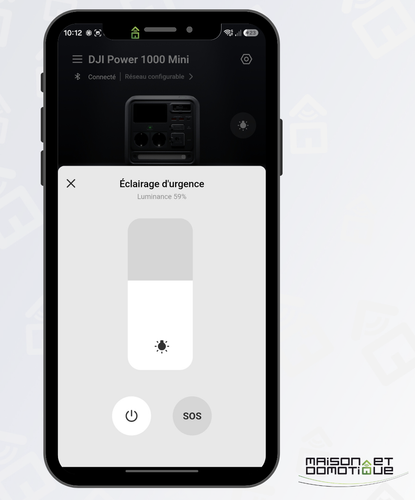
The light is immediately available. Its intensity is adjustable, and an SOS mode also makes it flash.
Not essential, but extremely practical once you have it.
A Capacity of 1,008 Wh… but Only 800 W Continuously
This is THE point to keep in mind before buying this DJI Power 1000 Mini.
An electric station has two completely different characteristics: its capacity, expressed in Wh, and its power, expressed in W.
The capacity of 1,008 Wh indicates the amount of energy available. A constant consumption of 100 W could theoretically work for about 10 hours. In reality, you need to deduct losses related to the inverter and various electrical conversions.
Power, on the other hand, determines what can be plugged into it at any given moment. And the Power 1000 Mini is officially rated for 800 W continuously and 1,000 W maximum on the 230 V output.
DJI specifies that some devices rated up to 1,200 W can operate, but it is by no means a guarantee that any 1,200 W device will work. This is where several tests yield different results. A resistive load close to 900 W may work perfectly, while a motor-driven device consuming only 650 W may trigger a safety shutdown because of its starting current.
Thus, the power listed on a device’s label does not tell the whole story.
What Can We Really Power?
For standard electronic devices, the limits are ultimately much less problematic than one might imagine.
A laptop consuming 60 or 100 W? No problem. A PC screen? Same. A TV, an internet box, a NAS, LED lighting, battery chargers, a game console, a projector, or a small refrigerator? All these fit perfectly within the Power 1000 Mini’s playground.
A complete desk with a computer, several monitors, network equipment, and various peripherals can easily stay under 400 or 500 W. And in this context, having 2,600 W like on a Power 1000 V2 would not change the usage at all.
On the other hand, things get complicated with heat-producing devices.
A kettle often consumes 1,800 to 2,200 W. A hairdryer can exceed 2,000 W. A coffee machine may require 1,200 to 1,500 W during its heating phase. The same applies to electric heating, toasters, or certain cooking plates.
The Power 1000 Mini is not designed for these uses. Some equipment around 1,000 W works perfectly, while others may trigger a safety shutdown. This depends particularly on the type of load and the current drawn at startup.
This limitation is not really a hidden flaw: it stems from DJI’s choice to focus on a compact station.
If your goal is to regularly plug in a kettle, a powerful coffee machine, a hairdryer, or small electrical appliances in a van, it’s better to look towards the DJI Power 1000 V2 with its 2,600 W or the Power 2000. However, for computing, drones, photography, lighting, networking, or regular camping use, the 800 W continuously is more than sufficient.
A Good Battery for Working Far from a Socket
This is probably where the Power 1000 Mini makes the most sense.
Let’s take a very concrete example: you want to work a day in the garden. You plug in a laptop consuming 50 W, a 30 W screen, and your smartphone charging at about twenty watts. We are hovering around 100 W.

Even accounting for conversion losses, the station has plenty to cover a full day’s work.
For a photographer or videographer, the scenario is even more interesting. LED lights, camera chargers, laptops, drone batteries, control screens: all these devices consume relatively little but must be able to run for several hours. With 1 kWh available, you can go work without needing to hunt for the nearest electrical outlet.
Compactness becomes much more important than the ability to power a 2,000 W kettle for two minutes.
Camping, Road Tripping, and Van Life: Very Convincing, Under Certain Conditions
The Power 1000 Mini also seems to have been designed for car getaways.
It can power a small refrigerator or electric cooler, smartphones for the whole family, lamps, a Bluetooth speaker, a laptop, an electric pump, or various camping accessories.
DJI provides some estimates to get an idea: about 30 hours for a Wi-Fi router, 18 hours for some car refrigerators, or several dozen recharges for mobile devices. These figures obviously vary widely depending on the equipment used.
For a quick estimate of autonomy, a simple formula will do:
theoretical autonomy = 1,008 Wh ÷ device consumption
A 50 W device thus gives about 20 hours theoretically. In reality, plan for a little less due to conversion losses.

For regular camping or a weekend by car, it’s all good. However, for a van equipped with a kettle, coffee machine, microwave, and possibly electric cooking devices, the 800 W continuously becomes too restrictive. In this case, it’s better to transport a few extra kilos and opt for a more powerful station.
A Very Good Backup Solution for Home
The Power 1000 Mini also offers a nice surprise for fixed use: its ASI mode, the equivalent of what’s commonly referred to as UPS in English.
The principle is simple. The Power 1000 Mini is plugged into an outlet. Your computer, NAS, or internet box is plugged into one of its sockets. As long as the power is working, electricity flows through the station and normally powers the devices. Therefore, the battery doesn’t go through unnecessary charge and discharge cycles.
If the power goes out, the battery automatically takes over. DJI announces a switching time of less than 0.01 seconds, or about 10 ms. My tests conducted with a computer and several monitors recorded transitions around 9 to 12 ms, without the computer shutting down.
To protect a NAS, a fiber box, or a router, this is very real. And unlike a traditional computer UPS with only a few hundred Wh at most, we have here a battery of over 1 kWh.
Let’s take an internet box, a router, and a NAS that consume together 60 W. A power outage lasting a few minutes won’t even be noticeable, and an outage lasting several hours can be absorbed. On a desk consuming 300 W, we will still have several hours to finish our work properly.
However, it’s important to keep in mind the battery’s power limit when the mains power disappears. Because, connected to the grid in bypass mode, the station can let through up to 2,200 W on the European version. This figure does not mean that the battery can produce 2,200 W.
A 1,400 W coffee machine can therefore work when the power is present since the energy is coming directly from the grid. However, in the event of an outage, the battery will no longer be able to maintain that load. This is an important distinction.
Very Fast AC Recharging
A portable battery is only truly practical if it can be quickly put back into service.
On AC power, DJI announces charging from 0 to 80% in 58 minutes and a full charge in about 75 minutes. For a capacity of 1 kWh, that’s fast. The absorbed power approaches 1,000 W.

Of course, pushing that much energy into such a compact shell requires cooling the electronics. The fans kick in noticeably during rapid charging. I measured noise levels around 43 to over 50 dB depending on conditions and proximity of measurement.
The Power 1000 Mini is therefore very quiet under low loads, but it knows how to make its presence known when heavily utilizing its power. This is one of the physical trade-offs of its format: less surface area available for dissipating heat means more ventilation.
Fortunately, the application offers a gentler charging mode, around 500 W, when speed is not a priority. For overnight charging or when the station is placed near a desk, this is appreciated.
Solar Recharging: Up to 400 W Without External MPPT Module
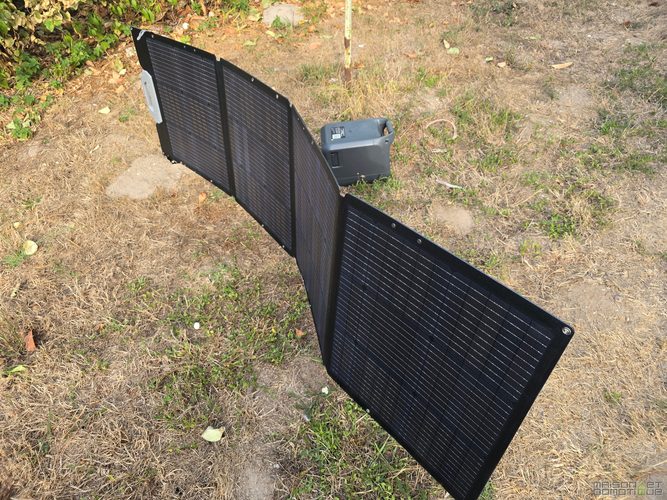
This generation brings an interesting evolution compared to the first DJI stations: the Power 1000 Mini directly integrates its 400 W solar MPPT controller.
You simply need to use the DJI Power MC4 to SDC cable, sold separately, to connect compatible solar panels. The SDC input accepts up to 400 W.
With a properly oriented 200 W panel and under good conditions, about five to six hours are enough to recover a large part of the battery. With 400 W actually available, the time can obviously be significantly reduced.
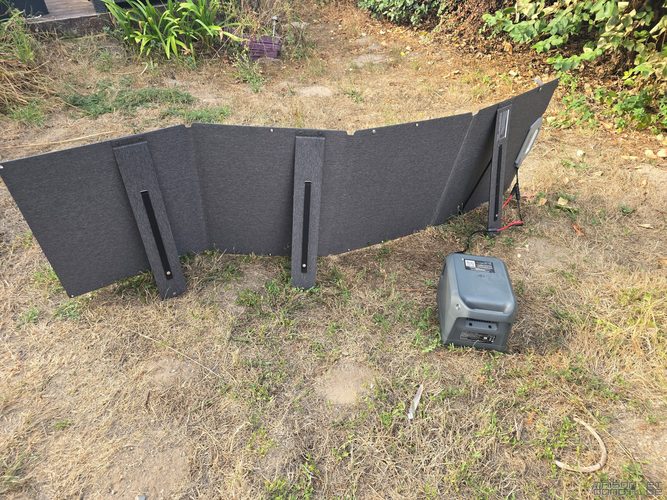
But as always with solar, the 400 W listed on a panel is a maximum power achieved under ideal conditions. Orientation, temperature, clouds, and season greatly affect production.
For a weekend off the grid, the combination of Power 1000 Mini + a 200 or 400 W folding panel forms a good duo. During the day, the panel recharges the station. In the evening, it powers lighting, computing, refrigeration, and mobile devices.
Car Recharging: 400 W Directly from the Battery
Another interesting function for road trips: the integrated 400 W car charger also requires the dedicated DJI Power cable, sold separately, which connects directly to the vehicle’s 12 V battery.
This is not just a simple cigarette lighter outlet limited to about a hundred watts. DJI announces approximately 160 minutes for a full charge at maximum power. In practice, after a few hours on the road, you can arrive at your destination with a nearly full station.
This is the kind of detail that makes the Power 1000 Mini much more interesting on the go than just a large USB battery.
It’s Even Possible to Recharge via USB-C
DJI has taken the concept quite far since the retractable USB-C cable is bidirectional. The station can receive up to 100 W via USB-C.
Of course, recharging 1,008 Wh at 100 W takes a long time. This won’t be the primary method. But if you only have a large USB-C charger on hand, the solution exists. It’s also convenient in some modern vehicles equipped with powerful USB-C outlets.
DJI Home App: Wi-Fi Directly Integrated at Last
The Power 1000 Mini features Bluetooth 5.0 and 2.4 GHz Wi-Fi. Unlike some previous generations that required an additional dongle, the connectivity is now built-in.

The station is controlled via the DJI Home app. Pairing is quite standard: the battery is detected via Bluetooth, and you can then transmit your Wi-Fi network settings.

Once connected, the app retrieves the information displayed on the screen: charge status, estimated autonomy, incoming power, outgoing power, and temperature. You can also activate the AC outlets or the SDC port remotely from the app.

The LED strip is also controllable from the smartphone, with precise brightness adjustment and activation of the SOS mode.
The energy parameters are even more interesting. You can set a minimum discharge threshold between 0 and 15%, limit the maximum recharge between 70 and 100%, configure a low battery warning, or request that the 230 V output automatically restore its state after a reboot. This last feature is particularly useful when the Power 1000 Mini is serving as a UPS for network equipment or a NAS.

You can also select the fast charging around 1,000 W or the quieter mode around 500 W. Finally, the app ensures firmware updates.

The whole remains very simple to use and offers real functions without making the app mandatory. A good balance.
LFP Cells Designed to Last
The Power 1000 Mini therefore uses lithium-iron-phosphate cells. Besides their longevity, they are appreciated for their better thermal stability compared to older lithium-ion chemistries used in many portable stations.
DJI claims over 80% capacity after 4,000 complete cycles, measured under its laboratory conditions. By using a complete cycle each day, 4,000 cycles represent nearly eleven years. In normal use, where one obviously does not fully drain the station every day, its potential lifespan is, therefore, very comfortable.
A BMS continuously monitors the cells, with various temperature sensors and protections against overcharging, overcurrents, abnormal temperatures, and excessive discharges. DJI also announces high mechanical resistance and operation possible up to an altitude of 5,000 m. The electronics have a treatment against condensation and salt spray.
However, be careful not to turn this information into a waterproof certification: the Power 1000 Mini is not a battery that should be intentionally left in the rain. DJI also advises against exposure to rain greater than a few minutes as well as prolonged exposure to condensation or saline fog.
In short: it will better withstand the challenges of outdoor use than completely open electronics, but it still needs to stay protected. The official operating range extends from -10 to 45 °C.
Temperature is Well Managed, Noise Less So at Full Power
The very small footprint could raise concerns about poor thermal dissipation. However, my various tests show a rather serious management.
During significant charging and discharging, temperatures around 45 to 47 °C were recorded near the air outlets or the hottest areas of the case. Nothing alarming for a station of this type. The ventilation works properly.
However, this is one of the few areas where the Mini format shows its limits. Around a few hundred watts, the station remains quite discreet. When the power rises to around 700 or 800 W or during rapid charging at 1,000 W, the fans noticeably speed up and become audible.
This is not dramatic in a garage, workshop, or outdoors. However, in a perfectly quiet room, you will know it’s there.
A Fixed Capacity without Expandable Battery
There is another important difference with some competing stations and higher-end DJI models: the 1,008 Wh is not expandable. It is impossible to later connect an additional battery to reach 2 or 3 kWh.
This choice obviously contributes to the simplicity and compactness of the product. But if your needs evolve towards residential autonomy, a heavily equipped van, or long-term backup power, you will need to change ranges.
The Power 1000 Mini is a portable 1 kWh station. It does not try to become a modular home battery, and ultimately this very clear positioning suits it quite well.
And Compared to the DJI Power 1000 V2?
The comparison is interesting because the two products have nearly identical capacities. The Power 1000 Mini offers 1,008 Wh compared to 1,024 Wh for the Power 1000 V2. In pure autonomy, the difference is negligible.
The philosophy changes completely when looking at power. The Mini stops at 800 W continuous / 1,000 W maximum, while the Power 1000 V2 goes up to 2,600 W. The V2 is therefore much more suited for household appliances, powerful tools, and usage in a van. But it is also bulkier and heavier.
The question to ask is therefore not “which one is better?”, but rather “do I really need more than 1,000 W?”. If the answer is no, the Mini becomes very attractive immediately. Why haul more volume and weight for power that will never be used?
To power a network, a NAS, computers, battery-powered tools, lighting, photo equipment, drones, or a small fridge, the Mini seems even more coherent.
A Price That Has Become Particularly Attractive
The DJI Power 1000 Mini is available for around €579, a well-placed price for a 1 kWh station that is also compact.
However, accessories need to be taken into account. The solar MC4 to SDC cable is sold separately, as well as the cable for fast recharging from a car battery or the various SDC adapters for drones. Depending on your usage, the bill can therefore rise.
But DJI offers various bundles combining the station, car charging, solar panels, or fast recharging for drones. It’s better to look at these packs before buying the accessories separately.
So, Who is this DJI Power 1000 Mini For?
This is probably the most important question of this test, as the Power 1000 Mini can be ideal or frustrating depending on the intended use.
For a photographer, videographer, or drone pilot, it’s hard to find much to criticize. It’s compact, offers 1 kWh, charges USB-C devices, has the SDC port, and easily fits into a trunk with the rest of the equipment.
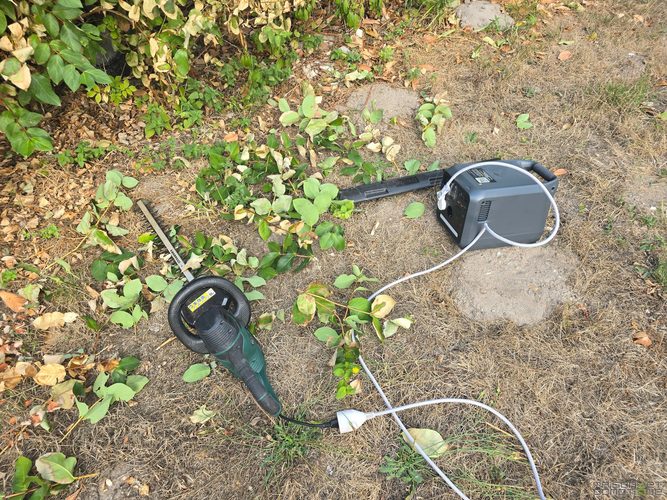
For working in a garden, a shed, or on a light construction site, the same conclusion applies.
To secure a NAS, an internet box, and a few network devices at home, its ASI mode does the job very well, and the 1,008 Wh provides a significantly superior autonomy to that of many small traditional UPS units.
For camping or road trips, it is also very convincing, especially when paired with a solar panel.
However, for use in a van with a lot of household appliances, serious thought must be given to the necessary power. A 2,000 W kettle will not suddenly become economical just because it is in the middle of a forest. The same applies to a hairdryer, a large coffee machine, a microwave, or an electric stove. In this context, the Power 1000 V2 or the Power 2000 will be much more suitable.
Conclusion: The 1 kWh Station That I Would Want to Take Everywhere
With the Power 1000 Mini, DJI has not sought to win the battle of watts. And ultimately, this is probably its best idea.
The brand has preferred to take a true 1 kWh battery and minimize everything that could be minimized to obtain a truly portable station. The result holds up well. 1,008 Wh in 11.5 kg and only 314 x 212 x 216 mm is already a nice feat. But DJI hasn’t just been content with reducing the case.
The retractable USB-C cable is extremely practical. The integrated 400 W MPPT and car charger are a plus. AC charging is fast, the SDC port provides a real advantage for drone users, and the DJI Home app is simple and effective.
The ASI mode with a switch around 10 ms also gives it a second life at home. When it’s not traveling, it can protect a NAS, an internet box, or a computer.
Its main weakness is perfectly identified: 800 W continuously is low for a 1 kWh station in 2026. Competitors, and even other DJI models, often offer much more. But it all depends on usage. A 2,000 W station offers no extra autonomy to a computer consuming 80 W. It simply allows you to plug in more powerful devices.
If you do not need to regularly power a kettle, hairdryer, cooking appliance, or large electrical tool, the need to transport a heavier station becomes questionable. And this is where the Power 1000 Mini finds its place.
It’s a station designed for nomadic creators, DJI drone owners, camping, road trips, light DIY, and backup power for computing. It does not seek to power an entire house. It prefers to offer you 1 kWh that you will actually want to take with you.
And on this point, the contract is largely fulfilled!


Please remain courteous: a hello and a thank you cost nothing! We're here to exchange ideas in a constructive way. Trolls will be deleted.