


Résumer cet article :
There are product tests that we carry out “just to see.” And then there are real situations, those that happen unexpectedly, at 10 PM on a weekday, when the whole street suddenly goes dark after a huge “boom” from the neighborhood transformer.
This week, I experienced exactly this scenario.
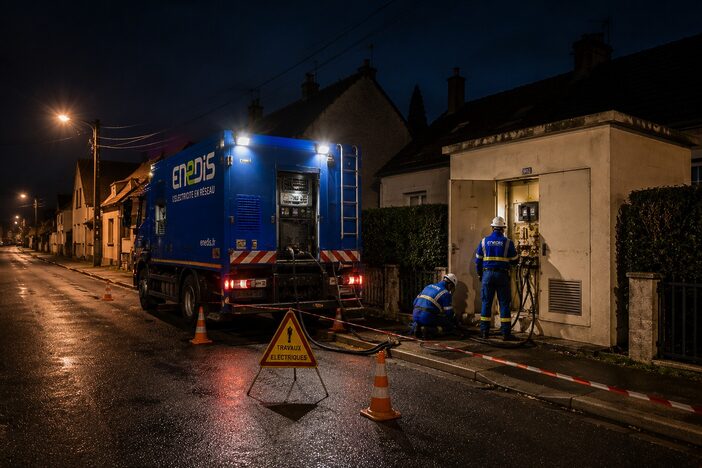
An electrical transformer literally exploded in my street. A dull noise, the whole house instantly goes dark, and then nothing. No light. No internet. No electric heating for some neighbors. Nothing at all in the entire street.
And honestly? This is when you realize how much our daily lives depend entirely on electricity.
Except this time, at home, the outage ultimately had very little impact. And it’s not thanks to a noisy thermal generator in the garden. It’s thanks to a very simple combination: a Marstek Venus E battery paired with a source inverter installed in the electrical panel.
And clearly, this experience has completely validated the interest in this type of installation, especially when living in a rural area like here in Sologne.
A power outage that lasted… two days
The most surprising thing in this story isn’t the outage itself. A transformer failing can happen. The real problem is the recovery time.
The outage started around 10 PM. Neighbors quickly alerted the mayor, who himself contacted Enedis. The teams only intervened the next morning around 10 AM. And despite that, it took nearly two full days before the power was completely restored. But apparently, several electrical problems occurred simultaneously in the area. Between public holidays and long weekends, thanks anyway to Enedis for their responsiveness!
When you live in the city, you often imagine that a power outage lasts an hour or two at most. In the countryside, it’s sometimes another story. In winter, especially, among overhead lines, storms, trees, and more distant infrastructure, outages can last a long time.
And this is exactly where this type of installation makes perfect sense.
The source inverter: the often-forgotten piece
The real discreet hero of this installation isn’t even the battery. It’s the source inverter.
I had detailed its installation in a previous guide, but as long as you don’t experience a real outage, you don’t really realize its importance.
The principle is very simple: the inverter allows you to manually switch the power supply of the house from the Enedis network to an alternative source.
In my case, this alternative source is the Marstek Venus E battery.
Once switched, the entire house continues to be powered normally, exactly as if the public network were still functioning.

And it changes everything.
The lights keep working. Internet remains active. The TV too. The computers run normally. The fridge and freezer stay powered. Even the microwave and air fryer worked without a problem.
As someone who works from home all day in front of multiple computers, I wasn’t disturbed at all. Honestly, after a few minutes, we almost forgot there was an outage in the whole street!
What the battery can truly power
The Marstek Venus E has a 230V output capable of delivering up to 2500 W continuously, with higher peaks to absorb device startups.
This is more than enough to power the essential uses of a house.
Of course, one must remain reasonable. The high energy consumers were intentionally cut off. The electric water heater remained off. The charging of the electric car also. These devices require a lot of power and the battery could not provide enough.
But for all other daily uses, no problem.
And ultimately, when you think about it, in the case of a long-term outage, it is especially these “vital” usages that matter: maintaining the cold chain, having lighting, cooking at least a bit, keeping the internet, and being able to continue working (especially when you work like me from home).
The heating wasn’t an issue here since it’s no longer cold (and anyway we heat with wood). And the kitchen runs on gas, which is a huge advantage in this type of situation.
The technical detail that changes everything
Where this battery becomes really impressive is in a very specific behavior that few people know about.
And honestly, this is probably what allowed it to hold up so effectively for those two days.
When a house has traditional solar panels with micro-inverters, they automatically shut down as soon as they no longer detect the Enedis network. It’s a mandatory safety measure to prevent any current from being fed back into the network while a technician is working.
The result: even with lots of solar panels on the roof… production drops to zero during an outage. Irony.
In my setup, thanks to the source inverter, the house was completely isolated from the public network. And yet, the panels continued to produce locally.
Why? Because the 230V output of the Marstek Venus E has a rather unique behavior: it can not only provide current… but also absorb a surplus of production coming from the domestic network.

And this is something very few batteries can do.
On most models on the market, injecting current towards a 230V output would immediately trigger a safety mechanism, or even completely shut down the battery.
The Marstek, on the other hand, perfectly manages this energy.
Moreover, during the first tests of the product, some users had even directly plugged a micro-inverter into this output to experiment with this behavior.
In practice, during the day, the battery powered the house… while automatically recovering the surplus solar energy produced by the panels.
The result is astounding.

Despite a continuous consumption of the house all day, the battery still showed around 95% by evening, ready to last through the night.
And then, you start to understand the immense interest of an intelligent hybrid system.
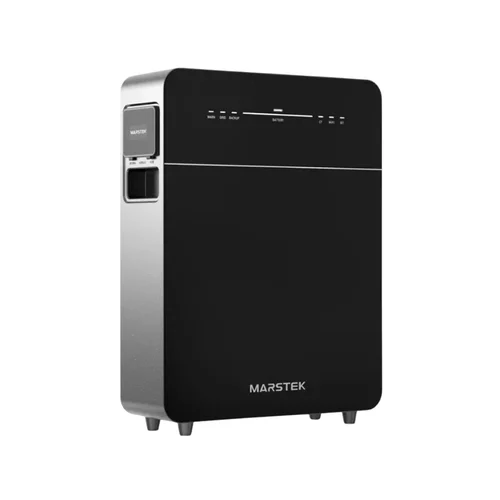
Marstek Venus 3E
Why this type of installation is becoming almost essential in rural areas
Before this outage, I primarily used this battery as an excellent solar optimization and self-consumption system.
After this experience, I see it almost as a piece of domestic resilience equipment.
Because in reality, our dependence on electricity has become enormous.
Without power today, many homes immediately lose:
- heating,
- internet,
- rolling shutters,
- lighting,
- cooking,
- sometimes even water, depending on the installations.
And when a power outage lasts several hours… or several days… the situation quickly becomes complicated.
In the countryside, this is even more true. Between winter storms, overhead lines, and sometimes aging infrastructure, long outages are not that rare.
A battery + source inverter system then brings incredible comfort.
No need to bring out a generator.
No fuel to store (especially at current prices).
No noise.
No engine maintenance.
No smell.
Everything switches almost instantly.

An experience that completely changes my view of domestic batteries
I had already mentioned in my initial test: the software interface of the Marstek Venus E is probably not the most advanced on the market.
But after this real-life outage, honestly… I almost don’t care.
Because at the moment it was essential to ensure the basics, this battery was flawless. When some of its competitors sometimes exhibited strange behavior (not all can support the powering of a complete house…).
No bugs.
No outages.
No overheating.
No strange behavior.
It simply did exactly what we expect from it: keep the house running for two full days.
And ultimately, that’s probably the most important thing for this type of equipment. In short, after this real-life test, it’s validated and approved!



Please remain courteous: a hello and a thank you cost nothing! We're here to exchange ideas in a constructive way. Trolls will be deleted.