
Résumer cet article :
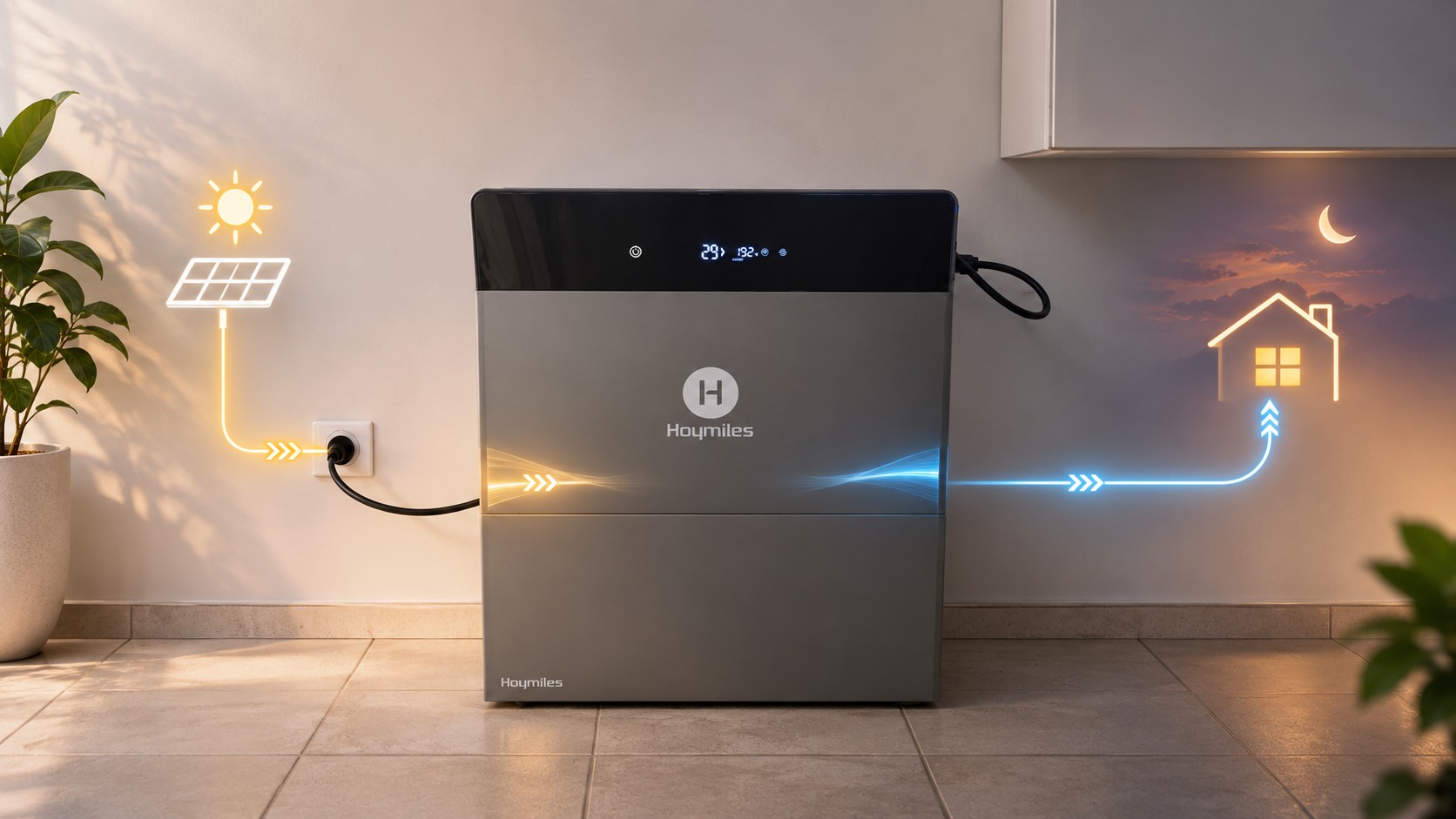
Ecoflow, Zendure, Bluetti, Anker… When people talk about plug & play solar batteries, it’s always the same names that come up. Yet there’s a good chance you already have some Hoymiles equipment at home without knowing it, since the brand makes a large share of the microinverters sold in balcony solar kits and installed on French rooftops. With the Hoymiles HiBattery 4020 AC, it’s stepping into the home energy storage market. The idea: a 4 kWh battery that plugs into a standard wall outlet, recharges using your panels’ surplus energy or during off-peak hours, then supplies that energy in the evening, when your home needs it.
I ran it at home for several weeks, with an HB-4020-S expansion unit to increase capacity to 8 kWh, my Shelly Pro 3EM to measure consumption, and an integration with Home Assistant via MQTT.
Hoymiles, a veteran of the solar industry
Hoymiles was founded in 2012 in Hangzhou, China. Its original business is microinverters: small units mounted behind each panel that convert direct current into 230 V. The brand says it is the world’s number one in this market outside the United States, sells in more than 190 countries, and employs over 2,200 people. It has been listed on the Shanghai Stock Exchange since 2021. If you’ve bought a plug & play solar kit in recent years, an HMS-800 or one of its cousins was probably hiding in the box.
Energy storage is no stranger to the company either. Hoymiles equips industrial and commercial sites with batteries, and in 2024 it launched the MS-A2, a 2.2 kWh battery that plugs in behind a balcony solar kit. The Hoymiles HiBattery 4020 AC follows it up with almost twice the capacity in a more compact enclosure. In other words, Hoymiles knew solar long before balcony batteries became fashionable, and you can tell as soon as you unbox it.
Unboxing the Hoymiles HiBattery 4020 AC
First impressions: the box is heavy. Nearly 50 kg for the main unit, including packaging. The battery alone weighs 42 kg, and the expansion unit weighs 35 kg. Make sure someone can help you lift it out of the trunk! Fortunately, there are two handles built into the chassis, and believe me, you’ll need them.
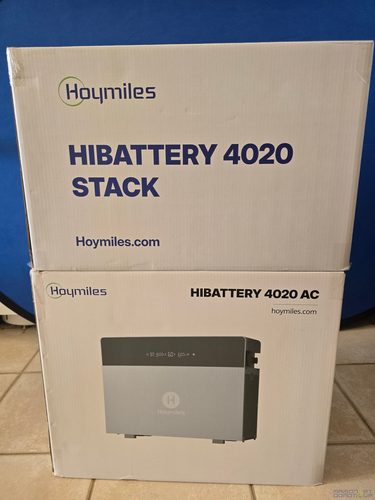
Inside the box, you’ll find the battery, a printed manual with a French-language section, wall-mounting brackets with wall plugs and screws, a waterproofing gasket, and a power cord about 1.65 m long, finished with a standard plug. At the battery end, the connector unlocks with a press of your finger, no tools needed.

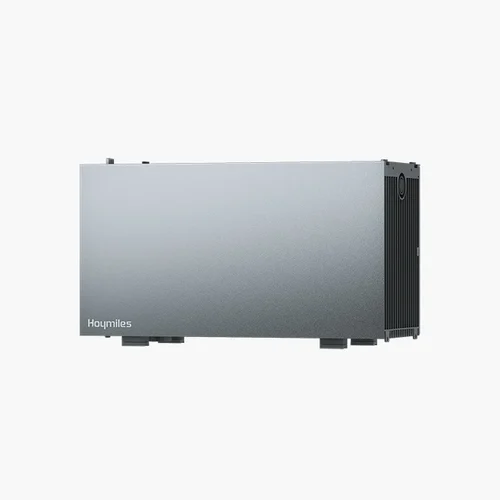
The finish feels very much like professional equipment: metal casing, exposed screws, cooling fins on the top and sides, and not an ounce of cheap plastic.

It measures 52 cm wide, 38.4 cm high, and just 19.9 cm deep. The expansion unit has the same width and depth, and is 27.5 cm high.
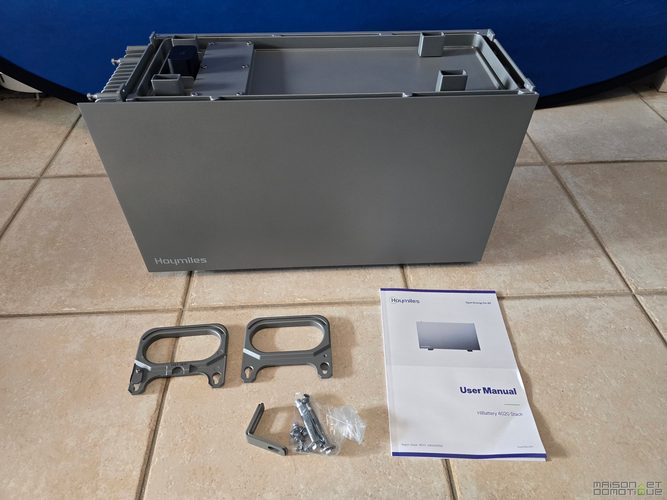
The expansion unit sits on the floor, and the main unit slots onto it via a connector underneath. You just need to remove the protective covers in place:
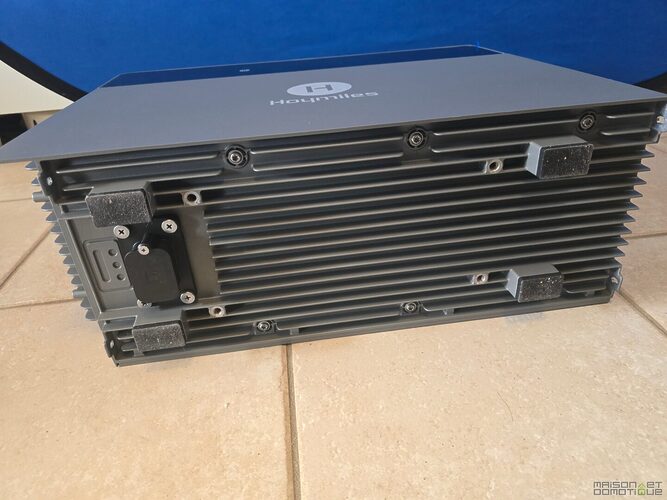
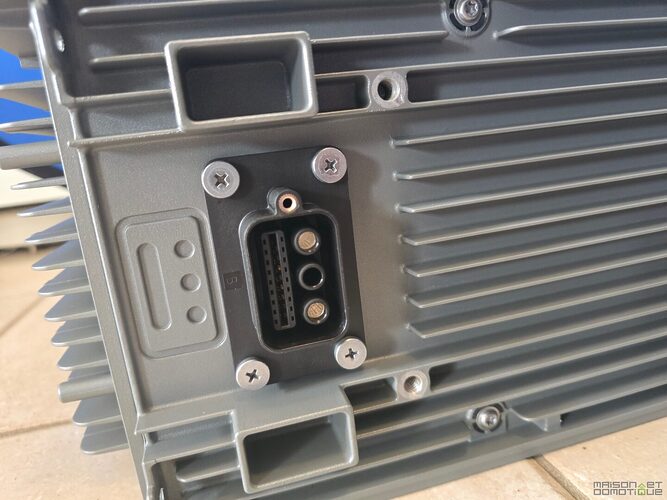
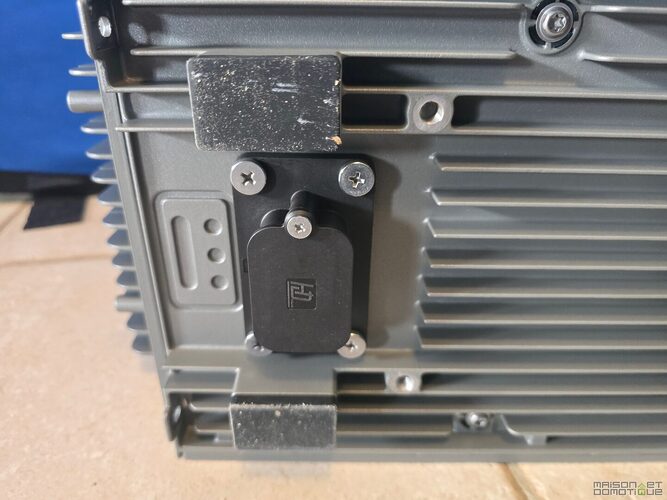
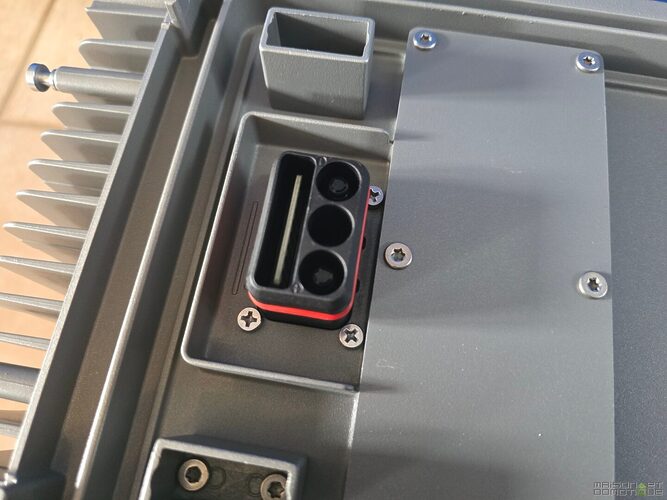
My 8 kWh stack is therefore 66 cm high and weighs 77 kg. It should be secured to the wall with the brackets provided to keep the whole setup stable, especially if the battery is in a thoroughfare.
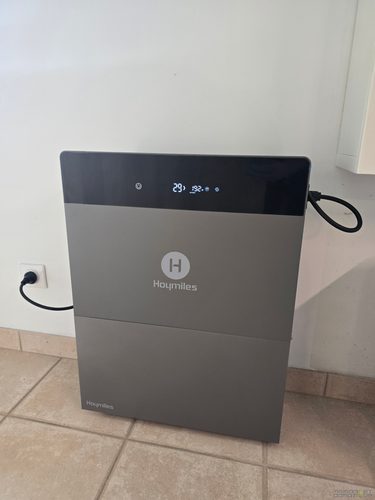
On the front, a small screen displays the charge level and the power going in or out, with touch buttons for power, Wi-Fi, and the backup outlet. A quick glance as you walk past is enough to see where things stand. The only things missing are a “%” symbol and a clear arrow to distinguish charging from discharging, which sometimes means opening the app to be sure.
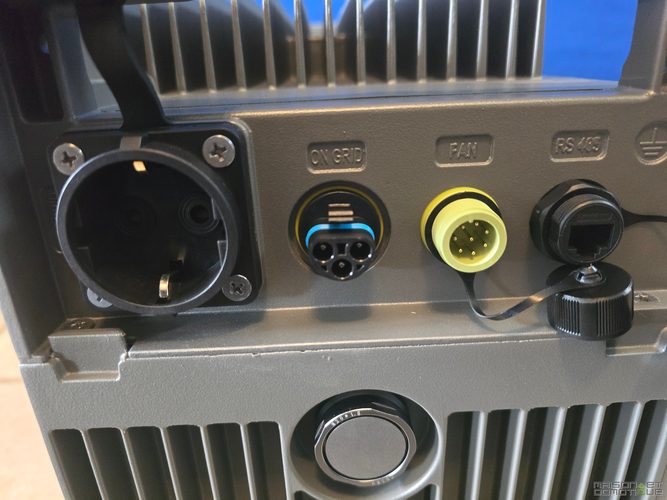
On the right side, there’s an “off-grid” outlet for backup power, an “on-grid” outlet that connects the battery to the home’s electrical grid, a “Fan” port for the optional ventilation kit, and an RJ45-format RS485 port for a wired connection to the Hoymiles meter. It’s not Ethernet, so don’t plug your router into it. A ground terminal and a pressure relief valve complete the picture.
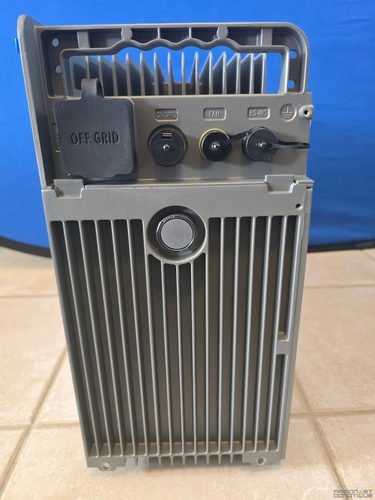
You may have come across the HiBattery 4020 X in other reviews. It’s exactly the same battery, but with four MC4 inputs for connecting up to 4,000 Wp of panels directly. The AC version doesn’t have these. It’s aimed at people who already have a solar installation, regardless of the brand of inverter or microinverters, and want to add storage without climbing back onto the roof.
What’s under the hood
Inside, four large 314 Ah LFP prismatic cells are connected in series at 12.8 V. That gives you 4,020 Wh, which is where the product gets its name. Hoymiles claims more than 8,000 cycles before capacity drops to 70% of its original level, or over twenty years at one cycle per day. The warranty is 10 years.
Safety has clearly been taken seriously. The BMS, the brain that monitors and balances the cells, incorporates 48 protection functions. An aerosol fire-suppression system is housed inside the casing, next to the pressure relief valve. LFP chemistry already greatly reduces the risk of thermal runaway, but when you’re installing 8 kWh in a garage attached to your home, it’s reassuring to know the manufacturer hasn’t skimped in this area.
The casing is IP66-certified, so it’s dustproof and protected against water jets. The battery operates from -20°C to 55°C, and a heating film kicks in below 0°C to bring the cells back into their charging temperature range. That’s reassuring in an uninsulated garage in Sologne, where January mornings can be pretty chilly. There’s no fan; cooling is passive, with noise levels claimed to be under 20 dB. I simply never heard it, even during the first few days when it was installed in the kitchen for initial testing.
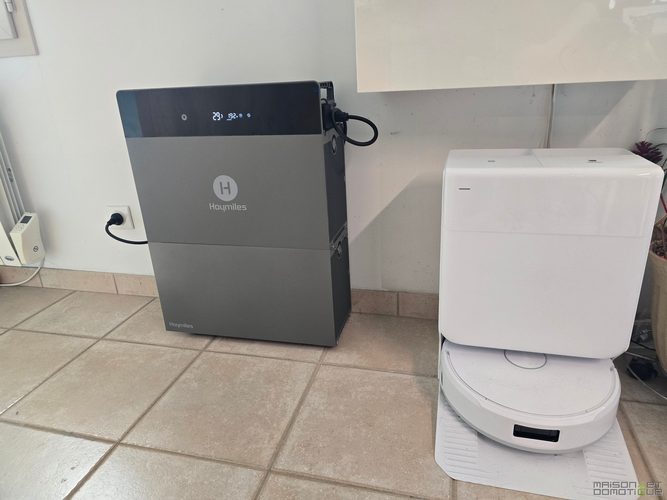
The built-in inverter is bidirectional. By default, it feeds 800 W into the on-grid outlet, and it can go up to 2,500 W if your electrical installation can handle it. It can also charge the battery from the grid at up to 2,500 W. Each battery module can handle 2,000 W while charging or discharging. Hoymiles claims a maximum conversion efficiency of 96.5%.
Installation and setup
On paper, you plug it into an outlet and you’re good to go. In real life, it all depends on the outlet.
When using an ordinary household outlet, keep the feed-in power at its factory setting of 800 W. The circuit is shared with other appliances and isn’t designed to handle more. To make use of the full 2,500 W, you need a dedicated line: 2.5 mm² cable, a 16 or 20 A type C circuit breaker, an upstream 30 mA type A RCD, and a properly installed ground connection. That’s what I did. My electrician’s qualification came in handy, and it’s a half-hour job for a professional. If your electrical panel intimidates you, leave this part to an expert.
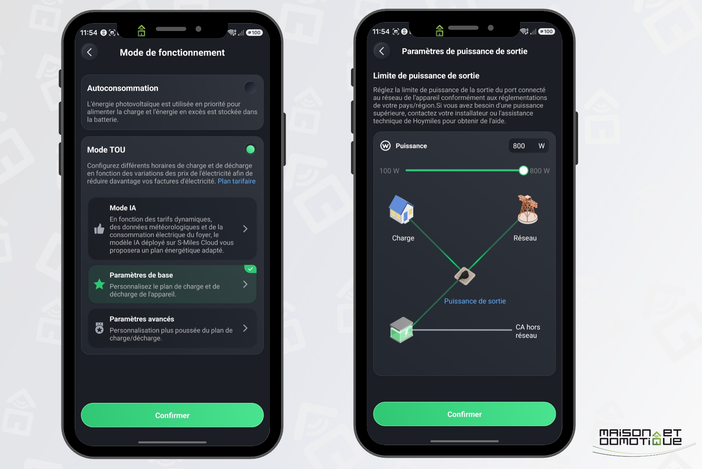
Setup is done through the S-Miles Home app, available for iOS and Android. Create an account, add a system, and the battery is detected over Bluetooth. Press the Wi-Fi button on the front, enter the password for your 2.4 GHz network, and it connects.
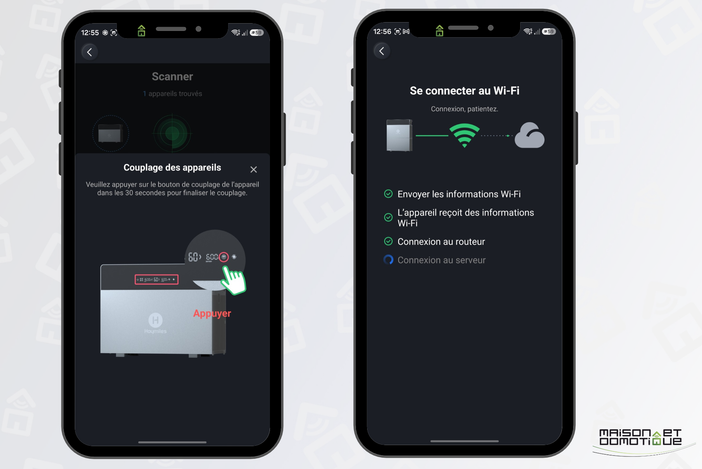
Five minutes, tops. Update the firmware right away.
The battery then needs real-time information about your home’s consumption so it knows when to charge and discharge. That’s what the meter installed in the electrical panel is for. Hoymiles sells its own Smart Meter, a DIN-rail module with a current clamp and a small 2 A circuit breaker. The battery also supports third-party meters: Shelly Pro 3EM, Shelly Plug S, EcoTracker, or Everhome. I already had a Shelly Pro 3EM in my panel to monitor my consumption, so I kept using it.
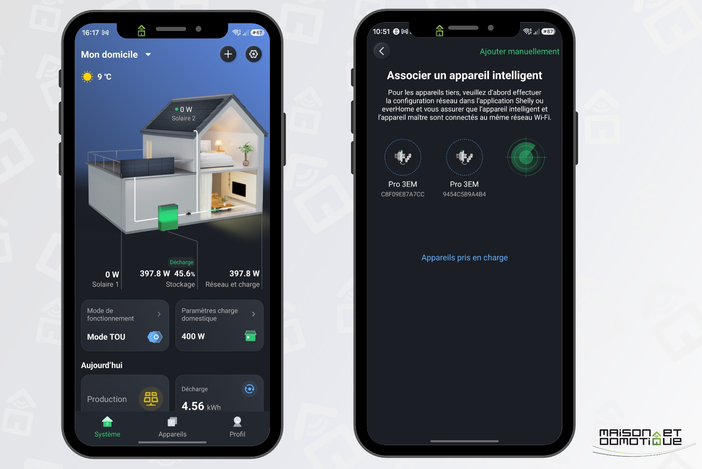
To add it, go to “Pair a smart device,” select Shelly, and the Pro 3EM is found on the local network. Note: it needs to be configured as three-phase in the Shelly app (even if you have a single-phase installation, with just one clamp in place to monitor your consumption). Otherwise, it won’t show up. Pair it with the battery and self-consumption mode is activated.
The expansion unit didn’t need any setup: it was detected automatically at startup.
The app is clear and responsive, with no ads. There are three tabs, an animated diagram of energy flows, and detailed daily, monthly, or annual statistics for production, charging, discharging, imports, and exports.
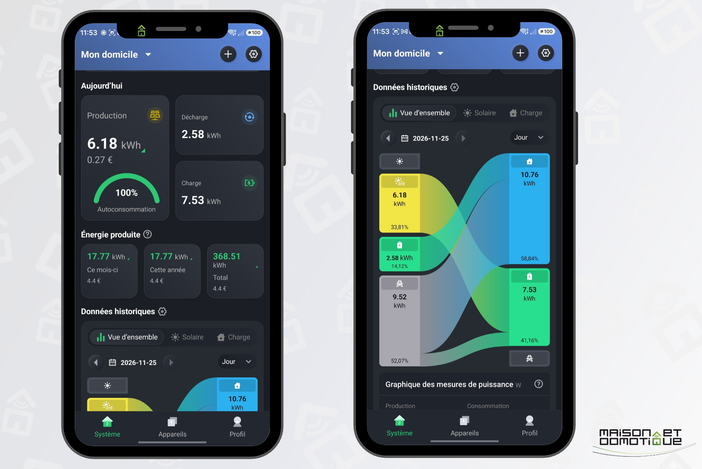
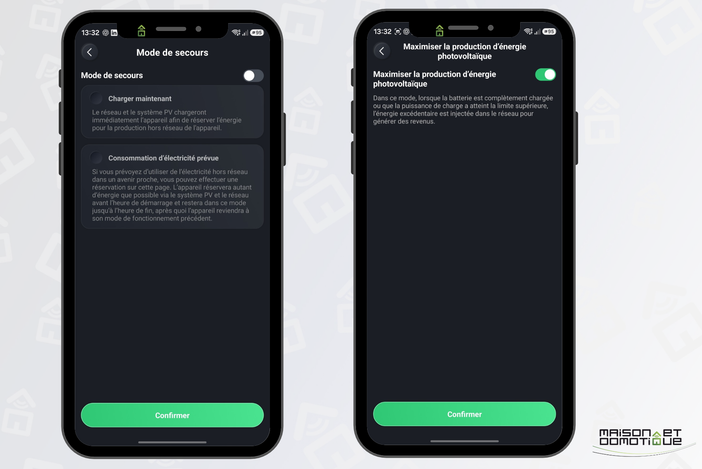
You can set the upper charge limit between 50 and 100%, the lower reserve between 10 and 70%, the feed-in power, the charging power from the grid, and whether to heat the cells. You can even restart the battery remotely, something many competitors can’t do.
Day to day: a battery that tracks your home’s needs to the watt
In self-consumption mode, the Shelly measures what’s coming in and going out at the Linky meter. When my panels produce more than the house consumes, the battery absorbs the surplus instead of letting it flow back to the grid. In the evening, when production drops off, it feeds just enough power to keep the Linky meter virtually still.
And it works remarkably well, as you can see in the graph:
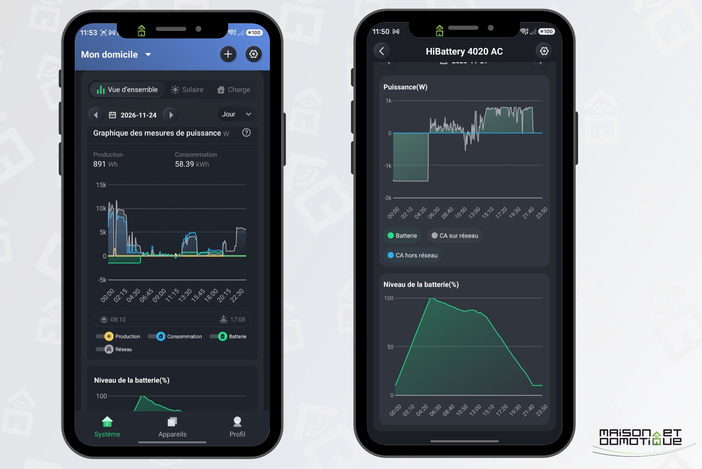
Grid imports are limited to just a few watts most of the time. The battery deliberately allows a tiny amount of power to flow back to the grid, so it doesn’t keep switching between charging and discharging. When I turn on the oven, the display responds within one or two seconds. The app takes a little longer to refresh, which can make it seem like there’s a delay when there isn’t.
You can see this in my Ecojoko readings: my consumption during the day is almost zero, even though the whole family was home on this Saturday.
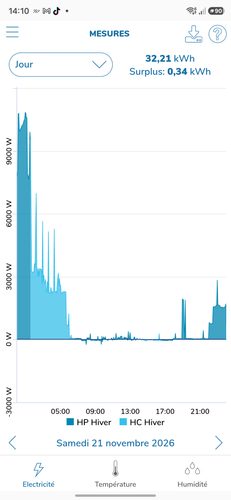
In terms of power, a single module tops out at 2,000 W when discharging. The inverter’s full 2,500 W output is only available with additional support, either an expansion unit like mine or solar power supplied to the off-grid outlet. With my 8 kWh setup, I can run the oven and one induction cooktop without drawing power from the grid. With a single module, 2,000 W is already more than enough for a typical evening with the lights, TV, router, fridge, and dishwasher.
In autumn, when the sun became scarcer, I switched to scheduled mode. The battery charges overnight during off-peak hours, then switches back to self-consumption for the rest of the day to offset peak-hour usage. Not every system lets you combine charging periods and self-consumption periods on the same day, and this setting keeps the battery useful out of season, when sunshine is scarce. The app also offers a mode based on dynamic pricing and weather-aware management, both designed mainly for the German market for now. With a Tempo plan, there’s nothing to stop you charging during blue nights and discharging during red days, as long as you set it up yourself.
Once you’ve entered your rates, you can even quickly see the savings made each day:
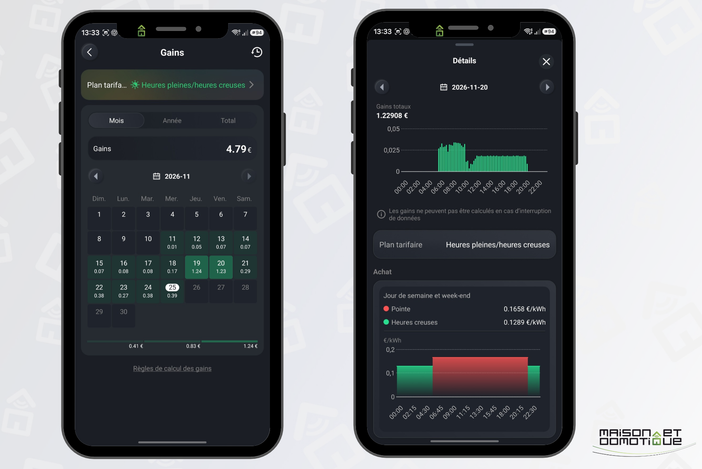
The claimed 96.5% efficiency applies to conversion alone. Over a complete cycle, charging and then discharging, taking into account losses in both directions and the electronics’ power consumption, you’re looking at closer to 85%. That’s average for this type of battery, and far more worthwhile than selling your surplus for a few cents per kWh.
The backup outlet: useful, but know how it works
The off-grid outlet supplies up to 2,500 W at 230 V, independently of the grid. Activate it by pressing and holding the dedicated button for two seconds, or through the app’s EPS settings. In the event of a power outage, devices plugged into it keep running, with a switchover time of around 20 milliseconds. I plugged in the garage freezer, the one you really don’t want to lose after a storm and six hours without power.
Only devices plugged into this outlet are backed up, not the rest of the house. If you want to power the whole house, ideally you’ll need a transfer switch, so you can easily switch between the grid and the battery.
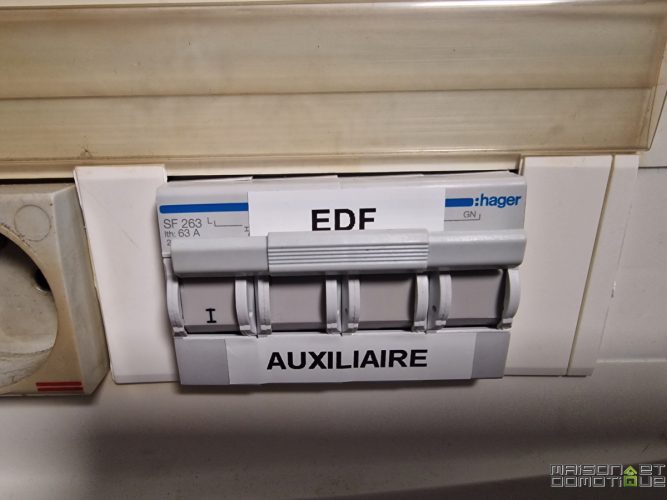
Warning: if the battery isn’t grounded, only connect Class II appliances, identifiable by the double-square symbol.
One interesting point: although the Hoymiles HiBattery 4020 AC doesn’t have MC4 inputs for connecting solar panels directly, you can still connect a microinverter and its panel to it. The microinverter then syncs with the 230 V produced by the battery and charges it, even during a power outage. In this setup, it’s compatible with all inverters, not just those from its own brand. Perfect for a garden shed or a small off-grid site.
Finally, the app has a backup mode that forces a full recharge when a storm is forecast. Out in the countryside, winter power outages are part of the deal, so I expect this feature will come in handy in the weeks ahead.
Home Assistant integration via MQTT
This is where the geek in me had a field day. The HiBattery offers an open MQTT service that you can enable directly in the app. Enter the broker address (in my case, the Mosquitto add-on for Home Assistant), the port, a username, and a password.
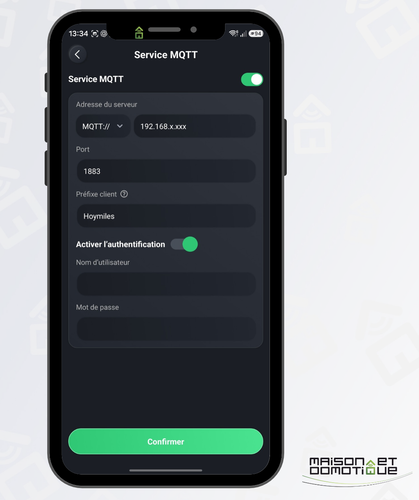
A few seconds later, the entities appear: charge level, charging and discharging power, off-grid outlet status, imported and exported energy…
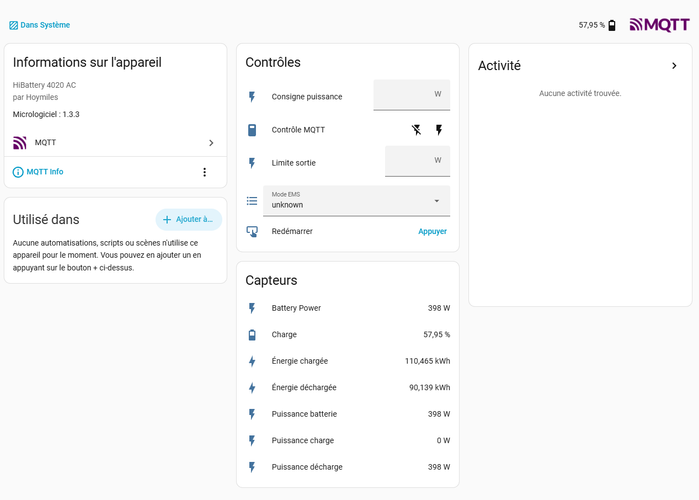
I use it in particular to divert surplus power to the water heater. The trigger is when the battery charge exceeds 95%. The condition is that the Shelly Pro 3EM measures more than 1,000 W of exported power for five minutes. The action is a Shelly relay that switches on the water heater, then turns it off as soon as export drops. Electricity that was previously sent to the grid for next to nothing now heats the water for the kids’ showers. Another very simple automation: a notification on my phone if the charge drops below 20% and Météo-France is forecasting thunderstorms.
Of course, the battery fits right into the Energy dashboard in Home Assistant:
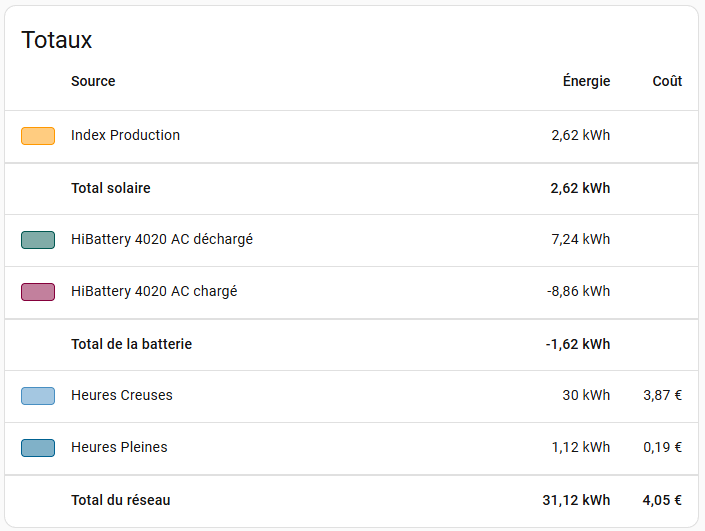
The MQTT commands available are still more limited than the read-only data, and some settings still have to be changed in the app. But an update due at the end of December is set to add more features in response to user feedback. Finally, an important point: everything works locally, with no cloud dependency, which is rarely this easy with the competition. That’s a big plus for Hoymiles!
A few minor drawbacks
Nothing deal-breaking, but they’re worth knowing about. First, the weight: 42 kg for the main unit, so don’t carry it alone if you care about your back. The RS485 port is very poorly documented. You need a dedicated line to get the full 2,500 W, so some electrical work is required. And anyone hoping to control everything from Home Assistant will have to wait a little longer.
My verdict on the Hoymiles HiBattery 4020 AC
Given Hoymiles’ track record, I expected a solid battery. I hadn’t expected it to be so easy to live with. It tracks the home’s consumption with impressive precision and takes just a few minutes to set up once the outlet is ready. It also works very well with a Shelly, which many of you already have in your electrical panel. The build quality inspires confidence, and the expansion units let you scale up to 16 kWh, so you can start small and add capacity as your needs grow.
The AC version is primarily for people who already have panels, on the roof or at the back of the garden, and are tired of selling their surplus for a handful of cents. It also makes sense even without solar, if you have an off-peak or Tempo electricity plan. An electrician can confidently recommend it to clients, since all it needs is a dedicated circuit and a meter. And Home Assistant enthusiasts will appreciate its local MQTT support.
It’s available for €1,499 for the main unit, and €1,078 for the HB-4020-S expansion unit. Note that Black Friday deals are currently available, making it possible to get one for less. If you’re looking for a serious energy storage solution, this could be the perfect time to take the plunge!
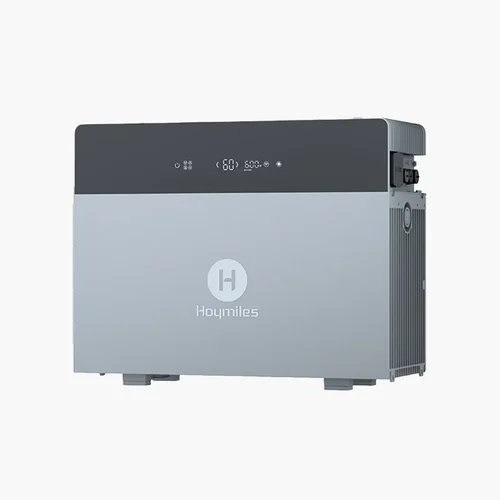
Batterie principale HiBattery 4020 AC