


Résumer cet article :
Turning on the lights from the sofa is nice. A smart home system that lowers your electricity bill and earns you a few dozen euros a year on top—that’s another story!
That’s the direction Enki is taking. With the heating season approaching, Leroy Merlin’s smart home solution is going all in on energy: the Energy Bonus is being extended to water heaters, a new module costing less than €30 makes an existing radiator smart, the list of compatible radiators is growing significantly, and the app is getting an energy management overhaul.
I attended the presentation of this new strategy by the Enki team. The new products are one thing, but the underlying idea goes further: turning thousands of radiators and water heaters into a huge pool of flexibility that helps relieve pressure on the electricity grid when it is under strain… and pays households for taking part.
The Energy Bonus comes to water heaters
The Energy Bonus was already available for Enki-compatible electric radiators. The idea is clever: rather than consuming electricity at all costs when the grid is under heavy demand, Enki temporarily reduces the consumption of certain appliances. In return, the user gets paid.
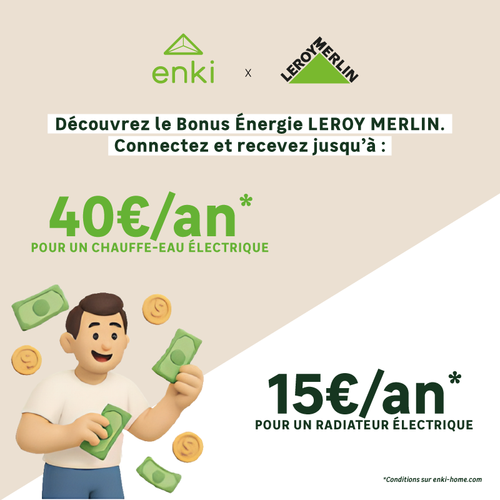
For radiators, this can amount to €15 per appliance per year. The program is now being extended to electric water heaters, with up to €40 a year.
A home with four compatible radiators and a water heater could therefore earn up to €100 a year.
Don’t worry, nobody’s going to turn off your heating when it’s -5 °C outside!
Enki explained how it works during the conference. When the grid calls for load reduction, participating radiators are controlled in rotation, in 15-minute intervals. The user chooses which ones take part in the Energy Bonus. The power drawn is reduced for a while, without the temperature in the home dropping noticeably.
For the water heater, it’s even simpler. Whether your 200 litres of water are heated at 2 p.m. or 10 p.m. doesn’t really matter, as long as there’s hot water when you need it. And a smart home knows exactly how to make the most of that kind of flexibility.
Your water heater becomes almost like a battery for the grid
A hot water tank stores energy as heat, so its heating can be shifted to another time.
If there’s excess electricity at some point during the day, Enki starts heating the water. During a consumption peak, it delays the heating.
For a single home, shifting a few kilowatt-hours obviously makes no difference to the French grid. But add together thousands of water heaters and radiators—perhaps hundreds of thousands in the future—and it starts to add up.
That’s the principle behind a virtual power plant: bringing together lots of small appliances to provide a substantial amount of controllable power.
Thomas Deflandre, CEO of Enki-Home, offered a striking comparison: if one million households shift their consumption at the same time, the power freed up is on the order of that produced by a nuclear reactor. The idea is to consume electricity when it’s more readily available, cheaper and less carbon-intensive.
Enki is aiming to provide several gigawatts of controllable capacity in France by 2030.
That’s a far cry from a simple smart thermostat.
A much smarter water heater in the Enki app
It still needs to be simple to use. Nobody wants to check the state of the electricity grid before taking a shower. So Enki has substantially reworked how water heaters are managed in its app.
To connect an existing electric hot water tank, you need a module sold at Leroy Merlin for around €39.90. The app then displays its energy consumption and power usage, and offers several operating modes.

For example, you can switch off the hot water completely while you’re on holiday and schedule it to turn back on before you return. No more freezing-cold showers on Sunday night when you get home…
There’s also a Boost mode to heat the water on demand, plus custom schedules to fit your household’s routine.
The app also manages peak and off-peak hours automatically. Enki says there are four scheduling modes, and charts have been added to track the tank’s energy consumption.
Once the water heater is enrolled in the Energy Bonus, some of this management happens automatically in response to the grid’s needs.
No need to replace your old radiators
This is the new feature I find most relevant: Enki is finally taking proper care of radiators that are already installed. Because telling people to replace five perfectly good radiators with smart models costing €250 each, in the name of saving electricity, is a hard sell.
So Enki is launching a small external control unit for less than €30 that makes an existing electric radiator smart.

The external design also has a practical advantage. Until now, installing a control module generally meant reaching behind the radiator or into a wall box. With this unit, installation should be within reach of many more people.
Once connected to Enki, the old radiator benefits from smart control and can also join the Energy Bonus program.
I think this is a smart move. Rather than reserving advanced features for homes with brand-new equipment, Enki is bringing existing appliances into its ecosystem.
Enki smart radiators from €89
For those who need to replace their radiators anyway, Leroy Merlin is also expanding its range of compatible products. According to Enki, 80% of the smart heating products sold by Leroy Merlin are now compatible with its platform. The range includes Noirot, Sauter, Bestherm and Airelec, with entry-level prices starting at €89.
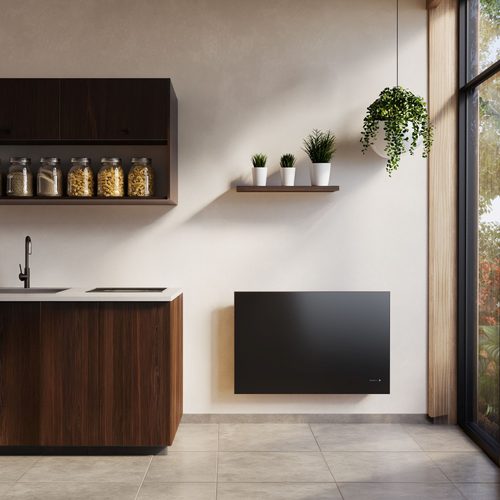
Leroy Merlin’s own brand, Equation, is also adding a new range, Fuji, with 24 models featuring dry inertia, fluid inertia or dual-core heating. Official prices start at €249.
Some models connect directly to Enki, with no additional hub required.
In short, smart heating is no longer reserved for high-end radiators costing several hundred euros, and that’s good news.
Heating control becomes easier to understand
The app is also getting an update on the heating front.
Instead of programming each radiator one by one, you create modes that fit your lifestyle: working from home, an evening in, away… When you select a mode, all the radiators adjust their setpoints.
Room-by-room scheduling is still available for those who like to fine-tune every detail.
The interface now gives you a clearer overall view of your heating, and a preview feature has been added: before switching off the heating or changing a setpoint, you can see what the result will be.

For now, Enki doesn’t offer true heating management based on the location of every household member. The team says it quickly gets complicated when you have children or people who don’t always carry their smartphones. However, you can already create scenarios linked to the alarm system. Alarm on, house empty: the heating switches to Away mode. Alarm off: the usual schedule resumes. That’s proper home automation, and probably more reliable than imprecise location tracking.
Up to €710 in savings
During the presentation, Enki put forward a figure that’s sure to catch people’s attention: a household could save up to €710 a year through its overall approach to energy management.
It’s important to understand what this figure covers. Enki isn’t paying you €710, and it isn’t just the savings from controlling your appliances. The calculation combines several factors: optimised heating, the Energy Bonus, optimisation of your electricity plan and other energy management savings.
For heating, Enki says smart control can save up to 20%. What you actually save will depend enormously on your home: its insulation, your preferred temperature, the equipment you have installed, and especially your current habits.
The Energy Bonus is much easier to quantify: up to €15 per radiator and €40 per water heater every year. And unlike theoretical savings on your bill, it’s a reward you can actually see come through.
Enki moves up a gear
To me, this is the real significance of these announcements.
Enki remains a general-purpose smart home platform: lighting, blinds, alarms, cameras, heating. Its ecosystem boasts around 500 compatible devices from 25 major brands, including Somfy, Legrand, Netatmo, Philips Hue, Sauter and Acova.
But energy is clearly moving to the heart of the strategy, and I think that’s the right choice. For years, smart homes have focused mainly on comfort: turning on a lamp from your smartphone, closing the blinds automatically, asking a voice assistant to turn up the heating.
The next step is putting that intelligence to work to save money.
Connecting a radiator to schedule it more effectively is already a good thing. Connecting thousands of them, along with water heaters, to automatically shift their consumption when the grid needs it—and returning some of the value to households—takes things much further.
We’ll have to see how it performs in real-world conditions. Is the new module really easy to install? Does the control work well? Do the savings materialise, and is the Energy Bonus transparent?
We’ll probably have a chance to revisit this in a few months and see how things are going! In any case, on paper, I really like the direction this is taking!


Please remain courteous: a hello and a thank you cost nothing! We're here to exchange ideas in a constructive way. Trolls will be deleted.