



Résumer cet article :
In April, I explained why Zigbee 4.0 could change quite a few things in home automation. One of the new features really caught my eye: Suzi, Zigbee’s Sub-GHz extension. The idea can be summed up in one sentence: keep the mesh, low power consumption and huge Zigbee catalog, but with much greater range and less trouble from walls. There was just one small detail that was anything but small: no products could be certified yet.
That changed on September 2, 2026. The Connectivity Standards Alliance (CSA) opened its Suzi certification program, and manufacturers can now get their Zigbee Sub-GHz solutions and interoperability validated. The first certified software stacks are already here, too. There’s still nothing for us to plug in at home, but we’re getting closer.
A quick reminder: what Zigbee 4.0 already brought to the table
Zigbee 4.0 goes quite a bit further than the Zigbee 3.0 we use every day with Home Assistant, Jeedom, eedomus or manufacturers’ gateways. It includes new security features, a revamped commissioning process, “batch commissioning” to pair several devices at once, and Zigbee Direct, which uses Bluetooth Low Energy to perform certain operations from a smartphone. It all remains backward-compatible with Zigbee 3.0.
But Suzi was what interested me most.
Until now, Zigbee meant 2.4 GHz. That’s convenient because the band can be used everywhere, but it’s also used by Wi-Fi, Bluetooth and a host of other devices. Suzi takes Zigbee below one gigahertz. The CSA refers to a band around 800 MHz in Europe and 900 MHz in North America. The implementations unveiled so far are aimed more specifically at 868 MHz here and 915 MHz across the Atlantic.
So Zigbee gains one of Z-Wave’s traditional selling points: a lower frequency that reaches farther and generally passes through obstacles more effectively.
Suzi certification is now open
Put that way, it sounds administrative. In practice, it’s the missing step. Manufacturers could already develop products using Suzi, but they couldn’t sell a product certified to this standard.
Since September 2, they can submit their products to the CSA. It checks interoperability between brands, security requirements and that the devices work properly. We’re no longer just talking about what Zigbee might be able to do one day: manufacturers can start preparing real products.

The first building blocks are already certified
Exegin Technologies is one of the first two software stack providers in the world to earn Suzi certification. That’s not exactly a surprise: its CEO, Leslie Mulder, is vice chair of the CSA’s Zigbee Sub-GHz working group, which helped develop Suzi.
I’ll admit it: a certified network stack is less exciting than a new Aqara sensor or a USB dongle for Home Assistant. But without this invisible building block, there’ll be no sensors or dongles.
One interesting detail: Exegin says its software is silicon-independent. That means a manufacturer could pair it with different processors and Sub-GHz radios, without being locked into a single chip family.
Why Sub-GHz has greater range
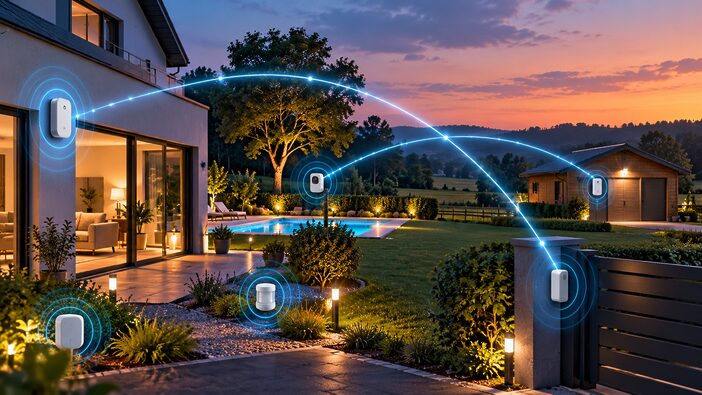
Think of a sensor at the far end of the garden, a detector on the gate, a probe in the shed, or a module in the pool equipment room or an outbuilding. With 2.4 GHz Zigbee, things can get complicated pretty quickly. You end up putting a smart plug halfway along the route just to use it as a router.
That’s exactly what Suzi aims to avoid. Below one gigahertz, waves pass through walls and structures more easily, and travel farther. The CSA also says there should be fewer interference issues when lots of devices share the airwaves.
Some long-range technologies mainly use a star topology. Suzi, on the other hand, keeps Zigbee’s mesh network. A device that’s continuously powered relays messages, and the network finds another route when a node disappears or a connection deteriorates. You get the benefits of Sub-GHz radio without losing what makes Zigbee strong.
Suzi won’t replace your current Zigbee setup
Suzi isn’t here to bury 2.4 GHz Zigbee: the two will coexist. The CSA provides for several architectures: an all-Sub-GHz network, a dual-band coordinator, or a mixed network with gateways between 2.4 GHz Zigbee and Suzi.
In practice, you could have a smart home hub with both radios. The home’s bulbs, plugs and sensors stay on 2.4 GHz. The gate sensor, outdoor probe or device in the outbuilding use Suzi. The controller links the two.
That’s a good thing, because nobody wants to throw away the dozens of Zigbee devices they already have at home.
Your current dongle won’t work with Suzi
Be careful not to confuse protocol compatibility with radio compatibility. I already mentioned this in April: no software update can turn a 2.4 GHz radio into an 868 MHz radio. Your coordinator may get Zigbee 4.0 firmware, but it won’t communicate over Sub-GHz if that radio isn’t on the board.
For Home Assistant, Zigbee2MQTT or ZHA, Suzi will therefore most likely arrive with a new generation of coordinators or dual-band gateways. There’s no need to rush, since consumer products aren’t available yet. An open certification program doesn’t mean you’ll find products in stock on Amazon tomorrow morning.
Huge range? Take the numbers with a grain of salt
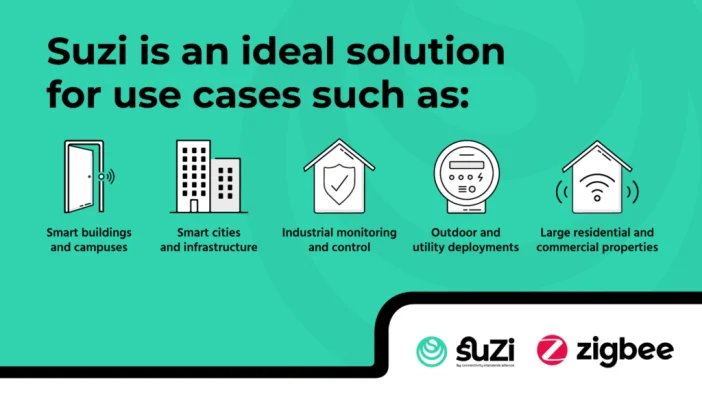
I can already see the marketing claims coming. The CSA talks about long range, better wall penetration and networks that need fewer repeaters. It has large buildings, campuses, outdoor installations, industry, smart cities and large properties in mind.
It’s still too early to promise several hundred meters with any product. Actual range will depend on the permitted power, the antenna and the data rate selected. It will also depend on the walls, other radio devices nearby and local regulations. A small sensor that’s meant to last for years on a coin cell won’t have the same radio as an outdoor unit plugged into mains power.
What matters to me is that Zigbee now has a standard architecture for using Sub-GHz, with mesh networking and interoperability between brands. That’s much more interesting to me than a range figure printed on a box.
A more serious competitor to Z-Wave?
The comparison is an obvious one. Sub-GHz was one of Z-Wave’s major selling points over Zigbee. In Europe, Z-Wave uses the 868 MHz band, away from the congestion of 2.4 GHz, and it propagates well through buildings. Suzi is entering that exact space.
But Zigbee already has a huge catalog behind it: lighting, plugs, temperature sensors, presence detectors, thermostats, locks, in-wall modules… If manufacturers get on board, Zigbee could combine this catalog with some of the radio advantages that set Z-Wave apart.
It all depends on that “if.” A well-designed standard isn’t worth much without products.
And what about Matter?
Matter and Zigbee don’t operate at the same level. Matter mainly defines how devices communicate and expose their features. Zigbee provides a complete network technology designed for low-power devices. So Suzi isn’t Zigbee’s response to Matter.
The CSA now has several technologies, each for a different use. Thread works well for many low-power Matter devices, and Wi-Fi for those that need bandwidth. Zigbee, and now Suzi, are for mesh networks packed with small devices. In my view, tomorrow’s smart home will rely less on a single protocol and more on gateways that can run several networks together.
Suzi could solve real problems in the home
That’s where I see the most potential. At my place, with the house, garden, pool and outdoor equipment, radio range is a real issue. Being able to put a sensor or actuator far from the house without building a chain of Zigbee routers? I’m all for it.
The same goes for a gate several dozen meters away, a connected mailbox, a greenhouse, a workshop or a detached garage. The CSA also lists outdoor areas and large properties among its target uses. In offices and industry, the benefits are even clearer: multi-story buildings, concrete or steel walls, and large areas to cover.
Since the network remains mesh-based and low-power, battery-powered sensors retain what made Zigbee so successful.
So, when will we be able to use it with Home Assistant?
Not just yet. Certification and the first certified stacks show that the ecosystem is taking shape. Everything that directly concerns us is still missing: coordinators, dual-band gateways, sensors and actuators. Home automation software will also need to support them.
I’ll keep an eye on Zigbee2MQTT and ZHA when the first consumer Suzi coordinators come out. That’s when we’ll be able to see what difference it makes to a Home Assistant setup.
Until then, there’s no reason to touch a Zigbee 3.0 setup that’s working. Zigbee 4.0 was designed for a smooth transition, after all. But if you’re planning to equip a large property, an outbuilding or remote devices in the coming years, make a note of this name: Suzi.
In April, I concluded that everything would come down to the first products and compatible coordinators. Five months later, we have certification and the first software building blocks. All that’s left is the fun part: devices to install at home. Probably by the end of the year, or early 2027. We’ll likely get a preview at CES, where I’ll be keeping an eye out for it ;-)



Please remain courteous: a hello and a thank you cost nothing! We're here to exchange ideas in a constructive way. Trolls will be deleted.