


Résumer cet article :
As we have seen through the latest tests, robotic lawn mowers have progressed tremendously in recent years. We are far from the models that required a peripheral cable, a perfectly placed RTK antenna, three prayers to the GPS god, and a garden as flat as a golf green. And with the Mammotion LUBA 3 AWD, we enter a different category.
I tested the Luba 3 AWD in its 3000 m² version. It is a model designed for large plots, complicated gardens, somewhat winding paths, areas with trees, slopes, holes, mounds, and everyday obstacles. Not just for a showroom lawn.
The LUBA 3 AWD range is available in several versions based on the announced mowing area: 1500, 3000, and 5000 m². All rely on the same technical base. The main difference lies in the surface capacity and the battery. The behavior, navigation, mowing, application, and overall philosophy remain the same.
The big innovation of this generation is the Tri-Fusion navigation. Mammotion combines a 360° Lidar, AI vision through dual cameras, and NetRTK via the iNavi service. No need to install a physical RTK antenna in the garden anymore. For those who have already lost an evening searching for the best possible location for an antenna, this is excellent news.
On paper, the LUBA 3 AWD ticks all the boxes for a high-end robotic lawn mower: four-wheel drive, a cutting width of 40 cm, two 165 W cutting motors, electrically adjustable height from 25 to 70 mm, multi-zone management, intelligent mapping, live camera, wildlife protection, Wi-Fi/4G connectivity, and the ability to climb slopes up to 80%, or 38.6°.
But a technical sheet does not mow a lawn. What matters is the actual behavior, especially on a living terrain. And this is where the LUBA 3 AWD becomes interesting. After testing it for 3 months, here is my feedback.
Unboxing and presentation of the Mammotion Luba 3 AWD
The Luba 3 AWD arrives in an imposing box, just like the robot.
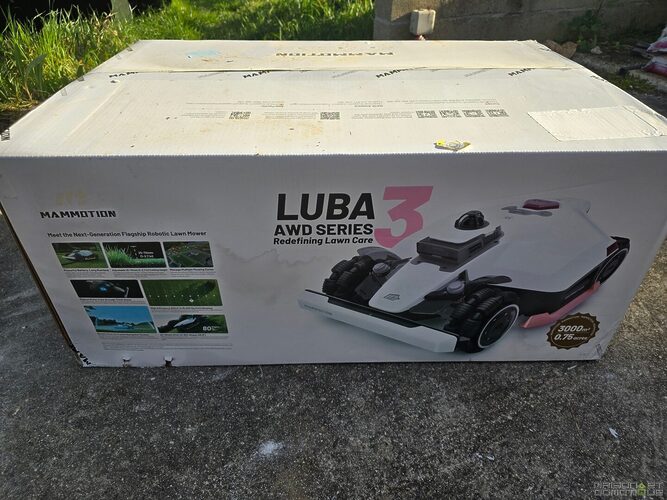
As soon as you open it, you can tell that Mammotion is targeting the premium segment. The robot is well protected, the accessories are neatly stored, and the quick start guide covers the essential first steps.
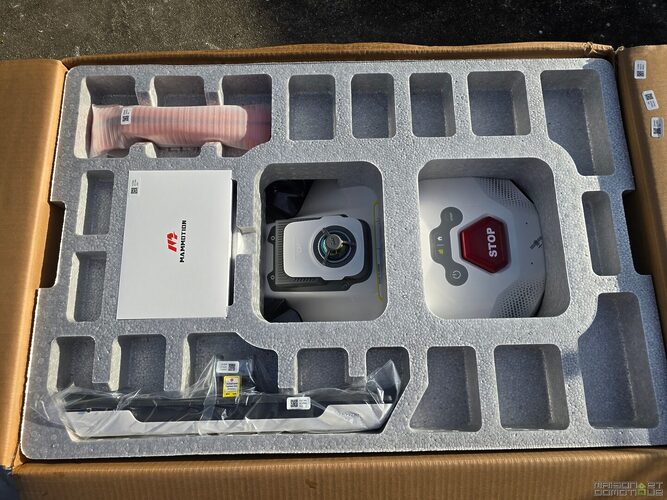

Inside the box: the robot, the charging station, the power adapter, the base fixation elements, the front bumper to install, the side protections, a safety key, a screwdriver, a small cleaning brush, and a set of spare blades. Finding extra blades right from the start is a nice touch, especially for a robot that uses two cutting decks with six blades each.
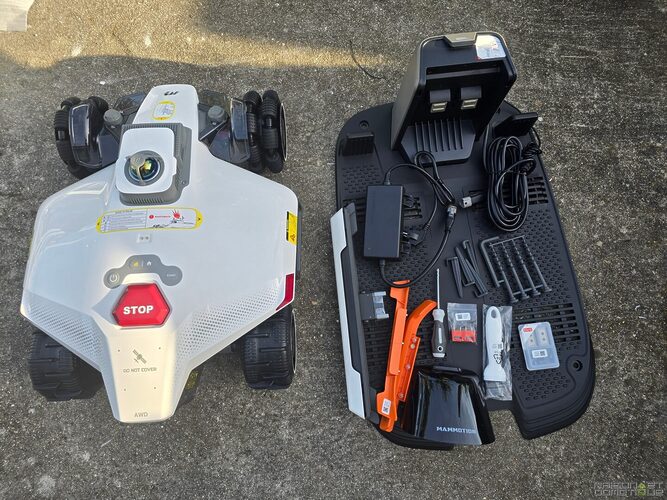
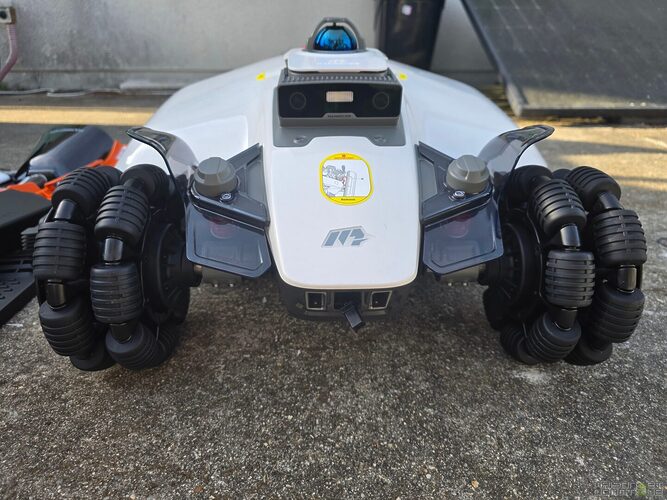
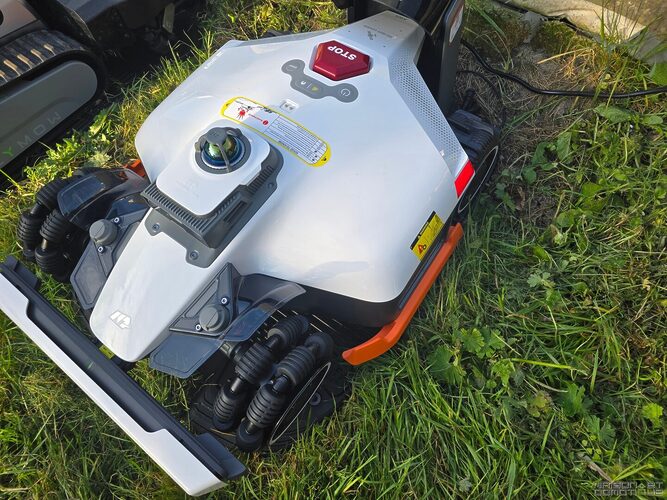
The design remains true to Mammotion. The LUBA 3 AWD still has that look of a small white Formula 1 placed in the garden. Sturdy, futuristic, somewhat aggressive, yet quite successful. You can immediately recognize the brand’s signature.

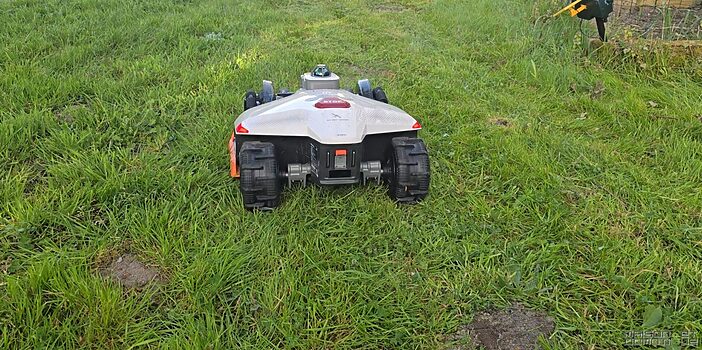
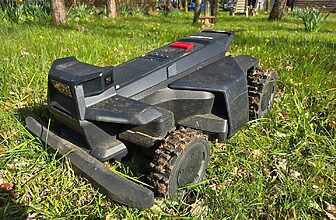
More imposing than a compact model like the LUBA Mini, it retains a fairly low profile, with large rear knobby wheels and omnidirectional front wheels.

On the top, you can’t miss the 360° Lidar turret, protected by a cage. It’s one of the key elements of this new generation.

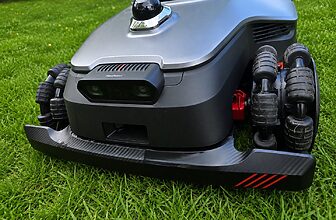
At the front, two cameras ensure stereoscopic vision, accompanied by LED lighting to work even when the light is low.

The mechanical bumper completes the set to stop the robot in case of contact with an undetected obstacle.
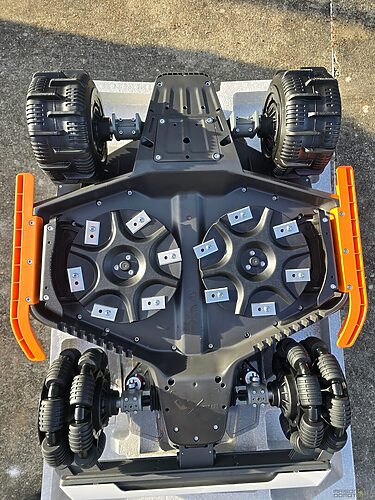
Under the chassis, two cutting discs with a total width of 40 cm. The blades spin up to 3,000 RPM, at a speed adjustable from the app. This is smart, as you don’t always need maximum power. On an already maintained lawn, a medium speed is often sufficient, with less noise and better autonomy.
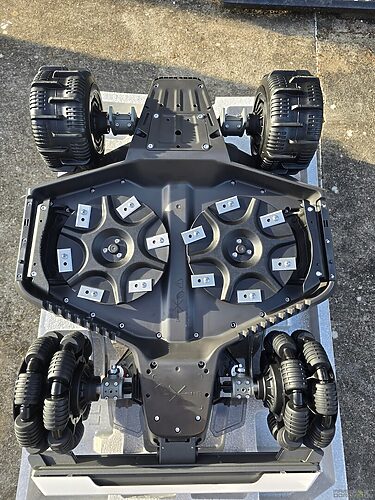
The robot weighs about 19 kg. Not a lightweight, but this weight contributes to its stability. You can feel that the machine is built to work on imperfect terrains. The plastics inspire confidence, the assemblies are clean, and the exposed parts seem robust.

A very high-end technical sheet
The Mammotion Luba 3 AWD is primarily a wireless robotic lawn mower. No cable to bury around the plot. The delimitation is done through mapping in the app.
The Tri-Fusion navigation combines three technologies. The 360° Lidar scans the environment and helps the robot understand the structure of the garden. The two front cameras detect obstacles, objects, animals, or unusual elements on the ground. The NetRTK via iNavi ensures precise positioning without a local RTK antenna, thanks to integrated Wi-Fi or 4G.
This is probably the biggest asset of the Luba 3 AWD. While some robots mainly rely on RTK, others on Lidar, and still others only on camera, Mammotion combines the approaches. The robot therefore has multiple sources of information to know where it is and what it should avoid.
On the aspect of traction, it has four independent drive wheels. Each wheel is motorized, with management designed for slopes, holes, bumps, and uneven terrains. Mammotion claims a capacity to climb up to 80% slopes, or 38.6°. As always, this value corresponds to favorable conditions: dry terrain, correct grip, well-maintained grass.

On wet, muddy, or very uneven ground, you shouldn’t expect miracles. But in real life, the LUBA 3 remains one of the most comfortable robots I have observed on difficult terrain.

The cutting relies on two 165 W motors, a width of 400 mm, and a total of twelve blades. The cutting height is motorized and adjustable from the app between 25 and 70 mm. Comfortable, especially during the first cuts of the season. You can start high and then gradually lower to achieve a shorter lawn.

The tested version, the LUBA 3 AWD 3000, is advertised for 3,000 m². Mammotion announces up to 175 minutes of autonomy, with automatic return to the base and resumption of mowing where the robot stopped. The higher version has a more generous battery, but the logic remains the same.
The robot is IPX6 certified, allowing for cleaning with water jets. No pressure washer, of course. That would be the best way to turn a premium robot into a very expensive paperweight.

Installation: finally a high-end robotic lawn mower that is easy to set up
The installation of the Luba 3 AWD is significantly simpler than that of the old RTK generations with positionable antenna. No need to search for an open point, no need to fix an antenna on a mast, no need to run an extra cable. You place the base, power it, connect the robot to the app, and start the configuration.
The front bumper must be connected first and then screwed on.

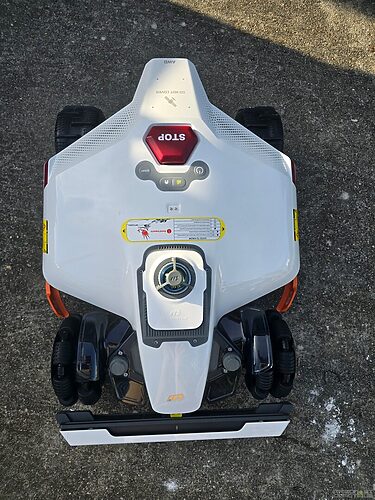
The side protections attach under the robot. Mammotion provides the appropriate screwdriver, which avoids rummaging in the workshop. Just be careful not to place the robot haphazardly on the Lidar turret during handling. It is protected, but it is not a carrying handle.

The base is placed on a stable and relatively flat surface, with clear access for the robot to exit and enter without contorting itself. You should also plan for electrical power nearby. The provided cable is okay, but depending on the chosen location, a well-placed outdoor outlet remains indispensable.
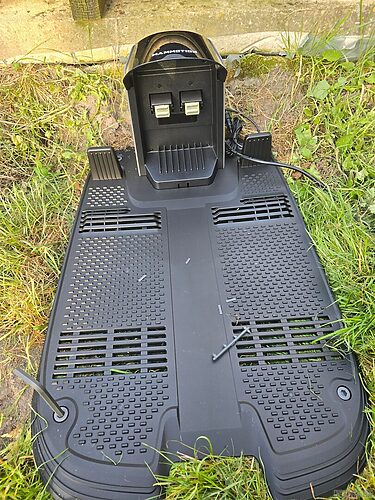
In my case, I chose a central location so that the robot can easily access the different areas of the garden. This is often the best choice when the terrain is cut up or when there are several passages to take.
Pairing with the Mammotion app is quick. The robot is detected, you connect it to Wi-Fi, and then an update may be proposed.

It’s better to do it before the first mapping. Modern robotic lawn mowers are as much mechanical machines as they are software products: an update can improve navigation, detection, trajectories, or stability.

Mapping: manual or automatic, but it’s better to prepare your terrain
Mapping can be done in several ways. The manual mode remains, in my opinion, the most accurate. You pilot the robot like a remote-controlled car from the app, following the boundaries of the plot. The app records the path and creates the mowing zone.

It’s simple, but you need to take your time. The quality of the mapping directly influences the quality of mowing, especially at the edges. A margin too wide when creating the map will leave more uncut grass along walls, fences, or flower beds. Too ambitious, and it may get stuck or trigger safety features in certain passages.
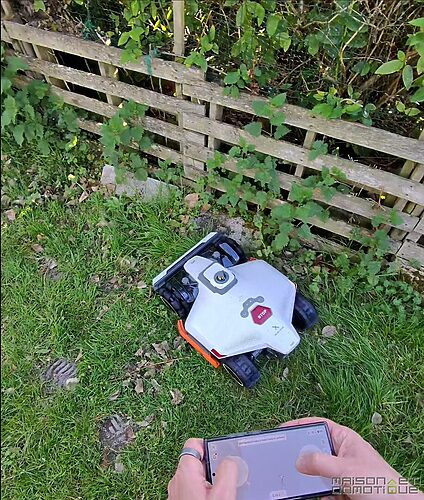
The LUBA 3 AWD can also perform automatic mapping. Thanks to the Lidar, it explores the environment and tries to understand the boundaries of the garden. It’s impressive to see, especially over a large open area. But one must remain realistic: automatic mapping often retains more margin. For a simple terrain, it’s practical. For a garden with borders, rails, flower beds, trees, pools, vegetable gardens, or delicate zones, manual mapping remains preferable.

The app allows you to create multiple zones, prohibited zones, passages between zones, and different settings for each space. In a large garden, this is essential. For example, you can have a main zone mowed twice a week, a wilder area mowed higher, and a zone around the terrace at a lower height.
During my trials, creating zones went smoothly. However, deep editing of the map sometimes requires a bit of adaptation. Mammotion has improved, but some competitors still offer more intuitive modifications directly from the couch. When you just want to adjust a small contour, it’s fine. When you want to restructure the entire organization of the garden, it’s better to think ahead before mapping.
Mammotion app: very comprehensive but not always obvious at first glance
The Mammotion app is the control center for the LUBA 3 AWD. This is where you manage mapping, zones, tasks, schedules, cutting height, mowing speed, blade speed, trajectories, perimeter turns, obstacle detection modes, rain protection, and wildlife protection.

It is very rich. Perhaps even a bit overwhelming initially. You sense that Mammotion wants to give a lot of control to the user, which will appeal to advanced users. For someone who just wants to “mow on Monday and Friday at 10 a.m.”, the logic requires a few minutes of getting used to.

The management of activities and programs can be surprising. You create an activity with its parameters, then you can launch it immediately or schedule it. It’s not complicated once understood, but the first time, you might be searching a bit.
The cutting settings are good. You can choose the height between 25 and 70 mm, define the movement speed, the spacing between passes, the cutting angle, zigzag mode, grid mode, perimeter turns, the order between interior and borders, or the obstacle detection level.
I appreciated the ability to modify certain parameters while the robot is working. If the grass is denser than expected, you can slow down the robot or increase the blade speed. If the cut is too high, you can adjust the height. This is handy, especially during the early cuts in spring.
The app also provides access to a live camera. You can see what the robot sees, check if it is stuck, monitor an area, or simply take a look at your garden. It’s not a full security camera, but it’s a real plus. Just be careful: the video feed heavily depends on network quality. In a large yard with weak Wi-Fi at the back of the garden, the fluidity can quickly degrade.

Another appreciated point is the battery-related options. The robot can intelligently manage its charge, limit certain cycles, and resume a task after recharging. It can also avoid charging unnecessarily to 100% too soon. Such details may seem minor, but for a product costing over €2,500, battery life matters.
Tri-Fusion Navigation: the real leap forward
The navigation is the most impressive aspect of the LUBA 3 AWD. The robot quickly gives the impression of knowing where it is. It doesn’t wander randomly, nor does it search for long minutes. It plots, contours, resumes its path, and returns to the base.
The 360° Lidar provides a comprehensive understanding of the terrain. The front cameras add precise detection of objects on the ground. NetRTK completes the positioning, especially in large open areas where the Lidar has fewer references.
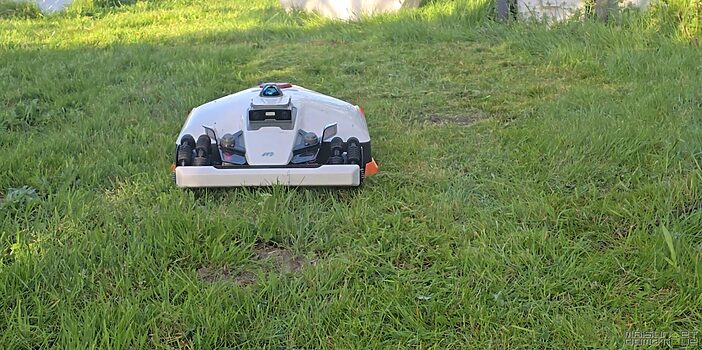
This fusion of technologies is particularly noticeable in busy gardens. Trees, vegetable beds, greenhouses, furniture, narrow passages, borders, fencing, transition zones: the robot moves with real coherence. It doesn’t just avoid an obstacle; it adapts its trajectory and continues its task.
On my terrain, about 2,500 m² to mow with trees, fixed obstacles, and multiple tricky passages, the LUBA 3 AWD proved to be very consistent. The trajectories are clean, the mowing strips well aligned, and returning to the base posed no issues for me.
This is where the absence of an RTK antenna becomes particularly pleasant. On older generations or on some competitors, losing signal near a wall, under trees, or close to a house can become troublesome. Here, the robot has other references. It can continue to work where a more traditional RTK model would start to hesitate.
Everything is not magical, however. If the terrain presents a very particular physical trap (a dip with flexible fencing, a passage too narrow, or a poorly managed step), the robot may get stuck. This is not a navigation problem, but a configuration issue of the terrain. The LUBA 3 AWD remains a robotic mower, not a small autonomous tractor able to reinvent the topography of your garden.
Obstacle Detection: one of the best on the market
Obstacle detection is one of the major strengths of the LUBA 3 AWD. Mammotion claims advanced recognition thanks to AI vision and Lidar. On the ground, the behavior is very convincing.
I tested the robot with various everyday objects: toys, gardening tools, balls, frisbees, thin objects placed in the grass. The robot avoided obstacles without trying to push or cross them. The frisbee is particularly interesting, as its low height often puts robotic mowers in difficulty. Many models touch, move, or partially pass over it. Here, the LUBA 3 AWD detected and bypassed it.
This is reassuring for family use. In a garden, there is always a forgotten ball, a dog toy, a garden hose, a shoe, a pine cone, or a branch fallen overnight. No system is infallible, and it’s essential to continue clearing the ground before significant mowing. But the level reached here is excellent.
The app allows you to choose the detection level: off, standard, or sensitive. The sensitive mode detects more elements, including small objects. But it can also interpret tall grass tufts as obstacles. The robot doesn’t always know how to distinguish between a weed to be cut and a plant to preserve. For an already maintained lawn, the sensitive mode is interesting. For a winter outing with tall grass, it’s better to stay in standard mode.
The protection of wildlife is also a point worth noting. Robotic mowers can be dangerous for small animals, especially hedgehogs. Mammotion offers options to avoid nocturnal mowing or reduce risks. Personally, I always recommend scheduling mowing during the day. A lawn can wait until morning. A hedgehog, not so much.
All-terrain capabilities: the 4×4 of the garden
The LUBA signature is its four-wheel drive. And on this LUBA 3 AWD, they fully play their role.
The robot performs very well on uneven terrains. Holes, bumps, mounds, roots, slight slopes: it maintains its trajectory and continues working. The rear wheels ensure good traction, while the omnidirectional front wheels facilitate maneuvers. The multipoint turns also limit damage to the lawn, although the robot’s weight may leave marks on very wet ground.
Mammotion announces a maximum slope of 80%. This needs to be nuanced. On dry ground, with short grass and good grip, the robot can tackle impressive slopes. On a wet, muddy slope with tall grass and soft ground, it will slip. This is normal; even a lawn tractor can struggle in these conditions.
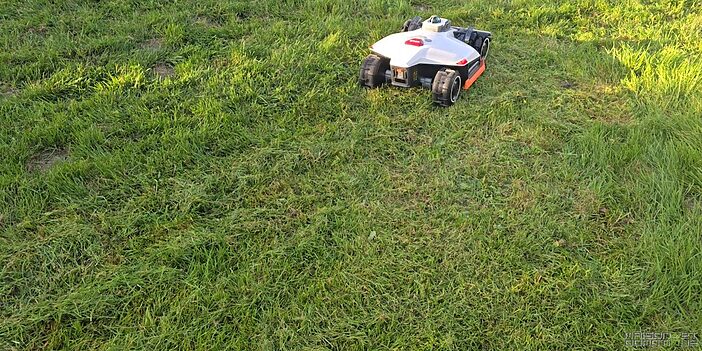
On my terrain, I do not have extreme slopes at 80%, but I have enough irregularities to judge behavior. The LUBA 3 AWD proved to be very stable. I didn’t see it getting stuck on a simple mound or a small bump. Where some lighter robots lose their trajectory or slip, this one continues.
However, you should avoid launching it anywhere after several days of rain. Its weight and traction can then work against it. If the wheels slip, they can mark the ground. On a nice dense lawn, this will be less of a problem. On soft soil or an old field, it’s better to wait for the ground to dry a bit.
Cutting quality: uniform and fast
With its two discs and 40 cm cutting width, the LUBA 3 AWD is designed for quick coverage. And it shows.
On a maintained lawn, the result is excellent. The strips are well defined, the cut is uniform, and you achieve that always clean garden look without having to take care of it. The cutting power holds up as well. The two 165 W motors tackle dense grass without faltering. On tall grass, the robot can manage, but you need to stay reasonable. Like all robotic mowers, it is not designed to clear a meadow that has been left unattended for three months. It can do so partially, especially at maximum height, but the result will require several passes.
During an initial mowing of the season, I recommend setting the height to 70 mm, reducing the movement speed, and letting the robot take several spaced passes. An equalization cut with a traditional mower can also be useful if the grass is significantly above the recommendations. It’s less glamorous, but it’s often the best way to start off on the right foot.
The motorized height adjustment is a real comfort. No more need to turn a knob under the robot. Everything can be done from the app. You can start at 70 mm, then gradually lower to 60, 50, 40 mm based on the desired result.
The robot also manages humid conditions well, within certain limits. I did not observe any major clogging during my test, but very damp grass can sometimes accumulate under the casings. Regular cleaning is still recommended, especially in spring.
Borders: good result, but not yet perfect
This is one of the few points where the LUBA 3 AWD shows a more typical limitation. Despite its cutting width and navigation precision, it does not have a system for cutting overhanging edges or an integrated trimmer.
Thus, there remains a strip to finish manually along certain walls, edges, or vertical obstacles. Depending on the mapping, this strip is around 10 to 15 cm. If you have level pavers, you can map by slightly overlapping the robot on the border, which significantly improves the result. But facing a wall or a fence, you will need to occasionally use the trimmer.
This is not unique to the LUBA 3 AWD: as we have seen in previous tests, most robotic mowers encounter the same limitation. However, some competitors are beginning to offer overhanging decks or systems dedicated to borders. With a robot of this level, we would have liked to see Mammotion go a bit further on this point.
The result remains good if the mapping is well done. The robot can make several perimeter rounds, and the app allows you to adjust the strategy. Just don’t throw away your trimmer yet.
Autonomy: you forget about it, and that’s a good sign
On the tested 3,000 m² version, the announced autonomy reaches up to 175 minutes. In practice, it depends on grass height, blade speed, terrain relief, number of obstacles, and mowing strategy.
On my 2,500 m² plot to mow, the LUBA 3 AWD performed several cycles with return to the base. I never had to worry about it. The robot returns to charge and then resumes where it left off. It works, and that is all we ask of it.
The adaptive charging is interesting. The robot can calculate what remains to be done and charge enough to finish. This avoids unnecessary cycles while maintaining autonomous operation.
For a large property, raw autonomy matters less than the robot’s ability to manage its schedule without supervision. And on this point, the LUBA 3 AWD is convincing. Once the zones are well set, it goes about its business.
Daily life: the kind of robot you end up forgetting
After several weeks, the real luxury with the LUBA 3 AWD is to hardly think about it anymore.
You schedule the zones, days, heights, and trajectories. The robot goes out, mows, contours, returns, recharges, and resumes if needed. The garden remains clean without us blocking a Saturday afternoon behind a gas mower. On a large property, it’s a fundamental shift in managing your outdoor space.
The noise level remains reasonable. You hear the blades, especially at high speed or in dense grass, but nothing compared to a traditional mower. You can run it without turning the garden into an airport runway.
The live camera adds an almost playful aspect. You can monitor the robot from the app, check what it’s doing, or simply look at your garden from its point of view. Personally, using it on my leisure terrain from a distance, it’s a feature that reassures me.
The manual mode can also be helpful. You can control the robot remotely and start mowing manually, a bit like a remote-controlled mower. It’s not the main use, but handy for redoing a small forgotten area.
Maintenance: simple, but not to be neglected
Like any robotic lawn mower, the LUBA 3 AWD requires minimal maintenance. You must regularly check the blades, clean the cutting decks, remove accumulated grass, and ensure the wheels remain clean.
The IPX6 certification allows for rinsing with water jets. Convenient after a wet mowing. Just avoid the pressure washer, which could send water where it shouldn’t go.
The blades are easy to replace, and Mammotion provides a set in the box. On a large property, they will wear out naturally faster than on a small city lawn. If your garden contains pine cones, small stones, branches, or roots, keep an eye on them more closely.
The base also needs to remain clean. A robot that returns with wet grass can leave residues around the charging contacts. A little brush once in a while can prevent many issues.
The limits to know before buying
The Mammotion LUBA 3 AWD is excellent, but it is not perfect.
Its price is high. The 3,000 m² version is listed at €2,699 on the official store at the time of writing. It’s a significant investment, even though the offerings align with the positioning.
The app is very comprehensive, but some logic requires an adjustment period. Deep modification of the mapping could be more intuitive. If you like to frequently reorganize your zones, it may require redoing part of the work.
The mowing of borders remains improvable. Without an overhanging deck or an integrated trimmer, you will always need to plan for some manual finishing.
The robot is imposing. For a terrain of 500 or 800 m² with numerous tight passages, a more compact model like a LUBA Mini 2 AWD may be more suitable. The LUBA 3 AWD makes sense on larger surfaces, complicated terrains, or gardens where its power is genuinely needed.
Finally, the all-terrain capabilities have their limits. It climbs very well and crosses zones where many other robots would abandon. But on saturated ground, steep slopes, and tall grass, it can slip and mark the terrain. Physics remains physics.
Who is the Mammotion LUBA 3 AWD for?
The LUBA 3 AWD caters to owners of large gardens or complicated terrains. If you have a nice area to mow, slopes, trees, multiple zones, irregularities, and want to avoid the peripheral cable, it is one of the most serious robots currently available.
It is also very well suited for those who want an autonomous, powerful robot capable of working without constant intervention. Its Tri-Fusion navigation reassures, its traction impresses, and its cutting quality is on point.
Conversely, for a small, simple, flat lawn with no obstacles and a few hundred square meters, it is clearly oversized. It would be like buying a rally 4×4 to go get bread. It works, but it’s not necessarily the smartest choice.
Conclusion
The Mammotion LUBA 3 AWD is one of the most accomplished robotic mowers I have tested. It combines very reliable navigation, serious obstacle detection, real cutting power, and four-wheel traction perfectly suited for difficult terrains.
The disappearance of the physical RTK antenna greatly simplifies the installation. The Tri-Fusion navigation ensures that the robot knows where it is and where it is going: you launch it, and it works. No need to monitor every movement or wonder if it will find its way back.
Not everything is perfect. The app could benefit from simplicity, map modification needs improvement, and border mowing remains less impressive than the rest. But that does not spoil the overall experience.
The LUBA 3 AWD is expensive. But it does not compete in the basic robotic mower category. It is a premium machine for large properties, with offerings to match. If your garden is large, irregular, or complicated, it is one of the most solid references available right now.

Please remain courteous: a hello and a thank you cost nothing! We're here to exchange ideas in a constructive way. Trolls will be deleted.