


'/%3E%3Cpath%20fill='%23b2b2b2'%20d='M241%20382q0%2016%2017%2026%2017%2011%2042%2011t42-11q16-11%2017-26V269H241'/%3E%3Cpath%20fill='%239f7e00'%20d='M241%20379q0%2014%208%2023%209%209%2021%209%2014%200%2021-9%209-9%209-23V269h-59'/%3E%3Cpath%20d='M241%20339v-70h59v110q0%2014-9%2023l-6%205v-68h-15v72q-8%200-14-4v-68zm59%2040c0%2022%2015%2032%2029%2032%2021%200%2030-18%2030-32v-40h-59'/%3E%3Cpath%20fill='%239f7e00'%20d='M266%20277v5h2v12h-3v-5h2v-5h-9v5h2v5h-4v9h3v18h-5v10h34v-10h-5v-18h3v-9h-4v-5h2v-5h-9v5h2v5h-3v-12h2v-5zm42%20101q0%2010%206%2017%206%206%2015%207%2010-1%2016-7%206-7%206-17v-29h-43'/%3E%3Ccircle%20fill='%230044ad'%20cx='329.5'%20cy='372'%20r='6'/%3E%3Cellipse%20fill='%230044ad'%20cx='300'%20cy='340'%20rx='16'%20ry='21'/%3E%3C/svg%3E)

'/%3E%3C/g%3E%3Cuse%20href='%23c'%20transform='matrix(-1%200%200%201%20720%200)'/%3E%3C/svg%3E)


'%3E%3Cpath%20stroke='%23000'%20stroke-width='4'%20d='m-35-37-13%2020m5%203%2013-20m5%203-13%2020m63%2042%206-9m1-2%206-9m5%203-6%209m-1%202-6%209m5%203%206-9m1-2%206-9m-96%200%2013%2020m5-3-6-9m-1-2-6-9m5-3%2013%2020m63-42-6-9m-1-2-6-9m5-3%2013%2020m5-3-6-9m-1-2-6-9'/%3E%3Ccircle%20r='24'%20fill='%23cd2e3a'/%3E%3Cpath%20fill='%230047a0'%20d='M0%200a12%2012%200%201%201%2020%2013%2024%2024%200%201%201-40-26A12%2012%200%201%200%200%200'/%3E%3C/g%3E%3C/svg%3E)


Résumer cet article :
The pool robot market is evolving quickly. Very quickly indeed. Just two or three years ago, the main novelty was the removal of the power cable. Today, high-end models have become completely autonomous, capable of cleaning the floor, walls, and waterline without any intervention. With the Scuba V3, Aiper aims to take a new step forward.
The brand has established itself with a few generations of successful cordless robots. With this V3, it is not just improving autonomy or suction power: it adds a real camera and an AI system called AI Patrol, capable of spotting the dirtiest areas to clean them first. The idea is to stop wasting time going over areas that are already clean.
On the technical sheet: suction power rated at 18,000 liters per hour, filtration that captures particles down to 3 microns, wireless charging on a station, cleaning of the floor, walls, and waterline, and a runtime of 3 hours (more in Eco mode). Everything is controlled via an app that even adapts cleaning cycles based on the weather or the pool’s history.
Ambitious features that place this model against the premium references in the market: the latest Dolphin cordless, the Beatbot AquaSense, or the high-end models from Zodiac.
I wanted to check if this artificial intelligence really brought something to daily life, or if it was mostly a marketing argument. After several weeks of use in different conditions, here is my feedback.
Unpacking the Aiper Scuba V3
From the moment it arrives, the Scuba V3 sets the tone.

Aiper pays attention to the packaging of its products, and this V3 is no exception. The robot arrives protected in a sturdy box, with each element individually cushioned in foam and thick cardboard. You can feel that the brand thought about transport.
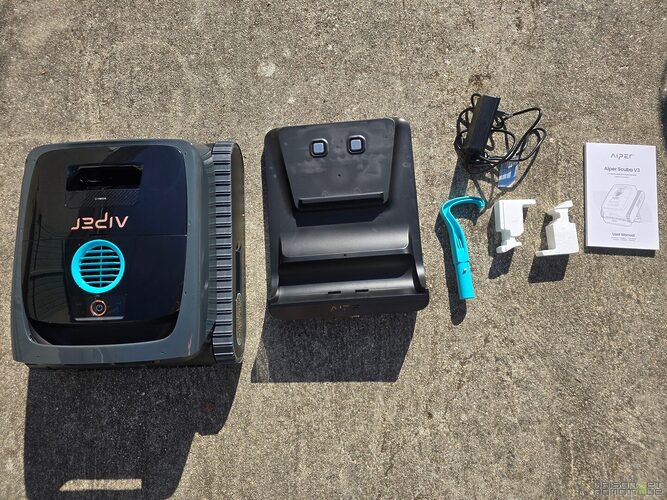
Once opened, the contents are complete. In the box: the robot with its filter basket already mounted, the vertical charging station, the power adapter, a hook to retrieve the robot at the edge of the pool, compensation floats for very smooth coverings, and the quick start guide.
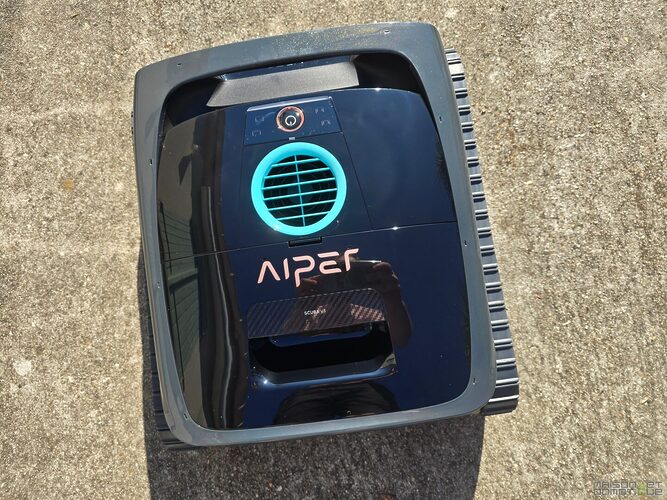
The overall impression is one of confidence. The Scuba V3 displays a modern design mixing matte black, metallic gray, and some turquoise touches, now characteristic of the brand. The quality of the manufacturing is immediately evident: the plastics are thick, the fittings precise, nothing suggests a low-end product.
Despite this robust construction, the robot remains lightweight: around 8.2 kg. It seems like a detail on a technical sheet, but it makes all the difference when you have to take it out of the water after several hours of use. On this point, Aiper is among the good students in the market.
A design thought out to the smallest details
By looking more closely at the robot, one discovers that practically every element has been designed for a specific function.
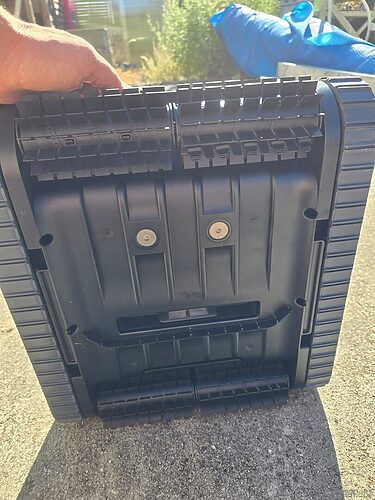
At the front, a large active rubber brush; at the back, a second one. Both rollers turn at the same time to dislodge impurities before they are sucked in.
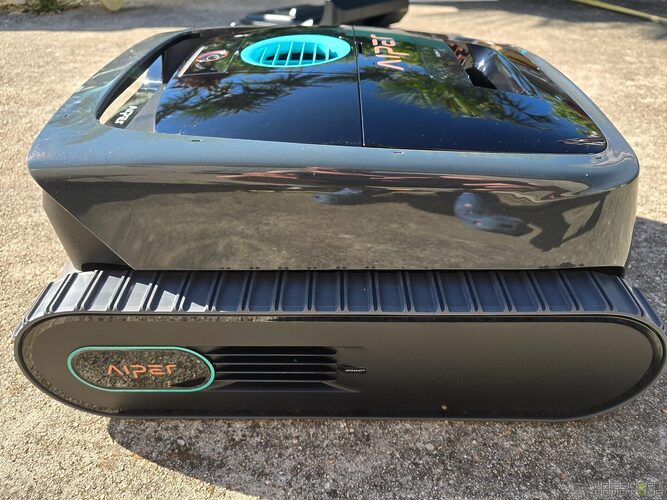
The wide side tracks also stand out. They provide good mobility on the bottom, and especially allow the robot to climb rather vertical walls.
Another element that immediately distinguishes the Scuba V3 from more traditional robots is its camera.

Installed at the front, it is the heart of the VisionPath system. Combined with ToF (Time of Flight) depth sensors, it continuously analyzes the environment, spots obstacles, and recognizes more than twenty types of debris to adjust its trajectory. Leaves, sand, twigs, small pebbles, or localized clumps are therefore no longer processed randomly, as was the case with previous generations.
Privacy has not been overlooked either. Aiper specifies that the images are processed inside the robot: no video is recorded or sent to the cloud, a point validated by an independent certification highlighted by the manufacturer. This is reassuring for those who might hesitate to install a camera in their pool.
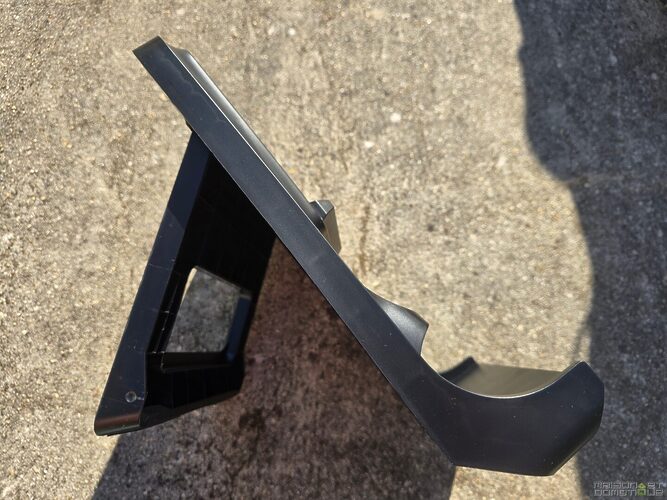
Finally, it’s impossible not to mention one of the most pleasant aspects of daily life: recharging. Unlike most competing robots, which still use a waterproof connector to plug in after each use, the Scuba V3 simply rests on its vertical station. The charging contacts are integrated, and the recharge starts automatically. No assembly is required; the support unfolds easily. It’s more elegant, more convenient, and prevents premature wear of the connectors.
It takes about five hours to fully recharge the battery.
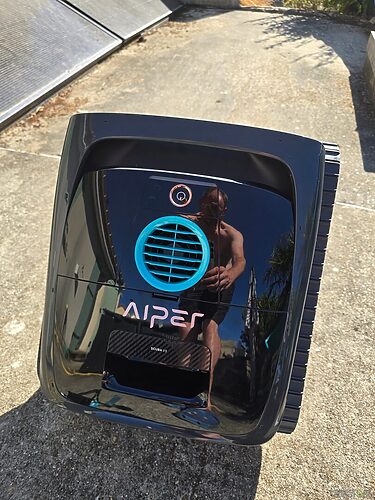
Installation: a few minutes is enough to be operational
One of the main advantages of cordless robots is their simplicity of setup. No need to install a transformer near the pool, unroll a long floating cable, or check that it doesn’t get tangled. With the Scuba V3, the preparation is quick.
After a first complete charge on its station, just turn on the robot and install the Aiper app on your smartphone. It’s available on both Android and iOS and detects the robot via Bluetooth. Once found, all you need to do is give it the Wi-Fi credentials so that it can connect to the Aiper cloud when necessary. The operation takes no more than a few minutes.

The robot is then ready to work.

A small detail not to forget: Aiper provides two foam inserts that slightly modify the robot’s buoyancy. Not essential in most pools. But if your pool has a very smooth surface (some liners or tiles) and the robot has trouble sticking to the walls or waterline, their installation really changes its behavior. The operation takes a few seconds, under the side tracks.

Even without opening the app, the Scuba V3 remains usable. The single button on top allows you to directly select four programs: automatic cleaning, floor only, walls only, or waterline only. Convenient for quickly launching a cycle without pulling out your phone.
But limiting yourself to these four modes would mean missing out on what makes this model so interesting.
An App that provides real added value
Unlike some robots where the app just displays the battery level, Aiper’s app is truly part of the product.
The main screen displays the charge level, the robot’s status, and the available modes. In addition to the four programs accessible directly on the robot, two exclusive functions appear in the app.

The first is undoubtedly the most interesting: AI Patrol. This is the mode that activates the Scuba V3’s entire artificial vision system. Once submerged, the robot first observes its environment before searching for the dirtiest areas. Unlike traditional robots that cover the entire pool according to a predefined or sometimes completely random route, the V3 first addresses the clumps of leaves, sand, or debris that it visually detects. Only after these areas are taken care of will it methodically finish the rest of the pool.
The second novelty is the AI Navium mode. Here, the robot no longer simply follows a fixed schedule. It observes cleaning habits, considers the weather, and adapts its next cycles. A very windy day? It will do a more thorough cleaning. A calm period with few dirt? It will prefer a lighter maintenance to save its battery.

The idea is appealing: rather than arbitrarily scheduling three cleanings a week, the robot decides for itself when a deeper clean is really necessary. This is typically the kind of function that quickly gets forgotten… because it works on its own.
You can also simply set a classic schedule with several cleanings per week, on the days and times of your choice.
Is the AI of the Scuba V3 a marketing argument or a real advancement?
AI has become an indispensable marketing argument. Robot vacuums, autonomous lawnmowers, surveillance cameras… it’s hard to escape the term.
In the case of the Scuba V3, however, it’s not just a slogan.

The robot is equipped with a real camera, supported by several ToF depth sensors that continuously analyze what is in front of it. The goal is not to film your pool, but to spot what’s lying on the bottom in order to adjust its trajectory. These data are processed within the robot, with no storage or sending to the internet.
In practical terms, once submerged, the robot starts with an observation phase. You can see it making some rotations at first, as if measuring the surroundings before getting to work. This is intentional: it maps the pool and identifies the areas that need its attention.
This difference in behavior can be quite disconcerting the first time. You might think it’s hesitating… while it’s simply preparing to intervene.
I conducted a pretty telling test: I intentionally dropped a pile of dirt at the bottom of the pool. Instead of continuing its path, the Scuba V3 almost immediately changed direction to treat that area, before resuming its usual course. I replicated the test with other debris: leaves, sand, small pebbles, with very convincing results each time.

Aiper claims that its system recognizes more than twenty types of debris and improves detection speed by up to ten times compared to traditional navigation. As is often the case with such marketing figures, it’s better to keep some perspective: against an old-generation robot that functions randomly, the gap is indeed spectacular. Compared to the best current robots that already use intelligent navigation without a camera, the gain is more measured. What clearly emerges from my tests, however, is that the Scuba V3 spends much less time on areas that are already clean and focuses more on where cleaning is truly necessary.
VisionPath: much smarter navigation
This AI relies on a second technology called VisionPath.
While many robots simply follow simple geometric paths, VisionPath combines input from the camera, depth sensors, and various onboard detectors to build a representation of the pool.

The robot then constantly adapts its path. It avoids return jets, navigates around pool drains, spots forgotten toys in the pool, and limits unnecessary passes over already clean areas. I saw it navigate around obstacles in a much smoother manner than previous generations, without getting stuck or wasting long minutes trying to overcome an impossible obstacle.
This has another effect: fewer unnecessary movements, meaning more autonomy. In a large pool, it allows for smarter use of the three hours of available battery, rather than wearing it out by going over the same spot multiple times.

In the end, this is probably the biggest evolution of the Scuba V3 compared to previous Aiper robots: not so much more power, but a robot that better understands what it has in front of it before acting.
A truly convincing bottom cleaning
The bottom remains the main task of any pool robot, and on this point, the Scuba V3 does not disappoint.
Its suction power, rated at 18,000 liters per hour, is associated with two active rollers that constantly dislodge impurities before their suction. Leaves, twigs, insects, sand, or small gravel are quickly directed towards the large suction opening under the robot.
What stands out is how it minimizes the resuspension of dirt. On some robots, the brushes agitate the water so much that part of the dust gets dispersed in the pool before being sucked up several minutes later. Here, the rollers work more gradually and effectively guide the debris towards the central suction. The result: the water remains much clearer throughout the cycle, which really changes the final result.

Once the main clumps are eliminated, the robot adopts a more methodical movement. After this targeted search phase, it shifts to a parallel band trajectory with slight overlapping between each pass to cover the entire surface. This second phase resembles the behavior of the best robots that already map their environment, with very uniform coverage of the pool.
At the end of a complete cycle, the bottom is impeccable. As always, a few very tight corners or some areas behind fixed obstacles may require a light manual pass – a classic case found on nearly all current robots.
Well-negotiated walls
Cleaning the walls is often the weak point of cordless robots: the weight of the battery complicates their adherence when climbing a vertical surface.
However, the Scuba V3 performs remarkably well. Its wide tracks offer excellent mobility, and the suction power keeps the robot pressed against the walls. Once at the top, it makes several vertical passes while gradually altering its angle to cover the entire surface.

Even the transitions between two walls are generally well handled. On a very tight angle, the robot sometimes tries twice before passing, but it eventually reaches the next wall without getting stuck. Given the variety of pool shapes, this is perfectly acceptable.
Linings of vinyl, painted concrete, tiles, or polyester shells do not seem to pose any particular difficulty. Aiper still provides the buoyancy inserts mentioned earlier, for exceptionally slippery walls.
The waterline: probably its strong point
If there’s one area that many owners postpone when cleaning their pool, it’s the waterline. Sunscreen, pollen, dust, grease, and limescale deposits eventually form an unsightly film that usually needs to be scrubbed by hand.

This is where the Scuba V3 impresses the most. Aiper uses a technology called JetAssist here: small side propellers expel water to keep the robot pressed against the waterline while moving it horizontally around the entire perimeter of the pool.
Unlike many robots that only briefly touch this area before descending, the Scuba V3 performs a real horizontal scrubbing. You can see it slowly progress all around the pool, its rollers exactly at the waterline. The greasy deposits and marks left by evaporation gradually disappear without manual intervention.
This is probably the best performance of a cordless robot in this price range today. Having just changed my liner, I appreciate having a robot capable of keeping the waterline clean, as it must be said that it is a hassle to clean, and unfortunately, a poorly cleaned waterline gives an impression of a neglected pool :/
Filtration that doesn’t just stop at leaves
Cleaning the pool is one thing. It is also essential to effectively retain everything that is sucked in.
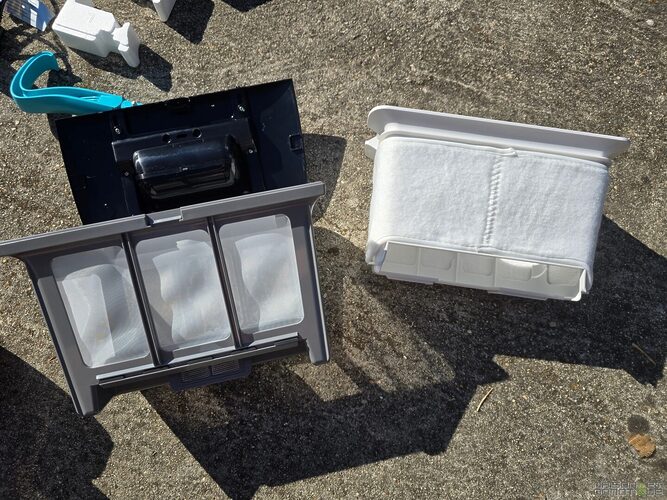
Aiper has provided a two-level filtration system. The main basket uses a mesh of 180 microns, well-suited for leaves, insects, twigs, pebbles, and other typical debris.

The real novelty is the second MicroMesh filter of 3 microns, delivered as standard: this cartridge captures extremely fine dust, pollen, very fine sand, or the first suspended algae residues.
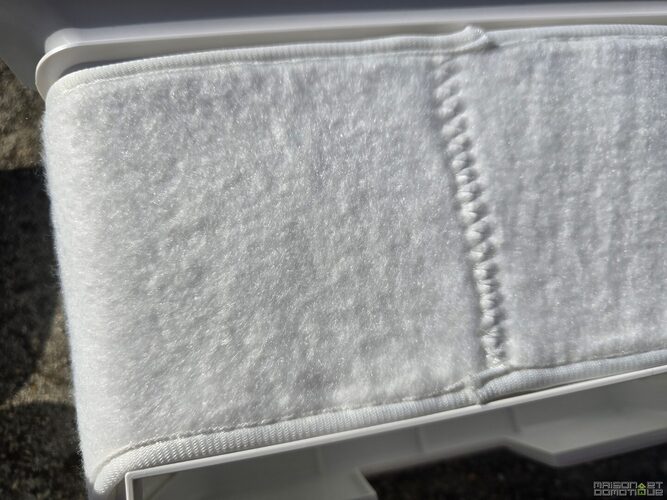
In a pool that has just undergone a windy episode or a storm, the difference is quickly noticeable: the water regains its transparency without solely relying on the pool’s main filtration system.


In practice, it’s better to adapt the filter to the situation. If the pool is very dirty after several days without maintenance, I start with the standard basket to remove large debris, then I do a second pass with the ultra-fine filter to refine the cleaning. This is the method I adopted after several tests on a heavily soiled pool, with recent storms following the heatwaves having not spared the pool…
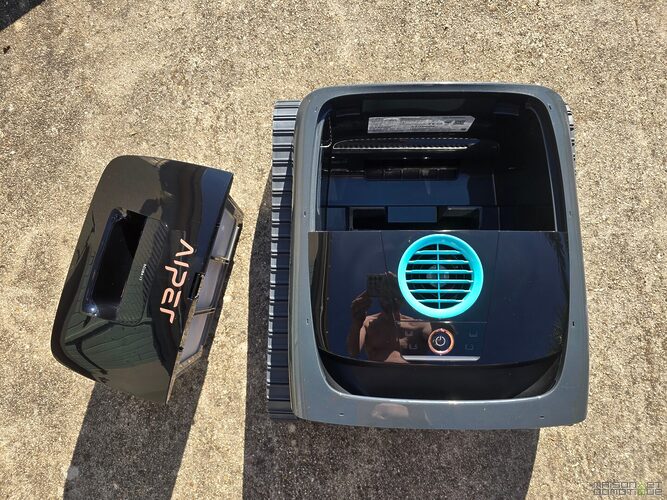
Cleaning the basket then takes only one or two minutes: a press on the latch allows you to remove the filter block, which simply needs to be rinsed with water before being put back in place. Simple, and without any tools.

An autonomy designed for large pools
On paper, the Aiper Scuba V3 announces up to 180 minutes of autonomy, or three hours of continuous operation. In Eco mode, this duration increases to about 210 minutes, or even more when the robot adjusts its power according to the level of dirt detected.
In practice, these figures hold true. In a medium-sized pool, a complete cycle of floor + walls + waterline is done without difficulty with just one charge. Even in pools approaching 150 m², the robot retains enough autonomy to complete its program. This is a real improvement compared to the first generations of cordless robots, which sometimes required a second charge for larger pools.
The Eco mode deserves special attention. It is not intended for deep spring cleaning or a very dirty pool, but for the regular maintenance of an already clean pool. The robot slightly reduces its power to prioritize operating time. Combined with the AI Navium mode, which adapts the cycles according to needs, it allows for even more spaced interventions by the owner.
The automatic return: a small detail that changes daily life
Everyone who uses a cordless robot knows this situation: the cleaning is done… but you can’t find the robot. It is stuck at the bottom of the pool with an empty battery, and you need to grab the telescopic pole to retrieve it.
Aiper has avoided this problem. At the end of its cycle, the Scuba V3 automatically rises against a wall and positions itself just below the waterline. The app simultaneously sends a notification indicating that cleaning is complete. You just have to reach out or use the provided hook to retrieve it.

The robot stays in this position for about ten minutes. If no one comes to retrieve it, it slowly descends to the bottom of the pool and turns off to preserve its battery: a welcome safety feature that prevents it from remaining suspended against a wall for no reason.
Once out of the water, all that remains is to place it on its charging station. The absence of a waterproof connector to handle is really pleasant in daily life: you simply place the robot on its base, the charging starts automatically, and the app immediately confirms that everything is working.
The few limits to know
No pool robot is perfect, even in this price range. The Scuba V3 is no exception.
The first limitation: submerged steps. Like many current robots, it cleans a large submerged area without any problem if it is deep enough, but narrow steps remain complicated. At about fifteen centimeters of depth, the robot lacks water beneath it to maintain its grip and cannot clean them properly. This is not a shortcoming unique to the Scuba V3 but a constraint encountered with most autonomous robots.
Very large pools with complex shapes are also a special case. Aiper designs the Scuba V3 for typical residential pools; if your pool has many submerged areas, multiple levels, or very atypical geometry, the Scuba V3 Pro or Ultra models will be more suited, with their specific cleaning functions for platforms.
Last point: wireless communications do not pass underwater. Once the robot is submerged, Bluetooth and Wi-Fi hardly penetrate the water. Therefore, it is impossible to modify the current program or summon the robot from the app: all settings must be made before it enters the water. This is not a weakness of the Aiper app, just a physical constraint of radio waves.
My verdict after several weeks of use
Aiper had already proven itself with the previous generations of Scuba. With this V3, the brand does not just add power or autonomy: it changes the way a robot cleans a pool.
The artificial intelligence is not just a marketing argument. The AI Patrol system brings real benefits: it detects the dirtiest areas before launching a methodical cleaning of the rest. The gain is measured less in time than in effectiveness: the robot concentrates its efforts where it is really needed, and then completes the work properly.
I also really appreciated the quality of the construction. The robot inspires confidence, the wireless charging station really simplifies daily life, and the double-layer filtration makes a real difference when the pool is loaded with fine dust or pollen.
The waterline is probably its greatest achievement. Thanks to the JetAssist system, the cleaning there is significantly more effective than with most competing robots, which merely skim this area that is so exposed to deposits.
Of course, some limits remain. Steps are still a challenge, very large pools with complex shapes will find greater satisfaction with the Pro or Ultra versions, and the app cannot control the robot once submerged. But these reservations do not suffice to undermine the excellent performance of the Scuba V3.
In the end, Aiper delivers one of the most accomplished cordless pool robots in its category: excellent cleaning quality, simple usage, and functions that truly enhance daily life rather than just inflate the technical specifications.

For an owner who wants to automate almost all the maintenance of their pool without the hassle of a cable, the Scuba V3 is now one of the most convincing models on the market. At least for me, it has perfectly convinced me. And used in tandem with the Aiper Surfer S2 that takes care of surface cleaning, it’s a top-notch combination :D


Please remain courteous: a hello and a thank you cost nothing! We're here to exchange ideas in a constructive way. Trolls will be deleted.