


'/%3E%3Cpath%20fill='%23b2b2b2'%20d='M241%20382q0%2016%2017%2026%2017%2011%2042%2011t42-11q16-11%2017-26V269H241'/%3E%3Cpath%20fill='%239f7e00'%20d='M241%20379q0%2014%208%2023%209%209%2021%209%2014%200%2021-9%209-9%209-23V269h-59'/%3E%3Cpath%20d='M241%20339v-70h59v110q0%2014-9%2023l-6%205v-68h-15v72q-8%200-14-4v-68zm59%2040c0%2022%2015%2032%2029%2032%2021%200%2030-18%2030-32v-40h-59'/%3E%3Cpath%20fill='%239f7e00'%20d='M266%20277v5h2v12h-3v-5h2v-5h-9v5h2v5h-4v9h3v18h-5v10h34v-10h-5v-18h3v-9h-4v-5h2v-5h-9v5h2v5h-3v-12h2v-5zm42%20101q0%2010%206%2017%206%206%2015%207%2010-1%2016-7%206-7%206-17v-29h-43'/%3E%3Ccircle%20fill='%230044ad'%20cx='329.5'%20cy='372'%20r='6'/%3E%3Cellipse%20fill='%230044ad'%20cx='300'%20cy='340'%20rx='16'%20ry='21'/%3E%3C/svg%3E)

'/%3E%3C/g%3E%3Cuse%20href='%23c'%20transform='matrix(-1%200%200%201%20720%200)'/%3E%3C/svg%3E)


'%3E%3Cpath%20stroke='%23000'%20stroke-width='4'%20d='m-35-37-13%2020m5%203%2013-20m5%203-13%2020m63%2042%206-9m1-2%206-9m5%203-6%209m-1%202-6%209m5%203%206-9m1-2%206-9m-96%200%2013%2020m5-3-6-9m-1-2-6-9m5-3%2013%2020m63-42-6-9m-1-2-6-9m5-3%2013%2020m5-3-6-9m-1-2-6-9'/%3E%3Ccircle%20r='24'%20fill='%23cd2e3a'/%3E%3Cpath%20fill='%230047a0'%20d='M0%200a12%2012%200%201%201%2020%2013%2024%2024%200%201%201-40-26A12%2012%200%201%200%200%200'/%3E%3C/g%3E%3C/svg%3E)


Résumer cet article :
I returned from IFA 2026 with a clear impression regarding Aqara: the brand no longer wants to just stuff the house with sensors, switches, and small home automation modules. It now also wants to take charge of the entire lighting ambiance, both indoors and outdoors.
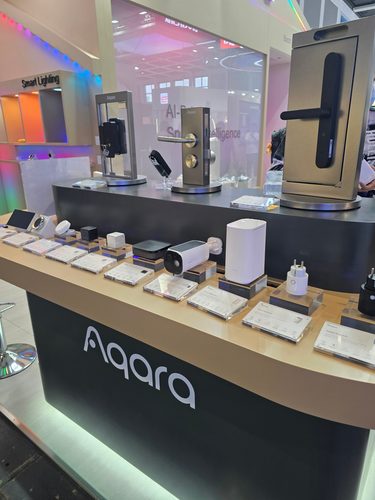
At its Berlin stand, Aqara did things smartly. Rather than lining up five new products on displays, the manufacturer recreated a living space where lights, sensors, cameras, switches, and controllers worked together. A good way to understand where Aqara wants to go with this new range: light becomes an integral component of the smart home scenarios.
Aqara no longer just wants to detect, it also wants to illuminate
This change of direction is quite logical. Aqara already has everything needed to know what is happening in a house: motion and presence detectors, open/close sensors, cameras, switches, thermostats, locks, etc. What was ultimately missing was a lighting range wide enough to make use of all this information.
This is what Aqara unveiled in Berlin with five new products: the Floor Lamp T1, the LED Downlight T2, the LED Strip T2, the Outdoor String Lights H1, and the Permanent Outdoor Lights H1.
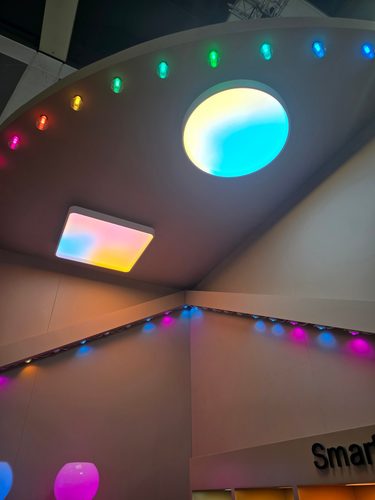
And there is a particularly interesting technical detail: this entire new range supports both Thread and Zigbee. This dual protocol ultimately allows you to choose your camp… or rather not have to choose definitively.
With Thread, the products natively benefit from Matter and can join the main ecosystems on the market: Apple Home, Google Home, Amazon Alexa, SmartThings, Home Assistant, or Homey. With Zigbee, they can instead leverage Aqara Home and its advanced automations more deeply, via an Aqara hub.
For someone who simply wants to ask their voice assistant to turn on the light, Matter thus brings simplicity. For enthusiasts of more advanced scenarios, Zigbee remains very relevant.
And you know me: it is precisely this second part that interests me a lot ;-)
Floor Lamp T1: 18 zones to transform a wall
The first new product is a 1.42 m high floor lamp. But the Floor Lamp T1 is not really intended to replace the ceiling light in the living room.
Its lateral lighting is designed to project light onto the wall and create an indirect ambiance. Typically, it is imagined perfectly next to the television for a movie night, behind a sofa, in a gaming corner, or simply to create ambiance lighting at the end of the day.

Aqara uses RGBIC technology combined with a 16-bit, five-channel chip here. The lamp mainly features 18 independently controllable light zones. This allows for gradients and transitions much smoother than those of a conventional RGB lamp.
It can also provide “true” white lighting. The color temperature can be adjusted over a particularly wide range, from 2,000 to 9,000 K, with a maximum brightness of 1,000 lumens and a color rendering index above 90.
The interest becomes even more evident when combined with the rest of the Aqara ecosystem. Imagine an FP2 or FP300 detecting your presence on the sofa after 9 PM: turning off the main lighting, setting the Floor Lamp T1 to 20%, adjusting the temperature to a warm hue, and activating a movie ambiance. Now we’re talking about truly smart lighting, not just a lamp controlled from a smartphone.
LED Strip T2: Aqara seriously amps up its LED strip
The LED strip has become a big classic of the smart home. Behind a television, under a kitchen unit, in a bookshelf, or along a cornice, it allows for easy creation of indirect lighting.

The new LED Strip T2 significantly enhances the formula. Aqara announces no less than 108 LEDs per meter. This high density is supposed to reduce the “dotted” effect still encountered in many LED strips. The manufacturer also retains its 16-bit, five-channel chip and offers 18 independent zones per section of 3 meters. The result I observed at the stand was quite convincing, especially regarding transitions between several colors.
The Strip T2 combines RGB and adjustable whites from 2,000 to 9,000 K, with up to 1,750 lumens and a CRI above 90. Three lengths are planned: 3, 5, and 10 meters, for a claimed power of 24 W.
The effects can be integrated directly into Aqara Home automation and the strip can also respond to music.
But Aqara adds another rather fun function: you can now describe the desired ambiance verbally, and Aqara Home will then generate a coordinated scene among several lights. Here, we find the Gen-Scene function and the brand’s desire to inject more AI into scenario creation.
It remains to be seen what this will actually yield in French and in a home equipped with many devices. On paper, the idea is certainly appealing.
LED Downlight T2: Matter even in ceiling spots
The LED Downlight T2 is probably less visually spectacular, but it could be one of the most interesting products for a complete home automation setup.
It is a particularly thin recessed spotlight, with only 20 mm thickness. Aqara therefore specifically intends it for false ceilings that don’t have much depth. Two sizes are planned, in 4 and 6 inches.

Two variants will be offered.
- The CCT version focuses on adjustable whites from 2,700 to 6,500 K, while the RGB CCT version adds 16 million colors and expands the white temperature from 2,000 to 9,000 K.
- The 6-inch version can reach 1,200 lumens, again with a CRI of 90.
Aqara has also planned a very simple function that I particularly appreciate in home automation: memory after a power cut. You can define the behavior of the spotlight when power returns, to prevent, for example, all the lights in the house from turning on at 3 AM after a brief outage.
Outdoor String Lights H1: the connected garland leaves the living room
Aqara is also seriously looking outside with the Outdoor String Lights H1. This is a light garland intended for a terrace, pergola, or outdoor dining space. It will be available with 15 or 30 bulbs, each delivering 40 lumens.
Once again, Aqara does not settle for RGB. The white temperature can vary from 2,000 to 9,000 K. A warm light can thus accompany a dinner on the terrace, while a cooler and more powerful lighting can be used when you actually need to see clearly.

The different zones can be controlled independently and can create gradients, animations, and colored ambiances.
Above all, these garlands can become full-fledged smart home devices.
A very simple scenario could, for example, automatically turn them on at sunset at low intensity. A presence detector could then increase the brightness when someone arrives on the terrace. And why not have certain lamps briefly flash when a camera or sensor detects unusual presence in the garden?
The lamps and their control box are certified IP65. However, be careful with the power adapter, limited to IP44, which must therefore be installed in a sufficiently protected location.
Permanent Outdoor Lights H1: install them and forget about them
The second outdoor novelty particularly pleased me with its principle.
The Permanent Outdoor Lights H1 are designed to remain installed all year round under a roof overhang. No more need to get the ladder out in early December to install Christmas decorations, then do it all over again a few weeks later to remove everything!

Each light point is individually controllable in RGBCW. The installation can therefore remain perfectly discreet in daily use with simple warm white, before switching to colorful animations for Christmas, Halloween, a birthday, or a party. The white temperature once again varies from 2,000 to 9,000 K and each module can produce up to 50 lumens.
The Permanent Outdoor Lights H1 will be offered in lengths of 15, 30, and 45 meters, corresponding to 30, 60, and 90 light points respectively. The system can be extended but also cut to fit the shape of the roof.
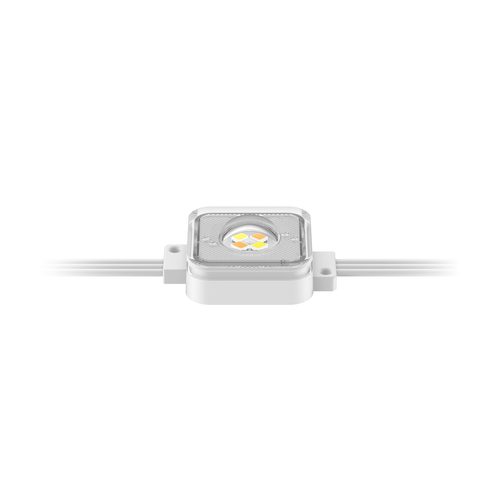
For the installation, Aqara plans either a 3M adhesive fixation or a screw fixation. The lights and the controller are IP65, while the power supply rises to IP67.
An integrated microphone in the controller also allows synchronizing animations with music, as I could see at the stand.
A demonstration far more illustrative than a row of products
What I particularly appreciated at the Aqara stand in Berlin was that these lights were presented in context. Aqara had recreated a complete living space, with its different lights but also its sensors, switches, cameras, and controllers.

The Cube T1 Pro, for example, allowed a complete change of lighting scenario by manipulating it.
Our friend Julien has even demonstrated it on his channel:
Also, be careful not to confuse this demonstration with any kind of video synchronization: the displayed images and the lights had simply been prepared together in different scenarios. Each action on the Cube triggered the corresponding scene.
Ultimately, it is here that these products become interesting. An RGB bulb controlled from an app is no longer that impressive in 2026. A house that automatically adjusts its lighting based on presence, time, activity, or other events is already much more interesting.
Aqara Builder also wants to involve users
The other announcement made at IFA was much less about hardware: Aqara Builder.
This new community platform is intended to allow enthusiasts of smart homes, developers, installers, integrators, and creators to share their projects, automations, and layout ideas.
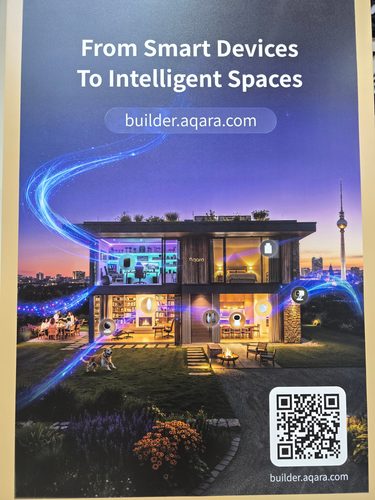
Aqara also plans AI-based assistance to help users envision and build their own scenarios.
The idea deserves to be followed: in an ecosystem as vast as that of Aqara, the problem is no longer necessarily finding the right hardware, but the right automation idea.
Aqara is gradually building a truly complete smart home
This IFA 2026 offering is particularly interesting because these five products, when put together, outline a clear direction for the brand, more than each taken in isolation.
Aqara already had the eyes and ears of the home with its sensors and cameras. The brand also had the controls, with its switches, curtain motors, thermostats, or locks. It is now adding a whole range of indoor and outdoor lighting.
And the choice of Thread + Zigbee seems particularly relevant to me. A user can start with Thread and Matter to enjoy a relatively simple setup open to Apple Home, Google Home, Alexa, SmartThings, Home Assistant or Homey. Those who want to go further can switch to Zigbee and Aqara Home to leverage more local functions and automations.

The new lights presented in Berlin are scheduled for October 2026, but we do not yet have the prices. So we will have to wait a bit longer to evaluate their value for money. But one thing is certain after visiting the stand: Aqara no longer wants to simply connect a few devices in the house. The brand now aims to orchestrate the entire room. And given all that its ecosystem already covers, it could become very interesting.



Please remain courteous: a hello and a thank you cost nothing! We're here to exchange ideas in a constructive way. Trolls will be deleted.