


Résumer cet article :
Residential storage without major renovations is attracting more and more attention. And we understand why. Between the reduction of the buyback rate for surplus energy, the desire to increase self-consumption, and the search for a bit more comfort in case of power outages or during expensive hours, AC batteries plugged into a standard outlet undoubtedly pique interest. In this category, the Marstek Venus E is generating a lot of buzz.
On paper, the promise is enticing. A LiFePO₄ battery of 5.12 kWh, capable of charging and discharging up to 2500 W in AC, compatible with an existing solar installation without modifying the inverter, with a dedicated backup mode and a smart meter aimed at zero injection. Marstek also announces installation in a few seconds, a 10-year warranty, very quiet operation, and compatibility with already installed photovoltaic systems. On the official French store, the Venus E 3.0 is currently priced at €1349 alone or €1399 with the CT002 meter, which also explains the interest it is generating at the moment. It’s clearly one of the best value for money ratios at present. After several months of testing, one thing quickly stands out: the Marstek Venus E is not just a “cheap” battery. It is primarily a particularly easy-to-set-up AC storage solution, with some truly good ideas.
In short
- The Marstek Venus E is a 5.12 kWh home battery that simply plugs into a power outlet, without altering an existing solar installation. It allows for the storage of photovoltaic surplus to be consumed later, with a power capacity of up to 2500 W and a backup mode in case of outages.
- Its installation is ultra-simple, its operation is silent and its capacity/price ratio is particularly aggressive. When paired with the smart CT002 meter (or a Shelly Pro 3EM), it becomes capable of automatically adjusting its charge and discharge to optimize self-consumption.
- It’s not perfect, especially due to an app that still needs improvement and an AI mode that is poorly suited to the French market, but it remains one of the most accessible and effective solutions for adding storage to a solar installation without heavy renovations.
👉 A battery clearly designed to democratize residential storage.
Unboxing the Marstek Venus E: a real home battery, not a gadget
The received box is relatively compact for a 5.12 kWh battery. But be careful: it still weighs 64 kg…

A quick note about the packaging: the manufacturer has provided an easy opening system, which consists of removing the entire top part once the straps are cut. Thus, there’s no need to struggle to take the battery out from the top of the box, phew!

The entire setup is perfectly protected by thick foam, which is reassuring.
The first thing that surprises is the format. The Venus E is not a small portable station that you can move with one hand. We’re talking about a compact block weighing around 60 kg, with dimensions of approximately 62.4 cm high, 48 cm wide, and 15.3 cm deep. It’s heavy, clearly.

But it is also much thinner than many competing solutions, allowing it to fit relatively easily in an entryway, pantry, garage, or along a wall without turning the room into a technical space.

The design is one of its standout features. The shiny facade, monobloc appearance, metallic structure, and overall finish give it a much more flattering look than average.

For a battery that may end up in a living space or a visible area, this is far from insignificant. It doesn’t “look out of place” in the house, and its acceptance by the household should be a bit easier ;-)
Inside the box, we find the essentials: the battery, the AC power cable, the wall mounting kit, and the documentation.

On the sides, we find useful connectors. On one side, the “Grid” connector for the main connection to the domestic network, as well as a 230 V backup socket for off-grid emergency power supply.

On the other side, a power button, an RS485 port, and a LAN / RJ45 port for communication.

If the entire battery is well thought out, one does wonder about the design of the side flaps. They protect the connectors well, but their perceived quality is inferior to the rest of the battery. The hinges seem a bit flimsy, the closure isn’t always very pleasant, but above all, these flaps open downward! It should be noted that with its IP 65 rating, this battery can definitely be placed outside. However, it would have been smarter to have the flaps open upwards, providing better protection for the connectors from precipitation. Well, it’s not disastrous on a daily basis, but for a product that is well-finished otherwise, this small detail is a bit unfortunate.

On the front, several indicators display the state of the battery, the Bluetooth connection, the Wi-Fi status, the presence of the CT meter, the backup mode, the network connection, and the charge level.

Technical Specifications: What the Marstek Venus E Really Has to Offer
The heart of the system is a 5120 Wh LiFePO₄ battery. Marstek announces over 6000 cycles and a 10-year warranty, with operation across a wide temperature range and an IP65 certification for installation under cover or in harsh environments. Communication can occur via Bluetooth, 2.4 GHz Wi-Fi, LAN, and RS485. The battery is also claimed to operate at less than 30 dB, which is a true asset: it knows how to remain discreet.
The other strong argument is its power. The Venus E allows for bidirectional charging and discharging up to 2500 W in AC. By default, however, it is set to 800 W, which keeps it within a more cautious framework for a plug connection. Switching to 2500 W is possible in the app, with a clear warning about the necessity of having an appropriate, ideally dedicated, line in 2.5 mm² and properly protected. In practice, this point is crucial. At 800 W, the battery already covers a consumption peak or some continuous uses. At 2500 W, it becomes capable of absorbing or supplying much more, but a flawless electrical installation is necessary.
In single-phase mode, the solution can add up to three batteries, for a total of 15.36 kWh, with a total power capability announced up to 7.5 kW via the ecosystem planned by Marstek.
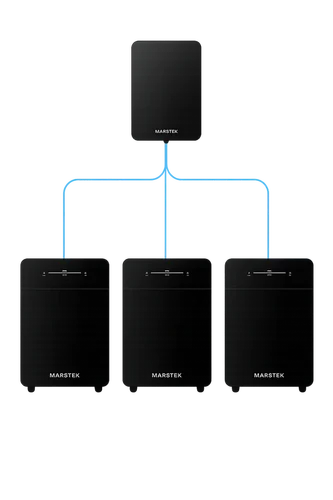
It’s also important to understand the philosophy of the product. The Venus E is an AC-coupled battery. It does not connect directly to solar panels in direct current, nor does it integrate an MPPT for connecting panels directly. Its role is different: it connects to the domestic network to store the surplus already injected into the installation, then restitutes it later. This is precisely what allows it to be so easy to add to an existing installation, whether on the roof or plug and play, without touching the already installed solar inverter.
Installation: Probably One of the Big Advantages of the Venus E
This is undoubtedly the point that explains the model’s success. The basic installation is really simple. You place the battery, connect it to an appropriate wall outlet, turn it on, install the Marstek app, then pair it via Bluetooth before connecting it to Wi-Fi. A setup that can be completed in just a few minutes, without tools (excluding installation of the smart meter, of course).
However, it is important to remember a few common-sense rules. No power strips. No lines shared with heavy devices. And if the goal is to exploit the 2500 W mode, a dedicated line is clearly preferable. I want to emphasize this. An AC battery of this type remains easy to use, but it operates at powers that are anything but trivial.

The mobile app does the job. Pairing is generally easy, the battery is quickly detected via Bluetooth, and then switches to Wi-Fi.

You then find information about charging, discharging, history, estimated savings, meter status, and operation mode selection.

Overall, the system is easy to handle, sometimes a bit too much. Because while simplicity reassures beginners, it also reveals a lack of software maturity in certain areas. Incomplete translations, imperfect presentation, occasionally sparse graphics, and especially options that are still lacking to go further.

In France, the AI mode isn’t particularly relevant today for the majority of users. Feedback shows that the AI mode is not yet the most pertinent for standard French contracts. In practice, users are mainly utilizing self-consumption mode and manual mode. The manual mode allows you to program charging and discharging time slots, which can already provide good services for charging overnight during off-peak hours and discharging in the morning or evening. This is actually the mode I used all winter, which allowed me to get through the red Tempo days without stress: the battery charged overnight during off-peak hours, up to 1000 W, which provides ample time to charge during off-peak hours. Once during peak hours, at 6 AM, the battery automatically switches to self-consumption: if the home needs energy, the battery reinjects what it can, and if, on the contrary, we have a beautiful day and a surplus of solar production, the battery stores it.
The Marstek Meter CT002: The Real Brain of Self-Consumption
The battery alone can already operate in manual mode. But to get the best out of the Venus E, the smart meter really changes the game. It measures in real time what goes in and out of the home, so the battery only injects what is necessary, when it’s necessary. In other words, it’s the element that transforms a simple programmable battery into a real managed self-consumption battery. It’s clearly the tool that allows for the automatic optimization of the usage of the Venus E and aiming for zero injection.

The CT002 installs on a DIN rail in the electrical panel and works with current clamps.


It handles both single-phase and three-phase systems, with real-time measurement, a stated precision of 1%, 2.4 GHz Wi-Fi, and Bluetooth. It can monitor three-phase networks or up to three monitoring points in single-phase.

You can see the benefit of the CT002 very well. When an appliance starts up, the meter immediately detects the change in consumption and asks the battery to compensate. This avoids abruptly draining the battery at a fixed power and instead allows for injection to be adjusted closely to the real needs of the home. This is particularly useful with variable consumption throughout the day, or to smooth out the power calls of a water heater, a small appliance, or a continuous consumption peak.
Its installation is not complicated for a professional or an experienced user, but it does require getting into the panel. In single-phase mode, only one clamp is usually used on the concerned phase. In three-phase mode, all three clamps can be utilized.


The CT002 is not mandatory. It’s important to remember that. Without it, the Venus E can still function in manual mode. With it, it becomes much more relevant in everyday use, because it can track the real flows in the house instead of relying solely on a schedule. This is why, in real life, it should almost be considered an integral part of the system.
And what if you already have a Shelly Pro 3EM?
This is great news for smart home enthusiasts: yes, the Venus E can also work with a Shelly Pro 3EM in certain cases. It can replace the CT002, provided that the configuration procedure is followed. This is interesting for those who already have advanced energy monitoring at home and don’t want to multiply modules in the panel.
There are, however, a few precautions. First, the battery and the Shelly must be on the same network. Next, you need to modify the RPC port on UDP from the Shelly with the value 1010, then restart the device so that the battery can detect it correctly. Until this setting is done, communication does not work. Once the correct port is configured, pairing is usually immediate and stable.
In short, if you already have a Shelly Pro 3EM, it can absolutely do the job. If you’re starting from scratch and want the simplest solution, the CT002 remains the most natural choice.
Daily Use: Where the Marstek Venus E Becomes Truly Interesting
On the ground, the Venus E seems to convince for a simple reason: it meets very concrete use cases.
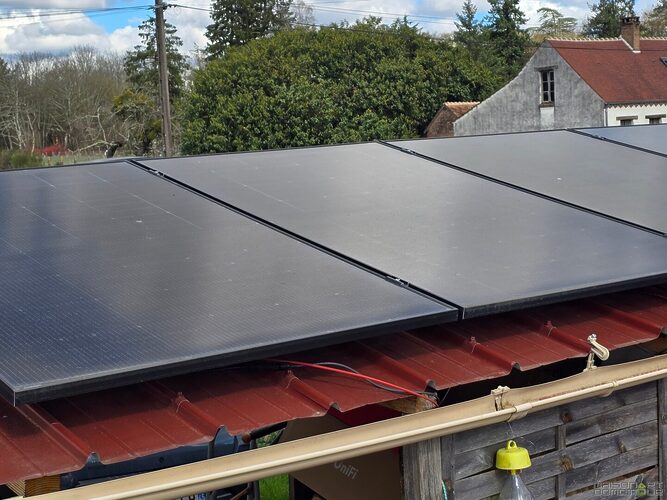
The first is, of course, the storage of photovoltaic surplus. If you already have panels on the roof or plug-and-play kits, the battery collects what would otherwise go into the grid. At nightfall, it returns this energy to run the consumption peak, lights, the box, the fridge, a television, some electronic devices, or even more if the line permits the 2500 W mode. This is precisely the type of usage for which it was designed.
The second is optimizing a subscription with off-peak hours. Even without panels, it is possible to charge it overnight at low prices, then discharge it during the day or peak hours. This is not necessarily the most profitable scenario if you only buy the battery for this purpose, but it’s a real bonus for those who already have it, especially on contracts like HP/HC or Tempo during the most expensive days.
The third is comfort. This is an angle that is often overlooked. Having 5.12 kWh available at home, even without aiming for perfect profitability down to the penny, brings real flexibility. We store the surplus instead of losing it. We smooth out consumption peaks. We relieve the grid a bit at difficult times. And we have an emergency power supply in case of outages. In this regard, the Venus E checks many boxes.
However, in practice, there is a small latency in compensation between the measured consumption variation and the battery’s response. It’s not huge, but it’s not totally instantaneous either. In practice, this means that a very brief consumption spike may still partially go back to the grid before the battery adjusts its injection. For the majority of uses, this is not a blocking point. For users who are very particular about absolute zero injection, this is a point to keep in mind.

The app also remains the most improvable link. It does the job, but it still lacks finesse. We would like more advanced settings on the minimum and maximum charge thresholds, more hybrid options between self-consumption and scheduled charging, or an interface that is clearer. It’s not a dealbreaker, but you can sense that the software part still has room for improvement. Fortunately, the developers seem to be listening to users, and many improvements have been made since its inception.
Backup Mode: A Real Plus, Not Just a Line on a Product Sheet
The backup socket is another major argument for the Venus E. And here, it’s not just marketing. Marstek claims up to 2500 W from this dedicated output, with an automatic switch over announced at 15 ms to maintain power to some essential devices.
In tests, I pushed this backup socket quite far. For emergency use, it opens up interesting possibilities: fridge, box, some lights, small home office, or even temporary power in a workshop or outbuilding. But since I have a source inverter, in my case I can connect the entire house via a single outlet. Due to its form factor and functions, it finds its place well under my electrical panel:

However, it is important to remain realistic. With a maximum of 2500 W, you won’t be able to power an entire house without making choices. It’s not a replacement for a large hybrid system with full recovery box. But for targeted backup, it is already very convincing. In case of a power outage, if I leave out electric heating, the water heater, and the oven, for the rest of the house, it’s perfect.
But it can also be used in a more original scenario, like recharging the battery via micro-inverters connected to the grid on this same output. This is an interesting point: since the Venus E doesn’t have a direct panel input with MPPT, it remains possible to use a synchronized micro-inverter on the backup output to inject AC solar into the battery while powering connected loads on the same power strip in parallel. It works, within the 2500 W limit, of course, with synchronization of the micro-inverter occurring after about a minute.
Moreover, the battery can even simultaneously manage production via micro-inverter and local consumption on this backup output. In other words, if your panels inject, for example, 200 W and a heater consumes 1000 W, the battery only provides the balance. This is exactly the behavior expected from a smart off-grid system. This isn’t the main use presented for this battery, but it works.
Integration with Home Assistant: Possible, Local, and Frankly Interesting
For Home Assistant users, the good news is that the Venus E can be integrated locally. It’s not an official native integration in Home Assistant to my knowledge, but a local API has been added on the Marstek side, and a HACS integration exists, allowing crucial battery information to be retrieved. This is a very interesting point for anyone wanting to take control of their energy logic.

The procedure is fairly straightforward. In the Marstek app, you first need to enable the “Local API” option in the battery settings. Then, on the Home Assistant side, you go through HACS to add the custom repository for the Marstek Local API integration, then install the integration and specify the device. Once in place, you typically retrieve information such as battery level, charging or discharging power, and various useful states for control.

For smart home enthusiasts, the interest is clear. With Home Assistant, you can go much further than the Marstek app. For example, it becomes possible to cross-reference charging status with daily rates, solar forecasts, overall consumption of the home, or even other batteries present in the house. This way, you can make several storage systems work together within the same energy logic.

In concrete terms, you can imagine several very useful automations. Automatically charging the Venus E at night only during off-peak hours if the weather for the next day looks bad. Reserving a minimum battery level for backup in case of a weather alert. Stopping a scheduled charge if another solar system is already enough to cover needs. Or only discharging the battery during certain periods when the kWh price is the highest. With Home Assistant, the Venus E becomes much more flexible than if using the app alone.
However, let’s be honest about two points. First, this integration relies on a local API activated within the app, so it depends on at least some software support from Marstek. Secondly, the most demanding users might find that local retrieval suffices for control, but it’s not yet perfect for ultra-responsive needs. Some mention RS485 as a “lower level” path to go even further, but it’s neither the simplest nor the most documented solution at this stage.
What to Remember After Analyzing the Product
The Marstek Venus E checks many good boxes. First, it truly simplifies access to residential storage. Its AC plug-and-play principle allows it to be added to an existing photovoltaic installation without touching the inverter. Next, it offers a serious capacity of 5.12 kWh, where many solutions start lower (often half). It also provides real power, a useful backup socket, compatibility with smart meters, and a possible local integration in Home Assistant. And most importantly, its current official price positions it very aggressively in the French market.
Against this backdrop, its flaws exist, but they are largely concentrated on the finish of some details and especially on the software. The app still lacks maturity. The AI mode isn’t very relevant for many uses in France. Pairing with a Shelly Pro 3EM requires a small technical manipulation. And while consumption compensation is good, it’s not always as instantaneous as the more demanding users might hope.
Ultimately, the Venus E appears to be a very coherent solution for several profiles. The individual already equipped with solar who finally wants to store their surplus without completely revamping their installation. The Home Assistant user looking for a locally manageable battery. And even the installer wanting to offer a simple-to-deploy residential storage solution, without major renovations, provided that serious attention is paid to the electrical line and the meter.
Who is This Battery For?
The Marstek Venus E is clearly aimed at those who want to step up their energy management without embarking on a heavy installation. It’s typically the right choice for individuals already equipped with solar panels, whether on the roof or plug-and-play kit, and who are tired of seeing their surplus go for free into the grid.
It will also suit those looking to optimize a peak/off-peak subscription by storing at night to consume during the day. This isn’t necessarily its primary use, but it’s an interesting bonus.
Home Assistant users will also find a real playground here, with the ability to finely manage charging and discharging cycles based on advanced scenarios.
However, it will be less suited for those looking for a completely autonomous solution with direct solar panel input (like MPPT), or a system capable of powering an entire house in case of an outage without discretion.
Conclusion
The Marstek Venus E is probably one of the most interesting AC plug-and-play batteries on the market currently in its category. Not because it’s perfect. It’s not. But because it puts 5.12 kWh of storage, up to 2500 W bidirectional, a convincing backup mode, an intelligent self-consumption logic, and an opening towards Home Assistant into a package that is easy to install and competitively priced.
If your aim is to add storage to an existing solar installation without replacing the inverter, without redoing the entire panel, and with rapid implementation, it certainly deserves consideration. With the CT002, it becomes much more relevant in everyday use. With a Shelly Pro 3EM already present, it can also integrate well into an advanced smart home ecosystem. And with Home Assistant, it reveals real potential for those who like to take control of their energy.
Its weaknesses are real, especially regarding the application. But they do not undermine the overall appeal of the product. At this price level, with this capacity and level of simplicity, the Marstek Venus E has very solid arguments. And frankly, for many households, it could very well be the battery that finally transitions residential storage from the status of an appealing idea to that of a truly usable day-to-day solution.
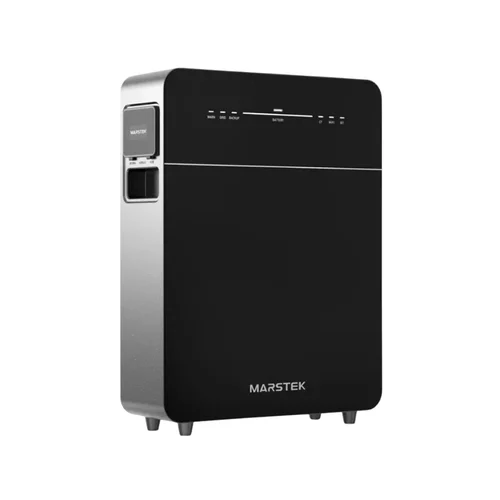
Marstek Venus 3E
What is the Marstek Venus E?
The Marstek Venus E is a residential AC-coupled battery designed to store electricity and return it later in the home. It connects to the domestic network without modifying the existing solar inverter, making it a very simple solution to add to an already established installation.
What capacity does the Marstek Venus E offer?
The Marstek Venus E has a capacity of 5.12 kWh, placing it above many competing plug-and-play batteries that start lower. This capacity already allows for covering a good part of the evening consumption peak or powering several specific uses.
What actual power can the Marstek Venus E provide?
The battery can charge and discharge up to 2500 W in AC.
However, it is often set by default to 800 W, which remains more prudent for a plug-connected installation. Switching to 2500 W requires a serious, clean, and suitable electrical line.
Does the Marstek Venus E connect to a standard outlet?
Yes, that is precisely one of its major arguments. The battery can be plugged into an appropriate outlet in the house without a major overhaul. But don’t go overboard: no power strips, no worn-out lines, and if you want to increase the power, a dedicated line in 2.5 mm² is clearly preferable.
Can the Marstek Venus E be installed without modifying its solar installation?
Yes. The Venus E is an AC battery, so it complements an existing installation without replacing the solar inverter. This is what makes it interesting for those who already have rooftop photovoltaic systems or plug-and-play kits and want to add storage.
Does the Marstek Venus E have a direct solar panel input?
No. It does not integrate a MPPT input to connect panels directly. It’s not designed like a classic DC battery but as an AC battery that captures energy already injected into the domestic network.
What is the Marstek CT002 meter for?
The CT002 is the brain of the self-consumption system.
It measures real-time electrical flows in the home so that the battery compensates consumption as accurately as possible. Without it, the battery can operate in manual mode. With it, it becomes much smarter and significantly more interesting in daily use.
Is the CT002 mandatory?
No, it is not mandatory.
But let’s be honest, in real life, it is almost indispensable if you want to effectively exploit the battery for self-consumption. Without a meter, you program. With a meter, you truly control.
Can you use a Shelly Pro 3EM instead of the CT002?
Yes, in some cases, the Marstek Venus E can function with a Shelly Pro 3EM. This is very good news for smart home users who already have this equipment. However, it requires a bit of network configuration. Therefore, it is not impossible, but it’s not the “just unbox and you’re done” mode.
Does the Marstek Venus E work well during off-peak hours?
Yes, it can be interesting during peak/off-peak hours.
You can charge it at night when the kWh is cheaper, and then discharge it in the morning or evening. This isn’t necessarily the only usage to aim for, but it’s a real bonus to further optimize consumption.
Is the AI mode of the Marstek Venus E useful in France?
Not really for the majority of households today. Feedback shows that the AI mode is not yet the most pertinent for traditional French contracts. In practice, users mainly utilize self-consumption mode and manual mode.
Is the Marstek Venus E silent?
Yes, it’s actually one of its true strengths. Several feedback reports highlight very quiet operation, with a noise level reported to be less than 30 dB. In short, it can stay in a home without disturbing you. And that changes everything.
Can the Marstek Venus E be installed in a living room?
Yes, its slim format and relatively neat design mean that it doesn’t look out of place in an interior. It remains heavy, but visually it stands out better than many competitors. This matters more than one might think when you don’t want to turn your home into a Wish nuclear power plant.
Can the Marstek Venus E power the house in case of an outage?
It has a backup mode via a dedicated outlet, allowing it to power essential equipment in case of an outage. However, it’s essential to stay realistic: it is not a large hybrid system capable of reviving the entire house without discretion.
Is the backup of the Marstek Venus E really useful?
Yes, for targeted backup, it’s a real plus. You can consider plugging in a fridge, internet box, some lights, a small office setup, or other essential equipment. We’re not dealing with meaningless marketing talk, there’s genuine use behind this.
Is consumption compensation instantaneous?
Not entirely. Feedback indicates that the battery responds well, but there is a slight latency. For most uses, this isn’t a big deal; it gets the job done. However, for absolute zero injection purists, it’s a point to keep in mind.
Is the Marstek Venus E compatible with Home Assistant?
Yes, and it’s clearly one of its significant advantages for advanced users. A local integration allows essential information to be retrieved in Home Assistant and to automate charging or discharging according to your own energy scenarios.
Why integrate the Marstek Venus E into Home Assistant?
Because that’s when it starts to get really powerful 😏
With Home Assistant, you can cross-reference:
– battery status,
– off-peak hours,
– weather forecasts,
– solar production,
– other batteries or devices.
In short, you regain control over your entire energy logic instead of just relying on the app.
Is the Marstek Venus E profitable?
It largely depends on your profile.
It becomes much more coherent if:
– you already have solar power,
– you are losing surplus,
– you want to smooth out your consumption,
– you plan to use the CT002 or Home Assistant.
If you buy it just to tinker around without a real strategy, profitability will be more questionable.
Who is the Marstek Venus E made for?
It is primarily designed for:
– individuals already equipped with solar power,
– those who want to store their surplus without major renovations,
– Home Assistant users,
– those seeking a battery that is simple to install but not foolish to use.
It will be less suited for those looking for a battery with direct solar panel input or a total emergency solution for the entire house.



Please remain courteous: a hello and a thank you cost nothing! We're here to exchange ideas in a constructive way. Trolls will be deleted.