


Résumer cet article :
Watching a movie without waking up the whole house… mission impossible? That’s exactly what I thought. Until I tested this Yamaha YH-L500A headset. And then… huge surprise. I literally felt like I had a home cinema in my ears, without making a single sound. And the worst part? Sometimes I prefer this experience to my speakers. Yes, really.
The real problem?
When watching a movie in the evening, you often have to choose:
👉 either enjoy the sound… and disturb everyone
👉 or lower the volume… and lose all immersion
This headset clearly resolves this dilemma.
What this headset offers:
- Home cinema immersion… in a headset
- No noise for those around
- Zero latency with movies
- Long-lasting comfort
For whom?
- Those who watch movies in the evening
- Those who don’t want to wake up their surroundings
- Those who don’t have a home cinema setup
First impressions: a headset that inspires confidence from the start
Upon opening the box, Yamaha remains true to its positioning: sober, clean, efficient.

No unnecessary frills, but a product that immediately inspires confidence.
The headset adopts a circumaural format with large enveloping ear pads.


The design is rather discreet, modern without being overdone, and especially designed to last.

The plastics are of good quality, the finishes are neat, and the whole remains lightweight despite its size (265 grams, which places it in a good average for a comfortable circumaural model, without any heaviness felt over time).

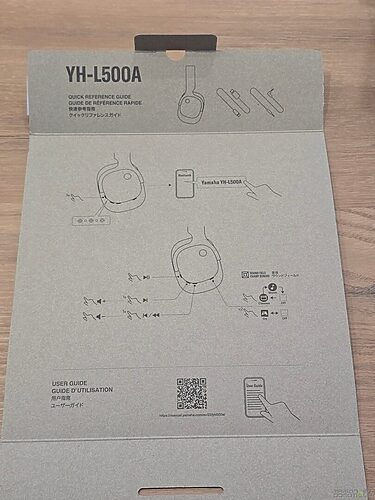
We find a rather simple ergonomics, with a few physical buttons on the earcup to manage playback, volume, and audio modes. Nothing complicated, and that’s quite appreciated in daily use.

On paper, this headset remains quite classic.
But in practice… it’s a different story.
Technical specifications of the Yamaha YH-L500A
The Yamaha YH-L500A gets straight to the point, with a coherent technical sheet for a home cinema oriented use and video streaming.
The headset features 40 mm dynamic transducers, a classic format but well mastered here, capable of delivering a wide and precise sound, especially on dialogues and effects.

The frequency response ranges from 20 Hz to 20,000 Hz, covering the entire audible spectrum, with a balanced reproduction suitable for video content as well as more classic listening.
On the connection side, we are on Bluetooth 5.0, supporting SBC and AAC codecs. No high-resolution codec like aptX or LDAC here, which confirms the positioning of the headset more oriented towards TV and streaming use than pure hi-fi. The headset integrates a multipoint Bluetooth function, allowing it to stay connected to two devices simultaneously. Convenient for switching from a projector to a smartphone without any hassle.
One of the key points remains the low latency, specially optimized for video content, to avoid any delay between sound and image.
In terms of battery life, Yamaha announces about 20 hours of use, which easily covers multiple movie nights without recharging. Recharging is done via USB-C, with a charging time of about 2.5 hours.
But the real heart of the product lies elsewhere: the Yamaha Sound Field technology, which allows simulating a three-dimensional sound environment. Unlike some headsets that only provide an approximate spatial effect, the goal here is clearly to reproduce the sensation of a room with speakers.
The headset offers two main modes:
- A “Cinema” mode for movies and series
- A “Music” mode for more classic listening
But can it really replace a classic home cinema?
Getting started with the Yamaha YH-L500A
No surprises here, and that’s a good thing.
Bluetooth pairing takes just seconds with an Android TV, a projector, or even a smartphone. In my case, with the Dangbei projector under Android TV, the connection was immediate. No specific settings, no bugs, nothing to report.
Yamaha offers an app if you want to fine-tune the settings, but apart from creating a custom equalizer, it remains anecdotal.


The multipoint feature allows connecting two devices at the same time. Typically, the headset remains connected to the projector and my Lenovo Yoga 2-in-1 laptop, which I sometimes use in tablet mode to watch a movie in bed. This multipoint mode saves me from juggling between sources, which is always very convenient (no need to pair every time I switch devices).

Another important point for this type of use: latency. Yamaha has clearly worked on the subject. In movies and series, there is no perceptible delay between image and sound. And that’s a detail that changes everything (because a slight delay instantly breaks immersion).
My real-life testing (and this is where it gets interesting…)
And this is where it gets really interesting.
Because at no point did I have that “headset” sensation.
I really felt like the sound was coming from the room.
Not from the headset. From the room.
Honestly, I didn’t expect that. Right from the first minutes, I had that little moment where you think: “okay… something is different here”.
Used with a Dangbei projector under Android TV, the headset makes perfect sense. From the first minutes, you feel a stunning spatialization of the sound. The dialogues seem to come from the front, the effects move around you, and the sound ambiance gains depth.

On an action movie, the explosions have depth, the movements are easily perceivable, and above all… you don’t have that sensation of being trapped in a classic headset. It’s more open, more natural.
On calmer series or movies, the headset also does its job very well. Voices are clear, well-centered, and do not require cranking up the volume unnecessarily. Result: you can watch for a long time without fatigue.
Same impression by the way when using it with my Samsung TV (which also directly accepts Bluetooth headsets).

On the comfort side, Yamaha has clearly done a great job. The headset fades away, even after several hours. The ear pads are soft, the pressure is well distributed, and ventilation is adequate. Even in long sessions (like a movie + an episode afterwards…), it remains comfortable.

Another point that surprised me is the headset’s ability to replace an audio setup in certain situations. When the whole house is asleep, it allows you to enjoy true immersive sound without compromise. And honestly, in some cases, the experience is even more precise than with classic speakers.
In short, it quickly becomes difficult to return to a standard headset after this. You quickly get used to this sensation of space, and it has rapidly become my go-to headset for watching movies alone.
It’s typically the kind of product where you think: “okay, I’ll just try it out quickly”… and in the end, you can’t go back.
Of course, not everything is perfect. The headset is still oriented towards “cinema”. For pure music listening, although a dedicated mode exists, it’s not its main playground. And those looking for a very neutral audiophile sound might be left wanting.
Conclusion
The Yamaha YH-L500A doesn’t aim to be perfect everywhere.
But on one specific point… it is formidable.
If you often watch movies late at night… you know exactly what I’m talking about. You want true immersion without disturbing anyone… this headset can clearly change your experience.
And honestly?
It’s typically the kind of product that you test out of curiosity…
…and which ultimately becomes indispensable.
Between convincing spatialization, comfort, ease of use, and controlled latency, it checks almost all the boxes for movie and series use.
It’s typically the kind of product you don’t necessarily expect… and that you quickly adopt once tested! Simple and effective, we love it! Available around €200 on Amazon, I can only recommend it to accompany your night sessions (or not!). Clearly… once tried, it’s hard to go back.
And you, do you watch your movies with a headset or speakers?

Please remain courteous: a hello and a thank you cost nothing! We're here to exchange ideas in a constructive way. Trolls will be deleted.