
Résumer cet article :
At home, dozens of connected devices constantly generate data: Shelly modules, Philips Hue lights, Linky meters, heating, home batteries, not to mention the various home automation hubs. There’s no shortage of information. And yet, when I want to understand what’s really going on at home, I still end up opening three apps, comparing graphs and cross-checking measurements by hand.
An AI could do that work for me. It could even learn about my setup, spot what’s wrong, tell me where I’m wasting energy, and one day compare my home with thousands of others. At least, that’s the bet being made by Spora, a French start-up that wants to “give a voice” to the connected home.
I had a long conversation with the Spora team, then joined the alpha testing program. For the past few weeks, Spora has been getting to know my home, its devices and the way I use electricity. The first results have been rather surprising.
An AI that learns about your home
When you think about it, the smart home isn’t all that smart. The thermostat knows the temperature in the living room, the lock knows when the door opens, the meter records consumption, and the smart plug measures how much power a device draws. But each one operates in its own little world, with its own app and data.
Even with a central platform like Home Assistant, Jeedom or SmartThings, it’s up to you to build the dashboards and automations that make use of all that data.
Spora approaches the problem differently. The service retrieves data from the devices you already own, then a conversational AI interprets it. Instead of reading graphs, you ask questions:
“Why has my electricity consumption gone up this week?” “Are all my devices working properly?” “Which device uses the most power at night?” “Why is it colder in this room than in the others?”
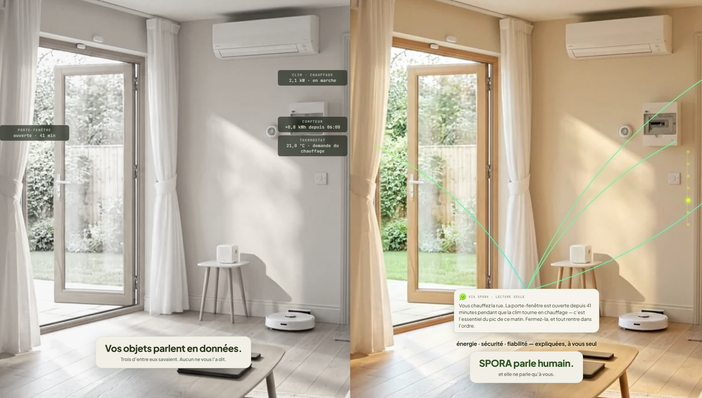
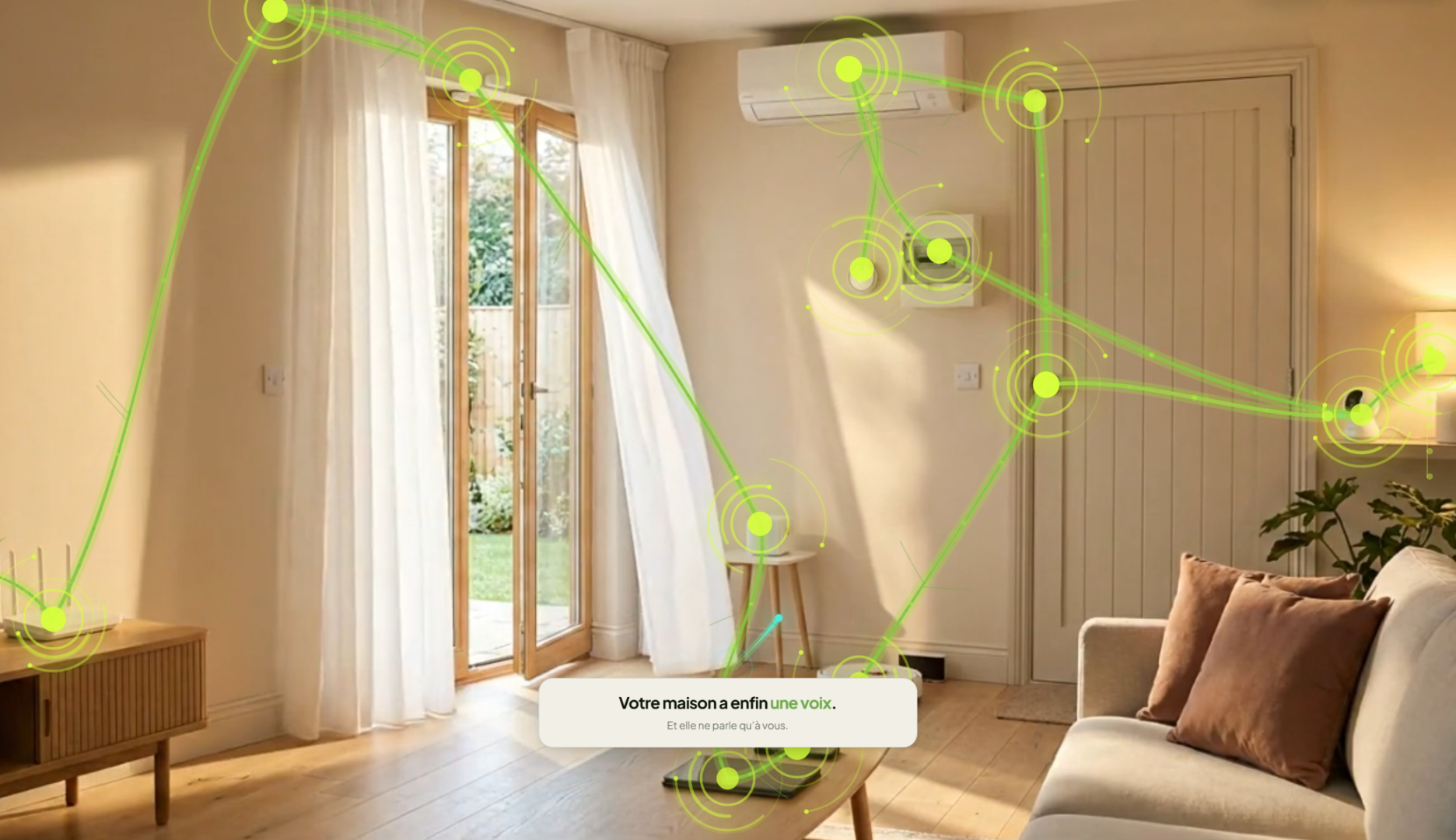
The team describes Spora as something like “ChatGPT for the home.” But it’s more than that. With a general-purpose assistant, you have to explain everything to it. Spora, on the other hand, discovers your devices on its own and works with their actual data. Spora digs through the data it can access, looks for correlations and tries to answer you in plain language. The idea goes beyond bringing devices together in a single interface: it’s about analyzing them together.
963 households surveyed on the limits of home automation
Before the launch, the team conducted a study, published in September 2026 under the title “A connected home is not a smart home.” It surveyed 963 households, mainly in France, Germany, the Netherlands and the United States.
The figures confirm what many readers experience every day. The most enthusiastic households juggle an average of 3.2 ecosystems, compared with 2 for everyone else, and 30.2% of respondents use a separate app for each device. Accumulating connected devices doesn’t make a home smart.
As for what people want, energy tops the list of topics they want explanations about (48.7%), ahead of security (44.2%) and device reliability (36.8%). The gap between continents is clear: 58.1% of Europeans mention energy savings, compared with 36.6% of Americans. It’s no surprise that Spora is starting with electricity consumption analysis, and with France.
77.8% of respondents say they are at least curious about comparing their home with similar homes. But privacy is a major concern: among those willing to share anonymized data, 84% have conditions.
The team also combed through 8 Reddit communities, official forums and 13 Facebook groups to understand the problems users encounter with different brands and the questions that come up most often. This work informs the suggested questions in the interface.
The full study results are available here.
How it works: connecting to the services you already use
Getting started is simple, which is a nice touch. No new hub to buy, no server to install, nothing to change on your network. Spora is a web app: you create an account, then authorize access to the ecosystems already in your home.
These connections use the manufacturers’ official interfaces, with OAuth wherever possible. You sign in with the manufacturer, authorize Spora to read certain information, and compatible devices appear in the service.

The team says around 90 brands and ecosystems are accessible, largely thanks to Samsung SmartThings, which acts as an aggregator. One important distinction: a brand accessible through a third-party platform is not a direct integration. Not every device from a brand is necessarily compatible, and not all of its data will necessarily be available.
During my first tests, the Linky meter, Shelly devices, Philips Hue, SmartThings and Sonos were already available. Nuki was too, but through SmartThings. Home Assistant, some Tapo plugs and weather data were announced for later. The list is updated over time based on user feedback.
A major advantage in France: Linky meters
For its launch in France, Spora has an interesting card to play: integration with consumption data from Linky meters. According to the team, that’s largely why the alpha started in France.
With the account holder’s permission, Spora retrieves the Linky meter’s consumption history, down to half-hourly intervals. That means you can get started without any home automation setup at all. A Linky meter alone is enough to spot peaks, understand daily habits or see when something is out of the ordinary. Spora then asks questions about the home and its devices to put those graphs into context.
Some of the cases reported by the first users are very interesting. In one home, Spora apparently helped identify unusually high consumption from a hot water tank: around 10 kWh instead of the usual 2, though the cause still needs to be checked (limescale buildup, settings or usage). Another user thought their dishwasher was running during off-peak hours, but the cycle was regularly starting half an hour too early. The team also says it has seen consumption patterns distinctive enough to infer the presence of a washing machine, without knowing its model.

That said, it’s important to be realistic about what a Linky can tell you. It can’t reliably identify every device that’s running. The AI can suggest likely explanations, but a smart plug or dedicated meter is still much more reliable when it comes to attributing consumption to a specific device. And Enedis data comes with a certain delay: it isn’t real-time measurement.
I connected Spora to my home
To see what Spora is really capable of, I connected it to my own setup. The AI has plenty to keep it busy :p
My home has been equipped for years with several home automation systems, including Home Assistant, and a whole lot of monitoring and control modules. Shelly devices track consumption, I have several Linky meters, solar panels and home batteries that I test regularly. The lighting, multimedia equipment and some of my other devices are connected too. In short, it’s a somewhat unusual setup, since it serves as a test lab for the articles published on Maison et Domotique. That’s exactly what makes this trial interesting.
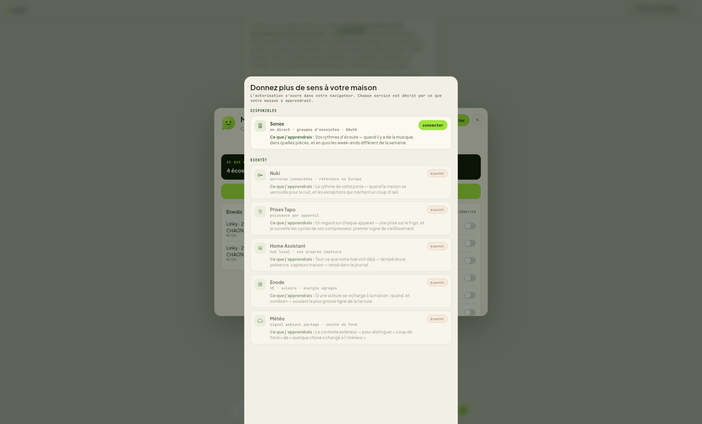
Once the first ecosystems were connected, Spora started retrieving data and gradually building a picture of my home. Unlike a general-purpose assistant, it looks at the readings it has actually received, and you can ask it about a specific date or device.
A detailed analysis of my consumption
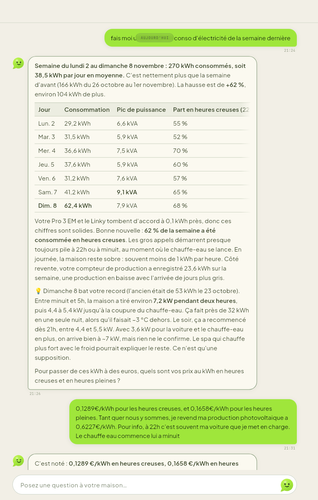
I asked it to analyze my consumption from November 2 to 8, 2026. It gave me a day-by-day summary: around 270 kWh for the week, or an average of 38.5 kWh per day. It compared that with the previous week, at around 166 kWh. An increase of about 62%!
For each day, I had the consumption, power peaks and the share used during off-peak hours. Sunday, November 8 stood out at 62.4 kWh, compared with 29.2 kWh on the previous Monday. Nearly 62% of the week’s consumption took place during off-peak hours, which makes sense: several high-consumption devices are scheduled to run during those periods.
From kWh to euros
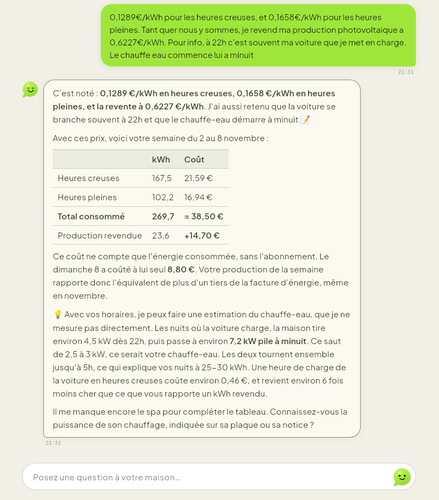
It becomes more meaningful when you give it your rates. I entered €0.1289/kWh during off-peak hours and €0.1658/kWh during peak hours for that period. Spora immediately converted the week’s consumption into euros: 167.5 kWh during off-peak hours, or around €21.59, and 102.2 kWh during peak hours, or around €16.94. That’s about €38.50 in energy for the week, excluding the subscription and anything not covered by those rates.
I’d also explained that I sell all the electricity generated by my solar panels to EDF, using a second Linky meter. For the same period, it found 23.6 kWh sold back to the grid. At my purchase rate of €0.6227/kWh, that comes to around €14.70.
A quick note to avoid confusion: when you sell all your solar production, it doesn’t supply power to your home or reduce the amount I draw from the grid. It’s a separate income stream that has nothing to do with my bill.
For someone who works with consumption spreadsheets every day, none of this is rocket science. But for an ordinary homeowner, getting a data-based answer by asking a simple question is a real change.
The AI is starting to understand the home’s habits
Spora doesn’t stop at the numbers. It also tries to explain the variations.
At my home, it spotted several large power draws at night, including around 7.2 kW for about two hours, followed by a more moderate level of power until early morning. Its hypothesis: charging the electric car, followed by the water heater. That makes sense, since I’d told it that I often plug in the car in the evening and that the water heater starts up at night. After a particularly energy-hungry day, it also wondered whether I’d used the hot tub.
That’s what I expect from an AI dedicated to the home: not just to flag a peak, but to look for the reason behind it, based on my habits and the devices I’ve described.
A young alpha, with a responsive team
Alpha testing means bugs. My home brought a few to light.
The first involved my two Linky meters. Spora was retrieving both consumption and production data, then stopped receiving anything after October 18. After a few checks, the team found the cause. My Enedis access covers two meters: one for the home and one for production that’s sold back to the grid in full. An unusual response from the second meter had been misinterpreted, and data retrieval had stopped for both. The team hadn’t encountered this setup before in the alpha. The problem was fixed without me having to touch the meters.
That’s what a testing phase is for: putting the software to the test in real homes, which are often more complicated than anyone initially imagined.
The case of the Shelly Pro 3EM
I also reported an issue with the Shelly Pro 3EM. These modules have three current clamps. They’re designed for three-phase power, but they can also be used to monitor three separate circuits. At my home, some of the clamps measure the car’s charging, the water heater or the hot tub.
The team looked into it and explained how it currently works. In single-phase mode, Spora retrieves the three measurements separately, using the names entered in the Shelly app. In three-phase mode, it currently only reports the total from all three clamps. Showing the per-clamp breakdown in this mode is planned.
While investigating, we also discovered that an old Shelly EM hadn’t sent anything for several days. It was still powered, but had dropped off the network without me noticing. This is exactly the kind of failure the service could help detect in the future. We keep an eye on our devices when they break down, but pay much less attention when they keep running without telling anyone anything.
Spora doesn’t control anything
This is probably the team’s most fundamental design choice: Spora operates in read-only mode. It retrieves information, analyzes it and makes recommendations, but doesn’t send any commands.
If a radiator is heating a room with the window open, it can tell you, but it won’t turn off the heating. If your car is charging during peak hours, it can suggest a different time, without changing the schedule.
That’s intentional. The team stressed the risks of an AI acting on its own on an electrical system, a lock or a security system. For the versions currently being considered, the team prefers to leave the decision to the user, and the official website presents read-only access as a design principle, not a missing feature.
So we’ll keep using Home Assistant, Jeedom or SmartThings for control. Spora sits above them, as a layer for observation and understanding. The two work very well together.
A tool for installers?
During our conversation, we also discussed a use case I hadn’t thought of: diagnostics and after-sales support for home automation systems.
Today, when a homeowner has a problem, they call their installer. But the issue doesn’t always come from the hardware: it could be unreliable Wi-Fi, a router that restarted, a cloud service that was unavailable for a few hours, or a misconfigured automation. Spora gives this example: six devices disconnect at the same time and six apps each report a problem, even though everything might be caused by a single router restart. An AI that connects these events can point the diagnosis in the right direction straight away.
Installers the team has spoken with already see this as a way to reduce unnecessary calls and site visits. You can imagine a professional monitoring several homes and, with each client’s explicit permission, getting a summary of issues with each installation. This won’t replace a proper diagnosis, but for initial checks across a few dozen homes, the time savings could be significant.
The long-term ambition: getting homes to learn from each other
For now, Spora analyzes each home separately. The next step in the project is a network capable of identifying common trends across homes.
The name wasn’t chosen at random. It comes from spores and mycelium, the network of underground filaments that connects fungi to their environment. The image fits the project: a home learns from its own devices, then, later on, several homes share what they’ve learned.
Consider two homes of the same size, in a similar climate, with similar heating systems. One uses significantly less energy than the other. If we know the settings, habits and performance of many systems, we can theoretically identify what works best. Spora could then tell you that similar homes use less energy and suggest options tailored to your home.
Spora is now approaching 150 alpha testers, which makes it possible to start building a sufficiently diverse dataset and identifying usage patterns.
This collective intelligence doesn’t exist in the alpha yet. The official website is clear: for now, each household’s data is used only for that household, and comparisons will come later.
Predictive maintenance, energy, help for loved ones: lots of possibilities
Spora’s posts on LinkedIn give an idea of the direction it’s taking.
One example is predictive maintenance for household appliances. Imagine a washing machine whose electrical behavior starts to change. On its own, nobody notices. But if thousands of similar machines show the same change before breaking down, an AI could recognize the signs and recommend maintenance before a major, costly breakdown.
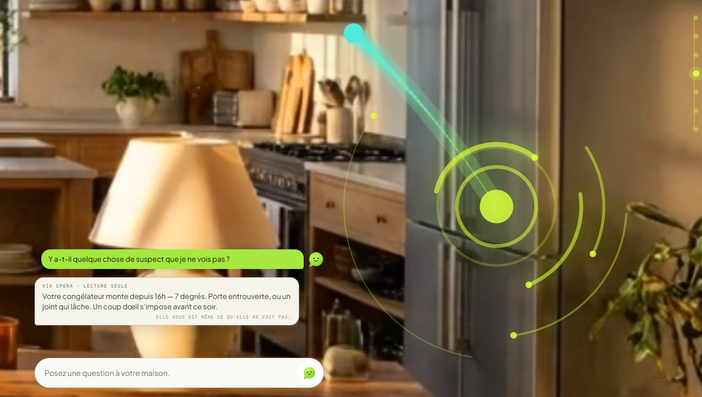
Other ideas relate to sleep, garden watering or coordinated electric car charging.
What about privacy?
Understanding a home’s habits requires access to sensitive data. The times the door opens, how the lights are used, the temperature in different rooms, electricity consumption: all of this says a lot about the occupants’ lives.
Spora is based on a key principle: “Trends travel. Your private life stays at home.” First of all, Spora is a French company and the data is hosted in the European Union. The service says it was designed in compliance with the GDPR and the EU Data Act.
It also operates in read-only mode; the AI doesn’t control any devices. Access can be revoked at any time, service by service. For future comparisons between households, the team says it intends to use only statistical trends, without sharing raw data, addresses or conversations between homes. The study also makes this clear: without privacy guarantees, this kind of service is unlikely to be accepted.
You can withdraw your permissions and request access to, export or deletion of your data. That’s reassuring, but as with any cloud service that can see your habits at home, it’s up to each person to decide what they’re willing to share.
How does it compare with Home Assistant, Jeedom and other AI assistants?
If you already use Home Assistant, you’re probably wondering why you shouldn’t simply connect an AI to your setup. I put the question to the team.
Home Assistant now integrates with many conversational assistants and language models. An experienced user can build their own analysis tools, including ones that run models locally. That’s the right approach if you want to control everything: the data, integrations and automations. But it takes skills, time and quite a bit of configuration.
Spora is aimed at someone else: the person with a few connected devices who doesn’t want to write scripts or build dashboards. The team has households with five to ten devices from different brands in mind. For them, asking a question in French and getting an answer that takes their home into account is useful right away.
For enthusiasts, the appeal will be more about analyzing habits, detecting anomalies and, above all, comparing setups down the line. In my opinion, that’s where Spora can make a difference, far more than with its conversational interface.
How much does it cost? A free version is expected to remain available
During the alpha, Spora is free. You connect your compatible devices, chat with your home and share your feedback with the team.
What happens after that? Nobody wants to connect their whole home only to find out later that they have to pay a hefty subscription. The answer is reassuring. The business model hasn’t been finalized, but the team plans to keep a permanent free version, with additional paid features. Other possibilities are being considered, such as offers for connected-device manufacturers, who could use the service to better understand their customers’ problems, improve their support or discover usage patterns invisible through their own apps.
No pricing information has been announced. We’ll have to wait for the official announcement to find out the prices, the limitations of the free version and the terms of use.
How do you join the alpha?
The program is open to a limited number of households, with priority given to France. Simply visit Spora’s official website and sign up. A short questionnaire asks about your devices and checks whether your setup matches the profiles they’re looking for.
The standard program prioritizes households with several connected devices, to gather as much feedback as possible on the integrations. But the team has set aside access for Maison et Domotique readers (using the exclusive code MAISONDOMO), even if they have more modest setups. A Linky meter alone is enough to explore the first consumption analyses.
Participants become “founding households” and receive a member number linked to their account. More importantly, they’re expected to do more than simply use the service: the team wants feedback on connection problems, incorrect answers, missing integrations and feature ideas. Questions Spora can’t yet answer directly inform development.
You can send your feedback to [email protected], and follow the project on its LinkedIn page or its Facebook page.
My take: a promising approach worth watching closely
After these first tests, I like Spora’s approach.
I’ve been working with home automation devices for nearly twenty years, and I’ve seen plenty of solutions promise increasingly smarter homes. We’ve made progress in compatibility, power, protocols and automations. But when it comes down to it, we’re still the ones providing the intelligence: understanding the devices, making use of their data, writing the routines and interpreting the results. Spora is trying to take on that work by making analysis and explanation its specialty.
What I appreciate most is being able to ask questions directly about my home’s data, request an analysis for a specific period and get a data-based answer in a few seconds. Bringing together several data sources makes it even more interesting.
It isn’t perfect, but we’re still in alpha. The integrations are incomplete, more unusual setups need adjustments, and the AI sometimes makes assumptions that are a little too flimsy. The requirement to use the cloud will put some people off, especially those who are committed to 100% local home automation. And the network for learning across homes, which is what makes the concept so interesting, is still unproven.
That’s what the alpha is for. The team isn’t presenting Spora as a finished product: it’s testing the service in lots of homes and use cases to find out where it’s genuinely useful. I think that’s a healthy approach, especially since my conversations with the developers showed me that they make fixes based on real-world feedback.
In my view, Spora belongs alongside today’s home automation solutions, not in place of them. If one day my home tells me that a device is starting to use too much power, that a heating setting isn’t ideal or that similar households manage their energy better, without me spending my evenings poring over graphs, then I’ll be convinced.
In the meantime, Spora is learning about my home. I’ll keep asking it questions, sometimes deliberately tricky ones, and connecting new devices as integrations become available. I’ll keep you posted on Maison et Domotique. After years of connecting our homes, it’s about time they finally told us what they’re up to!
To discover Spora and take part in the alpha program, visit sporanetwork.ai.