


Résumer cet article :
The house is no longer a static fortress: it becomes an intelligent organism, controllable from anywhere, at any time. Surveillance and home automation solutions reinvent the way families ensure the protection of their home. From the Wi-Fi camera set up in five minutes to the smartphone-controlled alarm system, the market has exploded in variety and ease of access. The democratization of connected devices, driven by brands like Somfy, Netatmo, or Yale, now allows working professionals, parents, or retirees to respond instantly to an alert or monitor their home live, whether they are at the office, on vacation, or commuting.
In this dynamic, security is no longer limited to simple intrusion. The connected home orchestrates heating management, remote garage door operation, video image consultation, but above all, immediate reaction to incidents thanks to notifications and video evidence collection. To navigate this, one must understand the technical aspects of centralized management, evaluate the coherence of each piece of equipment—from the Reolink camera to the Ajax Systems alarm—and integrate the digital protection of personal data. Thus arise crucial questions: how to choose the right devices? Should one opt for DIY or a monitoring subscription? What place should be given to home automation to move towards a truly intelligent house?
In short:
- Controlling one’s home remotely involves surveillance solutions, connected alarms, and centralized management via home automation.
- Modern systems offer night vision, intelligent detection, instant notifications, and simplified installation.
- The security of data and the prevention of digital intrusions are essential in any connected home.
- Mobile applications, professional remote monitoring services, and open-source alternatives (Home Assistant, Jeedom, etc.) are available for all budgets.
- Simplicity, performance, and comfort characterize today’s management of security and remote control of the home.
Surveillance technologies for controlling the home remotely
Evolution of connected security systems: simplicity and performance
In just a few years, residential security has undergone a major transformation. Previously reserved for professionals or large properties, surveillance systems are now accessible to all, with user-friendly environments and advanced features. Brands such as Somfy, Netatmo, Arlo, and Eufy have democratized access to these systems, offering cameras equipped with motion detection, night vision, and cloud recording, accessible via a simple mobile application.
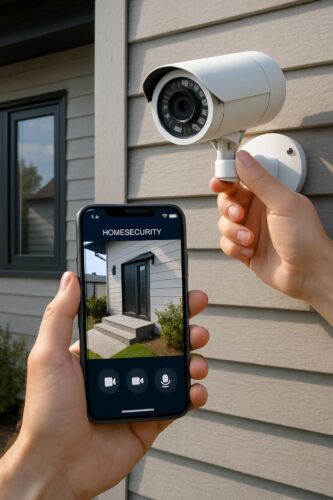
The current advantages lie as much in performance as in ease of installation, as seen with wireless cameras like Netatmo or Blink. Gone are the long and tedious configurations: ready-to-install solutions, guided by voice assistants or QR codes, allow for setup in a few minutes. The general public thus has access to proactive protection, with centralized notification management and automated responses to any unusual activity.
| Technology | Main function | Brand example | Ease of installation |
|---|---|---|---|
| Outdoor Wi-Fi camera | Visual and audio surveillance | Reolink, Eufy | Very high |
| Connected alarm | Intrusion detection | Ajax Systems, Somfy, Yale | High |
| Home automation management | Centralization and control | Homey, Delta Dore, Schneider Electric Wiser | Medium to high |
Why opt for intelligent home surveillance?
Choosing home surveillance meets a modern need: to protect one’s family and belongings while maintaining control over one’s house, wherever one is. The benefits are numerous: immediate deterrent effect from clearly visible cameras, surveillance varying according to habits (absence mode, night, etc.), collection of usable images in case of incident. Connected cameras (Ezviz, Dahua, Swann, Imou) detect movement, record the event, and alert immediately via smartphone.
Personal experience: during an attempted break-in while I was away, my Unifi camera triggered its alarm, sent me a notification, and started automatic recording. The images, easily extracted, allowed tracking down the suspect. The automation of security and the ability to access feeds, even remotely, create a new sense of peace in daily life.
- Deterrent effect and continuous surveillance, even at night.
- Ease of use with ergonomic mobile applications.
- Usable video evidence for law enforcement.
Choosing and installing effective devices for remote security
Essential features of a connected surveillance camera
Before purchasing, it is advisable to require certain key features from brands like Unifi, Imou, Dahua, or Ezviz. Battery life (Arlo, Blink) ensures independence and simplicity. Quick installation, image quality (at least full HD), and resistance to weather elements are essential for an outdoor camera. Good motion detection (with exclusion for animals) and strong night vision (up to 20 meters for Reolink) guarantee complete coverage, even in low light.
Real-time notifications, dual recording mode (local or cloud), and centralized management via applications promote high responsiveness. These devices, linked with open ecosystems like Jeedom or Home Assistant for example, can integrate seamlessly into an existing connected home.
| Criterion | Why it is essential | Brand examples |
|---|---|---|
| Night vision | Continuous surveillance, even in the dark | Reolink, Ezviz, Eufy |
| Weather resistance | Durable outdoor use | Arlo, Dahua |
| Instant notifications | Quick response in case of intrusion | Unifi, Blink |
Key steps for a successful installation of a surveillance system
The success of a surveillance installation begins with a precise analysis: which areas are vulnerable? Main access points, walk-through areas, and dark corners must be prioritized. It is advisable to install a camera at each entry point (including the garage), but also to monitor the terrace or garden, especially if valuable items are stored there.
- Plan for cable routing or opt for Wi-Fi depending on the needs for stability or flexibility.
- Avoid blind spots or direct light sources.
- Test each camera with the application to ensure the correct angle of view.
For a complete solution, combine camera and alarm: surveillance allows for quick verification, while the Diagral or Ajax Systems siren triggers an immediate response. Properly calibrating notifications avoids false alerts caused by animals or passing vehicles.
Home automation and remote control of the house: applications and security
Centralized management via smartphone and open-source solutions for the connected home
Home automation encompasses all technical solutions that allow control of one’s home remotely. Through intuitive interfaces, users control heating, lights, openings, and security. Platforms like Home Assistant, Jeedom, or Homey centralize management, making the experience unified, tailored to daily needs, and even accommodating people with reduced mobility. Open-source solutions are appealing for their scalability and the ability to leverage existing hardware like old tablets or smartphones turned into cameras or management dashboards.
Individuals can also opt for turnkey systems offered by Nice, Delta Dore, or Schneider Electric Wiser, combining performance and ease of installation while not neglecting the integration of effective surveillance.
| Platform | Technical advantages | Usage |
|---|---|---|
| Home Assistant | Openness, modularity, multi-brand management | Experts & DIY enthusiasts |
| Schneider Electric Wiser | Guided installation, wide compatibility | Users seeking simplicity |
| Jeedom | Advanced scenarios, personalized control | Tech-savvy individuals |
Data security and risk prevention in a home automation environment
Digital security becomes crucial when connecting one’s home. To withstand cyber threats, it is important to choose trustworthy brands (Somfy, Yale, Netatmo), keep systems updated, and use complex passwords. The home automation interfaces, which serve as gateways to all equipment, must be rigorously protected against unauthorized remote access.
- Favor storing data on encrypted or local servers.
- Regularly check connection logs and enable two-factor authentication.
- Avoid publishing video feeds on unsecured public platforms.
In case of breakdown or software failure, reliable and responsive technical support like that provided by Ring or Eufy becomes a major asset to preserve the protection of the home.
Advantages and tips for monitoring and controlling one’s home remotely
Concrete benefits of remote control for security and comfort
Remote control of one’s living space brings real added value to daily life. From a mobile application, it is possible to consult the video feeds in real-time, disable an Ajax Systems alarm, or interact with a visitor via a Ring intercom, no matter where you are. Intelligent systems also control lighting or shutters to simulate a presence and enhance the protection of the house during an absence.
- Energy savings through centralized management of household appliances (Delta Dore, Nice).
- Time savings and optimal responsiveness in emergencies.
- Increased accessibility, especially for seniors or people with disabilities.
Users appreciate the ease of use of mobile interfaces and the ability to configure custom scenarios, integrating fire sensors, leak detectors, or total automation.
Mistakes to avoid and tips for ensuring the effectiveness of a smart home
Despite the evolution of connected devices, some mistakes persist. Incompatibility between devices (alarm, camera, home management) can drastically limit the system’s effectiveness. It is therefore preferable to ensure the coherence of the ecosystem (Netatmo, Homey).
Furthermore, neglecting cybersecurity exposes the home to hacking: it is essential to conduct regular tests, keep devices updated, and frequently check the quality of internet connections. Periodic maintenance ensures reliability in the long term.
- Choose an expandable system (Aqara, Swann, Blink) to anticipate new needs.
- Get acquainted with open-source tools if you want to customize your solution while controlling the security of data.
| Common mistake | Consequence | Recommended solution |
|---|---|---|
| Incompatible devices | Limited features | Favor interoperable brands |
| Outdated systems | Decreased security, potential vulnerabilities | Schedule automatic updates |
| Poor camera positioning | Unmonitored areas | Regular review and repositioning based on new risks |
FAQ
What equipment to use to start home surveillance?
It is advisable to opt for a connected camera with night vision, motion detection, instant notifications, and management via a mobile application. Brands like Netatmo, Reolink, Arlo, or Imou offer suitable kits to get started.
Is professional remote monitoring necessary?
Remote monitoring provides constant control by a specialized center, ideal for extended absences. This service effectively complements self-monitored systems, but is not mandatory if real-time supervision and rapid response are ensured by the user themselves.
How to ensure the cybersecurity of a connected home?
Use strong passwords, opt for reliable brands (Somfy, Yale, Ajax Systems), enable two-factor authentication, and keep your equipment updated. Avoid sharing your video feeds on unsecured clouds or platforms.
Is it possible to use existing hardware for remote surveillance?
Yes, it is possible to transform an old tablet or smartphone into a security camera using open-source applications like Home Assistant or Jeedom. These solutions are cost-effective but often require technical skills.
What are the main advantages of home automation in daily life?
Home automation allows you to control security, lighting, heating, and access from your smartphone. It offers comfort, energy savings, responsiveness to incidents, and centralized management that simplifies life, especially for families and elderly individuals.

Please remain courteous: a hello and a thank you cost nothing! We're here to exchange ideas in a constructive way. Trolls will be deleted.