



Résumer cet article :
In a bustling mini PC market, the NiPoGi AM06 Pro that we are going to talk about today stands out as a promising newcomer. With a solid technical specification for its category and a competitive price, this compact cube integrates one of the latest AMD Ryzen 7 7730U processors (8 cores/16 threads up to 4.5 GHz), 16 GB of DDR4 memory, and a 512 GB expandable SSD, all powered by pre-installed Windows 11 Pro. Promising triple 4K display, dual network connectivity with Ethernet 2.5 GbE and 1 GbE, and features worthy of a modern workstation, NiPoGi aims to appeal to both telecommuters and enthusiasts of home automation integration or home labs. Facing competitors like Geekom, Beelink, or MinisForum, the brand’s positioning, already noted for its AM02, E1, or GK3 Plus that we had the opportunity to test earlier, aims to stand out through its power/price ratio.
Our test of the NiPoGi AM06 Pro reveals a versatile machine, smooth in all common uses, while remaining very low in consumption and remarkably quiet. The compact packaging, care given to ergonomics (VESA mount, easy upgrade access…), dual network capability, and integration of recent technologies (Wi-Fi 6, Bluetooth 5.2) outline a well-balanced mini-computer, coherent for a wide range of uses. This mini PC however raises the question of the limits imposed by the choice of a SATA SSD (where others are already opting for NVMe) and a plastic case, while remaining a reference in terms of modularity and versatility at a contained budget.
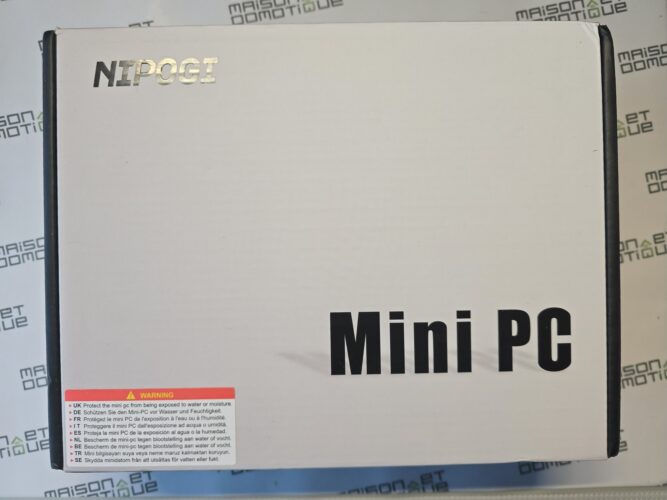
In brief:
- Mini PC NiPoGi AM06 Pro: AMD Ryzen 7 7730U processor (8 cores/16 threads), 16 GB DDR4 in dual channel, 512 GB extensible SATA SSD.
- Compact and sleek design: plastic cube case, easy access to components, VESA mount, USB-C power supply.
- Rich connectivity: Triple 4K output (HDMI, DP, USB-C), dual Ethernet (1 GbE/2.5 GbE), Wi-Fi 6, Bluetooth 5.2.
- Real performance: Very smooth in office tasks, multimedia, light virtualization, retro gaming; limited on modern 3D games.
- Effective cooling and silent operation, even under prolonged load.
- Upgradability: RAM upgradable, addition of 2.5″ SATA disk, easy maintenance.
- Excellent value for money for versatile usage & home lab.
- Limitations: Plastic case, no USB4, SATA SSD instead of NVMe, avoid demanding gaming.
Presentation of the mini PC NiPoGi AM06 Pro: positioning, price, and design
Market positioning analysis and value for money of the NiPoGi AM06 Pro
The NiPoGi AM06 Pro is part of the dynamic line of “plug & play” mini PCs, designed to meet the plurality of needs in the office, multimedia, light virtualization, or home automation tasks. In 2025, the segment consolidated by players like Geekom or Beelink finds here a determined challenger offering a solid configuration, designed for users looking for performance and versatility.
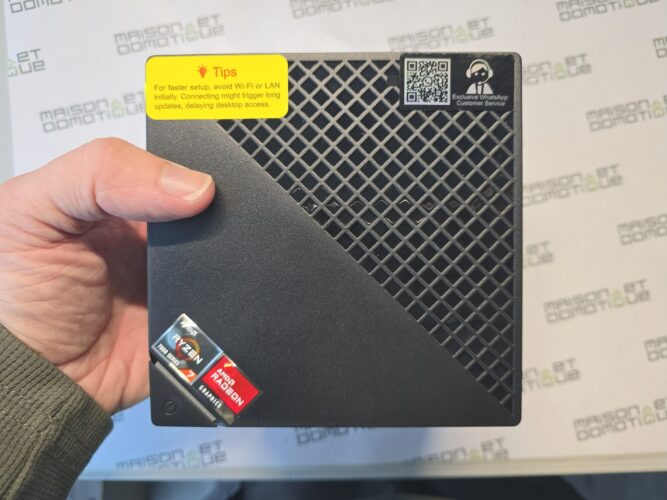
In terms of pricing, the AM06 Pro is priced around 350 euros on Amazon.fr (excluding promotions), a calculated positioning to effectively compete with the Geekom IT11 or the MinisForum Venus UM560 for example. This mini PC relies on the balance between the power of the AMD Ryzen 7 7730U processor and a generous allocation of DDR4 RAM (16 GB) in dual channel, a combination rarely offered at this price point among direct competitors. The storage provided by a 512 GB extensible SATA SSD further enhances its appeal.
Quick comparison with other NiPoGi models already tested:
- NiPoGi E1: entry-level, Celeron, for light office work
- NiPoGi CK10 I5-12450H: ultra-multimedia, Intel i5, more expensive
- NiPoGi GK3 Plus: more compact, less powerful, limited connectivity
In conclusion on this point, NiPoGi strikes where it needs to in 2025: compromise between performance, modularity, and understated design, all at a price that will suit students as well as freelancers or DIY enthusiasts.
Compact design, packaging, and accessories included with the mini PC NiPoGi AM06 Pro
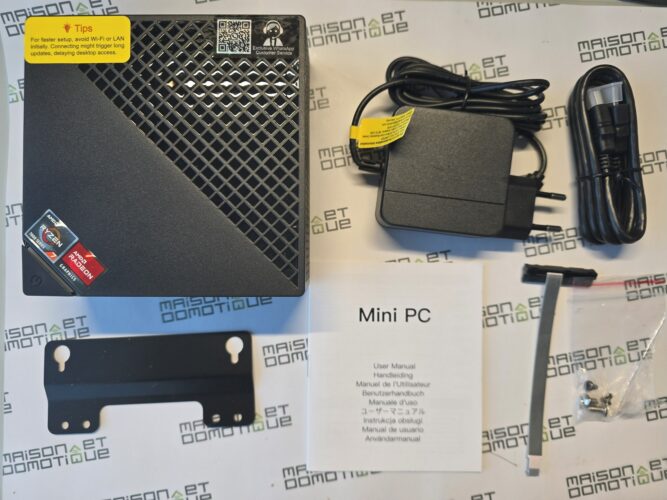
Upon opening the box, the NiPoGi AM06 Pro surprises with its simplicity. The mini PC is housed in carefully crafted packaging, accompanied by a complete set of accessories: USB-C power supply (65W, detachable cable), HDMI cable, VESA mount (for fixation behind a screen or under a desk), SATA extension, multilingual documentation, and a hardware kit.
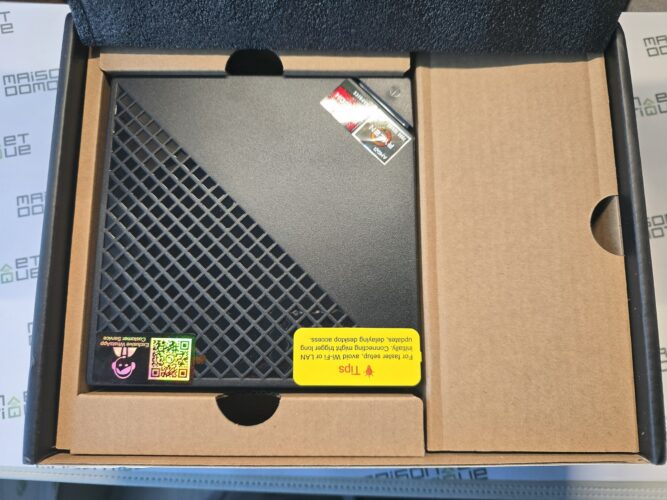
- Matte black plastic case with soft touch finish, reassuring grip
- Compact dimensions (12.8 x 12.8 x 4.5 cm) and lightweight around 375 g
- Well-organized front and rear connectivity for ergonomic access
- Backlit power button, discreet and pleasant to use
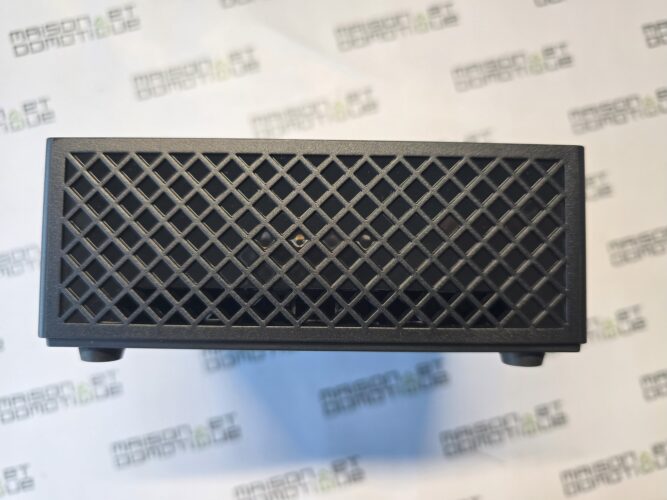
- Honeycomb ventilation grills at the back, optimized airflow management
- Easy internal access: 4 screws under the case, no special tool required
A closer look at the design reveals that the choice of plastic, while suggesting an accessible positioning, does not detract from the perceived robustness.
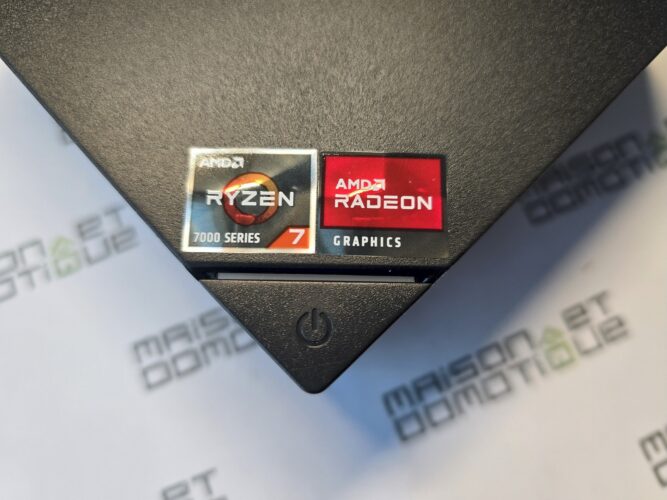
The side labels could be more discreet, but this detail does not undermine the overall impression of quality.
To access the RAM or SSD, the manipulation takes only a few minutes and provides a real advantage in the long term through the encouraged modularity.
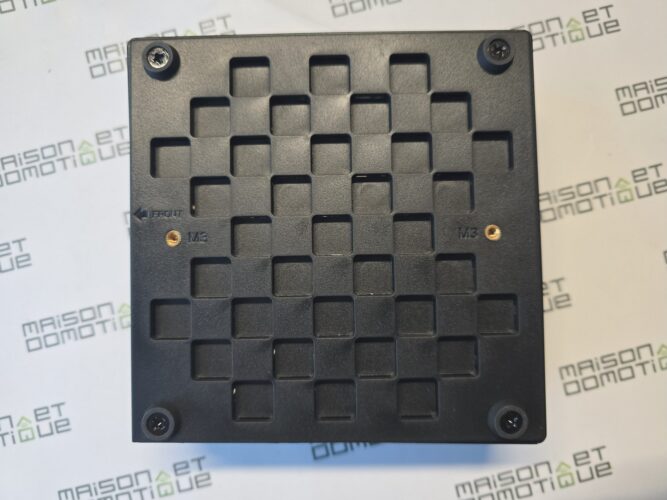
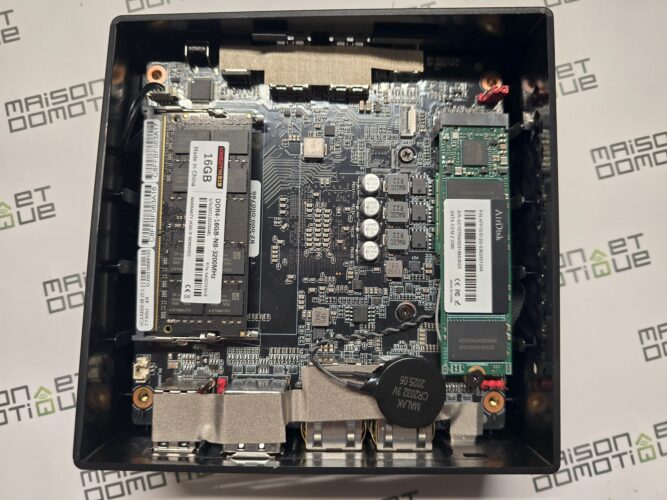
This attention to ergonomics and material simplicity appeals through the absence of sophisticated tools, which markedly differentiates NiPoGi from alternatives that can sometimes be cumbersome to open (like Geekom IT12, for example).
Technical specifications: Ryzen processors, RAM, and expandable storage
The heart of the NiPoGi AM06 Pro beats to the rhythm of the very energetic AMD Ryzen 7 7730U processor manufactured on a 7 nm process. This SoC features 8 physical cores and 16 threads, with a turbo frequency capable of reaching 4.5 GHz and a contained TDP of around 15-28W, depending on the configuration chosen in the BIOS. The graphical integration is provided by the AMD Radeon RX Vega 8 GPU (2,000 MHz), known for its versatility in less demanding 3D applications.
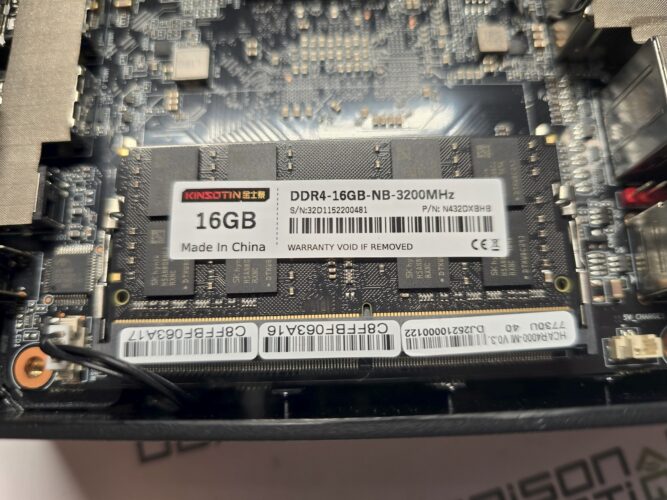
The memory is represented by 16 GB of DDR4 (dual channel, 3,200 MHz), expandable to 32 or even 64 GB on two SO-DIMM slots. This level of RAM is rarely achieved at this price and constitutes a strong point for light virtualization or advanced multitasking uses.
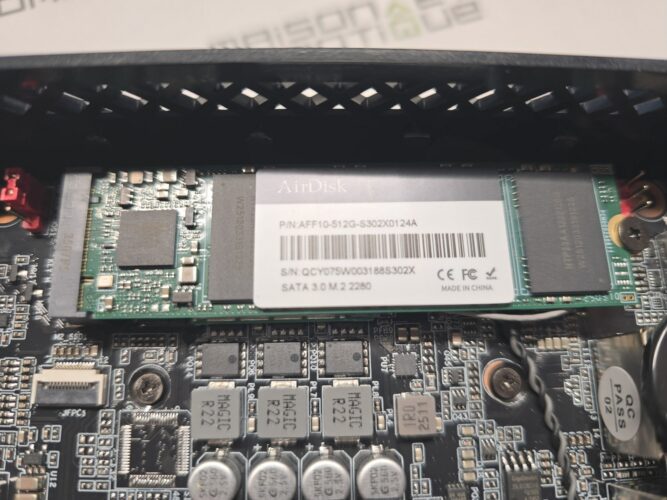
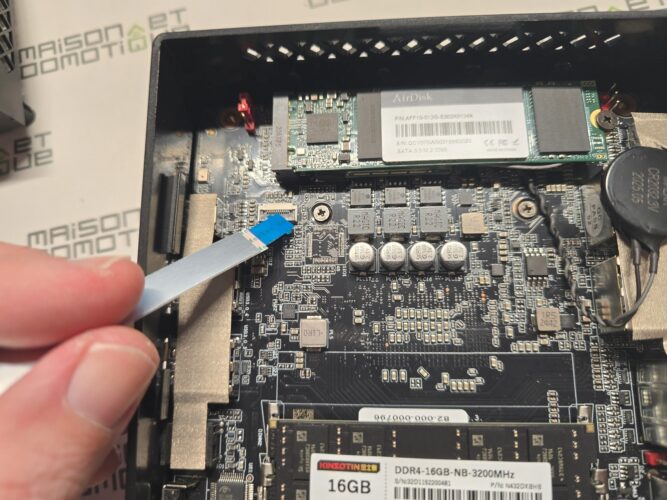
The main storage relies on a 512 GB M.2 2280 SATA SSD, provided by AirDisk (speeds around 550 MB/s in reading, 500 MB/s in writing measured during the test), which conforms to the announced specifications. For demanding users, NiPoGi has provided a free 2.5-inch slot for a second disk (SSD or HDD) in SATA, the appropriate extension being supplied in the bundle.
| Feature | NiPoGi AM06 Pro Specifications |
|---|---|
| Processor | AMD Ryzen 7 7730U, 8C/16T, 2.0-4.5 GHz, TDP 15-28W |
| Integrated graphics | AMD Radeon RX Vega 8 at 2,000 MHz |
| RAM | 16 GB DDR4 (upgradable) |
| Storage | 512 GB M.2 SATA SSD + 1 available 2.5” SATA slot |
| Connectivity | 2 x USB 3.2 Gen1, 2 x USB 2.0, 1 x USB-C (data/video), HDMI, DisplayPort, dual Ethernet (1G + 2.5G), 3.5 mm jack |
| Wireless connectivity | Wi-Fi 6 (Intel AX201), Bluetooth 5.2 |
| Dimensions & weight | 128 x 128 x 45 mm, 375 g |
| OS | Windows 11 Pro (pre-installed) |
This dense technical sheet illustrates NiPoGi’s ambition to provide its range with a serious asset, neck and neck with Geekom or MinisForum and aimed at convincing those who want to renew their IT environment without compromising on modularity or processing power.
Performance and uses of the NiPoGi AM06 Pro: benchmarks, connectivity, and cooling
Evaluation of CPU, GPU, SSD performance: multitasking, creation, and retro gaming
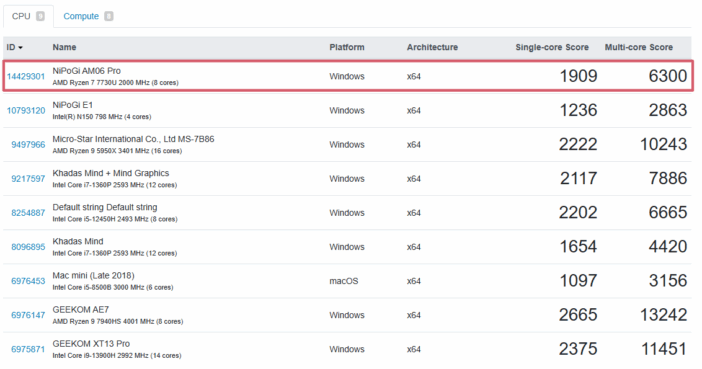
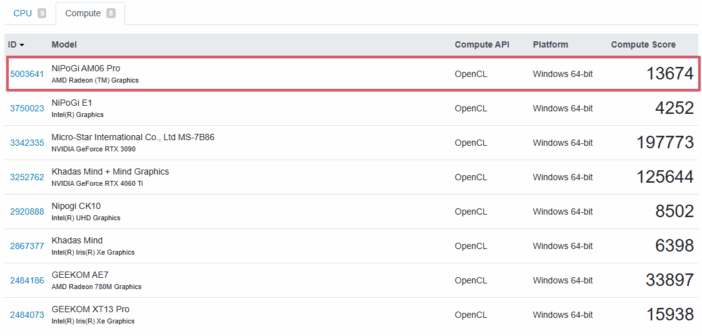
On the performance side, the test of the AM06 Pro runs smoothly from the first benchmarks. On Geekbench 6 and Cinebench R23, the machine reaches scores comparable to those of a premium laptop released in 2023: around 1,909 points (single-core) and 6,300 points (multi-core) on Geekbench 6, with excellent thermal stability even under sustained loads.
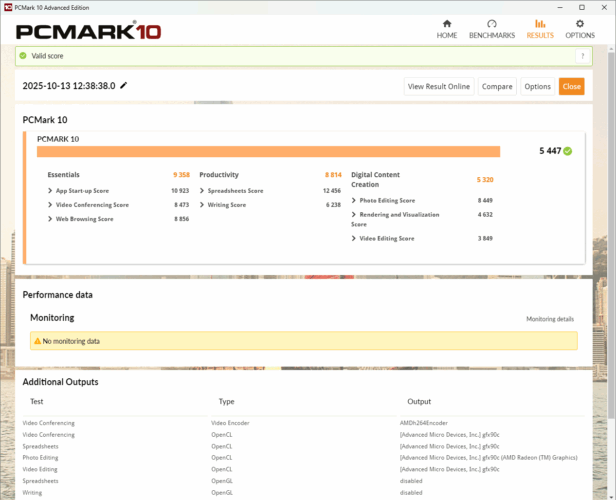
In intensive office tasks, multi-tab web browsing, light editing, or even occasional photo retouching, the mini PC does not lag, scoring a nice 5,447 on PCMark 10. Multitasking benefits fully from the AMD processor, which remains stable without troublesome overheating. Thanks to the AirDisk SSD, system boot times are rapid, and access to applications is almost instantaneous.
On the graphical side, the iGPU AMD Radeon Vega 8 allows for pleasant retro gaming (Sonic Mania, Street Fighter IV), or playing popular games that are not demanding in HD (Rocket League, Minecraft, LOL) at 60 FPS in 720p/1080p, sometimes with medium settings. However, on recent AAA titles or demanding Adobe suites (Premiere, After Effects), the limits of Radeon Vega 8 are quickly felt: this mini PC is clearly not aimed at demanding 3D gaming or advanced graphics creation.
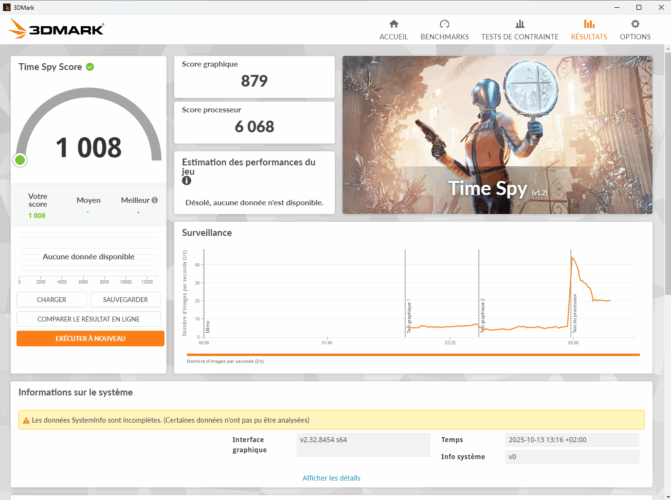
We won’t even go into the details of VR tests, as this mini PC is clearly not made for that.
| Usage | Experience on AM06 Pro | Notable limits |
|---|---|---|
| Office | Ultra-smooth, no latency | N/A |
| Light creation | Photoshop/Lightroom very good | Large format/RAW demanding |
| Light gaming / retro gaming | Classics emulated and indie Steam OK | Recent AAA games not recommended |
| Proxmox virtualization | 2-3 VMs without issue | More = limiting RAM/storage |
Regarding the SSD, the speeds obtained during the test are in the good average for a SATA SSD (AirDisk 512 GB), but remain limited to ~520 MB/s where NVMe would triple these scores. In practice, this translates to a few additional seconds on copying large files or launching heavy software, without any real inconvenience for daily use. The possibility of adding a second disk allows for more advanced server or local backup scenarios.
Rich connectivity of the NiPoGi AM06 Pro: ports, network, and wireless compatibilities
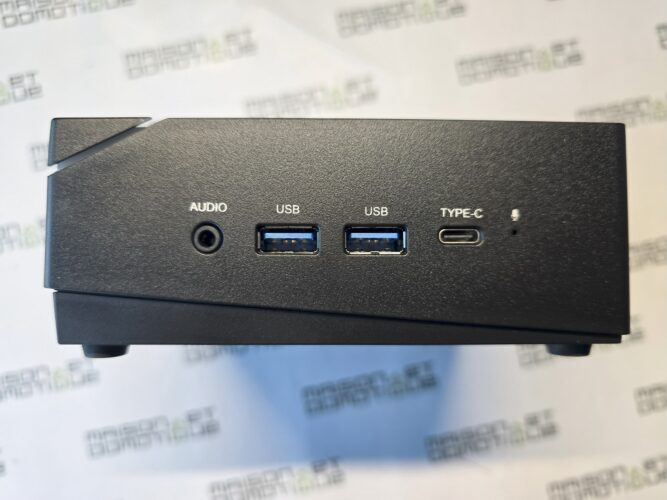
The diversity of the connectivity is another strong marker for the NiPoGi AM06 Pro. On the front, we find 2 USB 3.2 Gen 1, 1 USB-C supporting both data and video, and a 3.5 mm microphone headphone jack. Note that the microphone is even integrated on the right, which is uncommon.
At the back, there are 2 USB 2.0, HDMI 2.0 and DisplayPort video outputs (4K/60Hz), as well as 2 Ethernet ports (1GbE and 2.5GbE), a definite advantage compared to competitors that often only include one LAN port.
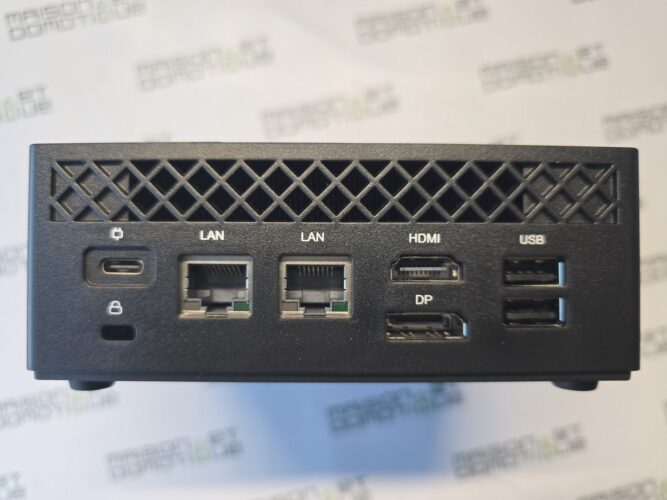
- Three screens can be used simultaneously (HDMI, DP, USB-C)
- Dual physical network: 1 standard port, 1 high-speed port
- Fast Wi-Fi 6 Intel AX201, extended coverage
- Bluetooth 5.2 for modern peripherals (keyboards, headsets, controllers…)
In testing: the Wi-Fi 6 connection easily reaches 770 Mbit/s under optimal conditions, and the 2.5 GbE LAN port approaches 2,400 Mbit/s in wired local network transfers (NAS, 4K video copies). These performances are ideal for home labs, home automation servers, Proxmox, or small NAS needs.
With its two Ethernet ports (1 GbE and 2.5 GbE), the AM06 Pro opens up clever scenarios that go beyond simple network connectivity: for example, it can be turned into a small router/firewall under pfSense or OPNsense with one port connected to the box (WAN) and the other to a switch (LAN), ideal for segmenting the home network and isolating connected objects via VLANs; in a home lab, it becomes a Proxmox or Docker gateway with one interface dedicated to administration and another for VMs/containers (NAS, Home Assistant, MQTT server, Pi-hole/AdGuard Home) to keep traffic clean; in media or backup use, it reserves the 2.5 GbE for the NAS to take advantage of much faster local transfers, while the 1 GbE serves a IoT sub-network or a bridge to a technical bay; and for integrators, the dual interface facilitates on-site testing (packet capture, port mirroring, transparent bridge) without impacting the production LAN. This network versatility enhances performance, security, and ease of administration while remaining simple to set up.
In summary, the connectivity of the mini PC AM06 Pro adapts well to both ultra-connected office environments and advanced home configurations. The only notable absences: no USB4/Thunderbolt for demanding professional peripherals, nor optical audio output.
Cooling system, temperatures, and noise level in practice
One of the best-controlled points of this mini PC remains its cooling. The internal fan, combined with honeycomb grills at the back of the case, ensures effective heat dissipation while keeping noise at an imperceptible level. In standby and office use, the AM06 Pro is easily forgotten.
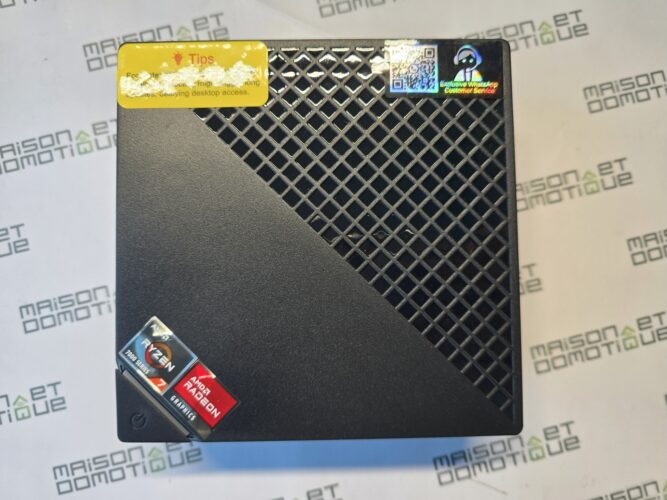
During prolonged periods of benchmarking or stress testing (CPU at 100% for over 20 minutes), the temperature does not exceed 79°C on the processor, with no degradation in frequency or perceived throttle.
| Usage | Average CPU Temperature | Fan Noise Level | Remarks |
|---|---|---|---|
| Idle/Office | 41°C | Almost inaudible (25 dB) | Cool and absolute silence |
| Gaming/Video Rendering | 68°C | Discreet (32 dB max) | No annoying airflow |
| Benchmarks/Stress | 77-79°C | Barely audible (35 dB) | Controlled noise |
Upon opening the case after prolonged testing, the thermal feeling remains quite reasonable: no sense of excessive heat, the plastic holds up well to rising temperatures thanks to targeted ventilation. The promise of a silent mini PC, largely usable even in a home theater environment or a bedroom, is thus confirmed.
Upgradability, installation, consumption, and technical analysis of the NiPoGi AM06 Pro
Installation of Windows 11 and upgradability: RAM, SSD, and secondary SATA disk
The NiPoGi AM06 Pro comes with Windows 11 Pro pre-installed and activated. The installation experience is seamless: no need for an initial network connection or mandatory Microsoft account during the first configuration. The total absence of bloatware facilitates the handling and accelerates the commissioning. This simplicity distinguishes the AM06 Pro from competing PCs that are sometimes cluttered with unnecessary software.
- DDR4 RAM installed in single channel by default (1×8 GB), leaving one slot open for easy upgrade
- Ability to upgrade memory to 32 or 64 GB
- SATA SSD M.2 replaceable by a larger capacity unit
- Simple addition of a 2.5-inch disk thanks to the free slot, with the provided extension
Hardware access is easy: 4 cross-head screws under the case are sufficient to access the motherboard to replace or complete RAM and SSD, with no capricious ribbon cables or fragile connectors in sight. For advanced users, it is possible to install an alternative to Windows (Linux, Proxmox) or to opt for an SSD upgrade for even more performance.
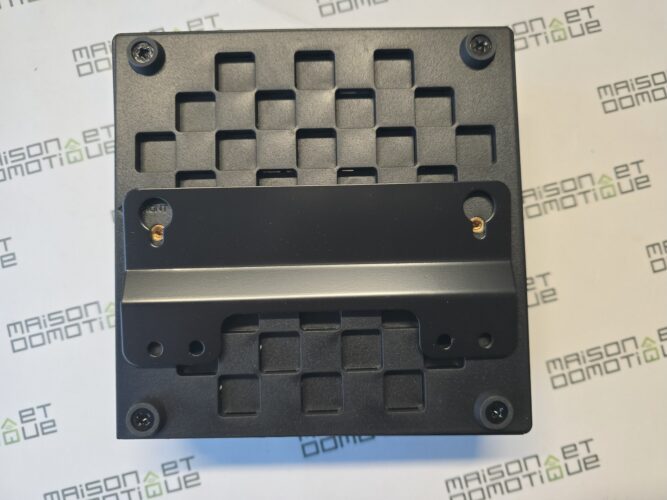
A practical point: the VESA mount in the packaging allows for integration behind the screen, thus freeing up desk space without sacrificing access to the ports.
Power consumption and efficiency of the low TDP AMD SoC
One of the main arguments of the AM06 Pro is its electrical sobriety. During tests, the measured consumption ranges from 6.5 W at idle (Windows, home screen) to 33 to 36 W under prolonged CPU load. This remarkable efficiency is due to the optimization of the AMD Ryzen 7 7730U processor, the carefully controlled TDP, and the absence of a dedicated graphics card.
| Scenario | Measured Consumption | Advantage |
|---|---|---|
| Idle/Rest | 6.3-7 W | Ideal for NAS/Server 24/7 |
| Light Office | 9 to 12 W | Common needs |
| Gaming / Proxmox VM | 22-36 W | Compromise between efficiency/power |
| Extreme load | 36-40 W (brief peak) | No thermal drift |
This low consumption places the NiPoGi AM06 Pro as a preferred choice for green IT enthusiasts or continuous operation (telecommuting, home automation server, shared AirDisk, Proxmox). Here, we reach a nearly ideal balance between CPU power and ecological impact, where most desktop PCs remain much more power-hungry without achieving greater responsiveness in daily use.
A mini PC for various uses
With its low consumption, dual network interface, and good CPU/RAM reserve, this mini PC is perfectly suited for “service box” uses in a connected home: we can imagine it as an all-in-one home automation box under Home Assistant OS or Jeedom, with Docker to isolate Zigbee2MQTT, Z-Wave JS, Node-RED, Mosquitto, and Homebridge, plus an InfluxDB + Grafana for energy monitoring; as a Frigate NVR, it handles multiple 1080p/H.264 streams, especially if we add a Coral USB key to offload the AI, while keeping one network card dedicated to the cameras and the other to the main LAN; as a media server, it hosts Jellyfin/Plex + SMB/NFS sharing, with the 2.5 GbE providing comfortable transfers to a NAS; as a network gateway, it acts as a Pi-hole/AdGuard Home and VPN (WireGuard/OpenVPN) to secure the family, not to mention a small Proxmox platform for 2-3 VMs (Home Assistant, a virtual router OPNsense, a utility Debian) and for professional integration, it can serve as a protocol hub (Modbus/TCP gateway, KNX/IP via interface, LoRa/EnOcean/433 MHz gateways via USB dongles), a telemetry collector (Linky, inverter PV, PAC) and a Matter/Thread bridge with the appropriate keys. All of this remains silent, easy to maintain, and, above all, local, for a more responsive, private, and resilient home.
Conclusion
At the end of this test, the NiPoGi AM06 Pro lives up to its promise: a compact, fast, and very discreet mini PC, perfect for heavy office work, multimedia, a small lab at home, or a home automation stack. The Ryzen 7 7730U, dual channel RAM, and dual network connection excel in daily use, with a level of comfort that is rare in this price range around €350. We regret the choice of a SATA SSD and the absence of USB4, which limit throughputs and certain extensions, as well as the plastic case that might not please everyone. For modern 3D gaming, look elsewhere. For everything else, it’s an excellent value for money, scalable, easy to maintain, and designed to run 24/7 without making noise. A sure bet for telecommuters, students, makers, and home lab enthusiasts.



Please remain courteous: a hello and a thank you cost nothing! We're here to exchange ideas in a constructive way. Trolls will be deleted.