


Résumer cet article :
Last year, I cracked. New complete setup, HYTE Y70 Touch case, NZXT Kraken Elite water cooling… a beautiful machine that I built myself, like in the “good old days.” Except that in the meantime, the hardware world has changed. A lot.
I had already built quite a few PCs about fifteen years ago (like the famous “hackintosh“). Back then, it was almost a rite of passage. Today? It’s still possible… but clearly no longer as obvious. And above all, it’s not necessarily as interesting. I have had many requests about my setup. So I take the opportunity to take stock of this issue.
In short: is it still worth building your gaming PC in 2026?
- If you are looking for the simplest and quickest solution, pre-built gaming PCs are very convincing today, often with well-placed prices.
- If you enjoy tinkering, optimizing every detail, and understanding your machine, building remains a pleasure… but requires time and a minimum of attentiveness.
- And between the two, custom configurators likely offer the best compromise: a personalized setup, without the classic mistakes, and with a real time saving.
Building your gaming PC in 2026: a reflex… becoming less obvious
Building your PC has long been synonymous with savings and total freedom. You choose each component, optimize your budget, and know your machine inside out. On paper, nothing has changed.
In reality, it’s a little different.
Firstly, standards have evolved. With DDR5, PCIe 5.0, Thunderbolt 5, new power supply standards for GPUs, the multiplying NVMe SSD formats… not to mention lighting systems when you want to pimp your setup a bit (I actually plan to do a feature on this topic). Even having previously built PCs, you spend time getting back up to speed. And when you’ve never put your hands in it, the learning curve can quickly become… steep.
On top of that, there’s a completely unstable market. Graphics cards skyrocketing at the slightest launch, RAM and SSD prices rising due to AI-related demand, availability varying from week to week… and you find yourself making compromises you would never have imagined.
The result: building your PC remains possible, but it’s no longer necessarily the simplest or most rational path.
The real cost of DIY: savings or illusion?
It’s still often said that building your PC is cheaper. It used to be true. It’s not always the case anymore.
When you buy each component separately, you face retail prices, with their fluctuations. Impossible to benefit from the negotiations or volumes that some builders can have. And for components like GPUs, the difference can be far from negligible.
But the cost doesn’t stop at the displayed price.
There’s also the time. The time spent comparing motherboards, checking RAM compatibility, ensuring the case fits the cooler, that the power supply is sufficient… not to mention the hours reading tests and forums. It’s exciting, clearly. But not everyone wants to spend their evenings on it.
And then there are the mistakes. An incompatibility, a bad choice of power supply, poorly thought-out airflow… nothing insurmountable, but it can cost time, money, and a few nerves.
Last point often underestimated: customer support. When something doesn’t work, you have to identify the faulty part, contact the right manufacturer, manage multiple warranties… it’s not always very smooth.
In the end, the real savings can be quite different from perceived savings.
Pre-built PCs: a maturity often underestimated
For a long time, pre-built PCs had a bad reputation. Unbalanced configurations, approximate assembly, “exotic” components… they were often avoided.
That’s no longer really the case today.
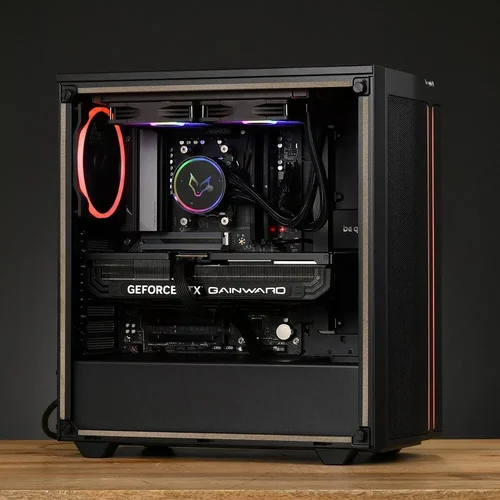
The so-called “Ready to Play” offers have evolved tremendously. The configurations are generally well thought out, with components that are coherent with each other. The assembly is clean, cable management polished, and most importantly, the machines are tested before arriving at your home. Basically, you plug it in, turn it on… and it works.
Be careful, we are talking about Ready to Play purchased from specialists in the field. Not from a PC in a supermarket next to the potato aisle… There, the configurations are sometimes shaky, and sometimes outdated by several years :/
Specialists like TopAchat offer these types of ready-to-use machines, with a level of finish that has little in common with what we knew a few years ago. And honestly, for someone who wants to play without complicating life, it has become a very solid option.
Another non-negligible advantage of Ready to Play: global warranty. One point of contact, one customer support, and no need to play detective in case of a problem.
Next-generation custom: when the configurator does the work
Between pure DIY and fully built PCs, there’s now a particularly interesting third way: assisted custom.
The principle is simple. You choose your configuration, but an intelligent tool takes care of checking compatibility and overall balance.
This is exactly what solutions like ConfigoMatic offer. You select your components, and the system automatically adjusts to avoid classic mistakes. No more wondering whether the RAM is compatible, whether the cooling is sufficient, or whether the power supply is properly sized.

Even better, some tools go so far as to provide performance estimates in games, with indicators derived from benchmarks like 3DMark, which I have already mentioned every time I test a PC. So we know what to expect even before ordering.

For those who don’t know where to start, assistants like PC Finder even allow you to start from your use (games, budget, resolution…) to build a coherent configuration.

So we keep the freedom of choice… without the pitfalls of DIY.
DIY, ready or custom: what choice in 2026?
It all depends on the profile.
The casual gamer, who simply wants to launch their games without worrying, will today find happiness in a Ready to Play PC. It’s simple, effective, and ultimately often well-priced.
The enthusiast, who loves to optimize, test, and understand every detail, will continue to enjoy building their machine. In this case, DIY remains unbeatable in terms of personal satisfaction.
Between the two, there is an increasingly common profile: the one who wants a powerful, well-balanced machine, but without spending hours on it. For them, custom via a configurator is clearly the most pertinent solution. In the end, they can choose to have it built or keep the pleasure of assembling it themselves.
| Criteria | DIY (built by oneself) | Ready to Play | Custom (configurator) |
|---|---|---|---|
| Price | Variable, sometimes cheaper… but not always | Often optimized thanks to volumes | Good balance price/performance |
| Time required | High (research + assembly) | Almost none | Low |
| Customization | Total | Limited | Very good |
| Risk of error | Present (compatibility, assembly) | Very low | Low |
| Customer support/warranty | Complex (by component) | Simple (global) | Simple |
| Delay before use | Variable | Immediate | Fast |
| Required level | Intermediate to advanced | Beginner | Beginner to intermediate |
Verdict: building your PC is still a good idea… but not for everyone
Building your PC in 2026 is not outdated. It’s simply become a choice.
A choice that requires time, a bit of research, and a certain desire to get hands-on. For some, it’s even a passion in itself.
But for many, the alternatives have progressed so much that they really deserve to be considered. Between pre-built PCs and intelligent configurators, you can now get a machine perfectly suited to your needs… without spending hours on it.
At its core, the real question is no longer “should I build my PC?” but rather “do you want to do it?”.
And that, is already an answer in itself 😉
FAQ: everything to understand before choosing your gaming PC
Is building your PC still cheaper in 2026?
Not systematically. Between price fluctuations, especially on graphics cards, and rising RAM and SSD prices related to AI, pre-assembled or custom configurations can sometimes be better positioned.
Is it difficult to build a PC today?
It’s not complicated in itself, but you need to be well informed. The compatibilities between components (RAM, motherboard, power supply, cooling) require more attention than before.
Are pre-built PCs reliable?
Yes, clearly more than before. Configurations are now well-balanced, tested in advance, with clean assembly and a global warranty.
Is custom via configurator a good alternative?
It’s often the best compromise. You keep personalization while avoiding classic mistakes thanks to automatic compatibility tools.
What choice for a beginner gamer?
A Ready to Play PC remains the simplest solution. No assembly, no complex adjustments, and a machine ready to function immediately.

Please remain courteous: a hello and a thank you cost nothing! We're here to exchange ideas in a constructive way. Trolls will be deleted.