
Résumer cet article :
Picking up crumbs and dust is something any robot vacuum can do these days. A dried coffee stain, the bottom of the baseboards, or simply not spreading dirt from one room to another is another story. That’s where Narwal wants to stand out with the Freo 20 Edge, unveiled at IFA 2026 in Berlin. The idea: replace the usual two rotating mop pads with a wide cleaning roller, continuously supplied with clean water and scraped as it works. Narwal calls it FlowWash, and until now, it was mainly found on more expensive models.
The specs are impressive: 31,000 Pa of suction, anti-tangle brushes, LiDAR navigation, and a dock that takes care of almost all maintenance. But a spec sheet has never cleaned a floor. What matters is how well it mops and how the robot handles hair, rugs, and things left lying around.
The Freo 20 Edge borrows some of the brand’s premium-model technology and leaves other features out to keep the price down. Some of these choices aren’t noticeable in use. Others are. That’s exactly what we’re going to take a closer look at.
Unboxing and first look at the Narwal Freo 20 Edge
In the box: the robot, the dock, its access ramp, the power cable, a side brush to install, a quick-start guide, and a manual in French. Everything you need to get started without buying anything else.
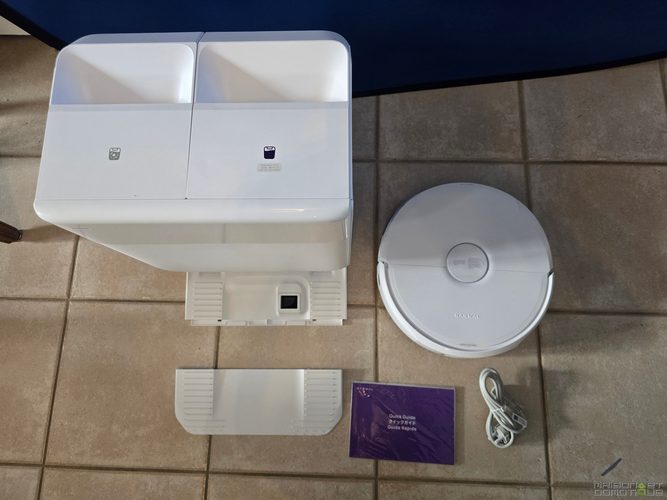
White casing, rounded shape, understated design: the Freo 20 Edge looks like a Narwal. Nothing over the top, which is a good thing for an appliance that’s going to be on display in the living room.
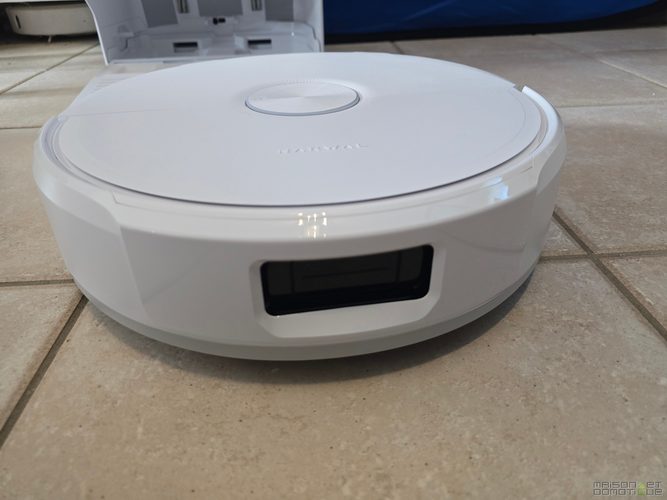
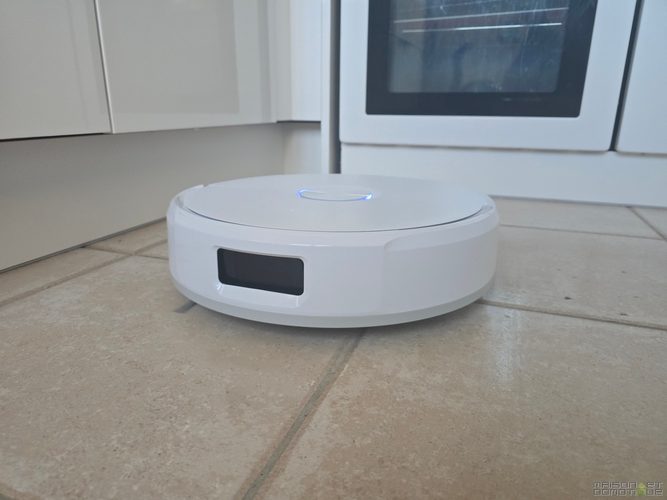
The robot measures 363.5 × 351.2 mm, stands 9.5 cm tall, and weighs 4.9 kg. It’s a standard size, but its height is worth noting: despite its LiDAR navigation, it doesn’t have a turret on top. The dToF sensor is integrated into the chassis, allowing it to fit under more furniture. Of course, it depends on the clearance under your sofa, but those extra few centimeters make a difference.

A few physical buttons on top are all it takes: start or pause a cleaning session, or send the robot back to its dock. Handy when you don’t have your phone to hand.

At the front, structured-light sensors assess the shape, distance, and position of objects in its path.
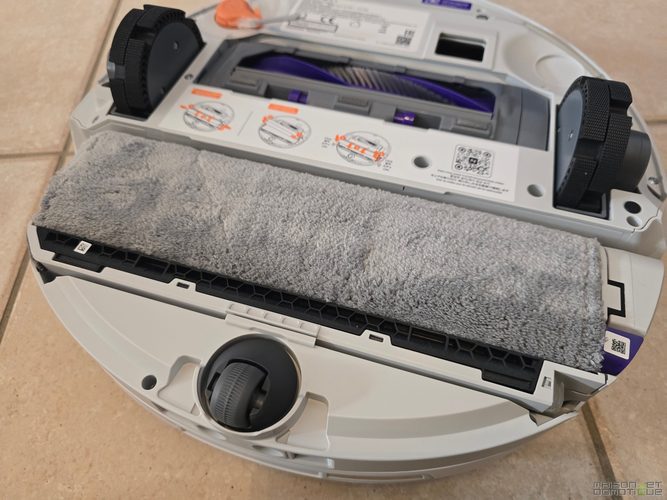
Flip the device over and you can see what sets it apart: a floating main brush, a dynamic side brush, and, above all, a mopping module that takes up a good portion of its width.
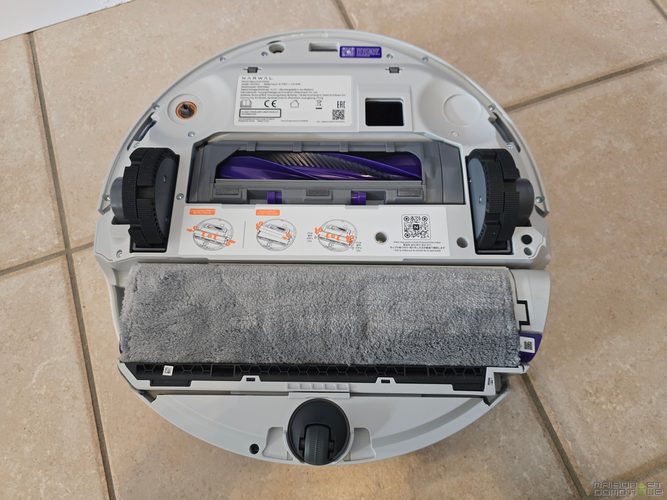
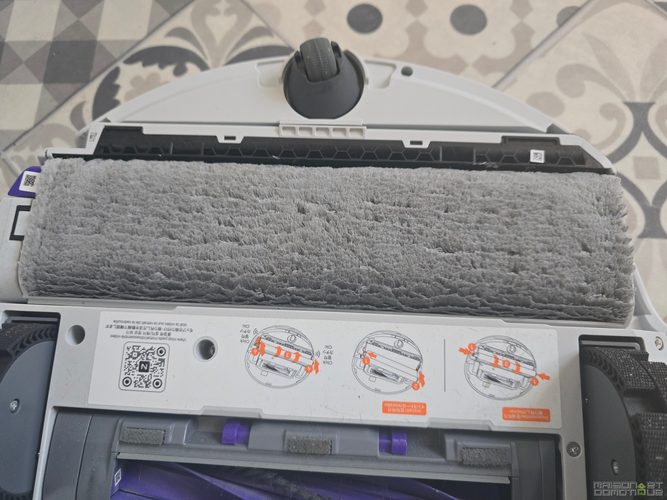
There are no rotating discs here, but rather a chenille-style mop roller measuring 26.6 cm long and 5.8 cm wide. The entire robot is built around it.
The dock: bulky, but fully equipped
It has the same white finish, and dimensions to take seriously: 36 cm wide, 45 cm deep, 53 cm high, and 8.6 kg. This isn’t a dock you can tuck away in a corner; you’ll need to set aside a proper spot for it.
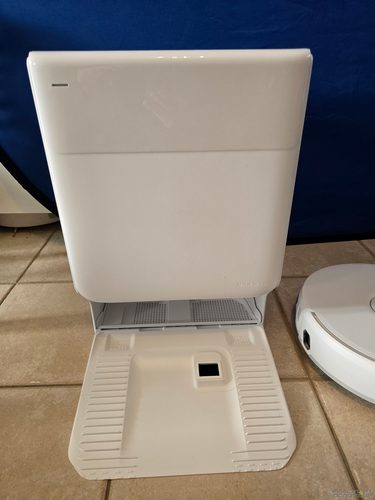
In return, it does pretty much everything you’d expect from a premium dock. Under the top cover are the clean- and dirty-water tanks. A 2.5-liter bag automatically collects the vacuumed-up dust.
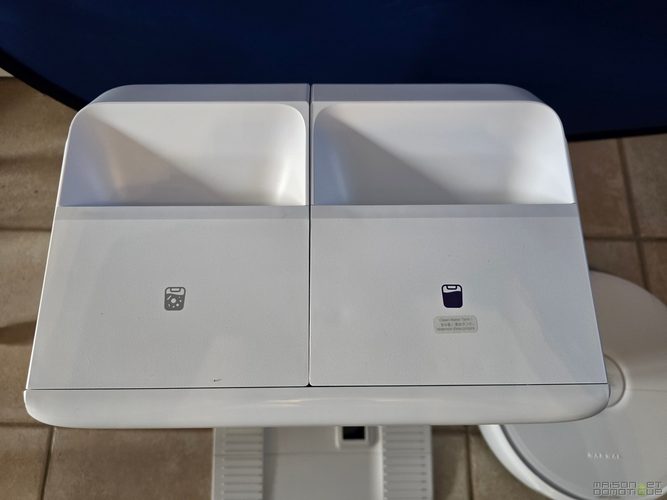
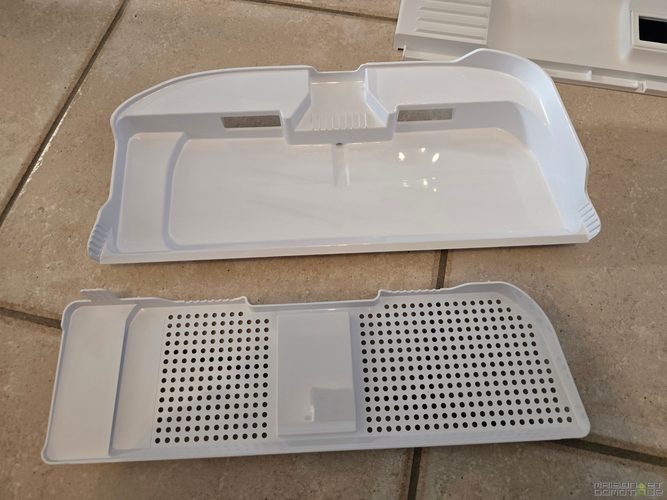
At the bottom, a system washes the roller and collects the dirty water. Narwal has also included a removable tray and a replaceable debris filter, which makes things easier when it’s time to clean by hand. And that time will come: the dock automates a lot, but not everything.
Setting up and configuring the Narwal Freo 20 Edge
Nothing complicated. Place the dock on a level surface near an outlet, leaving enough room in front for the robot to enter and exit, and above it to open the tanks. Attach the ramp, plug it in, fill the clean-water tank, and place the robot on its dock for the first charge.
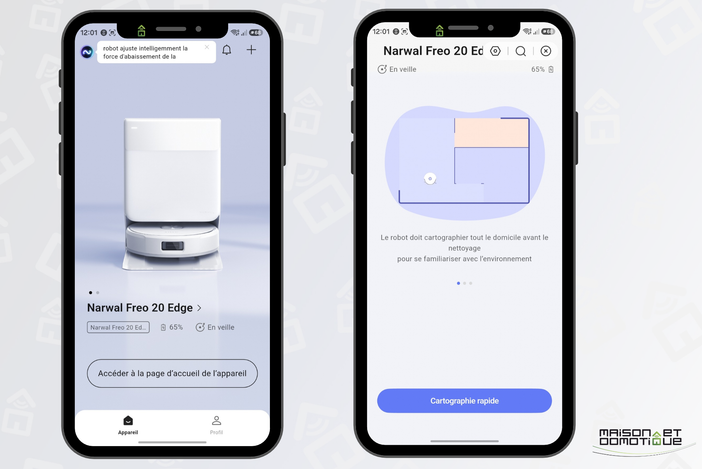
The rest happens in the Narwal app. Create an account (or sign in), tap to add a device, and the app will detect the robot if it’s switched on nearby. Your phone then sends it the Wi-Fi settings. The process guides you through every step, and no special knowledge is required.
Mapping
The robot then maps the home using its dToF LiDAR sensor. Since it doesn’t have a turret that continuously scans the room, it sometimes stops and turns in place to look in several directions. That’s normal, and especially noticeable during this first run.
At my place, the map was ready in about ten minutes for roughly 80m2. The time will depend on the size and layout of your home. I did have to tweak it a little by merging some rooms and splitting others, but that only takes a few taps in the app.
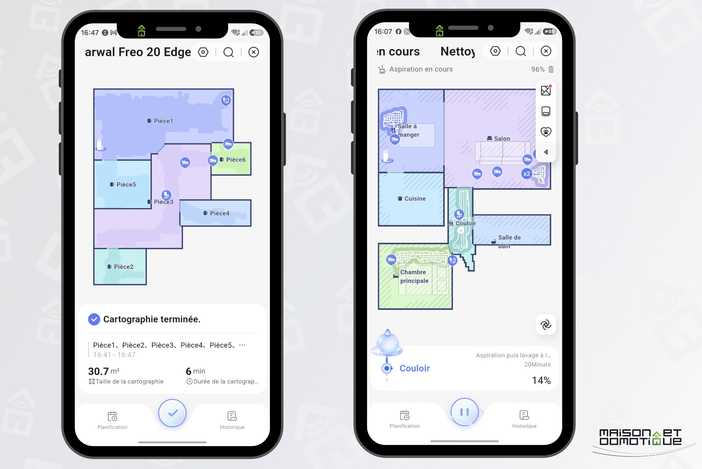
In the app, you can redraw room boundaries, merge or split rooms, name them, set no-go zones, and adjust how the robot handles rugs. In practical terms: just the kitchen after a meal, the bedrooms at another time, or the area where the kids have spread out their toys kept off-limits for the day. Those with a dog or cat can also protect the area around the food bowls.
FlowWash: the heart of the robot
To understand the benefits of the system, let’s start with conventional mop pads. On most robot mops, two pads spin against the floor and scrub it. It works, but the pads gradually pick up dust, grease, and residue. The robot regularly returns to its dock to wash them, and between washes, it cleans with increasingly dirty pads.
Narwal takes a different approach. The FlowWash module is a wide, chenille-style roller that rotates as the robot moves forward. Sixteen nozzles continuously supply it with clean water. As the bottom of the roller scrubs the floor, a scraper removes what has built up on the fabric, and the dirty water flows through a separate circuit.
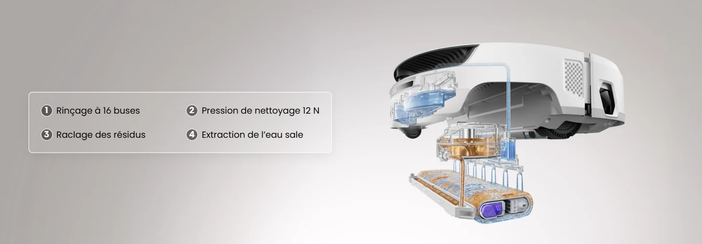
The goal is simple: don’t put back on the floor what you’ve just picked up. The roller keeps its cleaning surface much cleaner throughout the cycle. In a kitchen, with crumbs and splashes, or in an entryway where wet shoes and dog paws come and go, that makes a difference.
12 N of downward pressure
Narwal claims the roller maintains a constant downward force of 12 newtons. That’s a force, not a pressure in pascals: it keeps the roller pressed against the floor so it can work on the dirt. Combined with the chenille roller’s rotation and constantly refreshed water, it’s designed to tackle stubborn stains. The manufacturer also says it designed the nozzles to be less likely to clog with small bits of debris.
On paper, it sounds convincing. Let’s see how it handles real stains.
Mopping: the results
I tested the robot in various situations over two months, including a few challenging scenarios.
First test: coffee and ketchup left to dry for more than twelve hours on a hard floor. The coffee leaves colored marks, while ketchup is thick and sticky and needs scrubbing. To make things more challenging, the cleaning was done without detergent and with a fairly moderate level of moisture.
The coffee had almost completely disappeared after the first pass. The ketchup put up more of a fight, but the roller removed a good portion of it. A few marks remained at the end of the cycle, but in the end, the issue wasn’t so much the mopping as the robot’s ability to tell that an area was still dirty and needed another pass. We’ll come back to that below, in the navigation section.
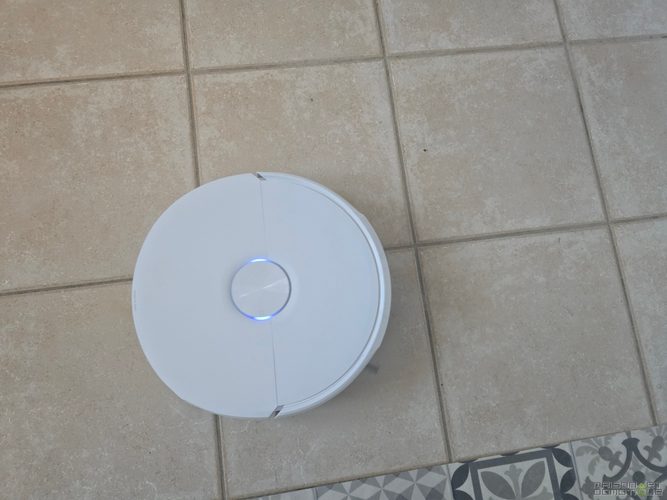
For my second test, I put a puddle of blue-colored water in the robot’s path. The roller passes over it, absorbs it, and continues with clean water. After it passes, the puddle is gone and there’s no visible blue mark on the floor. When I checked the roller after it had been washed at the dock, it wasn’t stained either.
That doesn’t make the Freo 20 Edge a wet-dry vacuum capable of sucking up a spilled bucket of water. But for wet marks and everyday spills, the system clearly delivers on its promises.
A roller that stays clean while it works
Another thing I noticed was the condition of the mop at the end of a cleaning session. After a demanding clean, rotating mop pads often come out quite dirty. With FlowWash, much of the residue is removed along the way, and in the tests I ran, the roller already looked fairly clean before it was even washed at the dock. That doesn’t mean there are no bacteria left, but dirt doesn’t build up on the cleaning surface. That’s probably the technology’s strongest selling point.
Vacuuming: 31,000 Pa, so what?
With a claimed 31,000 Pa, the Freo 20 Edge is one of the most powerful robot vacuums on paper. But that figure alone doesn’t tell us much. Brush design, airtightness of the system, airflow, and how the robot moves around the room all matter just as much, and a model with a lower figure on its spec sheet can easily perform better.
In my tests, the Freo 20 Edge did a pretty good job. On hard floors, crumbs and grains of rice are picked up with ease, including along the walls thanks to the side brush.
Just as with the ketchup, the power is there, but the robot doesn’t necessarily notice that debris is still left behind. That’s what sets it apart from the brand’s higher-end models, as we’ll see. For dust, crumbs, hair, and whatever gets tracked in from the garden on your shoes, its performance is very good.
DualFlow: hair and pet fur
If you have a pet that sheds or people with long hair at home, you know the scene: after a few weeks, a clump of hair is wrapped around the brush and you have to cut it away with scissors. The DualFlow system is designed to prevent that.
The main brush is a floating, asymmetrical cone-shaped roller. Instead of trapping hair in the middle, its shape pushes it toward an open end, where it enters the suction channel.
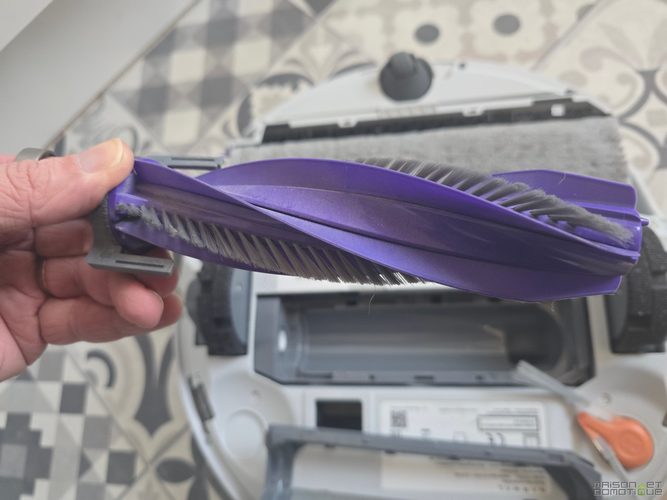
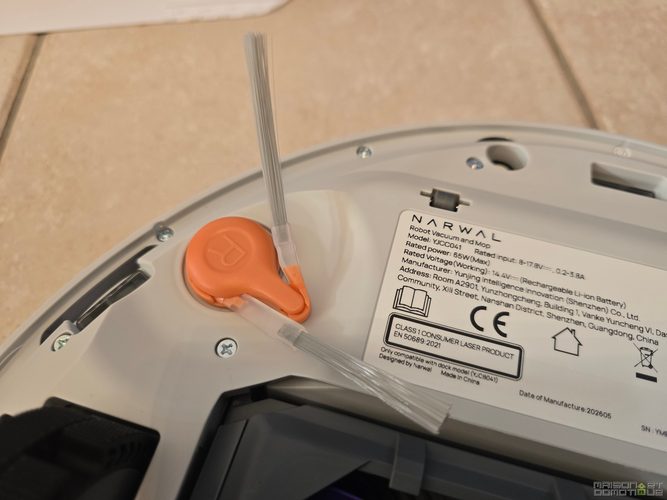
The side brush has its own mechanism too: it can reverse its rotation and draw its bristles together to get rid of hair that’s starting to wrap around them. A detangling cycle can run before the robot returns to the dock.
Tests with hair
In another test, I deliberately placed an excessive amount of long hair on the floor. The robot picked up almost all of it, with no noticeable tangling on the main brush. A few strands remained on the side brush, but they were easy to remove. With a more realistic amount, almost nothing is left on either brush.
No system will ever stop every strand of hair from getting caught, but this one does what it’s supposed to. That’s one less maintenance task in a home where pets roam freely.
EdgeReach: mopping right up to the baseboard
Another common weakness of robot vacuums is edges. A robot can travel along a wall without its mop reaching all the way to the baseboard, especially when the mopping module is in the middle of the chassis.
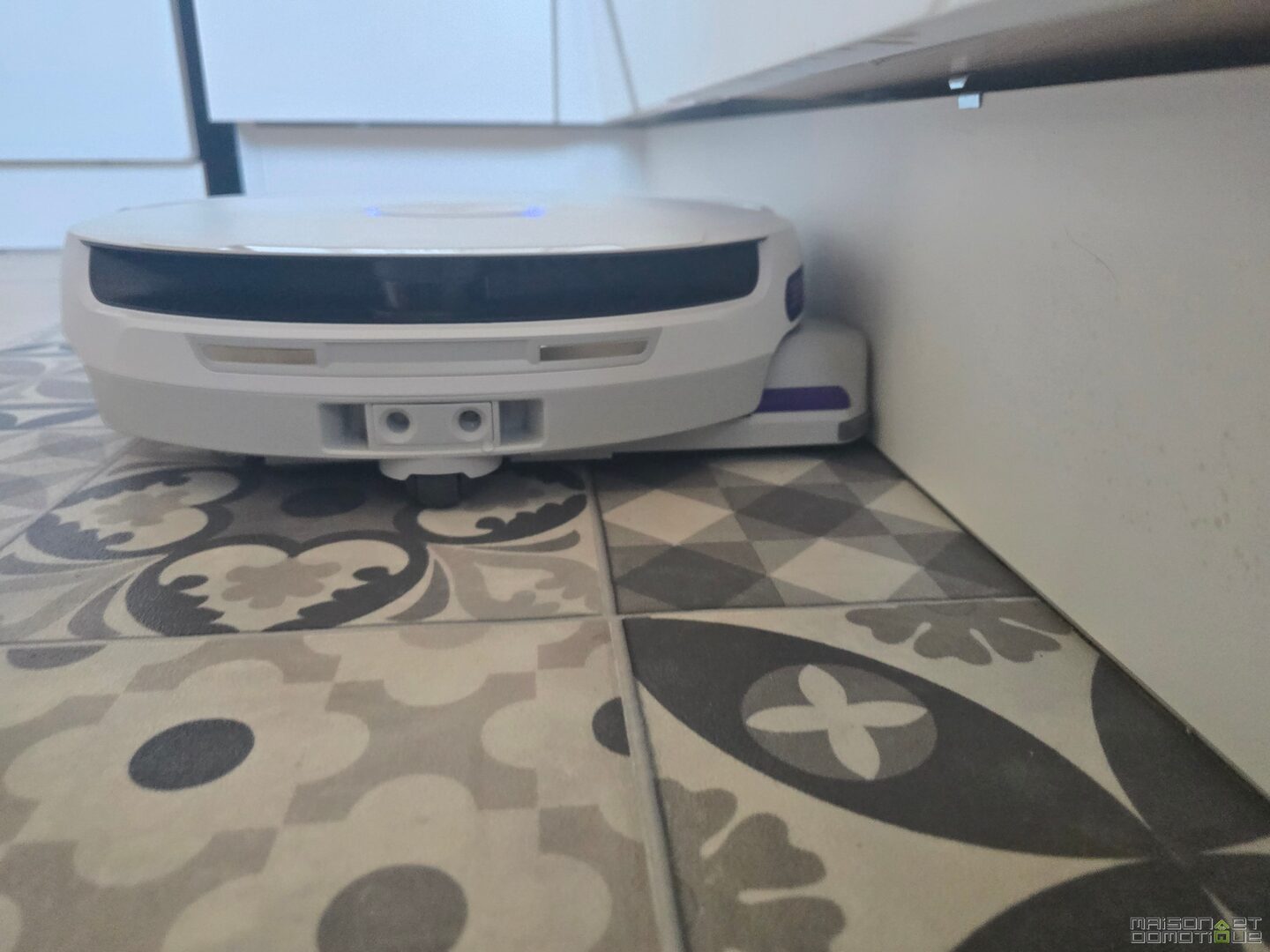
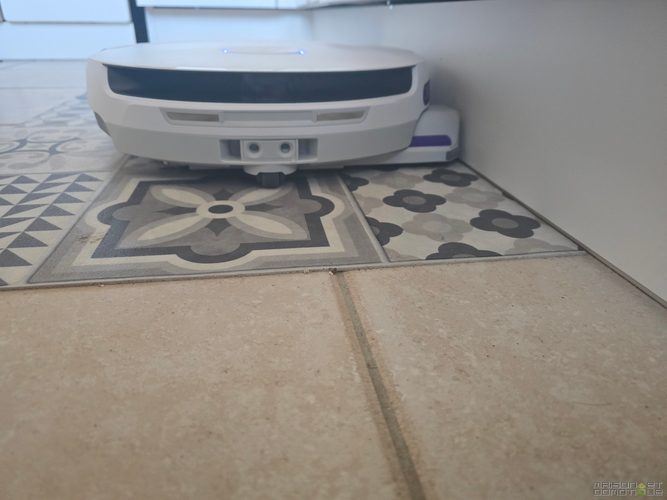
So Narwal added EdgeReach, which extends the chenille roller sideways by up to 48 mm. As it approaches an edge, the roller moves outward to get closer to the wall, furniture legs, and certain obstacles. The side brush, meanwhile, sweeps dust toward the suction inlet.
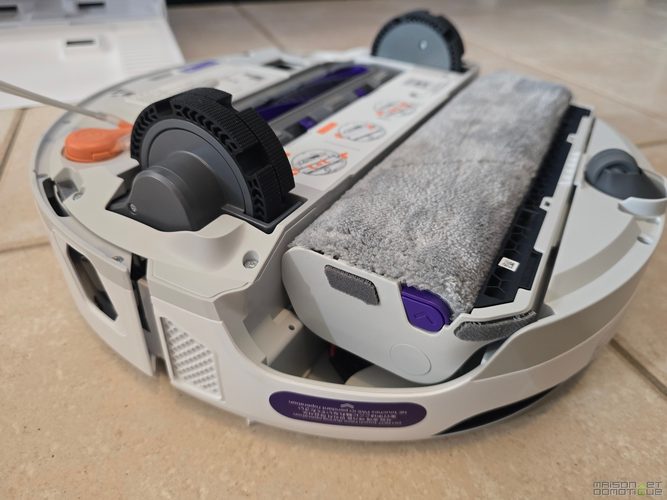
You can clearly see the extension in the photos, and it lets the robot mop areas the roller couldn’t reach while retracted inside the chassis. Around chair legs, the robot also adjusts its route to get as close as possible.
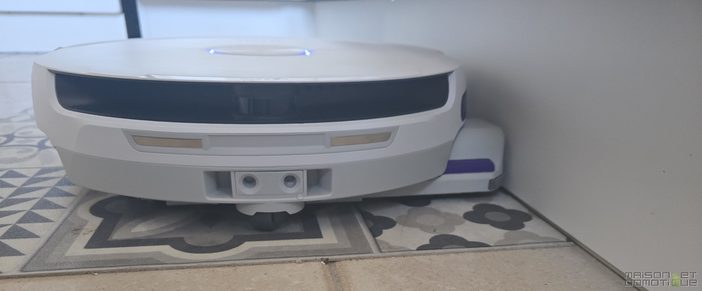
Very narrow corners, awkward angles, and the space under furniture that’s too low will always need a hand mop. But for the edges of a living room, kitchen, or hallway, it’s a real plus.
Navigation and obstacles: where Narwal made cuts
This is probably where the biggest compromise lies. The Freo 20 Edge combines integrated dToF LiDAR with structured-light sensors that measure object volumes. It doesn’t have the RGB cameras found on higher-end models, starting with the Freo 20.
On a spec sheet, that sounds like a minor detail. In use, it’s not. A camera paired with image processing doesn’t just see that there’s an object there; it tries to identify what it is. The robot can then distinguish certain types of dirt, recognize common objects, and adapt its behavior. The Freo 20 Edge, on the other hand, mainly detects a shape and a position. That works in many situations, but it’s much less effective with small, thin, or irregularly shaped objects.
Shoes, toys, chair legs: no problem
In my living room, the robot moves around a space with toys, a shoe, a table, several chairs, and a cable. It detects most obstacles and moves around them. It approaches chair legs cautiously and cleans around several of them. It detects the cable in its path, and the side brush slows down and then stops as it gets close, so it doesn’t drag the cable along. The report in the app correctly flags the obstacle. No complaints on this run.
Cables and socks: not so good
A more difficult test. Faced with several small objects, the robot avoids a fake pet mess, but bumps into a sock several times. It also misses some thin cables, especially when they’re short or hard to see, and one of them ends up under the robot. During several cleaning runs in a deliberately cluttered home, it sucks up a sock and gets stuck on a small cable.
These incidents are still uncommon across all the cleaning cycles, but they clearly show the system’s limitations. Overall navigation is good, but small-object detection isn’t on par with models that have visual recognition. In a fairly tidy home, this won’t be a real problem. If charging cables, socks, or small toys are often left on the floor, it’s best to do a quick pick-up before starting the robot.
The lack of a camera has another consequence: the robot can’t see that a stain remains or that debris has been left behind, so it can’t decide to go back over the area. That’s what explains the results with the ketchup and rice. The hardware can clean; it just lacks the information it needs to know where to make another pass.
Rugs and carpets
The Freo 20 Edge automatically detects rugs and changes its behavior when it encounters one. The roller then lifts by up to 12 mm to prevent the damp mop from touching the fibers. The app offers four settings for different types of rugs: prioritize vacuuming, avoid certain surfaces, or change the order of operations.
In my tests, it picked up hair and debris from a rug properly, although it sometimes needed an extra pass when the rug was very dirty or the dirt was embedded.
The 12 mm refers to the lift height; it doesn’t guarantee compatibility with every rug. On a thick or shaggy rug, that clearance may not be enough to prevent all contact with a damp roller. If your home has a mix of tile, hardwood, and rugs, choose the setting that vacuums the rugs before mopping the floors: the robot goes over the fabric before wetting its roller. It’s simple and avoids any nasty surprises.
It also lacks CarpetFocus, found on some high-end Narwal models, which improves suction contact with rugs. For everyday cleaning, this is more than enough. If you have a lot of thick carpeting, there are more specialized robots.
The app and Freo Mind
The app gives you two ways to go about it. The first is to set everything yourself: which rooms to clean, suction power, mop moisture, and number of passes. That’s useful if you know your home well, since a tiled kitchen has different needs from a hardwood bedroom.
But not everyone wants to spend ten minutes adjusting settings. That’s where Freo Mind comes in: Narwal’s smart mode, which makes the everyday decisions for you, including suction power, roller moisture, and cleaning route.
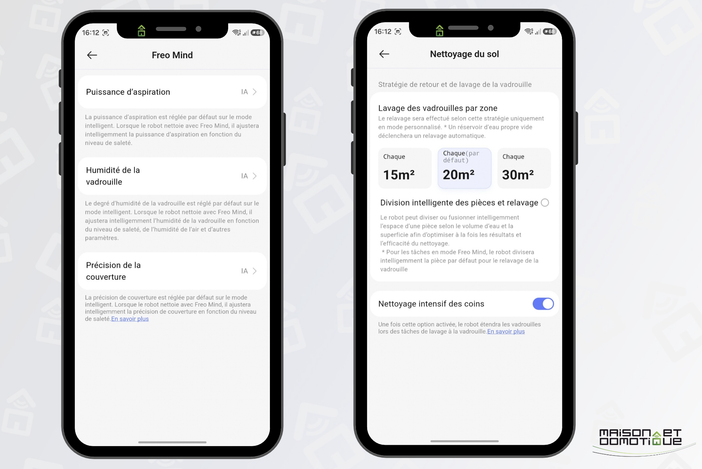
During my test, Freo Mind decided on its own to make two full passes through a room, first in one direction, then crosswise. It then cleaned the rug separately. You can see each route on the map in the app. Letting the system make the decisions instead of multiplying the settings has its advantages.
However, don’t confuse it with visual dirt detection. The Freo 20 Edge adjusts its cleaning strategy; it doesn’t see stains.
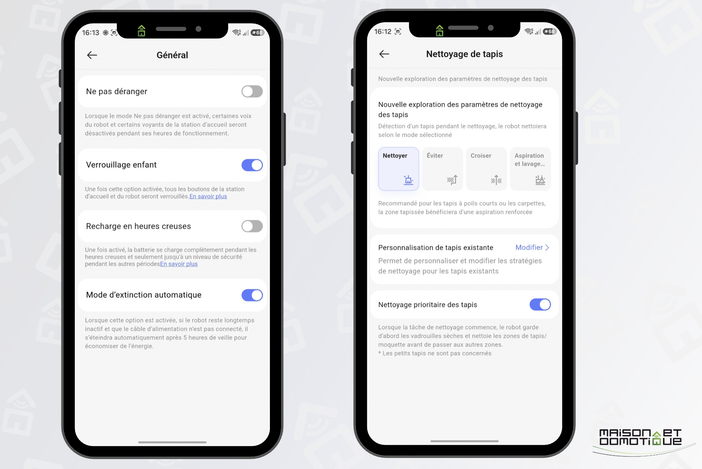
The app also gives you access to cleaning reports, dock settings, no-go zones, and rug options. Narwal says the robot is compatible with Alexa, Google Home, and Siri, within the limits of what those assistants allow.
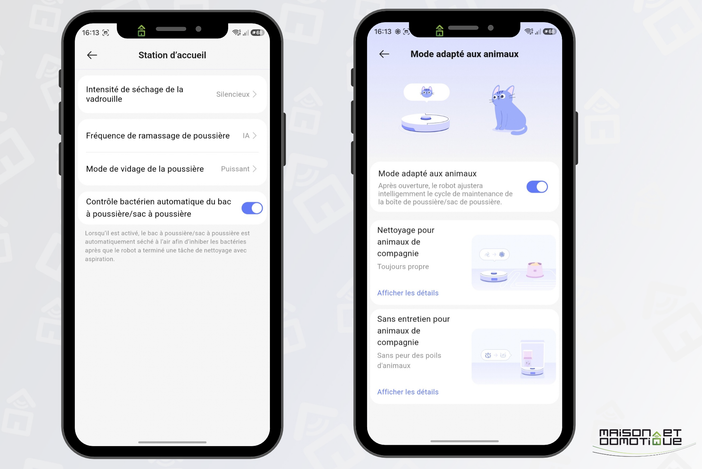
The dock in everyday use
A robot should also be judged by what happens when it returns to its dock. If you have to empty a bin after every run, wash the mop by hand, and cut hair off the brush, automation isn’t doing you much good. In this respect, the Freo 20 Edge’s dock is very well equipped.
Dust emptying
After cleaning, the robot’s dustbin is emptied into the dock’s 2.5-liter bag. Narwal claims up to 120 days of use thanks to waste compression. That’s under favorable conditions: with several pets, a large area, and one cleaning run per day, you’ll need to replace the bag much more often. But you no longer have to empty the small onboard bin.
Washing the roller
The dock also washes the FlowWash roller after use, removing residue from the chenille fabric and the collection circuit with a scraper and a debris filter to prevent clogs. Narwal also provides for automatic cleaning of the circuit and dirty-water tank. These are often the least pleasant parts of a washing dock to maintain, so this is a welcome feature, even if it doesn’t mean you can stop checking on it from time to time.
Drying at 45 °C
Once washing is complete, the dock dries the roller with hot air at 45 °C to reduce residual moisture and unpleasant odors. Several settings are available, including a quiet mode.
This mode is almost inaudible next to the dock. I measured about 30 dB with a sound meter, but that figure also includes the room’s ambient noise and the meter’s measurement floor, so it isn’t a reliable measurement of the dock alone. The impression, though, is clear: in quiet mode, you can barely hear it. That’s a welcome feature in a living room or open-plan kitchen.
What you still have to do by hand
Refill the clean-water tank, empty the dirty water, replace the bag when it’s full, check the filters, clean the brushes from time to time, and remove buildup from the dock.
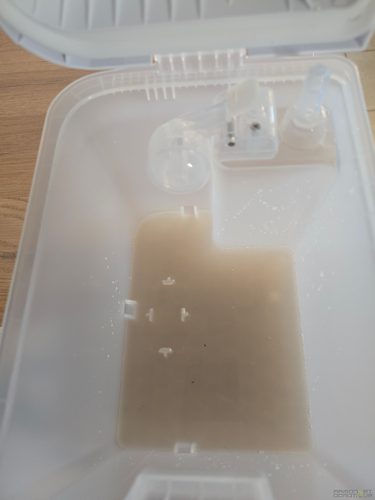
The mopping module can be removed for a thorough cleaning, which is a good sign for its longevity.
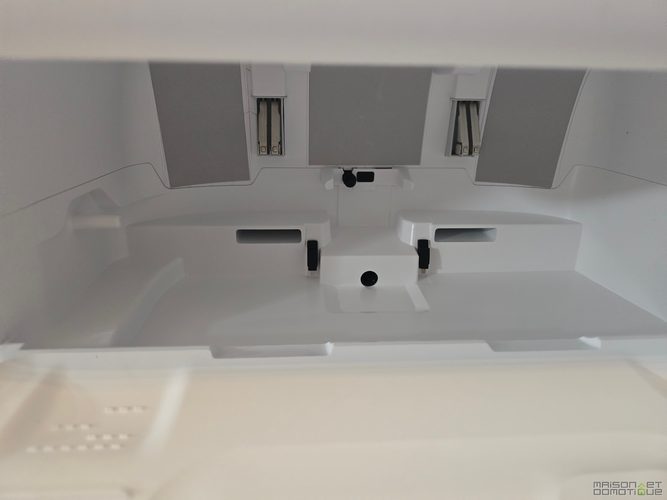
In its standard configuration, the dock doesn’t connect to either a water supply or a drain. It operates independently, but still needs to be manually supplied with water.
Battery life and noise
It has a 5,200 mAh battery and can cover up to 222 m² per charge according to Narwal, under favorable test conditions. In practice, it all depends on the suction mode, number of passes, room layout, and detours around obstacles: a thorough clean with several passes doesn’t use as little power as a quick maintenance run. When the battery runs low, the robot recharges and picks up where it left off.
Narwal also offers charging during off-peak hours. The robot doesn’t use as much power as a water heater, but if you’re on a peak/off-peak electricity plan, you might as well take advantage of it.
As for noise, it’s nothing unusual for this category. The sound level depends on the suction mode, and automatic emptying at the dock is temporarily louder. Quiet drying makes it easier to live with the dock, especially if you’re working from home while the robot runs.
Freo 20 Edge or Freo 20?
The names are similar, as are the spec sheets. Both have FlowWash, a claimed 31,000 Pa of suction, and DualFlow. But the Freo 20 Edge is a simplified version of the Freo 20, designed to make this mopping system more affordable.
The first difference is object recognition. The Freo 20 has two RGB cameras that work with its navigation system: it visually recognizes more obstacles and identifies certain types of dirt to adjust its cleaning. The Freo 20 Edge relies on LiDAR and structured light. That’s why it can move around a chair leg very well but struggles with a thin cable.
The second difference is heat. The Freo 20 mops the floor with hot water at up to 60 °C and cleans its dock circuit at a very high temperature. The Freo 20 Edge continuously supplies clean water but doesn’t have these heating functions. Its 45 °C hot-air drying has nothing to do with washing the mop in hot water.
So the Freo 20 Edge retains the features that matter most for everyday hard-floor cleaning: the wide roller, clean water, strong suction, and an automated dock. The Freo 20 adds visual recognition and more advanced hygiene features. If your home is mostly tile, hardwood, and a few rugs, the Edge has plenty to offer. If your home is often cluttered, or you want more precise obstacle recognition, consider the model above it.
Limitations to know before you buy
- Small obstacles. Structured light works in many situations, but it isn’t a substitute for visual recognition. Socks, thin cables, and small objects can still trip it up.
- No camera, so it can’t identify areas that are still dirty. It mops very effectively when the chenille roller passes over a stain, but the robot doesn’t always know when it needs another pass.
- The dock is bulky: make sure you have room to install it and open the tanks.
- The 12 mm lift requires caution on thick rugs, especially when the roller is damp.
- Maintenance is largely automated, but you still have to refill the clean water, empty the dirty water, and replace consumables.
None of these are deal-breakers, but it’s better to know before you order.
Black Friday 2026: up to €1,122 off at Narwal, plus an extra 5% with our code
The Freo 20 Edge arrives at just the right time: Narwal is launching a major Black Friday 2026 promotion in several phases.
Until November 30, the manufacturer is offering discounts of up to €1,122 on certain products and bundles. These are the maximum discounts across the entire promotion, not a guaranteed discount on the Freo 20 Edge.
Some robot orders qualify for a gift, depending on the offer: a pet bandana, a small acrylic tag, or a canvas bag. New members receive 200 points when they sign up, plus 300 more when they subscribe to the members’ newsletter, which also gives them access to a giveaway with six prizes, including gift cards worth up to €200. Until November 30, points are doubled on purchases made by registered members. One final round of offers and gifts extends the promotion from December 1 to 7, 2026.
Our code MAISONBF26: an extra 5% off
Narwal gave us a code reserved for Maison et Domotique readers, valid across its entire range: MAISONBF26
It gives you an additional 5% off eligible products in the official store. It works for both new and existing customers, once per person, and can be combined with current promotions. It’s valid now through November 30, 2026, inclusive.
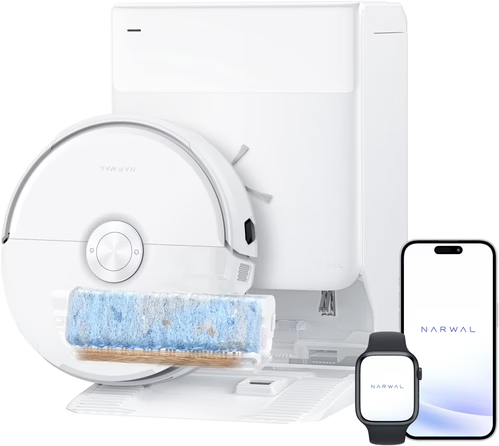
If you’re considering the Freo 20 Edge or a higher-end model, now’s the time to compare. Prices vary depending on the promotion phase and bundles, so check the final amount in your cart after entering the code.
You’ll find the deals at the official Narwal store. To compare prices and availability, you can also check out the Narwal deals on Amazon, but code MAISONBF26 is intended for the official store.
Conclusion
With the Freo 20 Edge, Narwal isn’t trying to pile on flashy features. It keeps what makes its best floor-cleaning robots so good, and it comes down to one word: FlowWash.
The chenille roller, continuously supplied with clean water and rinsed as it works, does a better job than rotating mop pads, and the tests with dried coffee, ketchup, and a puddle of colored water show that this is more than a marketing claim. The wide contact area, 12 N of downward pressure, and EdgeReach extension also play a part. The 31,000 Pa of suction does the job on both hard floors and rugs, and DualFlow does a good job of preventing hair from tangling. Add a dock that empties the dustbin, washes and dries the roller, and you have a robot that needs little attention.
Its weak point is obstacle recognition, which falls behind that of its bigger siblings, especially when it comes to cables and small objects. Without an RGB camera, it also can’t spot stubborn dirt and go back over it. If things are often left lying around on the floor at home, it’s worth considering.
For a fairly tidy home with mostly hard floors and a few rugs, we think it’s a good compromise, especially with the Black Friday discounts. The Freo 20 Edge isn’t the most sophisticated robot on the market, and it doesn’t claim to be. It mops very well, vacuums effectively, and practically takes care of its own maintenance, all without the price tag of premium models. For many households, that’s more than enough.