



Résumer cet article :
Last year, DJI entered the robot vacuum market with a rather surprising first ROMO P. There was the transparent design, of course, but above all, the navigation: the drone giant had repurposed much of its environmental perception expertise in a device tasked with… cleaning the house. And it worked really well.
That said, it wasn’t perfect. At nearly €1,900, the ROMO P was aiming very high, and it was still missing some features offered by its top competitors.
One year later, here’s the ROMO P2. Its lineage is immediately obvious from the outside, but the engineers have changed a lot more than you might think. Suction power is up to 36,000 Pa, a new mop arm is guided by LiDAR, carpets and liquids are handled better, mechanical legs let it cross surprisingly high thresholds, the dock has been improved, and the robot is even quieter.
Most importantly, it arrives at €1,299 (recommended retail price), €600 less than its predecessor cost at launch.
Has DJI found the right formula on its second attempt?

DJI ROMO P2: a familiar look that works
It’s impossible to mistake the ROMO P2 for any other robot vacuum. DJI has kept the ROMO P’s transparent design: you can see some of the inner workings of both the robot and the dock, and the circuit boards, ducts, and motors are part of the look.
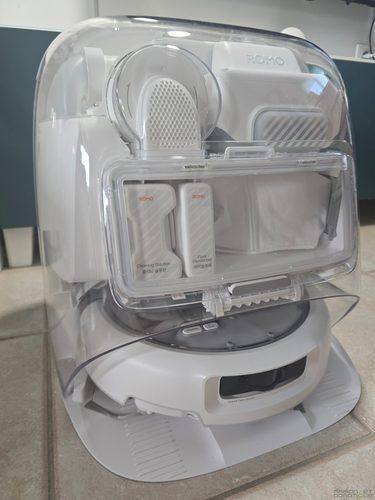
You’ll either love it or hate it, but at least it isn’t yet another white robot parked in front of a big white box.
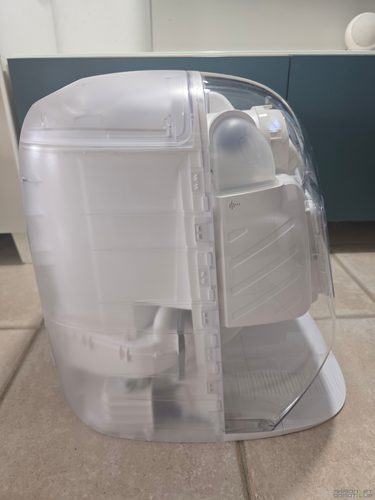
Making a transparent device is actually more complicated than you might imagine. You can’t hide messy wiring or a rough fit and finish behind a plastic cover: everything has to be neat. It almost feels like looking at a laboratory machine rather than a household appliance.

The P2 has evolved a little compared with the ROMO P: the gray and silver elements are more understated, and the overall look seems brighter.

DJI also offers a ROMO A2. The robot is still transparent, but the dock is white, and two features are missing: the floor deodorizer and UV treatment for the dust bag. If you don’t care about the fully transparent look or these two options, the A2 is worth considering.

The ROMO P2 still measures about 35 cm in diameter and 9.8 cm in height. With no LiDAR turret on top, it stays under the 10 cm mark. Some competitors are shorter, though: it’s worth measuring the clearance under your sofa and lowest furniture before buying.
A dock that’s still as impressive as ever
The dock follows the same general design as the first generation. At about 44 cm tall, 42.5 cm wide, and 45 cm deep, it’s still imposing, but fairly reasonable considering everything it contains.

On top, there are two tanks: about 4 liters for clean water and a little over 3 liters for dirty water.

A front panel provides access to the dust bag and two cartridges.

There are two because, in addition to detergent, DJI adds a floor deodorizer cartridge. In the app, you can choose to mop with water alone, with detergent, with an extra rinse, or with deodorizer. It’s an unusual feature, but the deodorizer is more of a nice little extra than an essential function.

These cartridges are proprietary. You can’t pour your usual cleaning product into a tank, so you’ll need to factor in this ongoing cost.

The dust bag also gets UV treatment, which is meant to limit the growth of microorganisms.

Most of the work on this dock has gone into self-cleaning. DJI claimed up to 200 days without intervention for the previous generation; now it says 365 days. To achieve this, the dock combines a coating that dirt sticks to less, pressure washing, and a system that flushes away residue.

That figure is based on measurements under conditions chosen by DJI. But after several weeks of use, my tests show that the dock stays surprisingly clean. It won’t be spotless after cleaning hundreds of square meters, but it still stays relatively clean. One detail still bothers me, though: the bottom of the wash tray isn’t easy to remove, unlike on some competitors. When it needs to be cleaned by hand, it won’t be as convenient as you’d like. That’s a shame.
Water heated to 80°C…
DJI now says the mop pads are washed with hot water at up to 80°C, then dried with hot air. On paper, it’s a good idea: hot water loosens grease trapped in the fibers more effectively, and drying prevents dampness and unpleasant odors.

In practice, it’s true that the pads come out clean and dry completely.

36,000 Pa: DJI steps on the gas
Let’s flip the robot over. Suction power increases from 25,000 Pa on the ROMO P to 36,000 Pa on the P2, a 44% increase on paper.
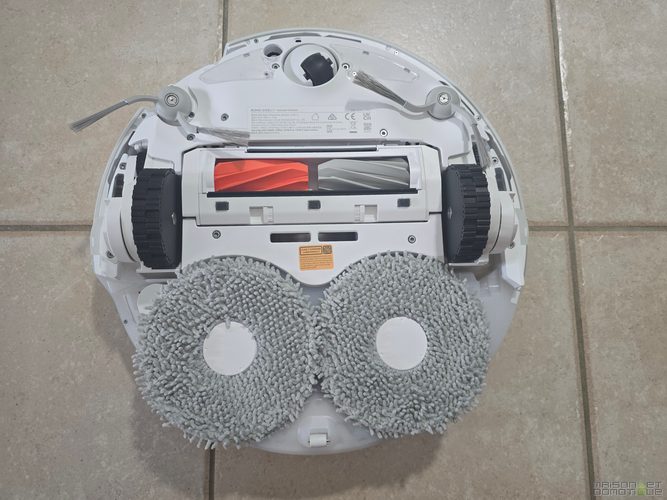
Pascal ratings have become a contest to see who can advertise the biggest number, and they don’t tell the whole story. The airtightness of the airflow system, the brushes, and how the robot adjusts its power matter just as much. The ROMO P already had excellent suction, and the P2 doesn’t disappoint.
In the center, we find the excellent dual-roller system, with two separate rollers. Hair moves toward the middle before being vacuumed up instead of wrapping around the brush. If you have a pet or long hair at home, it makes a real difference.

In a measured test using 100 g of a mixture of sand, cat litter, and wood shavings, the P2 picked up about 99 g on hard floors, with both the rubber brush and the combination brush. On a standard carpet, it picks up about 85%, which is still very good.

It still struggles with very long-pile carpets. Depending on their construction, the robot may have trouble moving forward, and its performance drops considerably. So it’s not the best choice for a home covered in thick carpeting.
Adaptive suction
Ultimately, I’m less interested in the 36,000 Pa than in how the robot uses them.
Thanks to its cameras and sensors, the P2 detects some concentrated patches of dirt and changes its strategy. A few pieces of cat litter scattered in front of the litter box? Instead of moving on, it slows down, increases suction, and makes another pass.
On carpets, a plate lowers to better seal the space around the brushes and concentrate suction within the fibers. The main brush can also lift when it isn’t needed, for example during mopping-only runs or when dealing with certain liquids.
In my view, this ability to adapt matters more than the race for Pascal ratings.
Two side brushes, and it’s not just for show
DJI has kept a feature that’s becoming rare: two side brushes, whereas most manufacturers now use just one.
This DualSweep system sweeps dust toward the central rollers from both sides, and the shape of the brushes helps prevent hair from tangling. The right brush can also extend to reach dust in corners. It does a very convincing job along baseboards and in corners.

One small drawback: these two brushes still don’t lift. As we’ll see, that matters when there’s liquid on the floor.
The robot arm, the ROMO P2’s real star
If there’s one mechanical innovation to remember, it’s this one.
DJI has kept the two rotating mop pads, but the one on the right is now mounted on an articulated arm that pivots through 123°. Its reach is 7.8 cm longer than the previous generation, and it doesn’t simply extend the mop to its limit: the arm has its own LiDAR.

The robot knows where the wall, chair leg, or underside of a piece of furniture is, and constantly adjusts how far the mop extends. It’s fascinating to watch it work around a table: the mop reaches dirt around chair legs without the robot needing to make multiple passes. It even slides about 4.5 cm under some furniture that the robot itself can’t fit beneath.

It covers more ground, but also saves time, since the robot has to make fewer detours. My tests also show that it’s significantly faster than its predecessor over large areas.
Why mop pads instead of a roller?
It’s a debatable choice. In 2026, several high-end competitors use a roller that is continuously rinsed with clean water. The advantage is clear: in theory, the part that touches the floor stays cleaner, and liquids are handled very well.
DJI is sticking with its two rotating pads. On a large, perfectly flat surface, a good roller can do a better job, especially by leaving less of a damp film behind. But the P2’s mop pads are much thinner. With the new arm, they can reach under the toe kick of a kitchen cabinet, under some appliances, or around a chair leg—places a thick roller will never fit.

Neither system is objectively better; it all depends on your home. In terms of cleaning performance, DJI’s thick pads scrub well. Even dried-on marks come off in one or more passes, and the robot makes extra passes on its own when it detects a very dirty area.
Navigation with a touch of drone technology
This is DJI’s specialty. The ROMO P’s navigation had already amazed me, even though DJI had never made a robot vacuum before.
On second thought, it’s not that surprising. A drone needs to know very quickly where it is, map its surroundings, detect obstacles, and correct its course without hitting anything. A robot vacuum does the same thing, but in two dimensions.

The P2 combines a front-facing 3D ToF LiDAR, two fisheye cameras, and a side-mounted 3D ToF LiDAR, all brought together by algorithms derived directly from DJI’s drones. And there’s still no turret on top.

DJI says the robot can detect some obstacles just a few millimeters in size. Unlike many marketing claims, this one holds up at home. USB cables, Lego bricks, toys, socks, pet bowls: the P2 spots objects that plenty of robots still charge straight into.
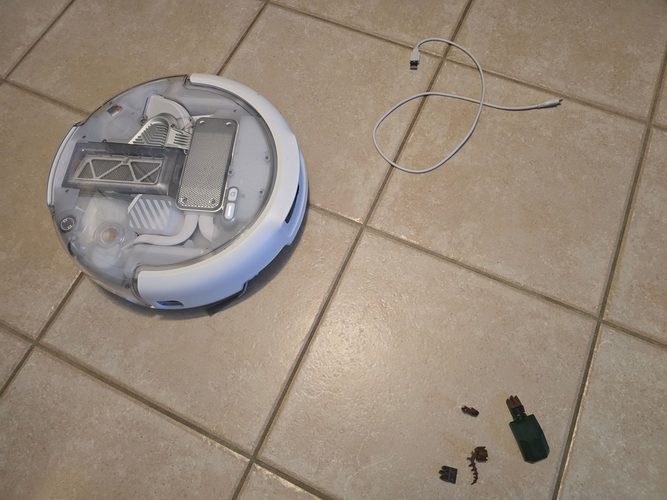
During my long-term testing, it became very rare for the robot to get stuck.

This may be the most important quality in a robot vacuum. It’s not much use advertising 30,000, 40,000, or 50,000 Pa if the robot gets stuck on a cable after twenty minutes.
It can even see in the dark
The front lighting has been redesigned. The LEDs are placed very low and shine directly on the area captured by the cameras, covering up to 2,000 cm² according to DJI.

The robot can therefore see well in a dark room, which is useful if you run it at night or while you’re away with the shutters closed. It can spot dirt and obstacles without relying on the lighting in your home.

It detects liquids, even transparent ones
Another welcome improvement is liquid detection. Not just a large coffee spill on white tile, but also transparent liquids that can be difficult to see with the naked eye.
The benefit is simple: sucking water into the system designed for dust is never a good idea. When it detects a puddle, the P2 can avoid it, finish cleaning the rest of the area, and then come back to deal with it. Suction stops, the main brush lifts, and the mop pads take over. It even starts by cleaning around the edge of the puddle before moving toward the center, making several passes if needed.
In a kitchen, dining room, or home with children and pets, this is the kind of feature that’s genuinely useful.
The side brushes, which don’t lift, remain a concern. They stop spinning, but still touch the floor and may come into contact with the liquid. The robot’s chosen route greatly reduces the risk, but doesn’t eliminate it entirely.
Legs that let it climb thresholds up to 8.5 cm high
Another spectacular new feature is hidden underneath the P2: small mechanical legs that allow it to change its height.

On a simple obstacle, it can theoretically climb up to 4 cm. On a two-level threshold, DJI claims 8.5 cm. In testing, it managed to climb steps higher than 4 cm, which is already remarkable for a device of this kind.
Few homes have thresholds 8.5 cm high, let’s be honest. But in an older house with changes in floor level, sliding-door tracks, or thick rugs, it makes a difference.
The legs also come in handy on rugs. As the robot climbs onto or off a rug, it raises its rear slightly to stop the mop pads from rubbing against the fibers or dragging the rug along with it. The ROMO P was limited to about 2.5 cm.
Carpets remain its Achilles’ heel
Let’s talk about carpets, too. The P2 detects carpets, increases suction, raises its mop pads by about 15 mm, and uses its legs to handle some pile heights. But it still can’t leave its mop pads at the dock.

This was already a complaint about the ROMO P, and DJI hasn’t addressed it. On a standard rug, there’s no problem. On wall-to-wall carpeting or a thick rug, a 15 mm lift doesn’t guarantee that the damp pads will never touch the fibers. Several high-end competitors can now leave their mop pads at the dock when they’re only asked to vacuum carpets. At over €1,000, we would have liked to see the same feature here.
And as we’ve seen, the P2 may struggle to climb onto very long-pile carpets or maintain a proper route on them.
If your floors are mostly hardwood or tile with a few standard rugs, like mine, it’s nothing deal-breaking. But if your home has thick carpeting over much of its floor, think twice.
A surprisingly quiet robot
Here’s an improvement you won’t notice by reading the spec sheet. DJI claims up to 85% less sound energy than the previous generation, which doesn’t mean 85% fewer decibels—the two concepts are completely different.
In practice, the P2 is very quiet. In standard suction mode, the motors, wheels, and mop pads make very little noise, and you can watch TV or talk in the room while it’s running. At full power, of course, 36,000 Pa doesn’t make it silent. Emptying the bin into the dock is still brief but noisy, as it is with almost all competitors.
Otherwise, DJI has done a great job with the acoustics.
DJI Home, a feature-packed app
Everything is controlled in the DJI Home app. First, you let the robot map your home, and once again, the navigation works wonders: walls, openings, rooms, and carpets are quickly identified.

You can then edit the map, divide or merge rooms, rename them, add virtual walls, no-go zones, thresholds, or a pet area. Multiple floors are supported.

For each room, you can set the suction power, water flow, number of passes, cleaning pattern, and product used. You can schedule a light daily pass in the bedrooms and a more thorough clean in the kitchen, for example.

Routines can be started directly from the home screen. Once your schedules are set up, you don’t have to fiddle with fifteen settings before every cleaning session.
AI that chooses how to clean
The app also lets you decide how the robot responds to what it detects: make extra passes over stubborn stains, clean more thoroughly when it spots particles, vacuum certain debris before mopping, or handle liquids separately.

After each session, a report shows the route taken and any problems encountered. If an obstacle prevented it from cleaning an area, a photo helps you understand what happened. More often than not, the culprit is a shoe left in the wrong place.

Cameras and privacy: DJI is preparing an offline mode
Cameras moving around your home inevitably raise privacy concerns.
The monitoring feature lets you access the robot’s cameras remotely, protected by a password. Photos of obstacles can be automatically deleted after 14 days.

Most importantly, DJI has announced an offline mode: the robot will work without an internet connection and keep your data in your home. It’s scheduled for release by the end of 2026. That’s very good news for a device with cameras that enters every room. We’ll have to see how it works once the firmware is available.
Enough battery life for most homes
DJI has kept the 5,000 mAh battery and claims about three hours of runtime under the best conditions. In reality, it all depends on suction power, water flow, the number of passes, and the layout of your home.
For about 100 m² of vacuuming and mopping, expect between an hour and a half and just under two hours, without needing to recharge along the way. When I run it only on my ground floor, which is about 75 m², the robot finishes with around 50% battery remaining.
So a typical-sized home can be cleaned on a single charge. If the area is larger, the P2 returns to recharge and then picks up where it left off.
ROMO P vs. ROMO P2: what’s really changed?
This was the question I was most interested in after testing the first generation. The ROMO P was far from bad: for a first attempt, DJI had set the bar very high.
The P2 keeps what worked: the transparent design, the anti-tangle dual central brush, the two side brushes, the two mop pads, excellent navigation without a turret, and a dock that was already highly autonomous.
Here’s what’s changed:
- suction power increases from 25,000 to 36,000 Pa;
- climbing ability increases from about 2.5 cm to 4 cm for a simple obstacle, and up to 8.5 cm for a double-level threshold, thanks to the mechanical legs;
- the extending mop is now mounted on a 123° articulated arm guided by its own LiDAR, with an extra 7.8 cm of reach;
- carpets are handled better thanks to the pressure system, liquids (even transparent ones) are detected, and the main brush can lift;
- the dock’s advertised self-cleaning interval increases from 200 to 365 days, and the water can reach 80°C;
- the robot’s movements have been refined to be smoother and quieter.
Some of the first model’s shortcomings remain: the mop pads still can’t be left at the dock, and the side brushes still don’t lift. It’s also still missing a small screen in front of the dustbin filter. Large particles end up clogging the filter directly, so you’ll need to clean it by hand more often.
And above all, a completely different price
This is probably the most important change. The transparent ROMO P launched at around €1,900. Even though it was excellent, it was hard to justify at that price.
The ROMO P2 is priced at €1,299, while the ROMO A2 costs €1,199. For its launch in France, DJI even temporarily dropped the P2 to €1,059 (and to €999 during Prime Day).
It’s still a high-end model, but the situation is completely different now. At €1,299, the P2 goes head-to-head with premium models from Dreame, Roborock, Narwal, and Ecovacs, with a few unique strengths of its own. At around €1,050, it becomes a very compelling option for what it offers.
So, how good is the DJI ROMO P2?
When DJI entered the robot vacuum market, I wondered what a drone specialist was doing there. Two generations later, the answer is clear.
DJI may not yet have the same experience as established manufacturers when it comes to floor cleaning, but it has mastered the essentials: helping a machine understand its surroundings and move around on its own. That makes all the difference day to day. A truly autonomous robot isn’t the one with the biggest Pascal rating on the box. It’s the one you can start before leaving home without spending ten minutes picking up cables, toys, and socks. The P2 impresses in this regard.
This second generation also adds what the first one was missing: more power, much better edge cleaning, liquid detection, improved carpet handling, the ability to cross thresholds with ease, and an even more autonomous dock.
It still has some flaws. Not being able to leave the mop pads at the dock is hard to forgive at this price point, and the side brushes should have been able to lift. If you have a lot of thick carpeting, keep in mind that results will depend heavily on the carpet.
What really changes my opinion compared with the first ROMO is the price. At nearly €1,900, the ROMO P was a big ask, despite its strengths. At €1,299, and even more so at around €999, the P2 can hold its own against the market leaders.
DJI made a successful debut in the world of robot vacuums. With this P2, the brand shows that it listens to criticism and responds quickly.

Please remain courteous: a hello and a thank you cost nothing! We're here to exchange ideas in a constructive way. Trolls will be deleted.