


Résumer cet article :
The Mova Lidax Ultra is part of this new generation of robot lawn mowers that truly change the way we approach garden maintenance. No peripheral cable to bury. No RTK antenna to place in the right spot. No headaches with a station that must absolutely see the sky. Here, everything relies on 3D 360° LiDAR navigation, supported by a camera and artificial intelligence.
And of course, when you’ve already experienced the older generations of robot mowers, it changes a lot of things. You set up the station, create your map, adjust a few parameters in the app, and the robot can take care of the lawn methodically.
The version tested here is the Mova Lidax Ultra 1000, designed to cover up to 1000 m². The range also includes models for 800, 1200, 1600, and 2000 m², with starting prices announced at launch of 949 € for the 800, 999 € for the 1000, 1099 € for the 1200, 1499 € for the 1600, and 1699 € for the 2000.
Mova highlights several key technologies in this series: UltraView 2.0, which combines 3D LiDAR and AI vision, UltraTrim 1.0, which allows the cutting disc to come within 5 cm of the edges, detection of over 300 obstacles, management of up to 150 zones, and the ability to work on slopes of up to 45%.
In short
The Mova Lidax Ultra 1000 is a robot lawn mower without a peripheral cable or RTK antenna, designed for gardens up to 1000 m².
Its major strength: LiDAR 3D + AI camera navigation, which allows it to accurately map the terrain, manage multiple zones, and mow methodically.
The UltraTrim function is another real pleasant surprise: the cutting deck shifts to better manage the edges. As a result, there is much less grass to be dealt with by the trimmer.
The Mova Home app is comprehensive: cutting height of 3 to 10 cm, restricted zones, paths, seasonal programming, rain/frost management, onboard camera, and anti-theft security.
On the downside, it is a bit slow on larger areas and can miss small, low objects like a thin hose or a sock.
In short, a precise lawn mower, easy to install, and very convincing for automating mowing without complicating life.
A robot lawn mower without cable or RTK antenna
The first big advantage of the Mova Lidax Ultra is its installation. Traditional robot mowers often required burying a peripheral cable all around the area. It was reliable, but honestly not very fun to install. It sometimes took several hours, a few curse words, and a good dose of patience.
RTK models simplified things by eliminating the cable. But they introduced another constraint: the GPS antenna. It must have good reception, the station must be correctly placed, and trees or buildings shouldn’t interfere too much. In a simple garden, that works. In a garden with hedges, walls, trees, or uneven areas, it can sometimes be trickier.
The Mova Lidax Ultra works differently. It uses its 3D 360° LiDAR to orient itself in the environment. It observes the fixed elements around it: house, walls, trees, fences, flower beds, sheds, permanent furniture… and uses them as reference points. Mova claims a range of up to 70 m for this technology, which suits most residential gardens.
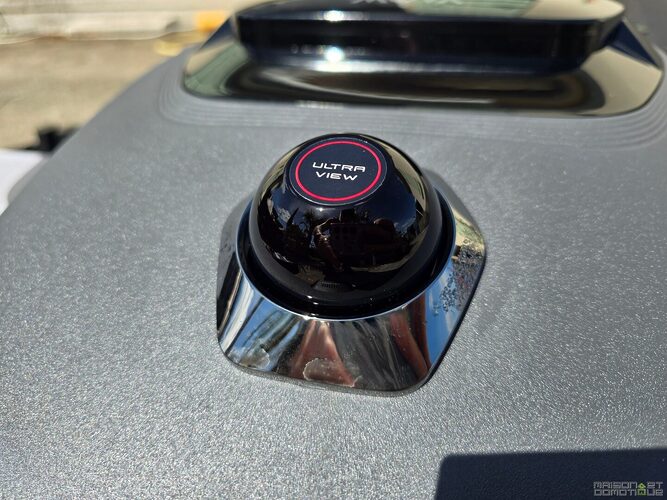
In practice, this means you can place the station much more freely. It doesn’t need to be under a perfectly clear sky like with some RTK systems. You can even install it in a place that isn’t necessarily in the middle of the lawn, as long as the robot can reach the mowing area by rolling.
It’s a real advantage in modern gardens, often divided into several areas: terrace, pool, flower beds, vegetable garden, path, shed, hedges, narrow passages… The robot doesn’t need a “perfect” terrain to work properly.
Design and build quality
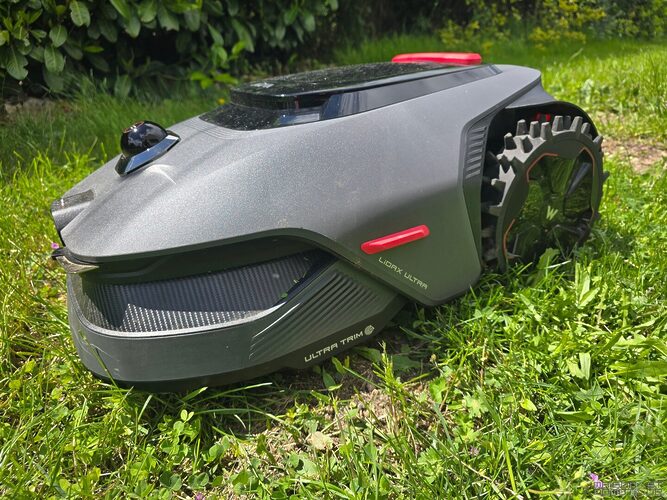
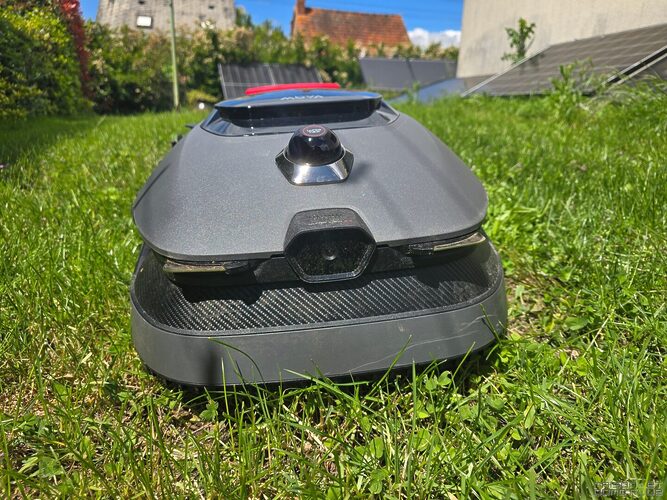
The Mova Lidax Ultra gives a good impression right out of the box. The design is modern, almost sporty, with an elaborate hood, a clearly visible LiDAR on top, a front camera, large knobby wheels, and a finish that exudes premium product quality.
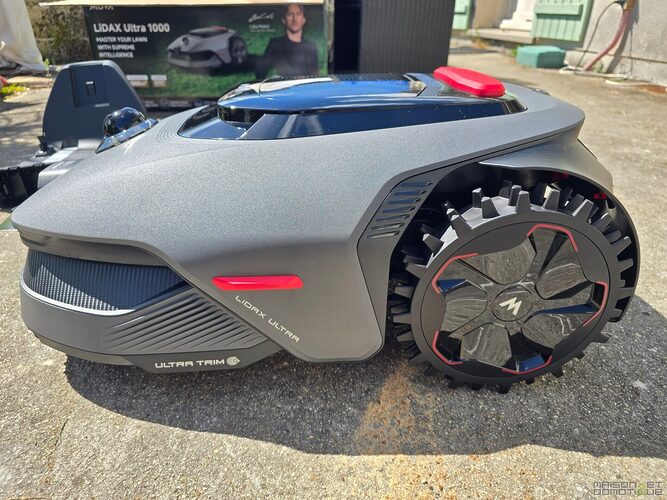
The robot is not tiny, but it’s coherent with the announced area and the equipment on board. On top, you find the mandatory Stop button, the rain sensor, the LiDAR, and a cover that provides access to the control screen.
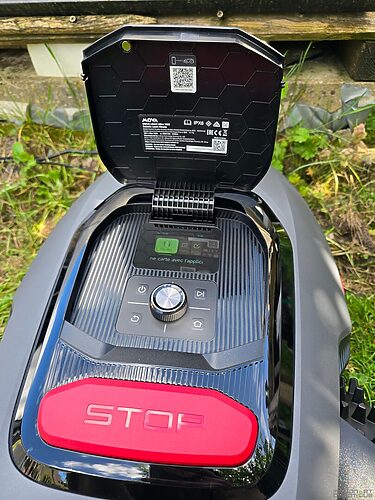
This screen allows you to enter the PIN code, manage a few functions directly from the robot, or launch certain commands without necessarily taking out the smartphone.
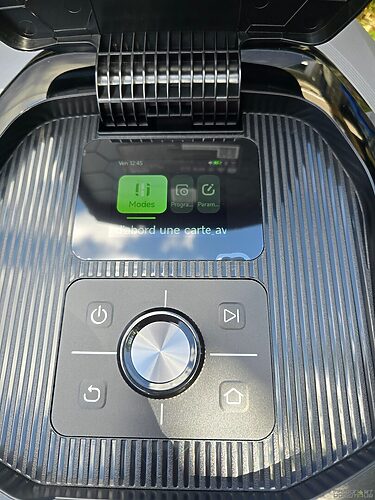
At the front, the camera contributes to obstacle recognition and can also be used to visualize the garden from the app.

On the sides, the two large drive wheels ensure propulsion. They are well knobby, with good width and reassuring grip.

At the front, two freewheeling wheels allow for directional changes.

Under the robot, there is a cutting deck equipped with three small rotating blades, like on many robot mowers. Some competitors have five, six, or even more, but the number of blades isn’t everything. Here, the cut is clean, regular, and the blades are easy to replace.
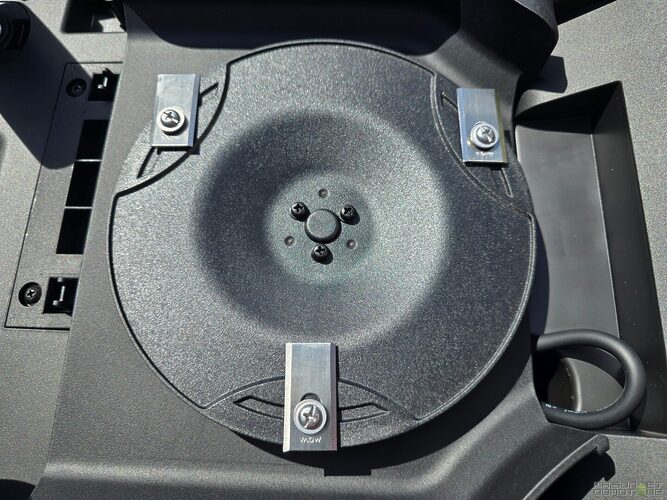
The interesting detail is mainly in the cutting deck: it can shift laterally thanks to the UltraTrim 1.0 function. This function allows the blades to get closer to the edge of the robot to limit the strip of uncut grass along walls, edges, or flower beds. Mova claims a cut of less than 5 cm from the edges.

And in the field, this function really changes the experience. We’ll come back to that later.
Contents of the box
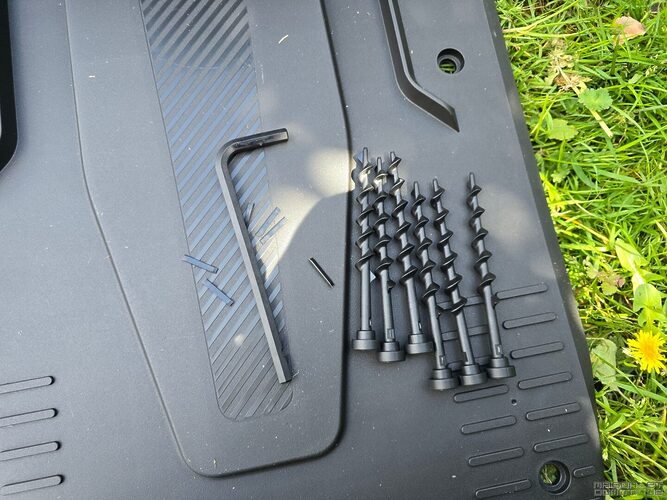
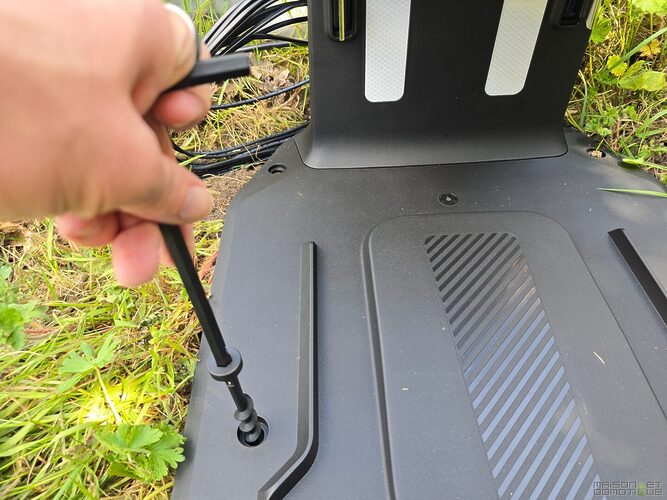
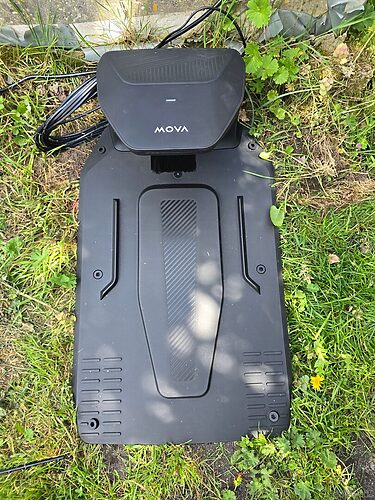
In the box, you find the robot, charging station, power supply, base mounting screws, replacement blades, associated screws, a screwdriver, documentation, and a small protective brush related to the LiDAR. The packaging is solid, the robot is well padded, and it all inspires confidence.
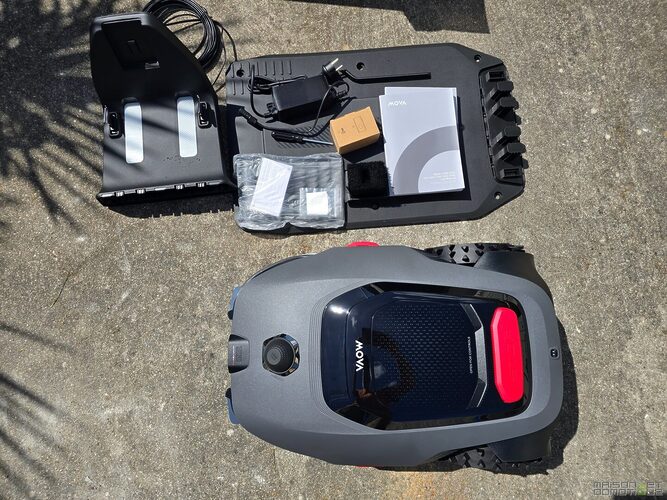
The station is fixed to the ground using the provided screws. It’s best to install it on a stable and relatively flat surface. You also need to allow some space in front, as the robot exits its base and then performs a calibration phase: it turns around to locate itself, which requires a minimum amount of clearance.
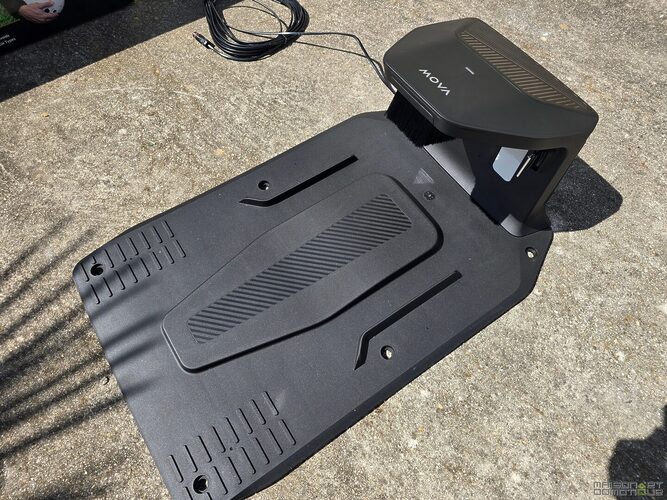
Here’s a useful little tip: if the station is placed directly on the soil or lawn, placing a slab or thin plate underneath can make cleaning at the end of the season easier. It might sound trivial, but when winter comes and it’s time to put the equipment away, you’ll be glad not to find a base full of dirt.
Installation: much simpler than a cable robot
Installing the Mova Lidax Ultra is done via the Mova Home app. It’s the same app as for other products from the brand, like the robot vacuum cleaners. Adding the robot is done by scanning the QR code, then connecting the device to Wi-Fi.


As often, you need to use a 2.4 GHz Wi-Fi network. This is a point to check before installation, especially if the box is far from the garden or if the station is in a spot with limited reception. A good outdoor Wi-Fi network, or at least decent coverage at the station’s location, is recommended.

Once the robot is added, it’s advisable to immediately carry out the updates. Robot lawn mowers of this generation evolve a lot through software. Obstacle detection, trajectories, edge management, localization… everything can be improved over time. So, it’s a reflex to adopt from the start.
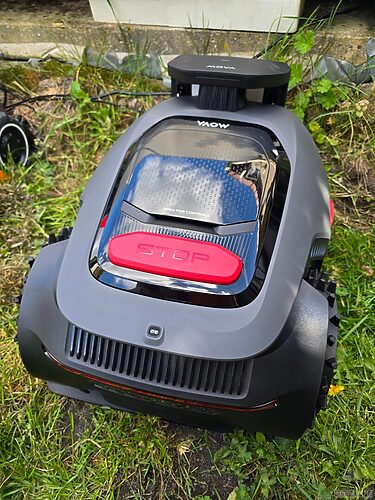
The physical installation is very brief: you place the station, secure it, plug in the power supply, place the robot on it, and then move on to mapping. Nothing to do with a day spent burying a cable around the yard!
Mapping: better to take the time to do it well
Creating the map is an essential step. It determines the precision of the mowing afterwards.
The Mova Lidax Ultra offers automatic mapping, but in practice, manual mapping remains the best option for obtaining a clean result. Automatic mapping will work for those with a perfectly defined garden, with edges around hedges, flower beds, etc. Automatic mapping can function on simple edges, but it can also struggle as soon as the terrain has a slightly particular element, like a sign, a high edge, or a not clear enough separation.
My advice: for a simple garden, automatic can come in handy. For a precise result, it’s better to map manually.
In manual mode, you thus pilot the robot from the app, a bit like a remote-controlled car, making it follow the exact boundaries of the area to be mowed.

You need to define a starting point and then guide the robot all around the area to be mowed. When you return to the starting point, the area is closed and recorded. The operation requires a bit of attention, but it remains simple. And above all, it avoids letting the robot interpret complex edges, irregular flower beds, or ambiguous zones on its own.

Zones, paths, and restricted areas
The Mova Lidax Ultra does not just settle for a simple global map. It can manage multiple mowing zones, paths between zones, and restricted areas.
This is very useful in a real garden because a lawn is not always a nice perfect rectangle. You may have a main zone in front of the house, another behind, a path around a pool, a strip of lawn near a terrace, or even a small isolated piece next to a path.
To connect two zones, you create a path. The robot does not necessarily mow on this path: it mainly uses it to move from one zone to another. Thus, you can have it take a specific passage, for example, between two flower beds, along a path, or around a tree.
Restricted zones are just as useful. You can draw them in the app or create them by piloting the robot around the place to be excluded. This can be useful for a flower bed, a stump, a vegetable garden, a pond, a freshly sown area, or a space where you never want the mower to go.

The advantage of a well-defined restricted area is that the robot can then mow neatly around it. Instead of just avoiding the obstacle at the last moment, it integrates it into its mowing logic.
Double map and up to 150 zones
Another interesting function: management of two maps. Mova announces a double map with up to 150 zones.
This can be useful in several situations. For example, if the front and back of the house do not connect, you can create two distinct maps. You will then need to move the robot manually from one side to the other, unless there is a passage. You can also imagine using it in a second home or at a relative’s house by taking the robot and possibly its station.
However, be careful: if the robot works on a map where it cannot physically reach its base, it will not be able to recharge itself. You will need to anticipate the autonomy or move the station. That’s logical, but it’s worth knowing before dreaming of a robot that magically crosses the house to go from the front to the backyard.
A very comprehensive app
The Mova Home app is one of the robot’s strong points. It allows you to manage mowing very finely, without becoming incomprehensible.
From the main screen, you can launch a complete mowing, choose only certain zones, request only edges, send the robot to its station, or switch to manual mode.

The mowing settings are numerous. You can define the cutting height, mowing speed, direction of passes, automatic edge mowing, activation of UltraTrim, obstacle detection, avoidance distance, or even specific parameters for each zone.


The zone-by-zone adjustment is particularly interesting. For example, you can request a higher cut in a more irregular zone, or lower in a very flat part. You can also adjust the speed according to the terrain, or even adjust the cutting angle.

The app also offers seasonal programs. You can create a spring/summer program and another autumn/winter. It’s quite clever since a lawn does not grow the same way in May, August, or October. The mowing rhythm, height, and schedules can therefore be adapted more easily.

There are also options for protection against rain, frost, personalized recharging (during off-peak hours, for example), night mode, reduced speed, avoidance on paths, parental control, device sharing, PIN management, and maintenance.


In short, it’s comprehensive. Very comprehensive indeed.
Cutting height: from 3 to 10 cm
The cutting height range is one of the good points of the Mova Lidax Ultra. It goes from 3 to 10 cm, which is wider than on many robot mowers. Mova clearly promotes this range on its official sheet.
This is important since not all users like a very short-mowed lawn. Some prefer to keep it at 5 or 6 cm to better protect the grass, limit drying in summer, or maintain a more natural appearance. Others want a short cut in very visible areas.
The electronic adjustment from the app is comfortable. No need to go adjust a dial under the robot. You select the height, confirm it, and the robot adjusts the deck.
A small limit to be aware of: when the UltraTrim function activates for the edges, the deck drops to 3 cm. This means the edges can be cut shorter than the rest of the lawn if you set a higher general height. It’s effective, but not everyone will necessarily appreciate this visual difference.
UltraTrim: finally better managed edges
Edges are the Achilles’ heel of many robot mowers. Since the cutting disc is generally placed in the center of the robot, there often remains a strip of uncut grass along walls, fences, borders, flower beds, or trees. The result: you often need to regularly take out the trimmer.
With UltraTrim, the Lidax Ultra limits this problem. The cutting deck shifts to the side to bring the blades closer to the edge of the robot. Mova announces a cut of less than 5 cm from the edges.
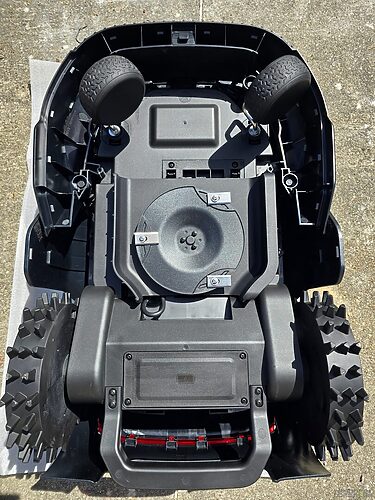
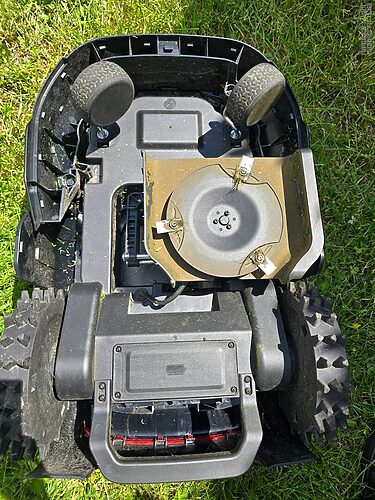
In actual use, the gain is quite visible. The robot can make a first pass on the edge, then a second with the shifted deck. On a passable edge, like a slab level with the lawn, it can overlap and cut almost flush. The result is excellent and avoids having to take out the trimmer.

Along a wall or vertical obstacle, there will inevitably be a small margin. That’s normal: the robot is not going to intentionally rub everywhere for fear of damaging itself. But you often go from a band of about 15 to 20 cm on some robots to a much smaller band. During tests, the robot really manages to leave very little grass to be retaken when the mapping has been done accurately.
This is undoubtedly one of the most convincing functions of the Lidax Ultra. It’s not an empty marketing promise. It is evident in practice.
Mowing quality: methodical and regular
The Mova Lidax Ultra works with organized trajectories. It does not move randomly like older robot mowers that bounced from one edge to another until they eventually covered the entire lawn.
Here, the robot follows a structured path, with parallel lines and methodical coverage. It slightly overlaps its passes to avoid missed strips. The result is neat and regular, with a real sense of controlled mowing.
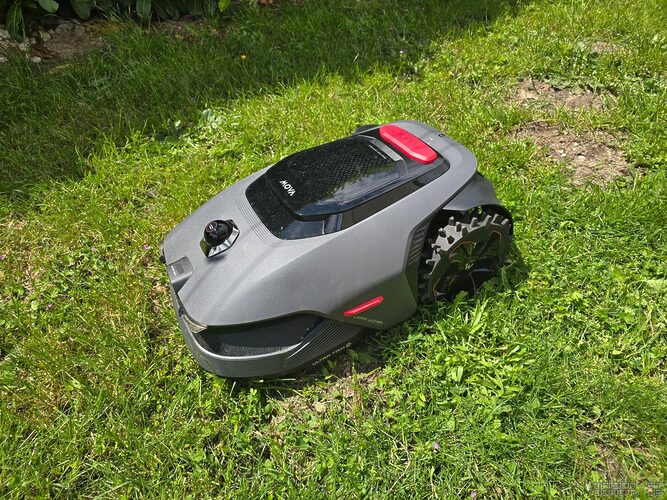
The cutting width is about 20 cm, which is standard for this type of robot. The three rotating blades do their job correctly. Even in slightly taller grass, the robot cuts cleanly, as long as you don’t ask it to turn a meadow into a golf green in a single pass.
As with all robot mowers, the Lidax Ultra is primarily designed for regular lawn maintenance. It cuts little but often. This regularity allows for a nice lawn. If the grass is very long, you may need to do a first cut with a traditional mower or set a higher height at the start, then gradually decrease it.
Operational silence
The robot is very discreet. Mova claims a noise level below 60 dB for this series.
In practice, you mainly hear the wheel motors and a slight cutting noise. Nothing to compare with a gas mower, of course, nor even with a traditional electric mower. So you can run it during the day without disturbing the neighborhood.
That said, even if it is quiet, it’s better to avoid running it at night. First, to protect small wildlife, especially hedgehogs. Then because visibility and detection are always more reassuring during the day. The robot has a camera and LiDAR, but a garden remains a living environment, with animals, forgotten toys, fallen branches, and displaced objects. Daytime remains the best choice.
Obstacle detection: very good, but not magical
The Mova Lidax Ultra combines LiDAR and AI camera. On paper, it can recognize over 300 obstacles and protect animals.
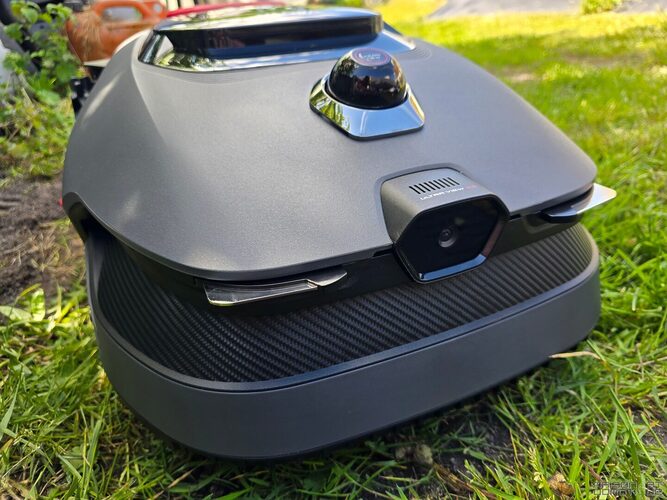
In practice, the detection is generally good. The robot detects large objects, people, animals, garden furniture, pots, chairs, tall or clearly visible obstacles. It slows down, stops, navigates around, and then resumes its work.
The app allows you to adjust the minimum height of obstacles to be detected and the avoidance distance. For example, you can ask the robot to keep 10, 15, or 20 cm of clearance around an obstacle. The larger the margin, the more secure it is, but the more small zones will remain uncut around the objects.
The camera also allows capturing photos of detected obstacles. It’s handy for understanding why the robot avoided a zone. In some cases, it can identify an animal, a person, or an object with a percentage of confidence. This is a function that we’ve already seen on some high-end robot vacuums, and it is starting to arrive in the garden.
But one must remain realistic: small, very low objects are still challenging. Thin garden hoses, socks, flat small toys, ropes, thin branches… depending on the color, height, position, and setting, not everything will always be detected. I experienced variable results with these small objects, with good reactions in some cases, but also misses on elements that are too low or too thin.
This is not unique to Mova. It’s a current limitation of many robot mowers. The best safety remains to tidy up the area before mowing, especially if children are playing in the garden.
Camera, live video, and patrol
The Lidax Ultra comes with a camera that not only serves for obstacle detection. It also allows real-time viewing from the app, and Mova highlights a patrol function called TrueGuard.
The idea is amusing: the robot can become a kind of mobile camera in the garden. You can check the image, verify a zone, launch a patrol, or receive an alert in case of human detection.

Is it essential? No. Is it practical? Sometimes, yes.
For example, if an outdoor alarm goes off, if you want to check that the gate is closed, or simply see what is happening in the garden while on vacation, the function can be handy. It should not be confused with a real fixed video surveillance system, which is more reliable, better placed, and operational 24/7. But as a supplement, it’s rather clever. Personally, I really like this function, and I regret that it is not widespread among all manufacturers, like Navimow, for instance.
The camera can also provide peace of mind when the robot works far from the house. You keep an eye on its environment, which is always nice with a device of this price that roams outside.
Management of narrow passages
Mova claims the ability to pass through passages of at least 60 cm.
In real use, two things need to be distinguished. Passing through a narrow hallway, yes, the robot can do that if the passage is well-mapped and sufficiently clear. Turning around in the same hallway is another matter.
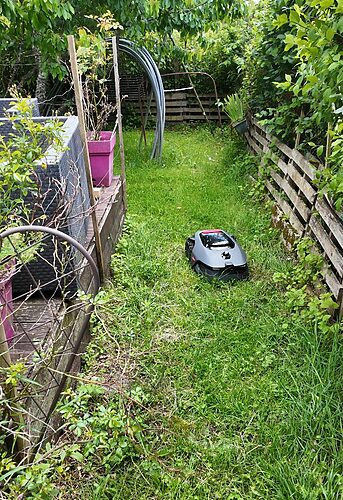
If the passage is long and narrow, you need to think about how the robot will enter, exit, turn around, and follow its path again. A 60 cm hallway may suffice for traveling, but not necessarily for maneuvering comfortably at the end. In this case, manual mapping and creating precise paths become very important.
Slopes and traction
The Mova Lidax Ultra is rated for slopes of up to 45%.
Its large knobby drive wheels clearly help it maintain traction. On wet or slightly uneven terrain, it performs well. It can overcome small obstacles up to 4 cm, allowing it to pass over certain irregularities, lightly marked roots, or small transitions between two surfaces.

But beware: the version tested here is not an AWD model. It has two driven wheels, not four. On an inclined or slippery terrain, a bit of slipping can be observed, especially during turns or repeated maneuvers.
This isn’t necessarily a nuisance on standard terrain. But if your garden has steep slopes, slippery areas, holes, roots, bumps, or complicated passages, you may want to look into an AWD model. Mova actually offers versions designed for this type of usage.
For a typical residential terrain, even slightly sloped, the Mova Lidax Ultra should suffice. For a very technical terrain, it’s best not to play the hero.
Battery life and mowing time
The tested Mova Lidax Ultra 1000 is designed for an area of up to 1000 m², but that doesn’t mean it will mow 1000 m² all at once. Like all robot mowers, it works, returns to charge, and then resumes where it left off.
This is an important function: if the battery runs low, the robot automatically returns to the station, recharges, and then resumes mowing exactly from where it stopped.
On the field, the robot is not the fastest on the market. It is methodical, cautious around edges, attentive to obstacles. This results in a nice mowing quality, but the total time can be long, especially on a large area with multiple zones, obstacles, and intermediate charges.
Is this a problem? Not really if the programming is well thought out. A robot lawn mower is not meant to mow like a gas mower on a Saturday afternoon in 45 minutes. It works alone, several times a week, while you do other things. That’s the whole point.
However, if you want a perfectly mowed lawn on 1000 m² in a minimum amount of time, you’ll have to accept that this type of robot operates differently. It’s continuous maintenance, not a big one-off mowing.
Power consumption
One can note a consumption of about 80 W during charging and a very low consumption in standby, around a few watts depending on whether the LED lights are activated or not.
In use, a robot lawn mower is generally very economical compared to the comfort it provides. The consumption will mainly depend on the area, number of mowings, charging duration, and frequency of use.
The app also allows managing personalized charging time slots. This is practical if you have a peak/off-peak contract, or if you want to avoid charges at certain times. For a house equipped with solar, you can also schedule mowings during production hours. There, we start to touch on a small optimization that pleases connected home enthusiasts ;-)
Safety and anti-theft
A robot lawn mower lives outdoors. Therefore, the issue of theft is important.
The Mova Lidax Ultra includes a PIN code, an alarm in case of lifting, and anti-theft functions.
When the robot is lifted, the alarm sounds, and you need to enter the PIN code to stop it. This is a good thing. On some older robots, it was sometimes possible to bypass the alarm too easily. Here, the behavior is more reassuring.
Be careful, to benefit from all the anti-theft functions (GPS position, full tracking), you will need the optional 4G module.

However, keep in mind that an alarm does not make a robot unstealable. It deters, alerts, complicates resale or use by a thief, but it does not replace common sense. If the robot is visible from the street, it’s better to place the station in a discreet area, activate all available protections, and if necessary, add an external camera or home automation.
Maintenance: simple, but essential
A robot lawn mower is not a completely maintenance-free device. It works outdoors, in humidity, dust, dirt, cut grass, sometimes in the rain. Therefore, it needs regular maintenance.
The Mova Lidax Ultra is rated IPX6, allowing for cleaning with a water jet, without high pressure.
You’ll need to monitor the blades, replace them when they are worn, clean under the robot, check the wheels, remove accumulated grass, and keep the sensors clean. The LiDAR and camera are the robot’s eyes. If they are dirty, navigation and detection can become less reliable.
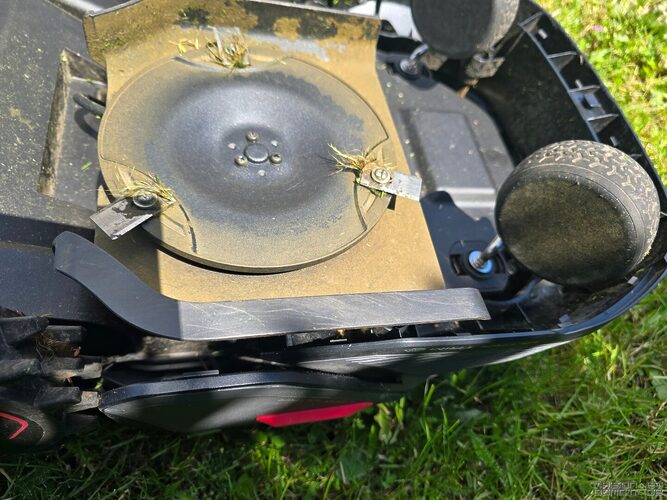
The screws of the blades also deserve a little attention. As is often the case with this type of system, if you wait too long before replacing them, they can wear out or get stuck. It’s better to change the blades and screws regularly rather than struggle with a damaged screw at the end of the season.
What it does better than many competitors
The first real strong point is the installation without cable and without RTK. For many users, this is the criterion that changes everything. No trench, no antenna, fewer placement restrictions.
The second is the precision of the LiDAR. In a terrain with hedges, walls, trees, or areas where RTK could be disturbed, this approach is very convincing.
The third is edge management. UltraTrim provides a real daily gain. It does not always entirely eliminate the need for a trimmer, but it clearly reduces the chore.
The fourth is the app. It is rich with many settings, without giving the impression of being hastily cobbled together.
Finally, the equipment/price ratio is very solid. At 999 € for the announced 1000 m² version at launch, you get a LiDAR robot, AI camera, multi-zone management, UltraTrim, live video, advanced mapping, and electronic cutting. It’s aggressive against many competitors.
For what type of garden?
The tested Mova Lidax Ultra 1000 is very suitable for residential gardens up to 1000 m², with one or more zones, hedges, flower beds, a few trees, edges, and moderately narrow passages.
It is particularly suitable for those who do not want to bury a cable, who do not want to manage an RTK antenna, or who have a garden where GPS reception may be complicated.
It will also be interesting for those who want to limit the finishing on the edges. If you have many walls, clean borders, or areas to edge, UltraTrim provides real comfort.
On the other hand, for a large, very open area, like a meadow without fixed obstacles nearby, an RTK robot may sometimes be more suitable. LiDAR needs reference points in its environment. Mova claims a range of up to 70 m, but in a large field that is very open, it’s not necessarily the ideal scenario.
For a very steep or very uneven terrain, you should also consider an AWD version.
Our opinion on the Mova Lidax Ultra 1000
The Mova Lidax Ultra 1000 is one of the most interesting robot mowers currently in its category. It successfully simplifies what was once tedious: installation, mapping, zone management, and regular mowing.
The LiDAR provides real precision. The app allows for extensive adjustments. The cut is clean. Edges are much better managed than on many classic models. And the absence of a peripheral cable completely changes the user experience.
There are still some limits, especially on small obstacles and difficult terrains. But for a standard residential garden, the compromise is excellent.
At 949 € for the 1000 m² version, the quality/price ratio is clearly one of its best arguments.
Conclusion: a very convincing robot lawn mower, especially for edges
The Mova Lidax Ultra 1000 checks many boxes: simple installation, precise navigation, comprehensive app, regular cut, good obstacle management, safety functions, and above all, a real improvement on edges thanks to UltraTrim.
It’s not a perfect robot. It does not like all small forgotten objects in the grass, it takes its time, and very steep terrains will benefit from the AWD versions. But to automate the maintenance of a garden up to 1000 m² without cable or RTK antenna, it clearly stands out as a model to closely consider.
This is the kind of product that makes you want to permanently leave the traditional mower in the garage. And that, for a robot lawn mower, is a good sign.


Please remain courteous: a hello and a thank you cost nothing! We're here to exchange ideas in a constructive way. Trolls will be deleted.