


Résumer cet article :
The subject of residential energy storage is booming, and I must admit that this field is extremely exciting! Every month brings a new innovation to push energy storage even further and help us achieve electrical autonomy. Of course, artificial intelligence plays a role, and the solution revealed today certainly benefits from it. This time it’s Ecoflow’s turn, a benchmark player in the field, which has launched two new stars: the Ecoflow Stream Ultra and the Ecoflow Stream AC Pro. Two solutions that do not just provide a bit more photovoltaic storage in the living room, but could well steal the show from all the classic inverters that are lying around in the cupboards. Let’s go for the presentation!
Unboxing the Ecoflow Stream Ultra and Ecoflow Stream AC Pro
You know that little excitement when opening a high-tech package?
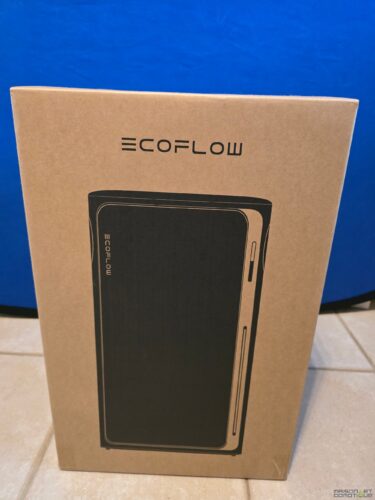
Here, it is clearly present. The boxes of the Ecoflow Stream Ultra and Stream AC Pro, quite massive but well protected, already inspire confidence from the first handling. No frills, but well-thought-out compartments and precise organization.
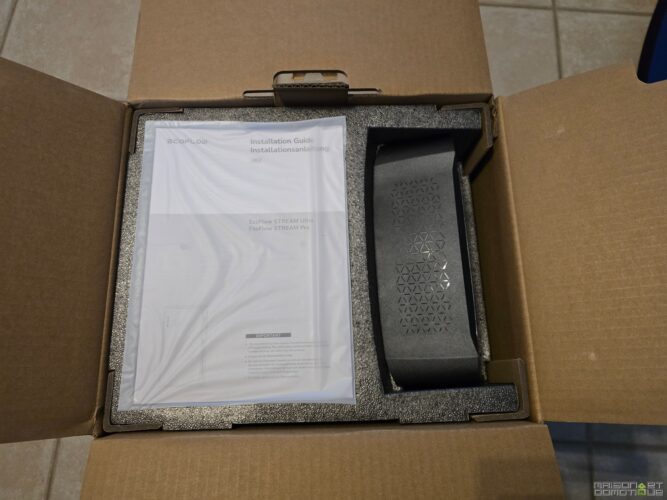
First step, we discover THE star: the battery itself. And there, surprise, the bulk is much less imposing than the photos suggested.
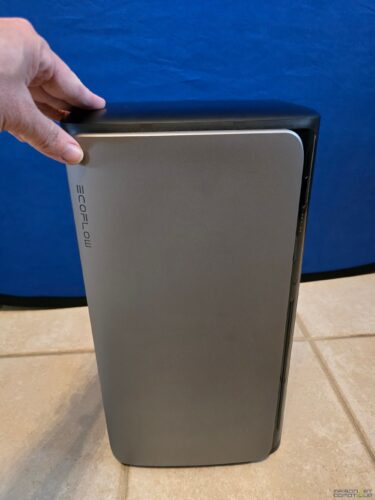
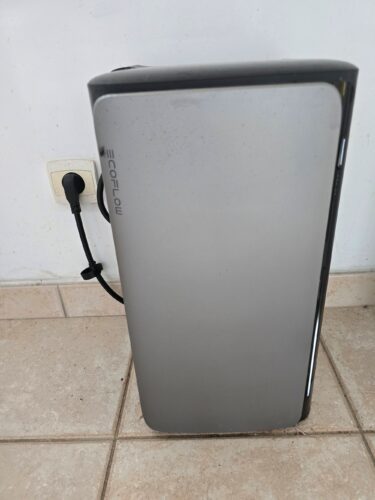
The Stream Ultra and the Stream AC Pro are designed on a vertical base, with a sleek silhouette. A totally different design from what the manufacturer is used to, but it allows for less floor space.
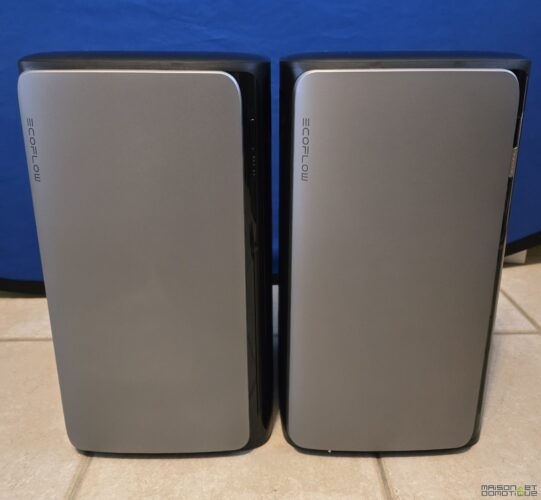
They display a clearly industrial but discreet design, with very high-quality matte plastic finishes, enhanced with metallic touches.
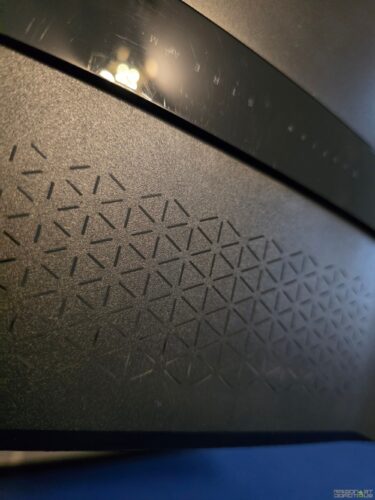
It’s robust, it’s dense (more than 20 kg each, after all), but the handling is smooth thanks to ergonomic handles molded into the mass, nicely wide, placed at the upper ends. Practical when you want to move the beast from the living room to the technical room without hurting your back.
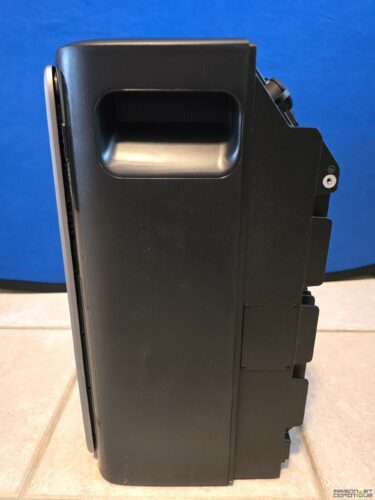
The format remains surprisingly compact: expect about 45.8 cm high with less than 29 cm deep for the Ultra, perfectly fitting under a worktop or in a modern pantry, even if, let’s be honest, one inevitably wants to display it a little to show off in front of tech-savvy friends.
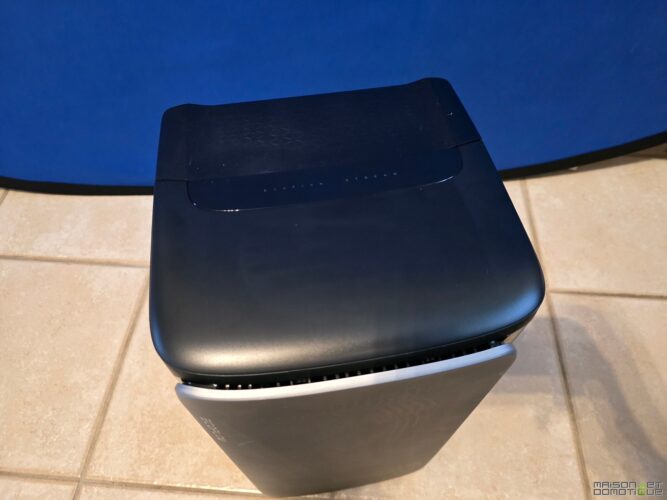
On the front, sobriety dominates: a wide LED status bar (the famous “status in 3 glimpses”!), ultra-readable, indicating the charge, energy flow, and various alerts. The connections are all grouped together, perfectly labeled to avoid any mishandling, with a cover or closure system on the AC sockets for added safety.
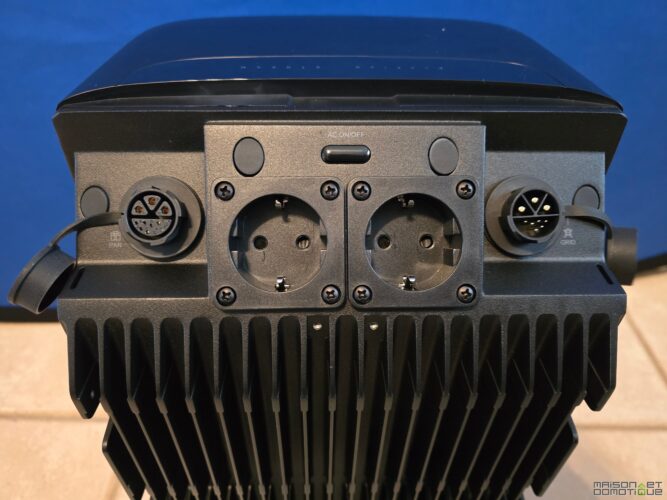
Speaking of connectivity, the Ecoflow Stream Ultra is impressive. We find:
- Two type E/F AC sockets with child protection, neatly integrated into the front, with enough space for angled or bulky plugs.
- A dedicated solar input port, which can accommodate up to four independent connections (with clearly identified and lockable connectors).
- An AC socket via a proprietary cord, for injecting energy into the house
- A main switch, with a nice click, just the way we like it (impossible to miss it in the dark during a power outage).
The Stream AC Pro, for its part, exactly retains the structure and design of the Ultra, with the notable subtlety of the absence of solar input ports. Instead, there is a reinforced AC port for charging, and an expansion port intended for cascading other Ecoflow batteries or connecting to a third-party ecosystem. The rest is identical: same sockets, same LED bar, same accessibility.
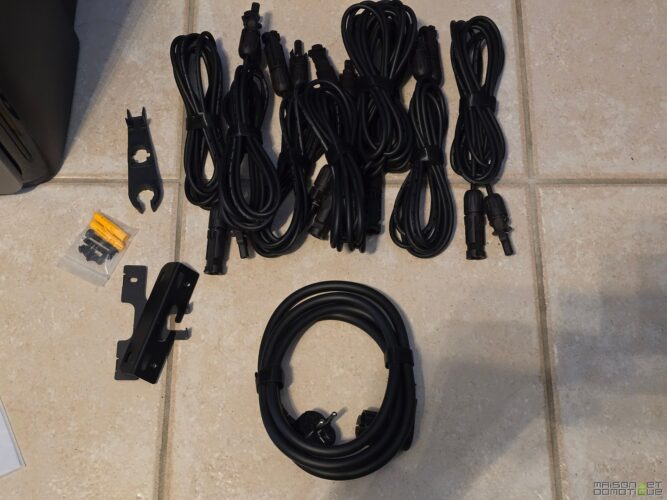
In the box, Ecoflow did not skimp on accessories. Each box contains:
- A complete set of cables: robust AC cable (oversized compared to actual consumption), suitable extensions, and grounding cable.
- A wall or floor mounting kit, with screws and anchors (if you’re the type to want to fix your battery like a radiator, Ecoflow has thought of everything).
- A beautifully illustrated multilingual manual. Special mention for the connection diagrams, readable by everyone, even on a Monday morning.
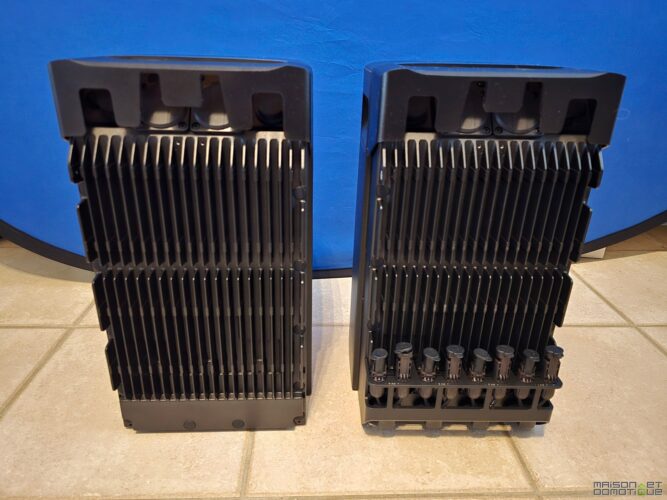
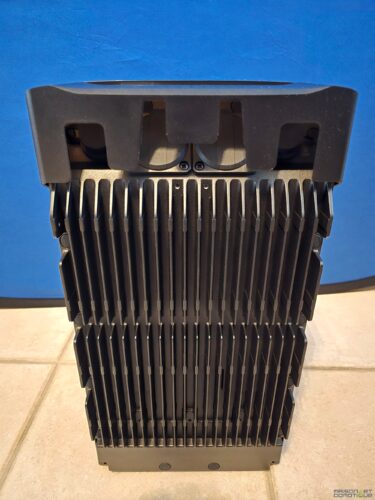
At the back, we notice the presence of multiple cooling fins, perfectly integrated. The absence of noisy mechanical ventilation, replaced here by a passive system, is immediately noticeable once powered on: we are in total silence, even when pushing the battery to its limits.
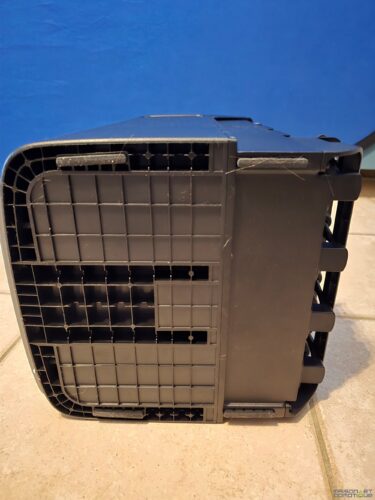
A small detail: the presence of wide and sturdy non-slip pads ensures very good stability for the whole, practical when the floor is not perfectly flat or during somewhat rough handling.
On the branding side, the Ecoflow logos are discreetly affixed to both models, no big advertisement effect but just enough to show the pride of a premium technology.
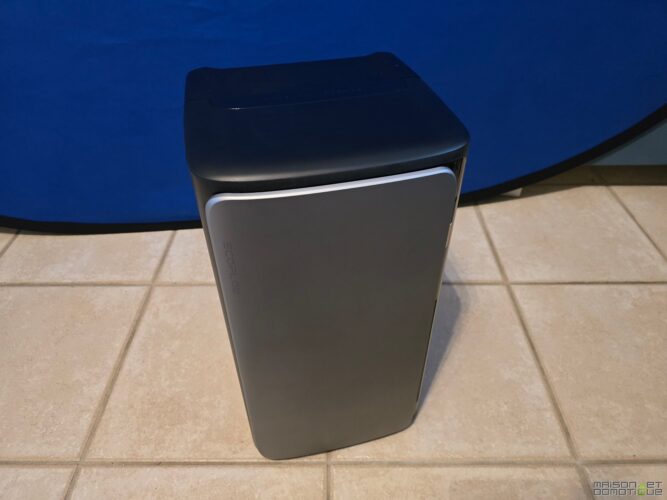
In short, unboxing the Stream Ultra and AC Pro, we immediately feel the care taken with every detail, from the pro-quality accessories to the overall design thought out for the user who wants to plug in, move, install, all without a thousand questions. Ecoflow strikes hard on this part: it’s not just a battery but truly an object that one displays and handles with pleasure. Personally, I love this design change!
Technical comparison and differences between the Ecoflow Stream Ultra and AC Pro
Under the hood, both batteries play the tight duel card. Both adopt LiFePO4 chemistry (LFP for the insiders), a guarantee of longevity (at least 6,000 cycles with 70% capacity remaining). Both are equipped with a 1,200W hybrid inverter to power two AC sockets, but it’s on inputs and solar flexibility that the Ecoflow Stream Ultra gains the advantage.
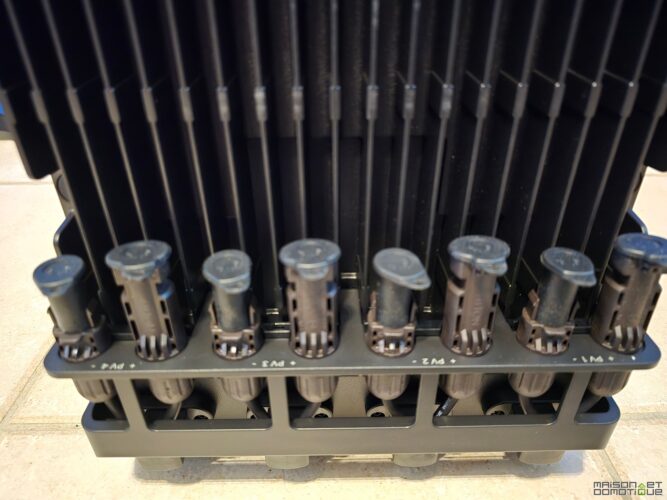
The Stream Ultra offers four MPPT solar inputs, capable of taking up to 2,000W of photovoltaic panels (4x500W). It can even climb to 3,200W input via compatible micro-inverters. The AC Pro, for its part, does not manage direct solar input: it acts as an extension module, ideal if you want to push the capacity on the network or if your solar panels already have their own integrated micro-inverter. For practical work: by combining up to six batteries (AC Pro or Ultra), one can reach 11.52kWh of storage and a total power that can start giving cold sweats to your EDF subscription.
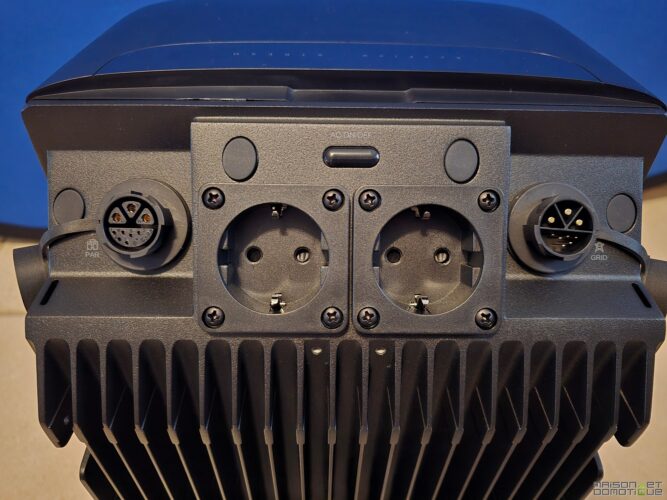
Note that both models offer a self-boost function, allowing temporary peaks of up to 2,300W output without tripping the meter. Perfect for the peak of a heat pump starting up or the kick of a stubborn vacuum cleaner.
Synthetic tables of main characteristics
| Model | Capacity | Solar Inputs | Continuous AC Power | Peak AC Power | Weight | Dimensions | Protection Index | Warranty |
|---|---|---|---|---|---|---|---|---|
| Ecoflow Stream Ultra | 1.92kWh | 4 x 500W (MPPT) | 1,200W (2x AC) | 2,300W | 23kg | 255x458x284mm | IP65 | 10 years |
| Ecoflow Stream AC Pro | 1.92kWh | None | 1,200W (2x AC) | 2,300W | 21.5kg | 255x458x254mm | IP65 | 10 years |
Configuration of the Ecoflow Stream Ultra and Ecoflow Stream AC Pro
We are now entering the easy part. Honestly, for someone used to juggling with temperamental wifi routers and home automation modules, the configuration of the Ecoflow Stream Ultra and Stream AC Pro is a piece of cake… But rest assured, for others it won’t be very difficult either. Ecoflow has really thought about its products for the general public.
As soon as we install the battery in its place (living room, pantry or tucked away on the balcony), you just need to grab a smartphone and launch the Ecoflow app. There, big surprise: automatic detection operates via Bluetooth if the battery is powered.
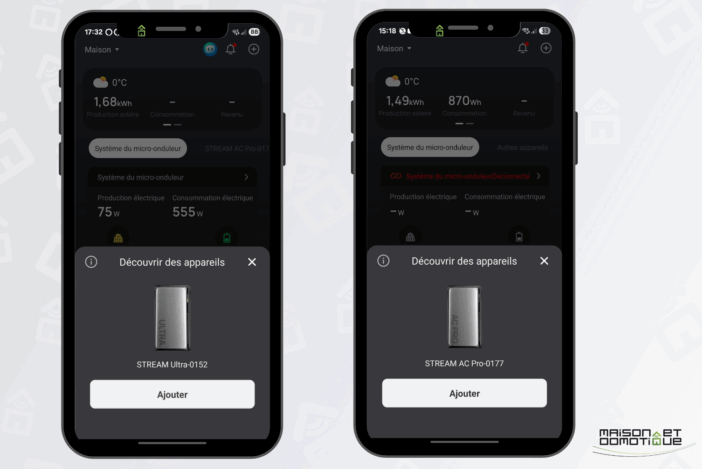
You input the Wifi to join (in 2.4GHz), give them a name, place them in a room (or installation), and proceed with updates if there are any.
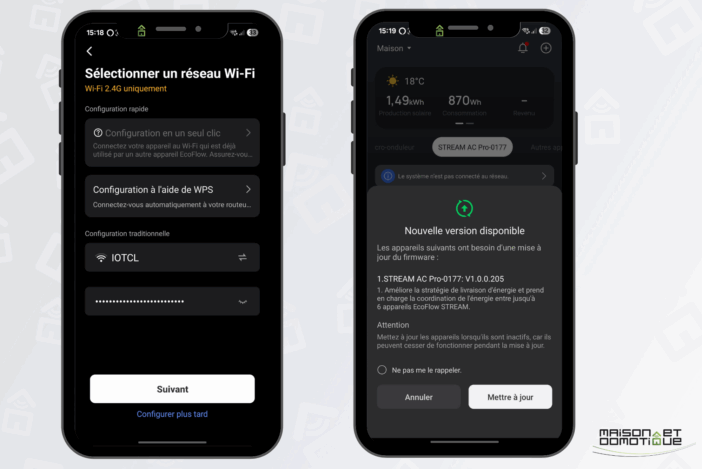
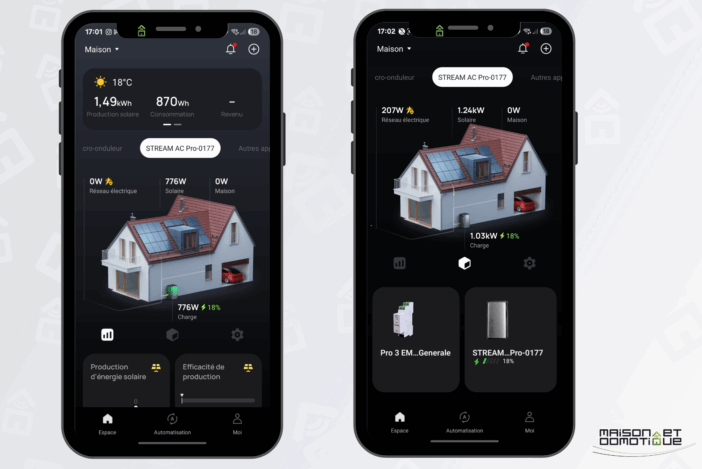
In less than a minute, both models appear in the app, with all characteristics at a click away: charge status, energy flow, history, advanced settings.
The connection of the Stream Ultra starts with connecting the solar panels. The MPPT solar connectors are clearly marked.
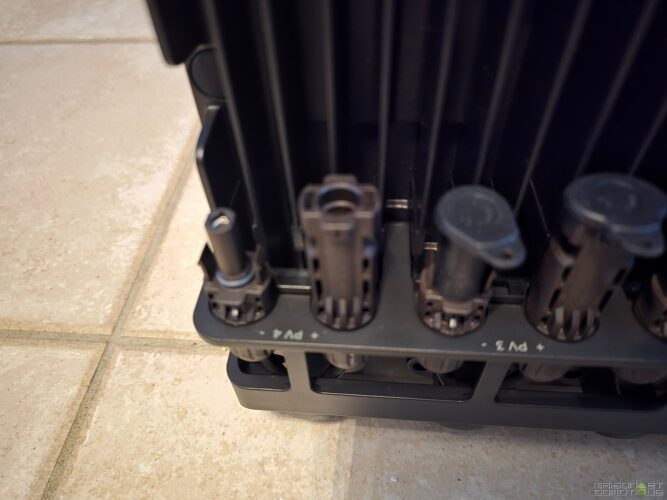
Male plug, female socket, click, impossible to go wrong. The terminals are protected by soft covers: zero risk of doing it wrong, even if you handle the cables with lumberjack hands. You can go up to four panels, in mono or multi-orientations, for optimal flexibility. Then, the AC plug: it connects like a regular household appliance. Really nothing complicated.
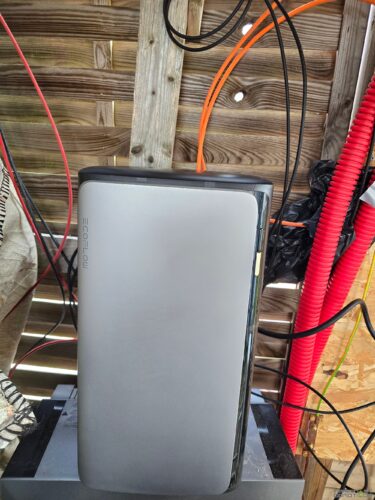
On the Stream AC Pro side, it’s the plug-and-play mode that prevails. You grab the AC cable, plug it into a household socket, and voila, the battery is already operational. No solar connection to foresee! Here, the emphasis is on maximum simplicity for those who just want to enjoy storage and charge transfer without modifying their existing installation. Honestly, it’s the dream for users who don’t want to touch the panels or calculate voltages by hand.
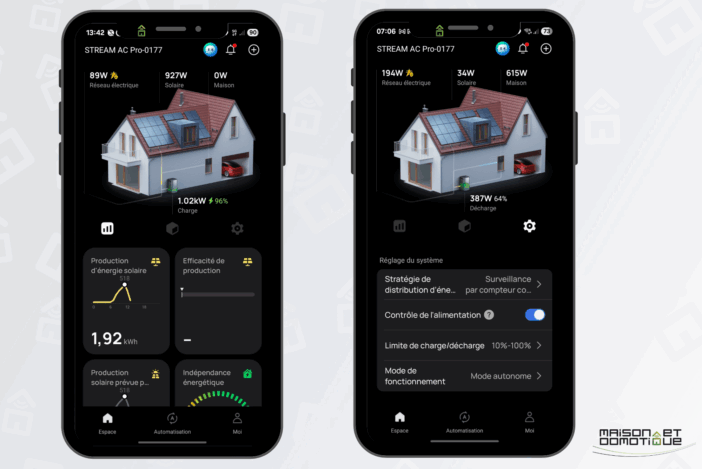
At launch, the app asks to select the mode of use: there’s the classic “automatic storage and restitution” to fully enjoy self-consumption, but also smart management based on schedules, weather, or even the price of kWh (the app communicates with the Nord Pool or Epex Spot electricity market to charge/discharge at the best time if desired). It’s also possible to create your own scenarios, for example, to only discharge the battery between 6 PM and 10 PM, or to only activate on days when the weather promises sunshine.
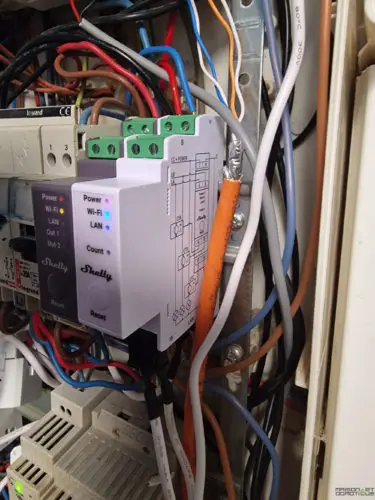
Of course, we find automatic management via the Ecoflow meter, or Shelly, as we have already seen in previous tests. This device allows automatic detection of consumption or electricity overproduction, which then enables the Ecoflow system to adapt accordingly.
The app is full of little options that make a difference: setting a safety threshold to never drop below 20% (super useful to keep a reserve, like powering the fridge in case of a power outage), turning on/off the “auto-boost” function to deliver a peak of 2300W to power-hungry devices, or even remotely monitoring what’s happening at home when you’re out and about. And it’s of course possible to receive push notifications for every key event (start of charge, switch to backup, consumption peaks…).
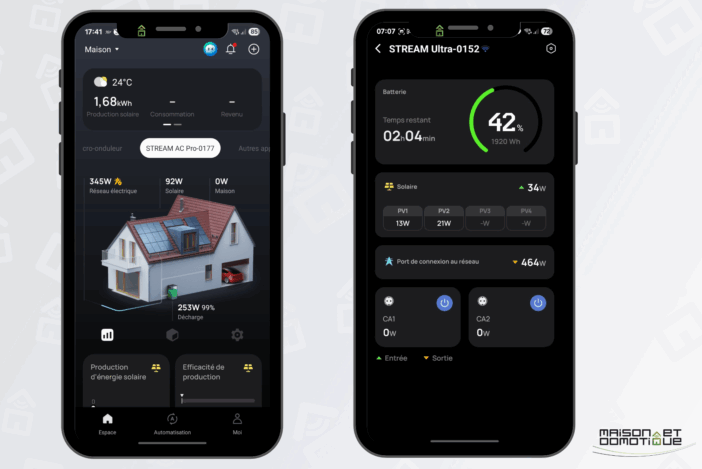
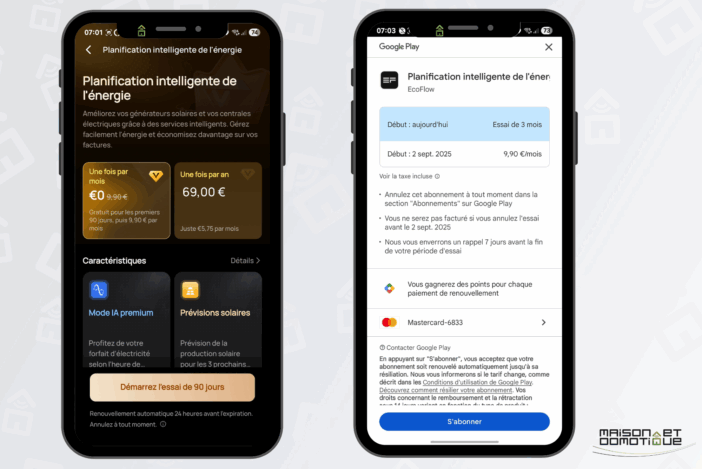
The good surprise is that all this configuration remains fun: you never feel like you have to earn a renewable energy engineer diploma to start the system. For those who like to play the optimization card, the Oasis AI module (optional and paid, of course, at €69 per year, but with 3 months free to test) relies on weather, forecasted consumption, and dynamic pricing to adjust real-time charging/discharging. With this module, you feel a bit like the invisible conductor of domestic electrical flows!
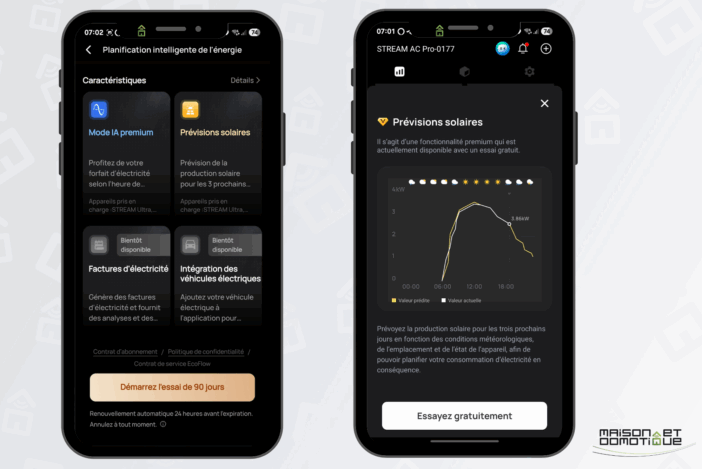
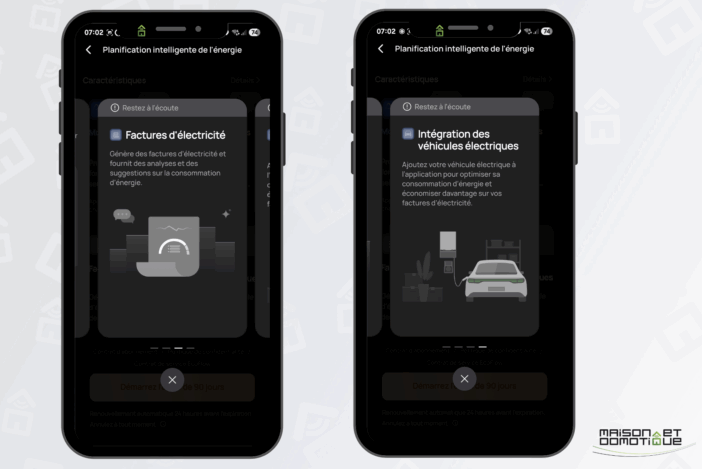
Need to go even further? The multi-battery configuration (up to 6 units connected in series) is done in a few minutes: the app offers a step-by-step guide to pair additional modules, manage their charging priority, and balance flows between the different Streams. And the interface is frankly intuitive: a dashboard allows you to visualize everything at a glance, with the possibility of acting on each battery individually. Practical when one battery powers the cellar and the other is dedicated to the office, for example.
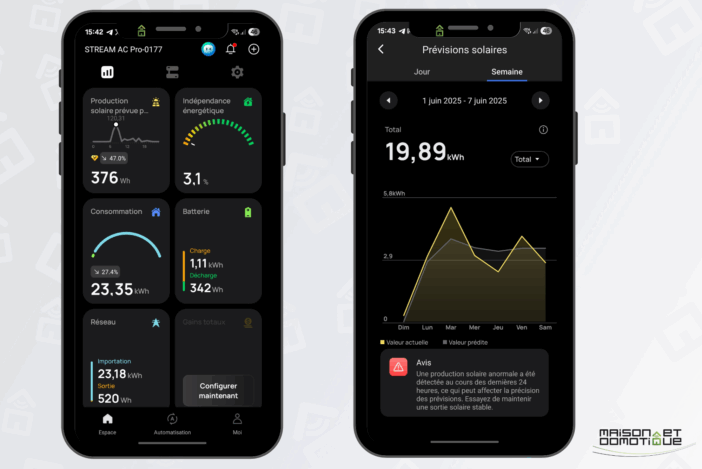
Last detail, but not the least: the software update. Both batteries frequently receive updates to fix bugs or add new functions; all this is done over the air, via Wi-Fi, without any cable to connect.
In short, from the first connection to advanced settings, the configuration of the Ecoflow Stream Ultra and Stream AC Pro is a stroll in the park that makes you want to explore all the corners of the app… even if it means spending a little more time than expected, just for the pleasure of supervising everything like a pro.
User feedback: the test of facts, at home and in daily life
No matter how much one pores over technical specs and spends hours reading lab tests, nothing replaces the shock of real life. Let’s say that the Ecoflow Stream Ultra and Stream AC Pro have faced all the elements… and all the family moods! A little trip on the ground, where numbers confront the reality of bulbs heating up and children always forgetting to turn off all the lights.
The Ecoflow Stream Ultra: the everyday power center
I started strong on the first day with the Stream Ultra: connecting to two 400W solar panels, AC socket for safety, and washing machine plugged in right away. First observation: the battery and its inverter handle the charging surges of these “tricky” devices without flinching, especially during startup peaks. Even the dryer, known for its bursts of power, couldn’t shake it. Whether to absorb surplus solar power or inject energy into the house in the evening, everything is controlled precisely. And we follow the charge/discharge curve in real-time in the app, a real treat for curve-obsessives.
A typical day? Early in the morning, the Stream Ultra, charged overnight during “off-peak” hours, begins powering breakfast: coffee maker, toaster, lighting, the whole crew runs without drawing from the grid. Around noon, the photovoltaic panels are supplying well and filling the battery without a hitch. In the evening, as the sun slides below the rooftops, the battery takes over for the recharging round: phones, electric bikes, the mini-oven for pizza… nothing is missing! And if there’s a bit of charge left overnight, the Stream Ultra ensures the operation of the box and fridge without a hitch.
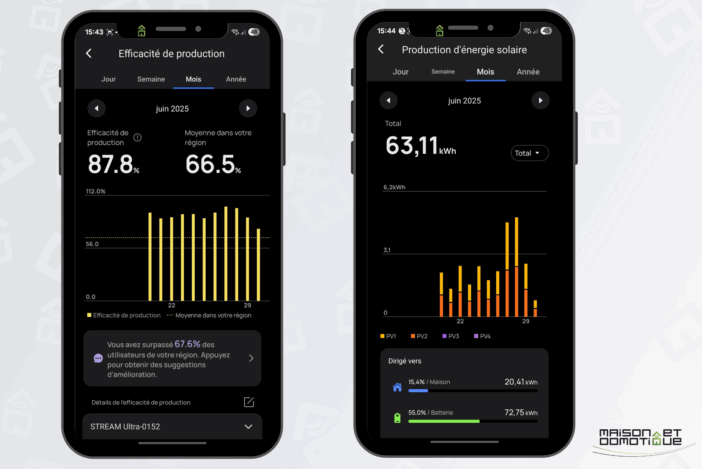
Where it truly stands out is in the fine management of flows and modularity: at any moment, you can decide to keep a reserve, or use 100% of the stock to aim for total autonomy. One Sunday, I really pushed the limits: plugged into a dedicated socket, our dishwasher started simultaneously with the TV and my gaming PC… and no alerts, no cuts! Impressive. For the most extreme users, it’s enough to stack two, three, or six batteries, and the house can almost last an entire day without calling on the conventional grid (except for the water heater or air conditioning, there are limits after all).
Stream AC Pro: the lazy (but clever) solution to capture every watt
On the balcony, or even in the living room, the Stream AC Pro is hardly noticeable. Simply plugged into a circuit socket, it gently absorbs all the surpluses from two micro-inverters. No configuration (other than defining operating hours and reserve in the app)… Honestly, it’s the ultimate plug-and-play, ideal for those who want to capture every stray kWh without fiddling with solar connections every morning in the early hours. Do you already have a Beem On solar station or Sunflower panels on the balcony? No worries, you plug in the Ecoflow Stream AC Pro into an electrical outlet, it takes care of collecting the slightest production surplus to store and return it later.
What’s surprising is the speed of switching between the grid and the battery. Typically, at the slightest variation in production or consumption, the battery instantly adjusts the flow: whether the family starts the oven or solar production drops behind a cloud, it manages the transition without cutting or micro-cuts, even for sensitive equipment like computers or the internet box. I intentionally simulated a power outage one evening when the battery was fully charged: neither seen nor known, the whole living room kept running in “island” mode.
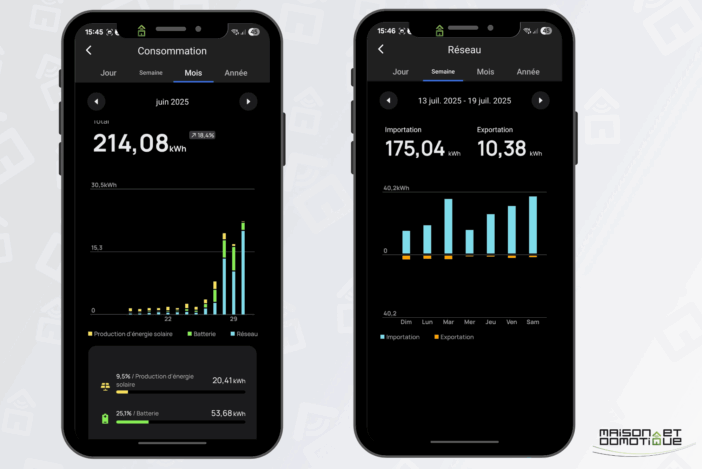
Another point, the multi-battery management offers beautiful prospects: in cascade, the capacity climbs to 11.52kWh. You can then assign each battery for a specific use: one for the living room, one for the office, one for the little one’s room. The app then allows you to juggle priorities, distribute discharge, or schedule charging when prices drop. Perfect for those who love dynamic pricing!
Environment, mold, and weather whims: real-world testing
I dared to tempt fate by placing the Stream Ultra outside for several days (terrace in the shade at 5°C in the morning, then full sun at +32°C in the afternoon). Verdict: no slowdown, no errors. The IP65 index is not just for decoration: despite dust, light rain, and even a memorable gust of wind, the battery never faltered, nor showed signs of humidity inside. The Stream AC Pro produced equally conclusive results after a stormy night followed by a dusty day like the wild west.
Finding on smart management: Oasis AI, notifications, usage report
Where I really enjoyed myself is in the semi-automatic management offered by the Oasis AI. The app, once subscribed, allows for true customization: priority charging before an anticipated heat spike, draining the battery as soon as the EDF buyback rate soars, or maintaining a reserve for the essential fridge all night. I even saw a weekly report pass by with the autonomy score, the solar usage rate, and suggestions to further optimize programming.
The notifications are relatively precise: you know when the battery reaches its low limit, when a recharge is planned (or has failed), and even when a weather event likely to influence production approaches. One quickly gets caught up in the game of being the “little conductor of energy”, trying to maximize autonomy and beat your own record of days without pulling a single kWh from the grid!
The energy report after a month of real usage
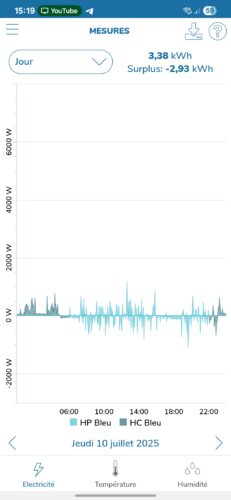
Two months of testing is enough to get a solid idea. In my case, the Stream Ultra allowed me to cover almost 70% of daytime consumption for all the appliances “except the water heater”, thanks to the dual solar/grid input and impeccable responsiveness. The Stream AC Pro absorbed up to 2.5 kWh/day of surplus, returned right when the family came bustling in hungry at dinner time. Result: the electricity bill dropped, the self-consumption rate exceeds 80% on “good” days (and even 95% in spring!), all without any impact on comfort.
Existing limits
Of course, it’s also necessary to talk about frustrations. Despite the announced power, as soon as you draw strongly on two very power-hungry devices simultaneously (oven + dishwasher or heat pump for example), there can be a lag of a few seconds where the battery caps at 2300W and prioritizes one at the expense of the other. This is rarely annoying, but it’s good to know before scheduling the laundry and roasting at the same time.
The Ecoflow app does the job well for basic management (visualization of flows, priority management, various alerts), but it’s not without flaws, especially if you are a home automation integrator at heart. I would have liked better integration with Home Assistant or Jeedom: today, home automation control remains limited via the official app, without a real declared API. For regular usage, it works fine; for home automation geeks, patience will be needed (but there’s hope given the works of some!). Finally, the AI module only reaches its full potential with the paid option, which may deter subscription-averse users.
However, for 98% of common uses, the app perfectly fulfills its mission: automatic startup, backup scenarios, remote diagnostics… it’s a joy (when you love monitoring your consumption between two coffees). The solution has been designed for the general public, so we can say that the goal has been achieved!
Robustness and lifespan: peace of mind guaranteed
Capacity, power, automation… but what about longevity? Both models proudly boast their 6,000 cycles guaranteed at 70% capacity, and EcoFlow offers a 10-year warranty, which is quite rare in the category. The IP65, as noted, allows for outdoor installation without cold sweats (balcony, terrace, technical room, no fear!). In practice, during testing, no power latency, no drop in capacity to report over the entire evaluation period. We’ll talk about it again in 10 years!
Conclusion
The Ecoflow Streams are perfectly tailored for those who want:
- To optimize every solar watt without DIY, nor aesthetic compromise;
- To take the plunge into storage without modifying the entire electrical installation;
- To manage the home “in 21st-century mode” from the app with a precise view of consumptions, weather, and even the grid;
- To manage their consumption peaks while avoiding blowing the meter (or the wallet).
In practice, these batteries have not radically transformed my energy routine… they have totally streamlined it. We move from abstract profitability calculations to concrete satisfaction: seeing the app display “total autonomy, 0 kWh purchased from the grid” is priceless. You have to experience it to realize how technology can, sometimes, truly change the dynamics of daily life.
If I had to keep a single expression, I would actually opt for “game changer”. The Ultra shines for the autonomy of a household that wants to maximize its solar self-consumption while remaining flexible and scalable. The AC Pro, on the other hand, plays the robust reinforcements to absorb surplus without asking anyone anything. Placed on a balcony or in a cellar, they change the dynamics of residential energy management and usher plug-and-play solar into a new, fun, efficient, and truly accessible era.
We can finally stop getting angry about the skyrocketing kWh and devote our savings to more… high-tech pleasures (hey, why not an extra scooter for the kids). Ecoflow Stream Ultra and Ecoflow Stream AC Pro: two solutions that finally make solar, simplicity, and serenity rhyme.
These new products are available on Amazon, but also on the official Ecoflow store, which has the advantage of offering various packs with one or more batteries, as well as solar panels if needed.



Please remain courteous: a hello and a thank you cost nothing! We're here to exchange ideas in a constructive way. Trolls will be deleted.