
The plug-and-play solar system takes it to another level with this 30 kWh Anker battery

Résumer cet article :
The residential solar storage market is heating up. After Zendure, EcoFlow, Bluetti, and Marstek, it’s now Anker SOLIX’s turn to add a piece to the puzzle with its new Solarbank 4 E5000 Pro. This time, the manufacturer is not settling for a minor cosmetic evolution.
Officially presented this week in Germany, the Solarbank 4 Pro marks a real shift in scale for so-called “plug-in” or “plug-and-play” solutions. We are talking about a battery with a 5 kWh capacity, capable of handling up to 5,000 W of solar input, managing up to 12 solar panels, injecting up to 2,500 W into the home installation under certain conditions, and increasing to 30 kWh of capacity with additional batteries. Anker also announces a lifespan of up to 10,000 cycles, a 100% discharge depth, Home Assistant compatibility, a 10 ms UPS function, and intelligent management via Anker PowerOS.
In short, we’re no longer talking about a small solar kit for a balcony that powers a fridge, an internet box, and a few standby devices. Anker is clearly looking to push plug-and-play solar towards something much more ambitious: a true energy management brick for the home.
A Solarbank 4 Pro designed to exceed the classic 800 W limit
Until now, plug-and-play solar kits had a significant advantage: their simplicity. You plug in the panels, connect the inverter or battery to an outlet, and the energy produced helps reduce the baseline consumption of the home. Perfect for absorbing the electricity draw, which refers to the permanent consumption of the house: refrigerator, internet box, mechanical ventilation system (VMC), standby devices, home automation, NAS, etc.
The problem is that this approach quickly hits a limit: the famous 800 W injection limit through a household outlet. For a small kit, this is not an issue. But as soon as you add multiple panels, a large battery, or even an electric car, a heat pump, or energy-hungry devices, this limit quickly becomes frustrating. This is precisely the point Anker aims to address with its PluginPower 2.0 technology.
In standard mode, the Solarbank 4 Pro can still operate as a classic solution. It connects to the household circuit via a Schuko socket and injects up to 800 W, without heavy modifications to the electrical installation. This is the simple, accessible mode that allows for quick start-up and covers the basic needs of the household.
But the novelty lies in the second mode. With PluginPower 2.0, TÜV certified according to Anker, the Solarbank 4 Pro can increase to up to 2,500 W of grid injection. This mode requires a dedicated circuit, verification of the installation, and the intervention of a qualified electrician. The idea is simple: continue to maintain a setup that is more accessible than a large traditional photovoltaic installation, while allowing for greater exploitation of the energy produced by the panels.
This is where the product becomes truly interesting. With 2,500 W available, we are not just talking about offsetting the baseline consumption. It can start powering a good portion of the common uses in the home: washing machine, dishwasher, oven during operational phases, computers, lighting, multimedia, small heating or air conditioning equipment depending on the situation. Anker estimates that this power can cover up to 95% of the typical daily electrical needs of a household, excluding major appliances like an electric vehicle charging station, a powerful heat pump, or an electric water heater.
However, caution should be exercised on this point. “Covering 95% of appliances” does not mean making a house 95% autonomous year-round. It primarily means that the 2,500 W capacity allows powering the majority of common appliances, as long as the solar production and the battery are sufficient. The distinction is important.
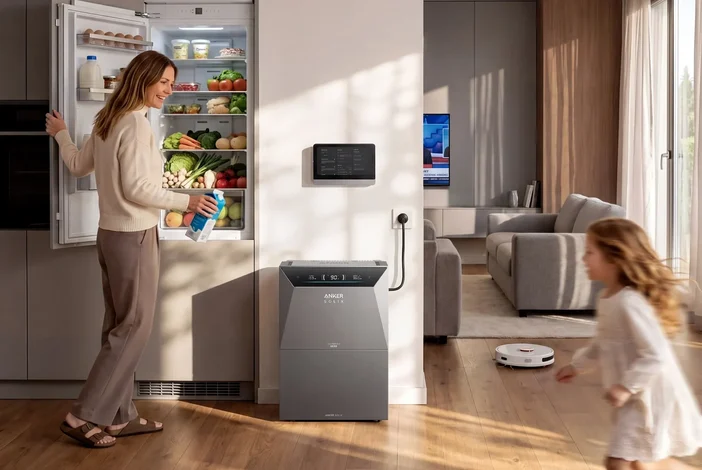
5,000 W solar input and up to 12 connected panels
The significant upgrade in this Solarbank 4 Pro is particularly evident on the solar input side. Anker integrates four MPPT trackers, capable of absorbing up to 5,000 W in total. Each MPPT can handle up to 1,250 W, allowing for the connection of up to 12 solar panels to the system.
This is three times more than many classic plug-and-play systems, often limited to four panels. And in real life, this is far from being trivial.
With four independent MPPTs, it becomes possible to spread the panels across several orientations: east, south, west, or even roof and façade. Instead of having a sharp production peak at noon, we can smooth production throughout the day. An east-facing panel will produce more in the morning, a south-facing panel will give its maximum around noon, and a west-facing panel will extend production into the late afternoon. For self-consumption, it is often smarter than concentrating everything at the same time.
During the presentation, the manufacturer even cited the example of installing 12 panels of 500 W, totaling 6 kW of installed power, even if the system can only handle 5 kW of effective input. In a configuration with multiple orientations, this over-sizing makes sense because the panels almost never all produce their maximum power at the same time.
This is an approach already seen in more traditional residential solar installations: one accepts to slightly over-size the panels relative to the inverter, as this improves production early in the morning, during cloudy weather, or at the end of the day. For a plug-in battery, it’s rather clever.

A 5 kWh battery from the base unit
The other figure that changes everything is the capacity. The Solarbank 4 E5000 Pro comes directly with 5,000 Wh, or 5 kWh. To put this into context, this is already more than some complete balcony batteries with extensions. Anker indicates that a base unit can be enough to power a typical household during the night, depending on the actual consumption of the dwelling.
In practice, 5 kWh already allows for quite a lot. If the house consumes 300 W continuously in the evening and during the night, this represents more than 16 hours of theoretical power supply. With an average consumption of 500 W, it remains around 10 hours. Of course, one must account for conversion losses, reserve settings, weather conditions, and the fact that not every day allows for completely filling the battery.
But this base capacity changes the logic. With a smaller battery, the aim is mainly to smooth production over a few hours. With 5 kWh, one can start thinking in terms of a full day: producing strongly during the day, storing excess, and then providing power in the evening when the panels are no longer generating.
The Solarbank 4 Pro can then receive up to five BP5000 extension batteries, each also with 5 kWh capacity. This results in a maximum capacity of 30 kWh for a single “round” of the Solarbank 4 Pro.
30 kWh is enormous for a solution from the plug-in universe. For a well-equipped house, this could represent a very comfortable reserve to absorb a large solar production, smooth consumption over several partially covered days, or optimize off-peak hours and dynamic rates.
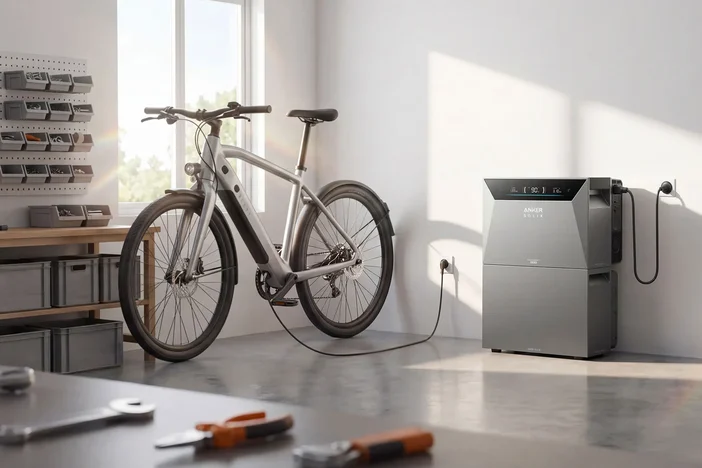
A modular architecture that can go much further
The Solarbank 4 Pro is not only designed as an autonomous battery. Anker also positions it as a component of a larger ecosystem, particularly with the Power Dock.
According to the information presented during demonstrations, the Power Dock will allow connecting up to four Solarbank 4 Pro systems. Each system can reach 30 kWh, so the whole could potentially achieve up to 120 kWh of storage. In terms of power, with four units capable of delivering up to 2.5 kW each, we achieve 10 kW of AC power. In terms of solar, four units at 5 kW input provide up to 20 kW of photovoltaic input.
Here, we clearly leave the world of solar balconies. We enter into a scalable residential power plant approach. The advantage is to be able to start small and then scale up gradually. Two panels today, six panels tomorrow, an additional battery later, and possibly a dedicated connection and a Power Dock if needs explode. This is a very interesting approach for those who do not wish to immediately invest the budget for a complete solar installation.
Anker also announces compatibility with its future EV Charger, which opens up scenarios around electric vehicles. Again, it will be necessary to see how this will all be managed in France, according to connection rules, permitted powers, and electrical installation types. But on paper, the system is beginning to resemble a true domestic energy platform.
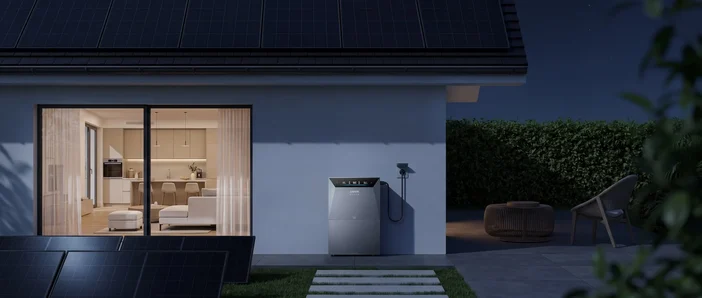
2,500 W output, 3,600 W in bypass, and a UPS function in 10 ms
The Solarbank 4 Pro incorporates a 2,500 W bidirectional inverter. This is a central point since it enables the battery not only to inject energy into the home but also to be recharged from the electrical grid. This grid recharge can become very useful with a peak/off-peak contract, a Tempo rate, or a dynamically priced supplier.
In the presentation, it was shown that the battery can be recharged via the grid up to 2,500 W, which would theoretically allow filling the 5 kWh of the main unit in about two hours.
Anker also plans to have a direct output socket on the device. In backup mode, this output can provide up to 2,500 W. In bypass mode, when there is still a connection to the grid, the available power can rise to 3,600 W, with part coming from the battery and part from the grid. This is handy for momentarily powering a high-energy device, while still keeping a margin when the battery alone isn’t sufficient.
Another important function is the UPS mode. In case of a power outage, the Solarbank 4 Pro can automatically switch to battery mode in 10 ms via its offline port. The goal is to maintain power supply for essential devices: internet box, router, NAS, lighting, freezer, computer, security system, or even some home automation devices.
However, please note: having a backup output on battery does not automatically transform the entire house into a backed-up installation. To power complete circuits, an appropriate installation, protections, compliant wiring, and, again, a qualified professional are necessary. But for critical devices connected to the dedicated output, the function is clearly interesting.
LFP 314 Ah cells announced for 10,000 cycles
On the battery side, Anker relies on automotive-grade LFP 314 Ah cells. Lithium-iron-phosphate chemistry has become the reference in this type of residential storage because it offers good thermal stability, a long lifespan, and a reassuring safety level.
The manufacturer claims up to 10,000 charge cycles, an estimated lifespan of about 15 years, and a discharge depth of 100%. In short, Anker indicates that the entire capacity can be utilized without artificially reserving a large part of the battery to preserve its longevity.
This is a figure to watch during tests because 10,000 cycles place the Solarbank 4 Pro at the top of the range. Many home batteries typically announce around 6,000 cycles. With daily use, 10,000 cycles would represent more than 27 years based on one complete cycle per day. In practice, Anker’s indicated lifespan remains at 15 years, which is already consistent with real conditions: temperature, discharge depth, charge intensity, calendar aging, etc.
The system also benefits from a 10-year warranty, an IP66 rating against dust and powerful water jets, a C5 corrosion protection certification, and an operating range of -20 °C to +55 °C.
The presence of a C5 protection is interesting for harsh environments, particularly near the coast. However, IP66 does not mean that the battery can be placed anywhere under continuous heavy rain or in a zone where water stagnates. The manufacturer also reminds us that outdoor installation must comply with the manual’s instructions, with adequate ventilation, proper protection, and elevated installation if necessary.
PowerOS, local AI, dynamic rates, and Home Assistant
The Solarbank 4 Pro operates with Anker PowerOS, the manufacturer’s proprietary software platform. It also integrates the IA voice assistant Anka, designed to enable contactless control and smarter energy management.
The system can automatically optimize charge and discharge cycles based on the weather, expected solar production, and consumption habits. Anker also indicates that its AI EMS can synchronize with more than 870 electricity suppliers to take advantage of dynamic rates.
In a concrete scenario, the battery could for example charge more at night when electricity is cheap, maintain a reserve if the next day’s weather looks poor, or conversely free up battery space if a large solar production is anticipated. This is typically the kind of optimization that becomes increasingly useful with Tempo, variable off-peak hours, dynamic contracts, and the declining valuation of surplus solar.
The other point to remember, which is particularly relevant to us, is the compatibility with Home Assistant via an open API support. Anker indicates that data processing is done locally, with bank-level encryption.
This is excellent news for advanced users. One can imagine very useful automations: turning on the water heater only if the battery exceeds 80%, reducing the charging power of an electric vehicle if the house consumes too much, cutting off certain connected outlets if the battery falls below 20%, or adjusting the heating setting according to expected solar production.
Again, it will be necessary to test the actual depth of the Home Assistant integration. Reading data is good. Being able to cleanly control modes, powers, charging thresholds, and priorities is even better.
Interesting compatibility with older Anker batteries
Anker seems to have understood a sensitive point: customers who have already invested in a previous generation do not want to throw everything away to switch to the new model.
The Solarbank 4 Pro is announced to be compatible with extension batteries BP1600 and BP2700 from previous generations. The new BP5000 battery will also be compatible with the Solarbank 2 Pro, Solarbank 2 AC, Solarbank 2 Plus, and Solarbank 3 Pro.
However, the demonstrations specify an important physical constraint: when mixing different capacities in the same stack, the smaller batteries must be placed at the bottom, with the larger ones on top, and the main unit at the top. For example, BP1600, then BP2700, then BP5000, then the Pro unit. This is a constraint to know before purchasing extensions, especially if one already has several modules. But this backward compatibility remains a significant strength. It prevents early users from being stuck in a material dead end.
Installation: simple at 800 W, more serious at 2,500 W
Anker announces a quick modular installation, and in theory, the system remains accessible. The batteries stack, the app detects the modules, the panels connect to the MPPT inputs, and the overall configuration is managed via the Anker app.
The first hands-on experiences show a fairly clear application, with visualization of solar production, battery level, power injected into the house, backup output, intelligent modes, and charge or discharge settings. The system distinguishes between device management and complete energy system management, allowing for multiple installations or sites within the app.
However, it is important to separate two uses.
In 800 W mode via Schuko outlet, we stay within the spirit of the plug-and-play solar kit. This is the simplest scenario, although local rules, the quality of the electrical installation, and power limits must always be respected.
In 2,500 W mode, it’s a different story. A dedicated circuit is required, verification by an electrician, and a declaration compliant with current regulations. Anker strongly recommends using the Smart Meter Gen 2, capable of monitoring overloads and adjusting power in real-time to protect the circuit.
This Gen 2 smart meter is actually included free with the launch offer for any order of the Solarbank 4 Pro.
Price, pre-order, and launch offer
The Solarbank 4 E5000 Pro is announced at a recommended retail price of €2,399. The extension battery BP5000 will be offered starting at €1,699. Pre-registrations have been open since May 12, 2026, with a launch offer valid until June 11, 2026.
During this period, customers can register without commitment to benefit from a 25% discount on the recommended retail price of the Solarbank 4 Pro and the BP5000 battery. The discount codes will be usable from June 12 to June 21, 2026 on the Anker SOLIX online shop.
At catalog price, a main unit at €2,399 for 5 kWh places the capacity around €480/kWh, excluding panels and accessories. With the launch discount, the price becomes much more aggressive. An extension BP5000 at €1,699 already drops to about €340/kWh at the public price, and even lower with the discount. Of course, the final cost will depend on the number of panels, the wiring, the Smart Meter, a possible dedicated circuit, and the intervention of an electrician.
Against Zendure, Bluetti, and EcoFlow, Anker strikes hard
The timing is interesting. Bluetti has just presented its Balco range, Zendure is pushing hard with its SolarFlow and PowerHub solutions, Jackery is entering residential storage with SolarVault 3, while other players are arriving in the modular residential storage space, such as Marstek, for example.
Anker responds here with a very strong proposition: 5 kWh from the base, 5,000 W solar input, 2,500 W output, 10,000 cycles, 30 kWh per round, compatibility with older batteries, Home Assistant, and Smart Meter Gen 2.
On paper, the Solarbank 4 Pro checks many boxes. It targets both the user who wants to start simply with an outlet, the one who wants to maximize self-consumption with multiple panels, and the one who envisions a gradual upgrade towards an installation closer to a real residential photovoltaic system.
This might be where the product is the smartest: it doesn’t force you to choose immediately between “small easy kit” and “big solar installation.” It offers a bridge between the two worlds.
What to check during a complete test
The technical specifications are enticing, but a solar storage product is primarily judged in the field. Several points will require thorough testing.
The first concerns actual yield. Between the panels, the battery, the inverter, charge, discharge, and injection, each conversion entails losses. The promise is appealing, but it will be necessary to measure what actually reaches the house.
The second point concerns intelligent management. Automatic modes often look very promising on paper. In practice, it all depends on the quality of forecasts, system responsiveness, Smart Meter integration, and the possibility of manual intervention.
The third point concerns Home Assistant integration. An open API is an excellent base. But for home automation enthusiasts, the real question will be what can actually be read and controlled: production by MPPT, charge state, charge power, discharge power, operating mode, thresholds, backup output, pricing scenarios, etc.
It will also be important to monitor noise, heating, outdoor behavior, Wi-Fi stability, application quality, the ease of stacking batteries, and the clarity of the large integrated screen.
Having already tested previous versions, I hope to have the chance to test this very promising new version!
A plug-in solar solution that clearly steps up its game
With the Solarbank 4 Pro, Anker SOLIX does not present just a slightly larger balcony battery. The manufacturer is clearly pushing the concept towards an evolving domestic energy management solution.
The 5 kWh base is comfortable. The 5,000 W solar input opens the door to true multi-orientation configurations. The output of up to 2,500 W allows for surpassing mere offsetting of the electricity draw, provided that installation rules are respected. The extension up to 30 kWh, and potentially much more via Power Dock, demonstrates that Anker wants to support households aiming for a gradual increase in capacity.
Not everything is “magical” though. The 2,500 W mode will require an electrician, an adapted circuit, and compliant installation. The price quickly rises with panels and extensions. And the promises related to AI, dynamic rates, and Home Assistant will need to be validated in real use.
But one thing is certain: plug-and-play solar storage is changing categories. With this Solarbank 4 Pro, Anker is clearly playing in the league of solutions capable of powering a significant part of the home, not just a few standby devices. For those following the evolution of self-consumption over the past few years, this is a significant shift.
Résumer cet article :
Ces articles pourraient aussi vous intéresser:


0 reaction