


Résumer cet article :
We know the temperature in the living room to the nearest tenth of a degree. We sometimes track our electricity consumption in real time, and the slightest opening detected by a sensor alerts us when a window has been left open. But what about the air we breathe in that same living room? Most of us have no idea.
With winter approaching, it’s a question worth asking. This October is still surprisingly mild. But sooner or later, the windows will stay closed and the heating will come back on. We’ll spend several months in homes that are aired less often, while the sources of indoor pollution won’t be taking a vacation.
The good news: connected sensors, CO2 monitoring, ventilation and air purifiers all fit right into a smart home. They even open the door to some pretty clever home automation scenarios.
Why air quality easily deteriorates in winter
We instinctively associate pollution with traffic jams or a plume of smoke above a factory. Pollution in our homes is much less visible.
And yet it comes from everywhere. Furniture, paints and building materials emit volatile organic compounds (VOCs). Cooking produces fine particles, as does DIY. Household cleaning products, air fresheners and candles regularly increase chemical pollution levels. Add dust, pollen, dust mites and pet hair, and the mixture can quickly become dangerous.
There’s also CO2, which we naturally produce when we breathe. In a bedroom occupied all night, or in an office where we spend the afternoon with the windows closed, levels rise quickly if the air isn’t refreshed.
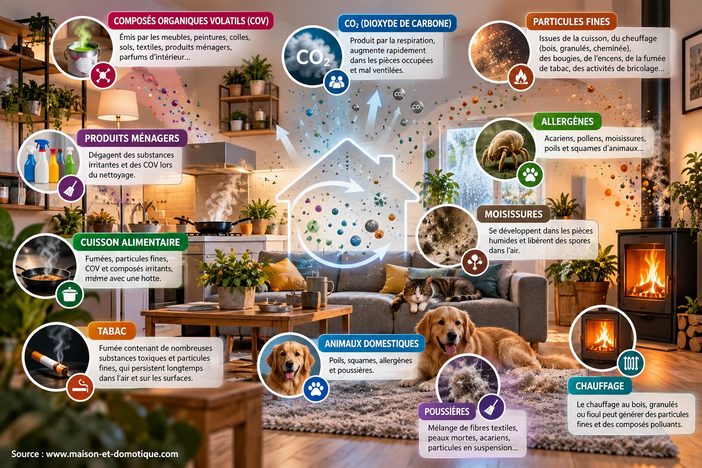
In winter, it’s even worse, for a very simple reason: when it’s 2 °C outside, we’re not exactly keen to throw the windows wide open. Especially after paying to struggle to reach 20 °C indoors!
Good ventilation is therefore essential. And whatever you may hear about purifiers, no filtration device can replace airing out your home or maintaining your mechanical ventilation system. And while an air purifier can be useful (as we explain below), airing your home regularly and maintaining your mechanical ventilation system are still essential.
Measure before you act: sensors are making their way into the connected home
If there’s one thing home automation has taught us, it’s that you can’t optimize what you don’t measure.
We started with temperature, then humidity, light levels, occupancy and electricity consumption. Air quality is the natural next step.
A CO2 sensor immediately shows whether the air is being refreshed enough. Many models also measure temperature and humidity, bringing together three useful pieces of information on the same dashboard.

Eoleaf’s Smart CO2 is a good example. It uses NDIR technology, measures CO2 from 0 to 10,000 ppm, and also records temperature and humidity. A color code sums up the situation at a glance: green below 700 ppm, blue up to 999 ppm, orange from 1,000 to 1,499 ppm, then red, with an alarm, from 1,500 ppm.
But its usefulness goes beyond the number on the display. The sensor connects to the Tuya Smart platform over Wi-Fi, letting you check readings remotely and keep a history of them.
That’s where things get really interesting for home automation enthusiasts.
With Home Assistant, air quality can become a trigger
Tuya has an official integration with Home Assistant. Devices added in the Tuya Smart or Smart Life apps can therefore appear in the platform, provided the Tuya API exposes the relevant functions.
That takes us well beyond simply controlling devices from an app.
Take a CO2 sensor installed in the office. As long as levels stay acceptable, nothing happens. If they exceed a threshold for several minutes, Home Assistant sends a notification to your smartphone: “Time to air out the office!” With motorized windows, you could even imagine them opening automatically, taking the outdoor temperature, rain and heating into account, of course.
Another idea: a multi-speed mechanical ventilation system, controlled by a relay or a suitable interface, that switches to a higher speed until the air quality returns to normal.
And there’s nothing to stop you combining everything. Room occupancy, CO2, humidity, outdoor air quality, temperature and heating status can all feed into one automation. Now that’s a smart home—not just a device you switch on from your phone!
Airing out your home is essential, but it doesn’t solve everything
Be careful not to confuse refreshing the air with filtering it.
When CO2 levels rise because there are four of us in a room, an air purifier can’t help: you need to let fresh air in. No filter can remove accumulated CO2.
An air purifier addresses a different need. It reduces pollutants in the air: fine particles, dust, pollen, allergens and, depending on the technology used, certain chemical pollutants.
The two complement each other. Opening the windows refreshes the air periodically (and therefore replenishes the oxygen), the mechanical ventilation system does so continuously, and the purifier treats the air already in the room by passing it through its filters to remove pollutants.
Keep this in mind when choosing your equipment: an air purifier should never become an excuse to stop opening the windows or neglect your ventilation system!
What should you look for when choosing an air purifier?
Not all devices are created equal, and the number of features listed on the box isn’t the best indicator.
Start with filtration. A HEPA filter is very effective at trapping particles, while activated carbon tackles some gaseous compounds and odors. By combining several technologies, you can therefore deal with several types of pollutants.
Airflow is also important. It’s usually listed as CADR (Clean Air Delivery Rate), measured in m³/h. An excellent filter with a flow rate that’s too low for the room won’t be much use.
Also consider noise, especially for a bedroom or office, as well as power consumption. An air purifier often runs for several hours a day: a difference of a few dozen watts can add up on your electricity bill.
Finally, think about consumables. The price and availability of replacement filters are part of the device’s true cost over several years.
It’s the combination of all these criteria that sets high-end air purifiers apart, far more than a flood of more or less useful features.
Multi-layer filtration to tackle different pollutants
Eoleaf has opted for a multi-layer approach. The brand says its devices purify the air in eight stages, including a pre-filter, an antibacterial layer, a medical-grade HEPA H13 filter, activated carbon, photocatalysis, UVC sterilization and ionization.
Each layer has its own role. HEPA mainly targets particles, while activated carbon takes over for some gaseous pollutants and odors.
In the NeoPur 400, the main filter unit combines five layers and weighs 1.7 kg. Eoleaf says it can be used for up to twelve months before replacement, and an indicator lets you know when it’s time.

Manufacturer claims are one thing. With this type of equipment, certifications often tell you more. Eoleaf says its devices have earned the European ECP ACL Air Cleaners certification as well as NF certification, and use HEPA H13-certified filters. The brand has also had its devices tested by an independent laboratory, Octopus Labs, particularly for fine-particle filtration under real-world conditions.
Eoleaf says it now has more than 14,000 customers in France and across Europe.
When the air purifier becomes a connected device too
That brings us to the point we’re most interested in here: connectivity.
The NeoPur 400 is designed for rooms up to 40 m², with a CADR of up to 420 m³/h. It consumes 12 W at speed 1 and 49 W at full power, and a maximum of 2 W in ECO standby mode. As for noise, Eoleaf specifies 32 dB at the lowest speed.
Most importantly, this connected air purifier has its own sensors and adjusts its speed automatically when air quality changes. You can also monitor its readings and control it from your smartphone.
Here again, Tuya Smart provides the link. From the app, you can turn it on or off, change its speed and mode, and activate certain purification functions. Voice control via Google Assistant, Alexa and Siri is also supported.
And at Maison & Domotique, we can’t help thinking of Home Assistant right away.
Since the NeoPur 400 uses Tuya Smart, you can consider integrating it with Home Assistant via the official Tuya integration. However, the available controls and information will depend on what the Tuya API exposes for this device.
If the right entities show up, you can do some really interesting things!
Much smarter home automation scenarios
Most air purifiers have an automatic mode, and for many users, that’s more than enough. Home Assistant, however, lets you think in terms of the whole house.
In the kitchen, for example: particle levels rise while you’re preparing a meal, the purifier speeds up, then switches back to automatic mode once the air returns to normal.
In a bedroom, the scenario will be quite different: night mode at bedtime, quiet operation until morning, then back to automatic mode.
Occupancy can also come into play. Why run the device at full power in a room that’s been empty for hours? Conversely, Home Assistant can start a more intensive purification cycle just before the occupants return, then dial it back as soon as it detects someone.
Just keep in mind that CO2 and particles are two different problems. If the CO2 sensor turns red, speeding up the air purifier won’t change anything. The right automation would be to increase ventilation or ask you to open a window.
Home automation really comes into its own when several sensors and devices work together.
A smart home should also learn to breathe
We’ve automated our homes a lot in recent years. The heating knows when we’re home, the blinds follow the sun, the lighting adjusts to ambient light, and solar production determines when to switch on certain appliances.
Air quality deserves the same attention.
The approach is much like what we already do with energy: measure first, optimize next. A simple sensor is enough to see how CO2 levels change over the course of a night, a work-from-home day or an evening when the whole family gathers in the living room. Sometimes the results are surprising.
Only then do we take action: air out the home, improve ventilation and, if the pollutants involved call for it, filter the air.
Connected devices like Eoleaf’s fit neatly into this approach, since you can monitor and control them remotely via Tuya Smart. And their potential compatibility with Home Assistant lets you imagine much more advanced scenarios, where air quality, occupancy, heating, weather and ventilation all work together.
A smart home shouldn’t just know when to turn on a light or turn down the heating. It should also know when to tell us it’s time to open a window and take a good breath of fresh air!



Please remain courteous: a hello and a thank you cost nothing! We're here to exchange ideas in a constructive way. Trolls will be deleted.