


Résumer cet article :
We hadn’t talked about it right away, but Anker took advantage of CES 2026 to unveil the SOLIX E10, a system designed to ensure a home’s power during outages… but also to better utilize solar energy on a daily basis. Where a conventional home battery simply stores and delivers power, the E10 adopts a hybrid approach: solar, battery, and “smart” generator working together to last longer during an outage.
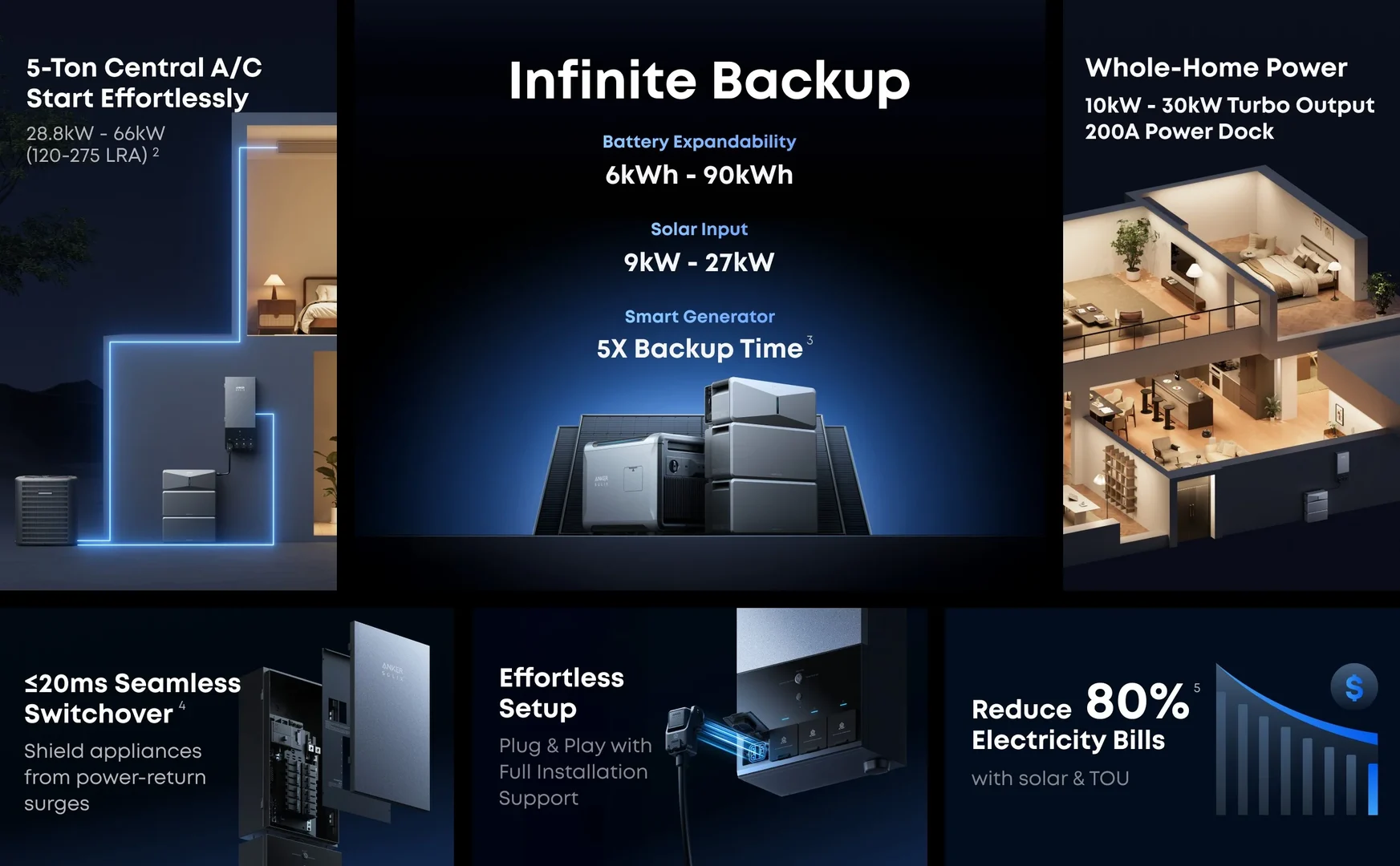
And on paper, Anker doesn’t cut corners: a basic configuration starts at 6 kWh, but the architecture is modular, with up to 30 kWh per “unit” and a maximum advertised capacity of 90 kWh in total.
The concept: solar + battery + generator, managed as a single system
The heart of the E10 is an inverter module (Power Module) paired with modular batteries (Anker mentions packs of 6 kWh). On the solar side, Anker highlights two MPPT inputs accepting from 30 to 450 V DC, with 4,500 W per input, which means 9 kW of solar power per E10 unit (and up to 27 kW with three units).

Where it gets interesting is the integration of the generator. Anker talks about a “Smart Generator” (tri-fuel according to sources: gasoline, propane, natural gas), capable of starting automatically and taking over to extend autonomy when the battery level is low, along with compatibility with existing AC generators (up to 9.6 kW in bypass). In short: the E10 does not necessarily replace a generator; it can use one intelligently.
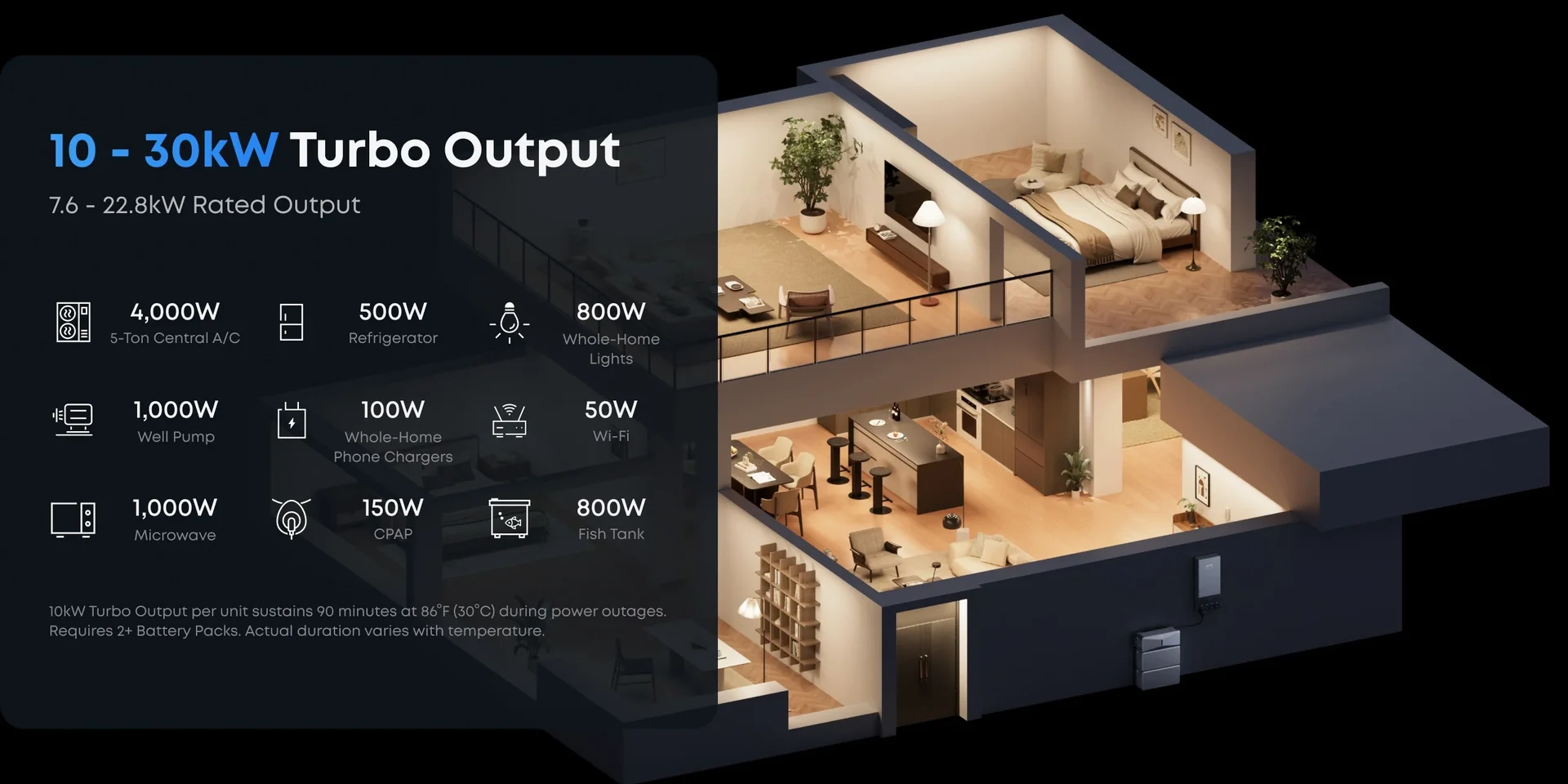
Power: enough to truly power a home
According to the figures announced by Anker, an E10 unit can deliver 7,680 W continuously (with battery) and ramp up to 10 kW in “Turbo” mode for 90 minutes (with two batteries), operating in 120/240 V split phase (US market).
Another interesting point: the management of current draw (starting motors, air conditioning, etc.) is clearly a focus, with Anker communicating about high “surge” capabilities and LRA equivalents for starting large equipment.
What changes compared to a “classic” home battery
The most tangible benefit is the long-duration outage strategy. A single battery is convenient… until the weather turns bad and the solar doesn’t provide enough power. Here, the (optional) generator becomes an automatic safety net, controlled to avoid wasting fuel unnecessarily, and designed to last over time.
Anker also emphasizes the benefits of DC charging from the generator, which is supposed to limit conversion losses compared to an architecture that would convert everything to AC (the “highway vs city” analogy is telling, though we’ll remain cautious until we have real field feedback).
Finally, the E10 is not just a large battery: with the Power Dock, Anker talks about a very quick switch (≤ 20 ms) and intelligent management of up to 12 circuits, with automatic prioritization of “essentials” during extended outages. Typically, the freezer, the box/router, some lights, and heating are prioritized… while car charging or the dryer are pushed to “secondary” status.
Real-life usage examples
Imagine a summer day: the solar panels power the home, recharge the batteries, and the E10 can smooth out peaks (oven + stove + water heater turning on at the wrong time). In the evening, the battery takes over to avoid pulling too hard from the grid during the most expensive hours (depending on the mode and configuration chosen).
Another scenario, much less pleasant: storm, power outage, and gloomy weather for two days. The E10 switches over, powers the priority circuits, and if the battery level drops too low, the generator can start automatically to recharge and extend the duration. It’s the kind of detail that makes a difference when you don’t want to play gauge guardian at 3 a.m. (yes, this is a reality for many people in rural areas…).
Installation, compatibility, and… the Europe point
Anker positions the E10 as a “whole-home” solution, with professional installation, especially if you opt for the Power Dock (panel/ATS) for automation and fine circuit management. There’s also a simpler approach through an entry box (Smart Inlet) that requires more manual intervention.
A crucial point for us in France: the published specifications (120/240 V, 60 Hz, split phase) primarily show a North American market orientation at this stage. In other words, the announcement at CES doesn’t automatically ensure immediate availability/compatibility for us in 230 V / 50 Hz. We will need to closely monitor potential European adaptations (or a dedicated announcement). But this suggests what could soon arrive in our regions.

Announced prices and availability
Regarding prices, the first prices mentioned in the US press are around $4,299 for a basic configuration, with more comprehensive packs (Power Dock, generator) that go higher. Pre-orders and the launch window indicated are expected in early 2026.



Please remain courteous: a hello and a thank you cost nothing! We're here to exchange ideas in a constructive way. Trolls will be deleted.