


Résumer cet article :
EcoFlow took advantage of CES 2026 to push a topic that resonates with everyone, individuals and professionals alike: stopping the “silos” between solar production, batteries, home circuits, and connected devices. The brand announced a partnership with Homey (now under LG) to enhance the interoperability of its Smart Home Energy Management System with the Homey platform, via the Homey Energy Dongle. In parallel, EcoFlow also unveiled an “Ecosystem Alliance” bringing together more than 15 brands, with the stated goal of making energy management more open and easier to integrate into a connected home.
EcoFlow x Homey by LG Partnership: What Changes Practically
The core of the announcement is this integration between EcoFlow’s energy management system and Homey, relying on the Homey Energy Dongle. The idea is to offer a unified control point to monitor, automate, and coordinate energy consumption and device operation, without adding additional hardware or third-party services. In other words: fewer layers, fewer workarounds, more consistency.
EcoFlow reminds us what it puts behind “Smart Home Energy System”: a platform that unifies solar production, home batteries, electrical circuits of the house, and connected devices into a single control “hub.” It features remote management, real-time energy flow tracking, multi-brand integration, and user-oriented functions such as charging alerts in preparation for bad weather, optimization based on rates (Time-of-Use), and customizable energy-saving schedules.
On the Homey side, the interest is evident for those already familiar with the “open platform” approach: Homey claims integrations with over a thousand brands, automation through Homey Flow, and a “Homey Energy” layer dedicated to consumption visibility. The announcement also emphasizes Homey’s open APIs and the role of the Homey Energy Dongle for real-time measurement and integration of additional energy hardware.
“Whole Home” Scenarios That Finally Become Natural
Where the announcement is interesting is that it discusses scenarios, not just “compatibility.” EcoFlow and Homey cite very concrete use cases.
For example, you can automate the starting of very power-hungry devices at the time when solar production is at its highest. In real life, this could mean: triggering a washing machine cycle, starting a water heater, or scheduling a recharge, only when the solar is “producing” and the battery is sufficiently comfortable.
Another key point: prioritizing essential devices during a power outage. Typically, you want the fridge, the internet box, a few vital outlets, or even a heating circuit to remain powered without having to ask too many questions, while the rest goes into “pause” or load-shedding mode.
Finally, the announcement highlights adjusting consumption based on the price of electricity, the battery charge state, and solar production. This is exactly the kind of logic that, once implemented, works “behind the scenes” and increases comfort… while avoiding unpleasant surprises on the bill.
The Ecosystem Alliance: The Other Announcement That Weighs Heavily
EcoFlow is not stopping at Homey. The brand also announces the Ecosystem Alliance, an initiative that brings together more than 15 smart home and appliance brands, with a promise: to move towards greater openness and interoperability concerning all things related to domestic energy.
On the visual of the announcement, several recognizable names for the connected home are already visible, such as Shelly, Bosch, Google Nest, go-e, and Homey, which gives a fairly clear idea of the targeted area: from load management to the integration of electrical equipment, including consumer-oriented home automation solutions.

EcoFlow specifies that this alliance is part of a roadmap for 2026, and that it relies on already announced partnerships, including a collaboration with BSH Home Connect unveiled at IFA 2025, as well as integrations with brands like Shelly and go-e. The stated goal is to push for “two-way” integrations through shared APIs and standardized interfaces, rolling this out globally starting in 2026, with initial demos presented during CES.
A CES Also Marked by Awards and “Volume”
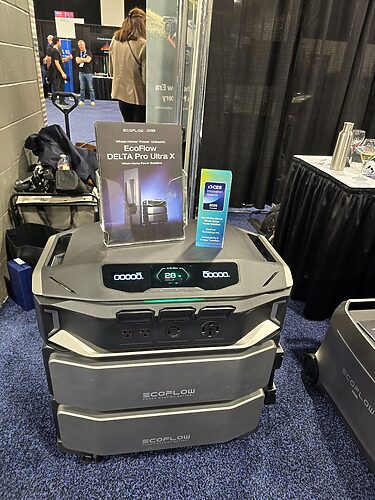
EcoFlow also arrived at CES 2026 with an impressive showcase in terms of recognition, including a CES Innovation Award 2026 won by the DELTA Pro Ultra X solution in the Sustainability & Energy Transition category. The manufacturer reminds us of its position as the world’s number one in sales in the “Smart Home Energy Storage Solutions” segment according to a Frost & Sullivan report (based on 2024 sales, study finalized in December 2025).

DELTA Pro Ultra X is a “whole-home” solution capable of integrating solar roofs (or DIY solar panels), generators, and grid, all in a single battery system for protection against outages, lowering bills, and maximizing solar use. There is also talk of an “installation announced in seven days,” real-time energy monitoring, personalized usage recommendations, and scalability to adapt to the household’s needs.

What to Remember
EcoFlow does not present “one more product,” but a strategy: to make domestic energy management more manageable, more automatable, and less dependent on closed solutions. The duo with Homey by LG clearly targets households that want to unify measurement, automation, and trade-offs (solar, battery, rates), while the Ecosystem Alliance seeks to expand multi-brand compatibility on a large scale starting in 2026.




Please remain courteous: a hello and a thank you cost nothing! We're here to exchange ideas in a constructive way. Trolls will be deleted.