


This year, at CES 2026, Bluetti was determined to cover the entire range, from the small plug-and-play “backup” to the nearly residential system, not forgetting vanlife and RVs. All under the theme “home, road, planet,” with a strong emphasis on efficiency, mobility… and a very clear shift towards home automation integration (yes, Home Assistant is explicitly mentioned!). Let’s take stock of the announcements and standout products.

Elite 100 V2 and Bio-Based Version: the 1 kWh station that wants to do it all (without becoming bulky)
The Elite 100 V2 is the “versatile” format: 1,024 Wh, 1,800 W continuous (3,600 W surge), and a “Lifting” mode at 2,700 W for resistive loads. In short: router + box + NAS, small fridge, lighting, laptop, or even a hot plate/coffee maker depending on the case.
Fast charging is a big part of the pitch: 45 minutes to reach 80% on AC (1,200 W), and 70 minutes for 100% (still on AC). In solar mode, Bluetti announces up to 1,000 W of PV. This places this model in the “I recharge quickly, I leave” category, typical for camping or lightweight home backup.

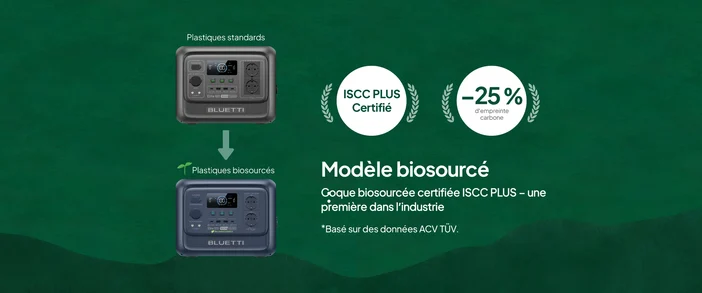
And then there is the “Elite 100 V2 Bio-Based” version. The chassis uses a bio-circular PC/ABS blend developed with Covestro, based on renewable waste (recycled vegetable oils, agricultural residues). The stated goal: -25% CO₂ emissions, ISCC PLUS certification, without compromising robustness, fire-retardant properties, or a claimed lifespan of 10 years. Visually, it stands out with an “Earth Deep Blue” finish and a small green leaf detail.
Elite 300: 3 kWh in a compact size, designed for apartments and RVs
The Elite 300 is presented as “the most compact of 3 kWh,” with a capacity of 3,014.4 Wh and a total AC output of 2,400 W, plus a Power Lifting Mode at 4,800 W (for resistive loads). Bluetti also emphasizes its reduced footprint (up to 19% smaller compared to competitors): practical if you want to slide it near the panel, in a technical closet, or in an RV storage compartment.

In terms of connectivity, the brand announces 11 outputs, with a TT-30R port (US version) for the RV world, and a genuine 12V/30A on the DC side to power more demanding equipment. UPS switching is rated at 10 ms, and management is done via Bluetooth + Wi-Fi through the app, with functions like Remote Wakeup, timers, and scheduling, as we have seen in our previous tests.

On the charging side, we are talking about 1,800 W on AC, up to 1,200 W in solar, and 2,400 W in AC+DC (hybrid). Given times: 95 minutes to reach 80% on AC, 78 minutes in AC+DC (80%), and about 4.1 hours for 100% in solar (at max). And an interesting point: Bluetti explicitly mentions compatibility with Charger 2 at 1,200 W, with a charging time of around 3.2 hours for a full charge via this module (depending on conditions).
Elite 400: 3.84 kWh on wheels, for “comfort” home backup
The Elite 400 goes up to 3,840 Wh, with 2,600 W continuous (up to 5,200 W in surge) and a Power Lifting Mode advertised at 3,900 W. The detail that stands out immediately: the “rolling” chassis, with a telescopic handle and wheels, because a 39 kg station… is much loved when it moves without breaking your back.

The charging is aggressive: up to 2,800 W in AC + solar, and a promise of 80% in 70 minutes. It also features a UPS mode (switch ≤ 15 ms), and especially a focus on standby consumption: 3 W in standby (AC+DC off), with detailed figures according to the status of the outputs (DC on, AC on, etc.). For “semi-permanent” use at home (internet box, NVR, lighting), this point really matters.

Like the Elite 300, the Elite 400 is controllable via the app (Bluetooth + Wi-Fi) with Remote Wakeup and scheduling. And typically, it’s these kinds of functions that prevent the “dead battery on the day it’s needed” syndrome: we plan a recharge before a weather episode, trigger a maintenance charging period during off-peak hours, and let the station do its thing.
FridgePower: ultra-slim, expandable… and finally Home Assistant compatible
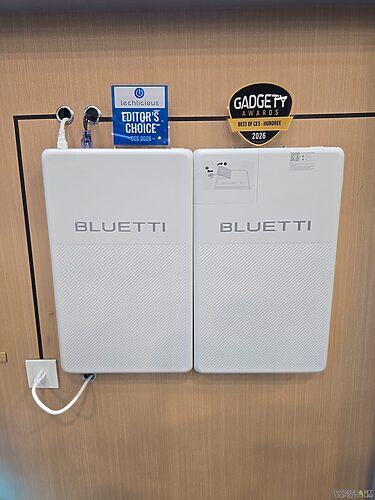
FridgePower is the little “smart home” bomb from Bluetti communication. The product is described as an ultra-thin backup (75 mm), installable flat or vertically, with 2,016 Wh, expandable to 8 kWh+. It clearly targets the “essentials” (hence the name), such as fridge/freezer, internet box, security, and a few lights.

Where it becomes interesting is the integration: Alexa and Google Home are mentioned, but especially a newly added “Home Assistant support,” focused on local control and custom automations.
Concretely, this opens up very practical scenarios that we will love. A simple example: in case of a power outage (detected via a voltage sensor, a Shelly, a module on the panel, or directly via the station’s status if the integration allows), Home Assistant can automatically cut non-priority loads, keep the fridge + network + cameras on, and send you a notification with the estimated autonomy. A smarter example: when solar production ramps up, HA restarts certain devices (water heater in small cycle, tool charging, ventilation) only if the battery level exceeds a threshold and if the PV power is sufficient. And at this point, we are no longer talking about “a battery,” but about genuine energy management.
Pioneer Na: sodium-ion for the biting winters
With the Pioneer Na, Bluetti highlights sodium-ion chemistry designed to better handle the cold (thermal stability). The promise is very clear: charging possible at -15°C and powering devices down to -25°C, which directly targets preparations for winter storms and regions where classic LiFePO₄ can lose usability without pre-heating.

For the figures: 900 Wh, 1,500 W continuous, Lifting mode at 2,250 W (for resistive loads), 20 ms UPS switching time, a standby consumption of 1.5 W, and especially an announced lifespan of 4,000 cycles (80%) for about 10 years. Fast charging claimed: 0–80% in 35 minutes via 1,900 W AC+solar.
This product does not necessarily target “whole-home backup,” but rather a backup “that works when everything is frozen.” And that’s the interesting point: battery technology that addresses a real everyday problem, not just a contest of watts.

RVSolar 48V: a true RV/boat system, not just a big battery
Bluetti also pushes an integrated 48V approach for RVs and marine use, with a system expandable up to 122 kWh and an announced output power of 6 kW.

The manufacturer mentions a RV5 “5-in-1” hub (inverter charger, inverter, MPPT, alternator charger, DC converter + protections), an open platform compatible with third-party equipment, and an installation claimed to take “30 minutes, secure & go.”

Bluetti also highlights the benefits of 48V: up to 30% less loss compared to 12/24V, and a system designed to be monitored via a control panel (“Pad smart control”) with diagnostics and remote access.

The batteries are rated IP65, with self-heating and endurance at -20°C, and a lifespan of 6,000 cycles.
For an installer, this is a very concrete issue: the 48V reduces currents, simplifies certain sizing, and changes the way to wire neatly in a vehicle. For an individual, it’s “I want an installation that looks like a home setup,” with control and a real distribution logic.
Apex 300: the modular system that goes from portable to “whole-home” backup
The Apex 300 is presented as a complete ecosystem, capable of shifting from portable use to advanced home backup. The brand highlights a “record-low 20W idle draw” and a UPS switching time of 0 ms, with switching 120V/240V (depending on configuration).

It has a base of 2,764.8 Wh (LiFePO₄), 3,840 W AC output, 7,680 W peak, and extensibility via batteries (up to 1 to 6 packs B300K) with a possible max charge of 6,240 W in certain configurations. In parallel, Bluetti mentions connecting 2 to 3 units in parallel, with a total capacity that can rise up to 58 kWh. And for charging, the product strongly pushes solar: dual MPPT, 2,400 W input (by default), and heavier scenarios via accessories like SolarX 4K, with high voltage PV inputs (the manufacturer mentions configurations up to 19.2 kW in PV for multi-unit/accessory scenarios).

Here, we are no longer talking about “I plug in a fridge,” but about “I want to offload, prioritize, and possibly combine solar + storage.”
Charger 2: energy “on the go,” and a true alternator + solar hub
The Charger 2 is announced as a car + solar energy hub, capable of combining an alternator and panels to output up to 1,200 W, with a “13× faster” charge than a traditional cigarette lighter. Bluetti also presents it as a bi-directional system: it can maintain/recharge a starter battery and manage “reverse charging” modes.

The manufacturer details a “Battery Link” mode (management of multiple Bluetti products), reverse charging modes (emergency jump start, trickle charge, pulse maintenance), and the possibility to power 12V/24V loads via a “Charger 2 DC Hub,” up to 700 W (Anderson port 50A). Control is announced via Bluetooth + Wi-Fi, with real-time monitoring and history.

Finally, the “installer-friendly” specs are there: dimensions 265 × 169 × 69.7 mm, weight 1.59 kg, temperature range -20 to 60°C, 75A fuse, IP20 rating, and cited compatibilities (B230, B300, B300K, B500K, AC200MAX, AC200L, Apex 300).
The Bluetti techno layer: EMS, connectivity, and a nod to Matter
The manufacturer emphasizes the system vision: BLUETTI Smart EMS (management and optimization, supports up to 18 battery cells), AI-powered BMS, 24/7 monitoring, and multi-network connectivity (5G/4G, Bluetooth, Wi-Fi). Bluetti also mentioned “coming soon” smart plugs designed to integrate with home automation systems through protocols like Matter.
In short, Bluetti is stepping up a gear and no longer wants to be just “the station manufacturer.” It wants to be the orchestra… and let you write the score (especially if Home Assistant is part of the plan). This is a fundamental trend at CES, and clearly, Bluetti is fully embracing it this year.





Please remain courteous: a hello and a thank you cost nothing! We're here to exchange ideas in a constructive way. Trolls will be deleted.