


Mammotion arrived at CES 2026 with a rather simple (and quite healthy) idea: to stop making “one robot for everyone” and offer a range where each model has a cocktail of sensors and power consistent with the type of garden. The manufacturer highlights a 2026 range centered around a new flagship model, the LUBA 3 AWD, and two more compact models, LUBA mini 2 AWD and YUKA mini 2, to cover urban lawns as well as complex multi-zone terrains.
And surprise: Mammotion expands its playground to the pool with the SPINO S1 Pro, a high-end pool robot that promises “intervention-free” autonomy, including charging.
LUBA 3 AWD: the new technological showcase (Tri-Fusion, precision ±1 cm)
The LUBA 3 AWD becomes the flagship product for 2026 at Mammotion, with a clear goal: to remain precise and reliable where gardens typically “break” robots, typically under trees, near hedges, between walls, or with areas where the signal is capricious. Mammotion emphasizes a positioning accuracy announced at ±1 cm thanks to its “Tri-Fusion” navigation combining LiDAR, RTK, and AI vision.

The novelty is the improved version of this Tri-Fusion, with a LiDAR now announced for 360° coverage, an UltraSense AI vision based on two 1080p cameras, and an integrated NetRTK module (depending on models).

Specifically, Mammotion describes a 360° LiDAR capable of scanning up to 100 meters around the robot, with a 360° horizontal and 59° vertical field of view, and the generation of a real-time 3D map (from the ground to the top of the trees), announced at ±1 cm through “millions of points”.

The NetRTK, on the other hand, aims to simplify installation: no peripheral cable, no RTK base to set up, the boundaries are defined in the app. On paper, this is exactly the type of detail that changes lives when it comes to equipping a client… or when you just don’t want to spend Saturday putting up stakes.
All-wheel drive: 80% slopes and 8 cm obstacles, for gardens that don’t take it easy
Mammotion emphasizes its “AWD” DNA (all-wheel drive) and announces the ability to handle slopes of up to 80% (38.6°). Four independent motors are mentioned, with stable trajectories on slopes and precise pivots thanks to an omni wheel, designed to preserve the lawn.
Another figure that speaks to real terrains: an improved adaptive suspension capable of overcoming obstacles of 8 cm (curbs, roots, thresholds). If you’ve ever seen a robot come to a sudden stop on a small “ridiculous” root, you can immediately see the interest.

More AI, more mowing throughput, and smarter energy management
The 2026 range relies on a new AI chip announced at 10 TOPS, with the idea of doubling the analysis and decision speed. Mammotion talks about instantaneous obstacle detection and real-time reactions, with a recognition of more than 300 obstacles, including in shadow or low light conditions, and the detection of risk areas such as cliffs, pool edges, or drop zones.
During the conference, Mammotion provided a more “field” reading of this power boost on the AI side: the goal is not just to “see more obstacles,” but to decide faster. They talk about perception and decision-making that doubles, with processing announced up to 10 trillion operations per second (10 TOPS), so that the robot reacts instantly when the environment changes (shadow, low branches, forgotten toys, etc.).
Another interesting detail mentioned at the mic: the robot would also automatically adjust power based on grass density, in order to keep a clean cut without wasting battery when the lawn is easier.
In terms of mowing performance, Mammotion communicates a cutting width of 15.8 inches, two high-power 165 W motors, and two disks with six blades. The manufacturer announces up to 650 m² mowed per hour, a 15 Ah battery, and a capacity of up to 7,000 m² per day, relying on AWD mobility.

An interesting detail for the home (and the bill): a new intelligent energy management system, announced for the new LUBA series, with customizable charge limits and off-peak programming. This isn’t “the” number one criterion for a mower, but in a household that is already optimizing its uses, it ticks the “common sense” column.
Availability and price: Mammotion announces the LUBA 3 AWD available in four models for areas ranging from 1500 to 10,000 m² (1 hectare), starting at €2399 in Europe, with pre-orders available now.
LUBA mini 2 AWD: the compact format, without sacrificing “all-terrain”
The LUBA mini 2 AWD clearly targets those who want the AWD approach but on more reasonable areas, up to 1,000 m², while retaining the ability to climb slopes announced at 80%.
The navigation evolves too: Mammotion mentions a tri-camera AI vision + NetRTK, powered by the 10 TOPS AI chip, with the possibility to explore the garden and define multiple mowing zones without perimeter wire.

On stage, Mammotion specified the logic behind this “tri-camera AI vision”: it would involve a mono camera duo + RGB camera (so not just “two more cameras”), to better estimate distances and enhance boundary recognition, even when light is low. In other words: the idea is that the LUBA mini 2 does better when the garden is not perfectly lit or when there are contrasting areas.
They also emphasized the “ready to work” aspect: the robot would be able to explore and map automatically right out of the box, without a heavy installation phase (this is clearly a message for people looking to avoid half a day of adjustments before the first mow…).
And there’s a very “field” point: the Ultra-Close Edge Cutting. Mammotion integrates a side disk with three mini-blades, announced to cut as close as possible to walls, fences, and flower beds. If this promise is confirmed in real conditions, it’s the kind of detail that can significantly reduce the need for edge trimming.
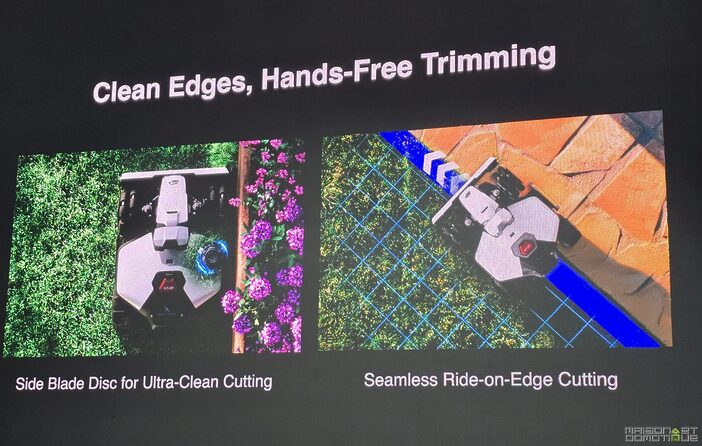
The conference also hinted that edge cutting is not limited to “cutting closer”: Mammotion talks about a customizable border mode, with the ability to intentionally widen the cutting along boundaries for a neater finish depending on the terrain configuration (walls, fences, flower beds, slabs, etc.). On paper, this is exactly the kind of adjustment that can further reduce the need for edging.
Availability and price: pre-orders available now, with prices starting at €1499, shipping as of February.
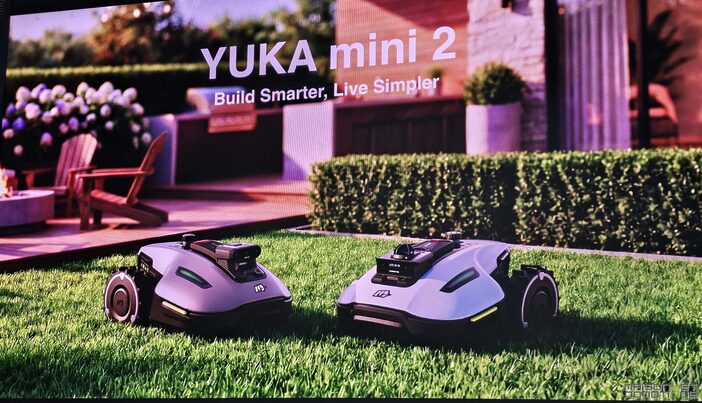
YUKA mini 2: two navigation philosophies, and a “drop & mow” mode
With the YUKA mini 2, Mammotion plays a different card: offering two navigation options depending on the terrain complexity, still for gardens up to 1,000 m². A 360° LiDAR + vision version is announced as ideal for complex spaces without physical boundaries, and a tri-camera AI vision version is announced for more standard terrains.
The conference provided a bit more context on the “small garden”: Mammotion clearly positions the YUKA mini 2 for dynamic spaces, with narrow passages, tight corners, and a family life around (pets, toys, garden furniture). They mention a capability to maneuver in very constrained areas, with passages announced around 20.6 inches, or about 52 cm.
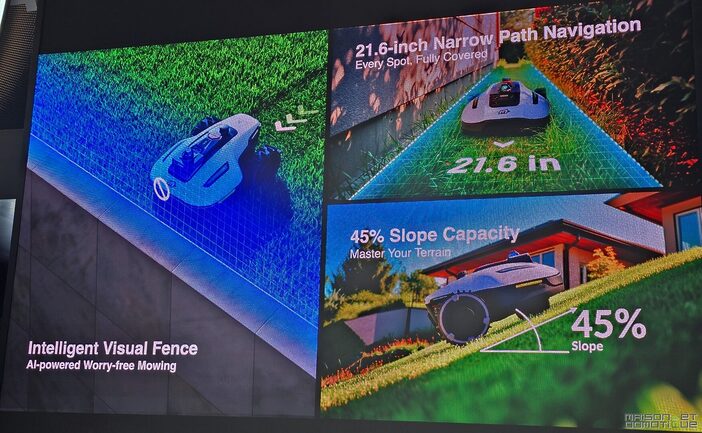
Regarding the LiDAR version, Mammotion also slipped in the notion of 3D planning (smart 3D path planning) in addition to centimeter precision: the idea is to exploit the environmental reading to optimize trajectories in small spaces, rather than simply following a “flat” path.

The 10 TOPS AI chip is also part of the package, with rapid and intelligent mapping, and especially a DropMow mode: the idea is to set the robot down anywhere and launch immediate mowing with a “perfect” N-path. In other words, the focus is on a very direct use, almost “ready to mow”, without spending ten minutes wondering if it is starting from the right place.

Availability: pre-orders open now.
SPINO S1 Pro: Mammotion enters the pool with truly autonomous recharging
This is the announcement that steps out of the garden: Mammotion presents the SPINO S1 Pro as its most advanced pool robot, with a simple promise to understand… and difficult to achieve: a robot that cleans, stays connected underwater, and returns to recharge on its own, without you needing to fish it out.

The core of the concept is called AutoShoreCharge™: Mammotion describes a reception and recharge system outside the pool assisted by a robotic arm, capable of automatically lifting the robot and placing it on its station. The SPINO S1 Pro guides, aligns, and positions itself on its base in a way announced as 100% autonomous, relying on “ultra-stable” underwater communication, integrated tracks, and the robotic arm. The expected result: the robot moves from water to land without handling, where many wireless models end up requiring a “rescue intervention”.

Another important detail: Mammotion announces stable underwater connectivity within a radius of 10 meters around the docking station, specifically to avoid signal loss, unexpected stops, and blockages during a cycle that transform an autonomous robot into a chore.

During the conference, Mammotion provided a very concrete reference: the underwater link would be announced as reliable within a radius of about 10 meters, around the docking station. The objective is clearly for the SPINO to maintain a clean guidance to return to “settle down” and recharge, even in deep pools or with somewhat difficult geometry (steps, angles, swirling areas).

The SPINO S1 Pro received a CES Innovation Award 2026, which gives an idea of the ambition level in the segment.
AI vision, cleaning modes, fine filtration: the technical sheet announces “pro”
Mammotion highlights an “intelligent AI vision” with real-time analysis: ZonePilot™ AI Vision would provide 360° vision via an onboard camera, with IMU, TOF, and pressure sensors. The robot would automatically identify dirty areas, steps, edges, corners, and obstacles.
The Adaptive Dirt Response system is announced to adjust suction power and path according to the actual state of the pool, in order to optimize the route and limit unnecessary repetitive passes.

On raw performance, Mammotion announces a suction rate of up to 6800 GPH, capable of lifting fine sediment, sand, and stubborn debris. Five modes are mentioned: floor, walls, horizontal waterline, complete, and border mode, with adaptation to shape and coating. The cleaning relies on double roller brushes, designed for floor, walls, steps, and waterline, and a double-layer filtration of 38 μm + 180 μm, to capture both leaves and microparticles.
For mobility, Mammotion announces four brushless motors and wide tracks, designed to maintain traction on slopes, angles, and curves. The rollers would be quickly removable for express rinsing, and the Mammotion app would centralize control.
Availability: launch announced in the first quarter of 2026, with final specifications and pricing to come.
A first step towards the professional market
Mammotion didn’t only talk about private gardens. The conference also opened a window on a “pro” ambition, with a project presented as a dedicated mowing solution for the commercial market: golf courses, parks, large public areas, etc. It is a platform designed to industrialize autonomy on a large scale, with a “24/7” productivity logic and fleet supervision.

Interesting point: Mammotion also mentioned a service/system called iNavi 2.0, with a promise of precision without depending on an Internet connection or a base station (again, this is positioned as a key building block for professional environments, where repeatability is desired and infrastructure constraints are minimized).

The idea behind this discourse is clear: to seek gains in labor and operational costs, by applying to large areas what they have already learned about “wire-free” consumer robots.

What these announcements really change in daily life
Taking a step back, Mammotion promotes two quite concrete ideas.
The first, on the mower side, is to reduce the gap between “it works in a perfect garden” and “it works at your place, with your trees, your zones, your difficult corners, and your sloped terrain.” The trio LiDAR 360° + AI vision + RTK (and the introduction of the integrated NetRTK presented as eliminating the RTK base) clearly aims at peace of mind: less installation, less adjustments, and navigation that holds up when the environment becomes complicated.
And in the background, Mammotion has also hinted at a more “pro” ambition, with the Mastin concept and the iNavi 2.0 service (announced as precise without relying on Internet or a base station), to transpose this “wire-free” logic and automation to very large surfaces and, in the future, to fleet management.
The second, on the pool side, is to tackle the most annoying moment with wireless robots: recovery/recharge. AutoShoreCharge™ and underwater connectivity within a radius of 10 m around the base are designed to avoid the “stuck” robot that needs to be manually fetched. If the promise holds true, we move from a practical device to a truly autonomous one, and that is rarely trivial.
You can find more information and video demos with my friend Julien from Ca Sert à Quoi:



Please remain courteous: a hello and a thank you cost nothing! We're here to exchange ideas in a constructive way. Trolls will be deleted.