


SwitchBot arrived at CES 2026 with a simple but ambitious idea: a home that doesn’t just obey scenarios, but “perceives, understands, and acts”. The company speaks of a unified ecosystem around embodied AI, meaning an AI that is not just a brain in the cloud, but lives in objects capable of interacting with the real world.
onero H1: the “most accessible” domestic AI robot, and above all the most versatile
It’s clearly the star of the booth: onero H1, presented as SwitchBot’s first “generalist” humanoid robot. The manufacturer had already presented a prototype of the K20+ Pro last year, which was based on a vacuum robot with a versatile platform. But this time, the idea is not to replace a specific product (a vacuum cleaner, a robotic arm, a gadget…), but to create a multitasking system capable of adapting to various situations, especially the chores that still resist classical automation. SwitchBot even summarizes the goal very directly: “trying to eliminate household tasks” rather than adding yet another specialized device.
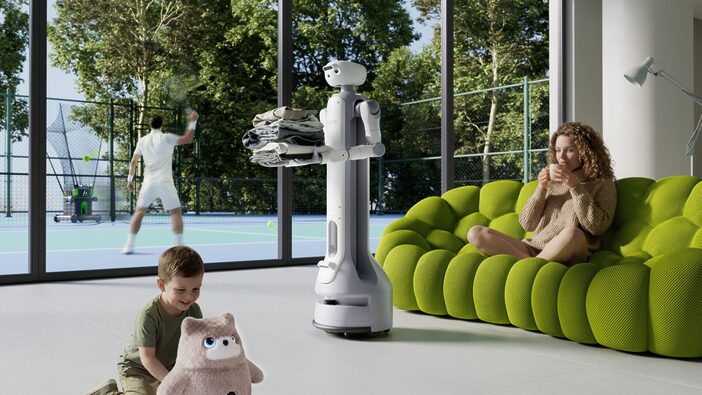
On the technical side, SwitchBot highlights a robot built around three components: a large dose of perception (vision + depth), tactile feedback, and an embedded OmniSense VLA model focused on stability and adaptation to domestic scenarios. In the speech, there’s also the desire to finely cover the environment with several Intel RealSense cameras distributed across the head, arms, hands, and even the abdomen, as well as a mechanism with 22 degrees of freedom for flexible movements.

In clear terms, the message is clear: if a robot is to be truly useful at home, it must know how to grasp, push, open, organize… and start over the next day without getting lost as soon as we change a doorknob or move a chair. SwitchBot insists on this more comprehensive “understanding” of objects (position, shape, state of interaction) to ensure reliable everyday contact gestures.
onero H1 and its A1 robotic arms are set to be available for pre-order soon on the official SwitchBot website. We’re excited!
Lock Vision Series: SwitchBot’s security, between 3D biometrics and Matter-over-Wi-Fi
Another major announcement: the SwitchBot Lock Vision Series, a range of connected deadbolt locks that focuses on advanced biometrics. The most notable point is the 3D facial recognition using structured light. SwitchBot explains that it uses infrared projection points to build a 3D “map” of the face, with liveness detection to counter basic attempts through photo or video, and local storage of user data.

The manufacturer claims “more than 20,000” points, with a false recognition rate reported as less than 0.0001% and unlocking in under a second.
On the home automation front, SwitchBot highlights Matter-over-Wi-Fi, with a very “consumer-friendly” promise: direct integration without a dedicated Matter hub, and compatibility with Apple Home (certification “in progress”).

The range also comes in a Lock Vision Pro version, which adds “contactless” biometrics through palm vein recognition, handy when hands are wet, somewhat dirty, or when you want to avoid touching a keypad.

And SwitchBot has thought of the dimensions, in a very literal sense: the presentation announces compatibility with most deadbolt locks, with precise measurements (door thickness 35 to 55 mm, drilling diameter 38 or 54 mm, backset center distance 60 or 70 mm), and an installation claimed to be doable with a screwdriver.
On battery life, the argument is strong: a DualPower and DualBackup system, combining a rechargeable 10,000 mAh battery (up to 6 months claimed), a CR123A battery rated for up to 5 years and 500 emergency unlocks, plus a USB-C port on the keypad for cases where someone finds themselves “dumb and mean” in front of a closed door.
Comfort Tech: MindClip AI, E-Ink weather station, and OBBOTO pixel lamp
SwitchBot didn’t just come with robots and locks. The brand is also pushing a new “Comfort Tech Lineup” aimed at daily life, where you just want things to be simpler, more readable, more fluid.
The SwitchBot AI MindClip is presented as a portable AI assistant, oriented towards a “second brain”. It continuously records meetings, conversations, and moments of daily life, then transforms all of it into structured summaries, actionable tasks, and a searchable knowledge base.

The angle is interesting: it’s not just a voice recorder, it’s a memory and research tool, capable of responding when a detail has slipped away, as can be offered by Fieldy (which is in testing with us). The AI features are linked to a subscription cloud service, and the device is announced to weigh 18 g, with over 100 languages and a “privacy-first” positioning including end-to-end encryption.

The SwitchBot Weather Station plays the role of the home dashboard. 7.5-inch E-Ink screen, integrated sensors, displays the date, time, sunrise/sunset, indoor temperature and humidity, air quality, weather, and six-day forecasts. SwitchBot adds an “AI” layer with daily weather briefings accompanied by recommendations, and even inspiring quotes related to the weather (you like it or you don’t, but at least it’s asserted). The station also announces calendar synchronization and scene shortcuts, with an important precision: these shortcuts require SwitchBot hubs.

Finally, SwitchBot OBBOTO is a “pixel globe” lamp aimed at ambiance and visual expression. The product features over 2,900 RGB LEDs, offers animations, pixel art, musical visualizations, motion detection, and mood animations driven by AI.

Customization happens through the app, with more than 100 predefined animations and the possibility to import your own content (pixel art and GIFs).

And in the midst of all this: Acemate, the AI tennis robot “true rally”
A little sidestep (but a fun one): SwitchBot also announces the presence of Acemate, an AI tennis robot presented as the world’s first tennis robot capable of offering a true rally experience, which we had already seen at IFA Berlin. It clearly falls outside the strict definition of “connected home”, but it fits well with SwitchBot’s guiding idea: machines that perceive, analyze, and react in the real world, not just boxes that send notifications.
What to remember
SwitchBot arrived this year at CES 2026 with a coherent roadmap: unifying its ecosystem around AI robotics, from the “big” (onero H1) to the “very everyday” (E-Ink weather station, ambient lamp, personal voice assistant), not to mention a major home automation and security project: the biometric lock compatible with Matter-over-Wi-Fi.
There will certainly be three points to watch closely: the actual autonomy level and functional security of onero H1 in real scenarios, the maturity of the Lock Vision Series (certifications, Apple Home integration, availability outside the US, daily biometric reliability), and the way SwitchBot plans to articulate all this into simple automations for the general public… without losing advanced users who want to integrate everything into their usual home automation environments. These are topics we will be following closely, and we will talk about them again soon!


Please remain courteous: a hello and a thank you cost nothing! We're here to exchange ideas in a constructive way. Trolls will be deleted.