


The lawn mower robot market is undergoing a major transformation, driven by the rise of LiDAR navigation technologies from players like Mammotion. With the Luba Mini AWD LiDAR, the brand aims to push the limits of autonomy, precision, and simplicity on surfaces up to 1500 m², while freeing itself from the traditional peripheral cable. Full motorization, intelligent connectivity (Wi-Fi, 4G, Bluetooth), and advanced mapping come together in a solution that attracts both demanding gardening enthusiasts and a new generation of users who are fans of high-tech and connected devices. Our hands-on experience reveals a high-performance device, easy to assemble, capable of overcoming obstacles and excelling on steep terrains, with the standout feature being the tri-fusion LiDAR technology, which eliminates certain compromises faced by previous generations.
- Tri-Fusion LiDAR Navigation: Unmatched precision and adaptability thanks to the combination of LiDAR, camera, and optional RTK.
- No cable installation: Quick setup, configuration via the app, installation without constraints even for 1500 m².
- AWD motor by Mammotion: Excellent grip, ability to tackle slopes up to 80%, and perfect handling of rough terrain.
- Intuitive mobile app: Multi-zonal management, LiDAR visualization, cutting height adjustment (20-65 mm), scheduling, remote control via Wi-Fi/4G.
- Uniform mowing on lawn: 6 oscillating blades, neat finish but perfectible edges, marginal wheel tracks.
- Limit: Sometimes overly cautious obstacle detection, no offset cutting deck, LiDAR energy consumption higher than average.
- Value: High-end Mammotion lawn mower robot, significant price but ideal solution for complex gardens or large areas without peripheral wire.
- Home Assistant smart home integration possible for connected home enthusiasts.
Complete presentation of the LUBA Mini AWD LiDAR lawn mower robot by Mammotion
The Luba Mini AWD LiDAR stands as a milestone in the Mammotion range. Designed to meet the growing demand for autonomous mowing solutions without peripheral cable, it addresses homeowners with gardens up to 1500 m² looking for a reliable, modular alternative, but also advanced technology that allows for intuitive and personalized handling. This lawn mower robot fits into the current trend where connectivity, embedded intelligence, and simplicity are prioritized by savvy consumers.

The history of Mammotion is young but already marked by innovation, with models like the Yuka Mini that we tested, which marked an advancement in the integration of RTK (Real-Time Kinematic) for wireless navigation. Now, the Luba Mini AWD LiDAR reinvents the game with three key advantages combined in the Tri-Fusion technology: a LiDAR module, a wide-angle camera for real-time obstacle detection, and the optional association with an RTK antenna, which is no longer mandatory. This new approach eliminates the logistical complexity of installing an antenna, providing a smoother and more accessible configuration experience.

The AWDrive (All Wheel Drive) motorization, a unique engineering feature of Mammotion, equips this model. Thanks to four-wheel drive and all-wheel transmission, the mower gains capabilities in tackling slopes, ideal for a garden scattered with slopes or obstacles. The possibility of dispensing with the limitations of RTK (and thus GPS) particularly highlights the LiDAR which adapts better to wooded gardens, hidden corners, and environments dense with interfering elements where satellite signals might struggle.

Through this evolution, Mammotion anticipates the growing demand for stress-free, efficient mowing, for both urban and rural users. The Luba Mini AWD LiDAR is designed for a generation that is not inclined to waste time on cumbersome installations or complicated settings. It paves the way for new references in practicality while remaining at the cutting edge of the latest advancements in garden robotics.
Technical characteristics and innovations of the LUBA Mini AWD LiDAR
Technically, the Luba Mini AWD LiDAR capitalizes on the heritage of Mammotion while marking real qualitative leaps compared to its predecessors. Its maximum mowing capacity is 1500 m², with the ability to manage up to 20 distinct or mixed zones, and to configure restricted areas. Regarding cutting, this lawn mower robot features a deck with six oscillating blades, ensuring a fine and uniform cut of the grass across the entire surface. The cutting height adjustment (20 to 65 mm) is performed electronically, either from the app or the onboard interface, providing instant adjustment based on grass type or seasonality.

For navigation and mapping, the integration of LiDAR plays a crucial role. Unlike the Yuka Mini or versions of the Luba Mini based solely on RTK, the LiDAR module continuously captures the environment in 3D and provides extremely precise mapping.

Combined with the wide-angle camera (used here for dynamic obstacle recognition), this technology optimizes mowing trajectories, reduces unnecessary maneuvers, anticipates emergency stops, and allows the lawn mower robot to navigate smoothly on complex terrains.

| Features | Luba Mini AWD LiDAR | Luba Mini AWD RTK |
|---|---|---|
| Main technology | LiDAR Tri-Fusion (LiDAR + camera ± RTK) | RTK (Antenna mandatory, GPS) |
| Max recommended area | 1500 m² | 1500 m² |
| Cutting height | 20–65 mm, electric adjustment | 20–65 mm, electric adjustment |
| Connectivity | Wi-Fi, Bluetooth, 4G | Wi-Fi, 4G |
| Obstacle management | Camera + LiDAR, automatic avoidance partially customizable | Based on RTK navigation with camera, less precise in dense obstacles |
| Station setup | No mandatory RTK | RTK antenna required |
The LiDAR module is adjusted at the top of the robot and must be placed and locked securely (a crucial point during the installation step).
Connectivity is set to be one of the most comprehensive on the market: Wi-Fi for local configuration and home control, Bluetooth for quick initial pairing and maintenance, 4G for remote control or in areas far from the home router. Finally, regarding security, the integrated SIM port allows the user to keep an eye on their robot wherever they are.
The Tri-Fusion technology, unique to Mammotion, also enhances the continuity of navigation: if the Wi-Fi coverage is fluctuating or the 4G signal wavers, the LiDAR still maintains the ability to estimate its position and locate itself in the environment, drastically reducing the risk of losing reference points observed on certain RTK units. This results in uninterrupted operation, as well as extended autonomy thanks to the path optimization and smart recharge algorithms implemented by Mammotion.
Through these developments, the Luba Mini AWD LiDAR clearly presents itself as the ideal lawn mower robot for atypical, complex properties, or those subject to challenging environmental disturbances that are difficult to manage via traditional satellite.
Quick installation and simplified configuration of the LUBA Mini AWD LiDAR lawn mower robot
One aspect that immediately stands out during the testing of the Luba Mini AWD LiDAR is the simplicity of installation, contrasting with the sometimes exhausting memory of hours spent burying kilometers of peripheral wire or aligning an RTK antenna to the millimeter. Upon receiving the package bearing the Mammotion logo, one finds three fundamental elements in the box: the robot mower itself, the LiDAR module (which must be installed), the robust charging station, and the corresponding power cable. In the absence of an RTK antenna to install, the promise of a quick setup is fulfilled.
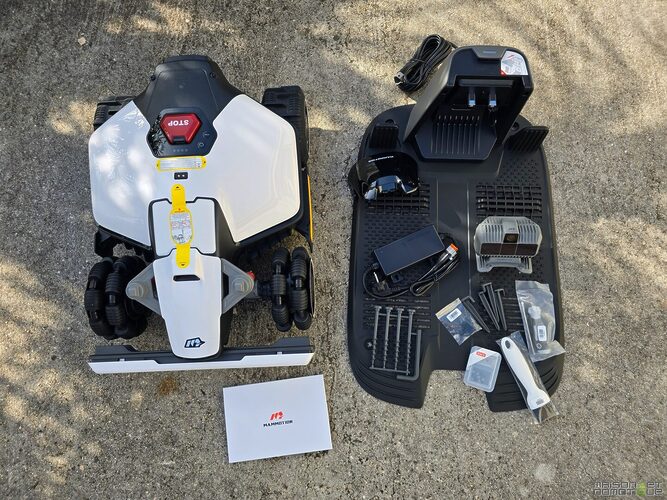
However, one technical detail requires attention: the installation of the LiDAR module. This key component, both discreet and sophisticated, conditions the continuation of the installation. If its location or fixation is not correct, the device will simply refuse to enter configuration mode. In this regard, Mammotion has clearly optimized ergonomics, but special care is needed, especially during the initial startup.

The next step engages the official mobile application. It effectively guides the user: quick account creation, identification of the lawn mower robot by serial number or QR code, secure linking via Wi-Fi, and then synchronization of different network parameters (Wi-Fi, 4G).

But the heart of the experience remains the definition of the mapping: the user delineates, thanks to the guidance mode, the areas to be mowed.

They place the robot, have it follow the edges of the lawns, trace the areas to avoid (flower beds, pool…) and validate the standard garden configuration in less than ten minutes.

At every step, the support from Mammotion is felt both in the interface and in the provided documentation, which is very clear and visual.

Quickly, a first mowing can be initiated without apprehension, at the simple press of a button.
User experience and features via the dedicated mobile application
The Mammotion app supports the user on a daily basis. Intuitive, fluid and rich, it centralizes all functions: adjustment of the cutting height (up to three saveable levels), choice of speed, distance management between passes, creation or deletion of restricted zones, multi-zonation (up to 20 distinct areas).

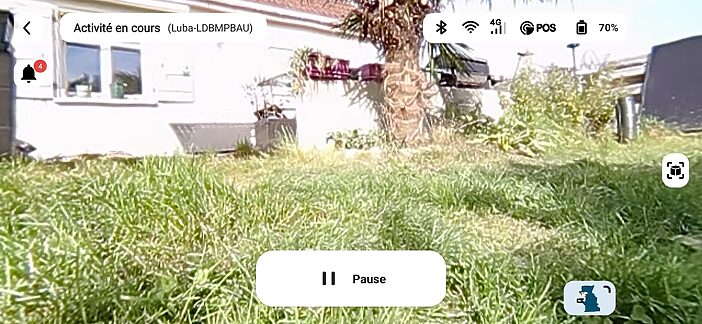
The mapping displays in real-time thanks to the information collected by the LiDAR combined with the camera; you can see at a glance the progress, the remaining coverage, and switch to manual mode as needed.

Behind this apparent simplicity lies a complex engineering: while most competitors restrict their lawn mower robots to a limited interface, Mammotion offers a true advanced dashboard, comparable to that of a connected car. In addition to monitoring cycles, the app integrates a live video via the device’s camera, useful for monitoring progress or checking security remotely using 4G. Remote control allows stopping, adjusting cutting height, modifying schedules, or even adding a new area to mow mid-season.
Among the uncommon options, the Home Assistant compatibility allows for complete automation of the robot in a smart home environment: customized mowing according to weather, context-based management based on the presence of people or animals in the area. Savvy users will find dedicated tutorials for the complete integration of the device into their connected setup.
Mowing performance, navigation, and daily use of the LUBA Mini AWD LiDAR
Beyond the numbers, the Luba Mini AWD LiDAR stands out for its remarkable cutting efficiency. Tested on a dense lawn typical of the countryside, it offers a very uniform finish, even cutting through slightly damp grass, where many competitors struggle or leave entire blades uncut. The six oscillating blades cutting technology fosters a clean job, greatly limiting the production of clippings while avoiding motor overheating thanks to an automatic rotation direction alternation.
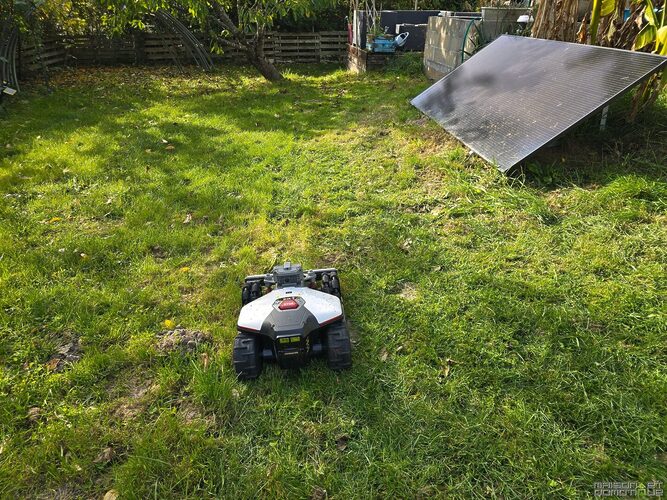
A strong point that I appreciate a lot: the electric adjustment of the cutting height, ultra-precise and adjustable on the fly, which ensures a pre-mowed cut close to the ground for a summer lawn, as well as a higher cut during water stress periods or high heat. The system is reliable, does not jam, and avoids the often tedious manual handling seen in other robots.

From a navigation perspective, the benefits of LiDAR are indisputable: the mowing robot’s path is fluid, without any perceptible hesitation. Even complex zones (trees in the center, furniture, low hedges) are skillfully managed, with the LiDAR establishing a 3D mapping of the environment, where traditional RTK models struggled or awaited manual correction.
| Functionality | Luba Mini AWD LiDAR | Distinct Points |
|---|---|---|
| Traction (AWD) | Yes (four-wheel drive) | Passage on slopes up to 80% and 5 cm obstacles |
| Multi-lawn zone | 20 zones max, simple configuration | Ideal for large areas or fragmented gardens |
| Cut quality | Excellent, precise cut, discreet wheel tracks | Non-offset deck, sometimes imperfect edges |
| Maintenance | Removable LiDAR module, IPX6 cleaning | Brushing, hose washing, easy blade replacement |
However, unsurprisingly, managing edges remains an area for improvement: the absence of an offset cutting deck requires manual finishing on a few centimeters around flower beds, or along walls. The wheel tracks, while remaining discreet, can still reveal passage on soft lawns or after rain.
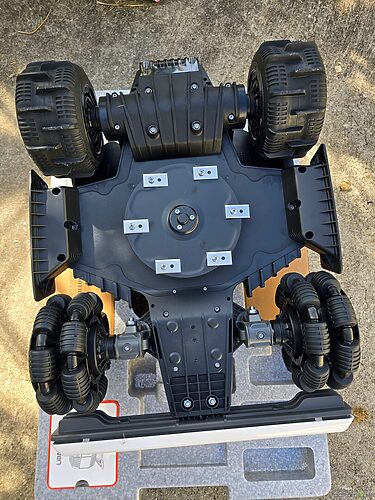
The AWD motorization deploys all its assets on steep or soft terrains. The crossing capacity, observed during trials, equals that of a miniature all-terrain utility vehicle: muddy terrains, bumps, small roots, everything is absorbed up to angles of 80%. From experience, it has shown no signs of fatigue, even on humid autumn days or in tight passages. The possibility of configuring multiple zones proves valuable for large properties or slightly complex setups: up to 20 independent areas according to seasonal needs or different grass varieties.
Regarding maintenance, Mammotion provides appropriate tools for removing the blades, disassembling the LiDAR module, and recommends rinsing with water (IPX6 standard). LiDAR navigation may require more frequent dusting of the head, but nothing that would block daily usage.
Focus on LiDAR technology and comparison with the RTK version
The LiDAR has become the leading solution in the navigation of autonomous lawn mowers. Its principle: emitting light waves that instantly generate a three-dimensional mapping of the site. Combined with the integrated camera, it analyzes every object in its path, makes real-time adjustments, distinguishes furniture, vegetation, and animals, thereby reducing the risk of collisions or forgotten areas.

The test of the Luba Mini AWD LiDAR reveals that this technology allows for almost total independence from the usual satellite signal disturbances (RTK), especially in gardens dotted with trees, verandas, or adjoining buildings. Signal losses become rare. The lawn mower robot dynamically adapts its routes; it slows down or stops in front of a sudden barrier, explores narrow passages that RTK models would have circumvented out of caution, all while maintaining a regular trajectory.
In practice, the obstacle detection managed by the LiDAR + camera combo reaches above-average precision. In our field experience, the robot reliably identifies children’s toys, trash bins, or the silhouette of a dog – no unfortunate collisions reported. However, on certain types of soft or changing obstacles, such as fine hedge branches, the algorithmic caution of the LiDAR leads it to avoid even areas that were still mowed in a “manual” test. This represents an excess of safety – certainly reassuring, but slightly constraining in dense or narrow areas.
Despite three detection modes, the lack of an intermediate sensitivity adjustment prevents optimal customization: the lawn mower robot may thus refuse access to zones deemed “risky” merely due to their topology, where the RTK model would have proceeded without hesitation. This choice embodies a philosophy of maximum safety but calls for future software adjustments from Mammotion, which is very attentive to its community of discerning users.
Also interesting: the energy consumption drawn from the LiDAR module is significantly higher than in RTK-only operation. In return, the assurance provided regarding navigation continuity and incident prevention justifies this gap for large properties or risky gardens.
As for the budget, the Luba Mini AWD LiDAR occupies the high-end segment, logically above its RTK equivalent or a Yuka Mini, but presents a truly premium usability value, especially when speed, simplicity of installation, and reliability are prioritized above all.

Mammotion Luba Mini AWD Lidar
Conclusion
In summary, if your garden has multiple obstacles, if satellite coverage is weak or if the absence of cable represents a critical constraint, the LiDAR version is currently the most versatile option on the market. Otherwise, more economical alternatives exist in the Mammotion range but will not offer the finesse or adaptive power of the Luba Mini AWD LiDAR tested here.
What is the main difference between the Luba Mini AWD LiDAR and the RTK version?
The LiDAR version relies on a LiDAR module and a camera for navigation and mapping, eliminating the need to install an RTK antenna. The RTK version, however, depends on a precise GPS/RTK antenna which is sensitive to surrounding obstacles. The LiDAR model adapts better to complex or heavily wooded gardens.
Is assembling the LiDAR module difficult for an individual?
The assembly requires attention: the LiDAR module is mandatory and must be precisely fixed. The operation is guided step by step in the Mammotion documentation and mobile application, allowing most users to complete the installation in under 10 minutes.
Can the sensitivity of the obstacle detection of the Luba Mini AWD LiDAR robot be adjusted?
The detection sensitivity is assisted by three modes, but currently lacks fine customization. This may impede perfect mowing of certain narrow areas. A future software improvement is expected.
Is the robot compatible with smart home systems?
Yes. Mammotion offers a Home Assistant integration: the robot can be controlled, automated, or programmed within an open smart home environment for intelligent management of the garden according to your criteria.
What maintenance is required for the Luba Mini AWD LiDAR?
It is recommended to regularly clean the LiDAR module (dusting), use water (IPX6 standard) for effective washing, and replace the blades with the provided tools, according to the frequency of use.


Please remain courteous: a hello and a thank you cost nothing! We're here to exchange ideas in a constructive way. Trolls will be deleted.