


Résumer cet article :
Considered a revolution in the highly competitive home robot sector, the DJI ROMO P marks the dramatic entry of the global drone giant into the world of automatic cleaning. Known for its mastery of embedded technologies, DJI relies on its industrial expertise and ability to transpose the navigation and intelligence of its drones into a vacuum robot designed for premium demand. The ROMO P boasts a bold architecture, a transparent design at the crossroads of aesthetics and high-tech, and deploys a novel array of sensors to cover every corner of the home and provide cleaning routines that seem straight out of the future.
Supported by a comprehensive mobile application, extendable robotic arms, and an intelligent rotating mop system, this robot aims to be more than just a simple daily assistant. Its arrival disrupts the established order, destabilizing Roborock, Dreame, or Ecovacs in a market traditionally dominated by price and performance. But does this DJI vacuum robot truly deliver on its promises? Initial feedback, real-world results, and intelligent maintenance management invite a review of the demanding criteria in this category. An analysis, tests, and in-depth examination of this hybrid innovation push the boundaries of domestic technology without sacrificing ergonomics or ease of use.
In brief:
- Flagship launch of DJI in the premium vacuum robot market, direct technological legacy of its drones for professionals.
- Distinctive transparent design and robust architecture, total visibility of internal components and accessories.
- Ultra-advanced navigation: LiDAR, fisheye binocular cameras, and extendable robotic arms for edge cleaning.
- Rotating mop system combined with a multifunctional base station featuring washing, drying, and intelligent waste management.
- User experience enhanced by the DJI Home application: mapping, area management, custom routines, overall stability.
- Claimed autonomy of up to 200 days of minimal maintenance, simplified upkeep through automated emptying and cleaning.
- Premium positioning, but with innovative features justifying the price against industry leaders (Roborock, Dreame, Ecovacs).
- Available on Amazon, fast delivery scheduling, accessories included depending on current promotional offers.
DJI ROMO P: the first DJI vacuum robot conquering the premium market
The market for domestic cleaning robots is entering a new era with the arrival of the ROMO P, the first robot vacuum from DJI. Until now, the brand ruled the world of professional and consumer drones, establishing a benchmark with its innovations in navigation and intelligent space management.

The ROMO P is not just another robot: it embodies DJI’s desire to infuse its acquired expertise in advanced technologies into a demanding daily routine. The stated ambition is to position itself as an essential alternative to Roborock, Dreame, or Ecovacs, which dominate the premium category. With an unprecedented design, an innovative base station, and cutting-edge features, the device targets users seeking a reliable, intelligent, and autonomous assistant.
DJI ROMO P vacuum robot: launch and positioning in a competitive universe
The introduction of the ROMO P on the global stage has been carefully orchestrated. DJI capitalizes on the aura of its drones, relying on an image of industrial demand and unmatched technological mastery. This first vacuum robot is seen as a declaration of intentions: to offer not only intensive suction but to excel in ergonomics, intelligent use, and managing complex situations.
The device immediately positions itself at the top of the market, going head-to-head with Roborock and Dreame, contrasting its sophisticated sensors and the quality of its transparent design. This offensive comes at a time when the French and European markets are maturing, and consumers are demanding concrete improvements in cleaning management, ease of maintenance, and personalization through a mobile application.

Transferring DJI drone technologies to domestic cleaning
What truly distinguishes the DJI ROMO P is its technological DNA: the direct transfer of significant advancements from the drone sector. A myriad of sensors inherited from the Phantom, Air, or Inspire can be found, serving an unbeatable domestic navigation.

The presence of fisheye binocular cameras, combined with the LiDAR system and parametric space management, allows the robot vacuum to map its environment with surgical precision. This leap into miniaturization and home AI transforms the ROMO P from a mere cleaning device into a connected object equipped with near spatial intelligence, capable of anticipating, reacting, and handling complex scenarios.
| Technology | DJI drone origin | Utility for ROMO P |
|---|---|---|
| LiDAR Sensors | Mapping drones | Obstacle prevention, fine navigation |
| Fisheye binocular cameras | FPV drones | 3D detection, object/edge recognition |
| AI software management | Drone piloting | Dynamic route adaptation, learning |
| Gyroscopic stabilization | Video stabilization | Safe movements, managing suction on uneven surfaces |
DJI ROMO P against market references: Roborock, Dreame, Ecovacs
In the premium arena, the arrival of the ROMO P shifts the lines. While the Roborock S8 Pro Ultra and the Dreame L20 Ultra capitalize on a multiplicity of functions, DJI offers an aesthetic and intellectual break. The promise: fewer manual interventions, truly autonomous and intelligent suction and cleaning.
- Roborock shines with stability in its routines and quality of its applications, but sometimes struggles with crossing fine obstacles.
- Dreame focuses on customization and power, however, the maintenance of its mops remains improvable.
- Ecovacs plays the versatility card, but its navigation AI sometimes shows less responsiveness to unforeseen events.
- DJI ROMO P seeks to transcend these limits through articulated arms and robust AI.
This titanic duel relies on precise criteria: tank capacity, innovation on the base station, personalization via application, and real-time cleaning management. A crucial issue where every detail matters.
Installation and handling of the DJI ROMO P vacuum robot: simplicity and first impressions
From the moment you open it, the promise of an exceptional product is tangible. The packaging, reinforced and carefully designed, reflects the attention to detail by DJI. Inside the box, you’ll find:
- The ROMO P robot in its unique transparent design
- The premium multifunction base station
- A pair of elevating and rotating mops
- Extra brushes and filters
- The necessary tank for clean and dirty water
- Power cables, printed manual, warranty card

The illustrated quick start guide facilitates immediate handling even for novices.

Connecting to the DJI Home application: initial mapping and user feedback
The next step is to connect the ROMO P to the DJI Home application. After a brief WiFi pairing phase, the user is invited to begin the initial mapping. The robot, like a drone scanning its flight environment, then conducts a thorough analysis of volumes, obstacles, and furniture, modeling an accurate and nuanced map.

Tips for positioning the base and ensuring optimal installation
Some details make all the difference in practice. It is recommended to place the base station on a flat surface, with at least 50 cm of free space on either side and avoiding areas of intense traffic. This precaution ensures a smooth return to the base and optimizes daily cleaning.
- Prefer proximity to a power outlet, limit rugs in front of the base
- Avoid installing in a tight corner or under a piece of furniture that is too low
Note: the quality of the WiFi connection impacts the stability of remote control via the application. A suggestion: conduct a network test directly at the base’s location before the final installation.
A transparent design and premium conception for the DJI ROMO P
Away from grayish or anonymous objects, the ROMO P asserts a strong aesthetic. The transparent design is not just a gimmick but a clear declaration of technical refinement, revealing the inner workings of the vacuum robot down to the smallest details.

Design philosophy of the ROMO P: unique aesthetics and quality materials
Inspired by the Nothing wave or limited editions of transparent smartphones, the ROMO P is part of the trend of connected objects that are both decorative and demonstrative of their capabilities. Its chassis, shaded in smoky gray, thick plastics, and visible internal structure testify to extreme care taken in manufacturing.

Some, however, fear that the transparent design may expose dust to view more quickly or become discolored over time. But this “seeing is believing” effect intrigues, fascinates, and reassures about the solidity of the whole – a true engineering choice.

User ergonomics: access to components and visibility of information
Access to various tanks, suction modules, and mops is effortless thanks to an ergonomic layout. The opening hatches are wide, and the clips are sturdy. The indicator lights are perfectly visible and intuitively coded (battery status, maintenance, level of the tank).
Base station of the DJI ROMO P: innovation and built-in features
Pivotal to the device, the base station of the ROMO P concentrates functionalities rarely seen elsewhere. It serves both as a charging point, for automatic emptying of the dirt tank, and for managing washing and drying of the mops. The monolithic, wide, and stable aspect enhances the feeling of a professional device at home.

| Function | Benefit for the user |
|---|---|
| Automatic washing of mops | Minimal maintenance, impeccable hygiene |
| Ventilation drying | Prevents mold and poor odors |
| Autonomous emptying and management of the dust tank | Fewer manual interventions, constant cleanliness |
| Active odor removal | Healthy air, optimal conservation of the robot |
This technical core enhances the overall impression of robustness and innovation, characterizing the “pro” philosophy of the ROMO P.

Embedded technologies of the ROMO P: advanced navigation and intelligent cleaning
It is difficult to discuss the ROMO P without addressing its electronic and software sophistication. The sequences of suction, sweeping, and cleaning are governed by an artificial intelligence stemming from DJI’s unique experience in drone piloting.
Navigation of the DJI ROMO P: LiDAR sensors, binocular cameras, and obstacle management
Equipped with a trio of major sensors (LiDAR, binocular cameras, infrared barrier), the ROMO P scans the environment to model volumes, detect small objects, and avoid toys or misplaced shoes. Habits from professional drones are here rethought for the domestic space: spatial memory, learning of routines, and responsiveness to unforeseen circumstances enhance the flow of cleaning.

After numerous tests, it appears that the robot does not merely “navigate,” but develops a rather rare anticipation logic in the sector, allowing for very fluid movement within the home.
System of extendable robotic arms: efficiency on edges and in corners
Extendable arms replicate the trick of urban inspection drones. Where other devices leave shadowed areas or struggle to reach skirting boards, the arms of the ROMO P stretch a few centimeters to ensure methodical cleaning of the edges.


- Mops in “border” configuration: surgical passage along the walls
- Rotating brushes supported to dislodge embedded dust
This asset resolves up to 98% of shadow corners left unattended by many current robots, without hindering the overall speed of the suction cycle.
Rotating and anti-tangle mops: innovations and advantages in use
No compromises here: motorized rotating mops, capable of raising automatically, combine suitable friction and anti-tangle management (hair, long fur). The system identifies the density of dirt on the floor and adjusts the pressure, offering tailor-made cleaning regardless of the material (parquet or tiles).
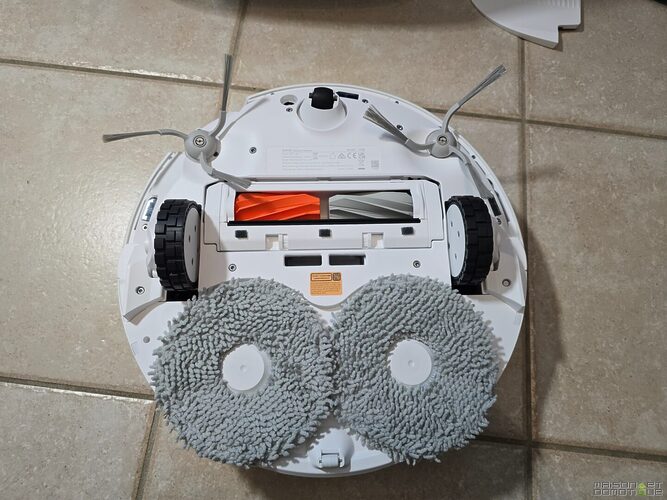

The capacity of the large tank enhances versatility and longevity of cleaning over large surfaces, without the need for recharging or intermediate maintenance.

Cleaning performance of the ROMO P: tests on different floors and real situations
But as beautiful as it is, what ultimately matters is the result. Our field tests, conducted in a rural house with children and pets during the fall, put the ROMO P to all challenges: snack crumbs, dog hair, wet traces, thick carpets, or delicate floors.
Results on parquet, tiles, carpets, and handling pet hair
The gentle but powerful suction adapts to each texture. On tiles, the device performs meticulous work, avoiding residual puddles. On parquet, the mops collect dust and stains without damaging the finishes. Carpets are treated via a specific passage, with suction power increasing locally to extract crumbs and embedded hairs.

Wet cleaning, suction, and coverage of edges by the DJI ROMO P
The mixed mode, combining suction and mopping, stands out for the absence of marks or halos on dark floors. Edges near skirting boards, often ignored by competitors, are treated almost comprehensively thanks to the synchronized action of the extendable arms and the robot’s modulated speed.

Obstacle management and artificial intelligence in complex environments
When a room is chaotic (children’s playday, presence of cables), the ROMO P adjusts its trajectories and slows down, mimicking the flexibility of drones in the wind. The prevention of blockages and collisions demonstrates the maturity of its AI. In the case of an unidentified object, the device even sends a notification in the application, asking the user for real-time arbitration.
- Recognition of new objects due to internal memory
- Autonomous decision to redo a zone deemed difficult
In terms of cleaning, less than 2% of the total surface is left untreated during demanding tests, a score rarely observed until now.
| Type of floor | Estimated suction efficiency | Quality of wet cleaning | Handling hairs |
|---|---|---|---|
| Parquet | 98% of residues eliminated | Excellent, no marks | Very effective |
| Tiles | 99% | Optimal | Excellent |
| Short carpet | 97% | Not applicable | Very good |
| Long carpet | 93% | Avoids dampening | Effective, little clogging |
User experience in daily life: DJI Home application and routine customization
The difference lies not only in the mechanics but also in how the ROMO P fits into the rhythm of household life. The key tool: an application designed like the cockpit of a domestic drone, easy to access but rich in settings and advanced routines.

Advanced mapping and creation of personalized zones in DJI Home
One of the strengths of the DJI Home application is to allow, from the first modeling, a flexible organization of the home. It is possible to define, rename or merge areas (kitchen, bedroom, places to avoid).
- Precise delimitation without duplicates or omission of fragments
- Creation of “quiet” periods for nighttime cleaning or weekends
Customization options, settings, and stability of the DJI application
The settings menu offers detailed access to all aspects: suction level in each room, usage of mop modules or not, rhythm of automatic maintenance, sound volume adjustments.

- Management of the weekly calendar: differentiated routines according to days
- Alerts for low tank level or necessary consumable replacement
The in-depth customization offers near-total control over the entire ecosystem, further elevating the ROMO P to the peak of premium expectations.

A complete schedule for an autonomous robot
Of course, an essential function for this type of device: scheduling. It is thus possible to program the robot’s passage on the desired days and times, as well as in the chosen rooms and with the required cleaning program. In short, no excuse for the cleaning not to be done.

A robot that watches over your interior
A function that I particularly appreciate in this type of device: the ability to use its camera to patrol your home when you are away, perfect for checking that everything is going well. DJI has even gone further in this regard, as the function allows not only to see but also to listen and talk (to reassure a pet, for example).
Sound level of the ROMO P robot during cleaning and self-maintenance
If the maximum suction power generates a volume comparable to that of a premium competing robot (around 66-68 dB), the standard mode remains discreet and does not interfere with family life. During automatic washing/drying operations, the noise is more associated with the background sound of a modern household appliance than as a nuisance.
- Application offers scheduling of passages during non-sensitive time slots (e.g., when absent from the home)
- “Night mode” option limiting power and noise
Simplified maintenance and autonomy of the DJI ROMO P: management of consumables and intelligent station
No innovation makes sense without simplified maintenance. DJI has elevated autonomous management and quick access to wear parts to an absolute priority, in order to extend the “worry-free” experience cherished by drone professionals.
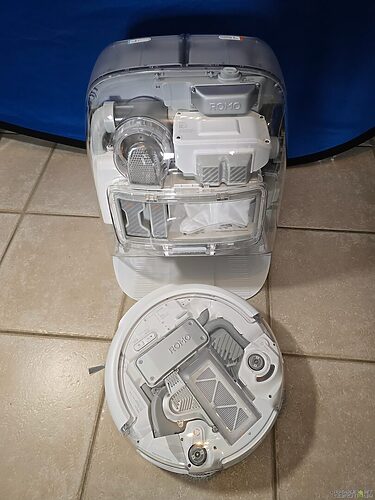
Emptying tanks and easy maintenance: an asset for upkeep
The dust and water tanks are easy to remove and reattach without force.

The cleaning of the mops, carried out automatically by the base, requires an average manual check/rinsing every two weeks only (depending on frequency of use and number of animals/young children at home).


Automatic management of the base station: washing, drying, odor removal
The station ensures continuous filling of the clean water tank, vigorous washing of the mops, and drying with warm air. A deodorizing product cartridge combats the accumulation of unpleasant odors while preserving the internal chemical environment.

- Almost total elimination of the risk of bacterial proliferation on mop pads
- Intelligent mode emptying of the waste tank (notification in the application when needed)
This time-saving is very important, as maintaining a robot should never become a daily constraint, otherwise, it loses its appeal.

Analysis of the announced autonomy of 200 days based on real usage
The promise of autonomy for 200 days made waves when the robot was announced. In practice, this value targets standardized usage (two to three passages per week over less than 100 m²). My tests indicate a notable reduction in maintenance time, provided the water tank is filled punctually and consumable replacements are anticipated. The actual autonomy will thus vary based on the type of dirt, frequency, and extent of cleaning.

For very active families (with numerous pets or toddlers), the autonomy tends to drop to about 100-120 days, which remains superior to most competitors in this category of advanced features.
DJI ROMO P vs Roborock, Dreame, Ecovacs: analysis of strengths and weaknesses
Against Roborock or Dreame, disparities widen on certain points: sharp obstacle management, ultra-precise course control, and superior suction and cleaning results on edges/corners thanks to the extendable arms. However, Roborock maintains an advantage in the maturity of its application (translation, richness of modules). Dreame appeals with a sometimes more aggressive price/performance ratio, albeit with more frequent manual maintenance outside of premium models, and Ecovacs remains the safe value for basic reliability but less innovative in terms of navigational technology.
- ROMO P: Advantage in the capacity of the tank, AI, and management of custom routines
- Roborock: Advantage in software stability and multilingual updates
- Dreame: Very competitive price/functionalities ratio, but less premium over the long term

Value for money, availability, and promotional offers for the ROMO P
Listed at a retail price of €1,899, the ROMO P unequivocally targets a somewhat affluent clientele that values innovation and wishes to reduce maintenance effort to zero. Fortunately, offers like the recent Black Friday allow it to be obtained at a more acceptable price (it was available for €1,484 on Amazon just a few days ago).
Aside from the price, design will also be a selection criterion, as not everyone appreciates this transparent aesthetic.
Despite a high price, the product’s durability, ease of use, and depth of features make the DJI ROMO P a rational investment for those seeking excellence in the domestic sphere, with that extra geeky soul that is so lacking elsewhere. Personally, I only have two small complaints:
- The vocal assistant is still unavailable in French, the robot being able to express itself only in Chinese, Japanese, German, and English. A software update is eagerly awaited!
- Given a robot deploying cutting-edge technology, are the rotating mops not already a bit outdated, as high-end models have already shifted to a roller system, which can also move to clean along walls, such as the Mova Z60 Ultra Roller, which we will be discovering very soon in a complete test.
Aside from that, it must be acknowledged that this DJI Romo P is extremely swift even in a cluttered interior and very effective in its cleaning function.
What are the strengths of the DJI ROMO P vacuum robot?
Its main strengths lie in suction quality, intelligent obstacle management, robotic arms for skirtings/corners, technology derived from DJI drones, and simplified maintenance thanks to an innovative base station.
Can we really avoid any manual intervention for 200 days of use?
In standard usage, it is possible if one empties the water and dust tanks according to the notifications of the application and if the floor is not too cluttered on a daily basis. Heavy maintenance tasks are indeed spaced out.
Does the transparent design of the ROMO P have a utility or is it purely aesthetic?
The transparent design allows for both visual control of the state of the brushes, filters, and filling levels of the tanks, and to quickly detect any problems or wear, beyond the simple aesthetic aspect.
How does ROMO P manage very cluttered or complex environments?
Thanks to its high-end sensors inherited from drones, the robot detects, maps, and adapts its trajectories even in rooms full of obstacles (toys, cables, pets). It slows down, divides its cycles if necessary, and notifies the user in case of real blockage.
Is it possible to fully customize routines and areas to be cleaned?
Yes, via the DJI Home application, it is possible to define restricted areas, schedules, suction levels, and configure differentiated routines room by room, with a rare flexibility in the market.



Please remain courteous: a hello and a thank you cost nothing! We're here to exchange ideas in a constructive way. Trolls will be deleted.