


Résumer cet article :
With the introduction of Gemini for Home, Google takes a decisive step in the field of the connected home, offering a new generation of voice assistant powered by artificial intelligence. In a market enriched with numerous innovations in home automation in recent years, the company aims to make an impression and reposition its entire Google Home universe around a reimagined user experience. Recent announcements demonstrate Google’s desire to accelerate the transition towards a smoother, more contextual home automation, where a fine understanding of needs and intelligent automation become the norm. At the heart of this strategy: the promise of simplified daily management, driven by the arrival of new flagship products like the upcoming Google Home Speaker, but also by the deep modernization of the Nest ecosystem.
The shadow of the HomePod mini, which has long dominated the compact premium speaker category, looms over Google’s strategy, which nevertheless adopts a boldly open and compatible approach. The stated priority is to integrate each new feature into an eco-responsible logic, while betting on the durability of devices and the privacy of exchanges. This long-awaited transformation for the community is also reflected in special attention to design, ergonomics, and by the systematic integration of Gemini in every link of the home automation chain, thus offering unparalleled homogeneity and increased intelligence.
In brief
- Launch of Gemini for Home, Google’s new AI for home automation, gradually replacing Google Assistant in the Google Home range.
- Unveiling of the Google Home Speaker (spring 2026), the centerpiece of the audio strategy, designed to take advantage of Gemini and compete with market benchmarks like the HomePod mini.
- Focus on compact design, four colors, 360° sound, stereo, multiroom, and advanced privacy settings (physical microphone, interactive light bar).
- New Nest cameras (indoor and outdoor) with AI and 2K HDR resolution, ultra-precise contextual notifications, integration into the Google Home app.
- The Google Home app and devices from 2016 to today are migrating to Gemini for Home, ensuring backward compatibility, security, and accessibility to the ecosystem.
- Extension of Google’s home automation offering with a connected doorbell, the ambitious promise of an intelligent and secure AI-driven home.
New connected speaker: the competitor to the HomePod mini
The launch of the Google Home Speaker opens a new chapter in Google’s connected home adventure. This model, set for spring 2026, emerges as the first major speaker released by the brand since the launch of the Nest Audio in 2020 – a pivotal period marked by the strengthening of privacy standards and the explosion of multi-point usage at home. Developed to leverage the advanced capabilities of Gemini, this speaker directly responds to users eager for sound performance and ease of integration, all while showcasing strong environmental ambitions.
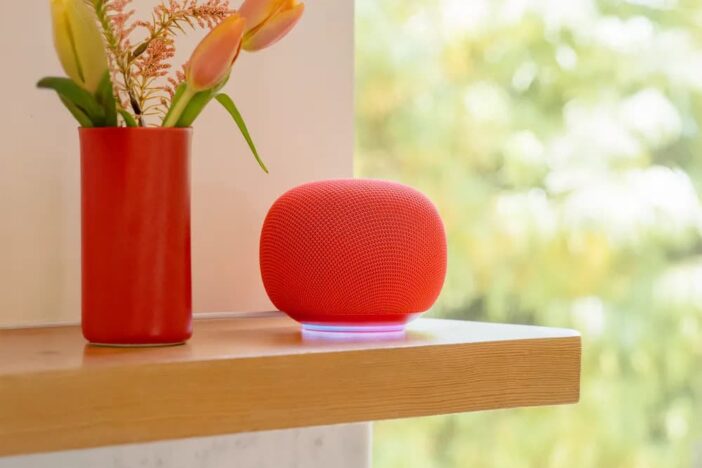
The design of the Google Home Speaker is characterized by its round and compact silhouette, designed to blend into any interior. Made from recycled textiles, it comes in four current colors (soft Boreal green, Peacock red, Graphite black, Chiffon white), reflecting the desire to combine aesthetics and durability. Beyond its appearance, the technological base is comparable to the competition: 360-degree audio diffusion, the ability to create stereo pairs, multiroom management, and expanded compatibility with the Google TV Streamer to offer a true home cinema experience. Google also places great importance on maintaining privacy, with a physical switch to turn off the microphone, coupled with an interactive light bar that responds to Gemini‘s prompts and informs the user in real-time of the listening status.
In terms of pricing, this speaker aims to compete with Apple’s HomePod mini, with an announced price of $99, positioning it as both an accessible and high-end product, intended to favorably replace the bulkier Nest Audio. These assets are further enhanced by the native integration of Gemini, ensuring richer exchanges, complex queries interpreted accurately and constant adaptation to domestic use.
The strategy unveiled by Google clarifies the timeline: the delayed release of the Google Home Speaker until spring 2026 is a deliberate choice to ensure the technical maturity of Gemini, as well as a solid experience at launch. This approach illustrates Google’s intention to rely on user feedback to refine the product before its large-scale distribution – the release is expected in France and several other countries simultaneously.
| Characteristics | Google Home Speaker | HomePod mini | Nest Audio |
|---|---|---|---|
| Format | Round, compact | Mini spherical | Vertical, bulkier |
| Colors | Boreal, Peacock, Graphite, Chiffon | Gray, blue, orange, white, black | Anthracite, chalk |
| AI Assistant | Gemini | Siri | Google Assistant |
| Price | $99 | $99 | $89 |
| Release | Spring 2026 | 2020 | 2020 |
| Privacy | Micro switch, light bar | Touch button, light signal | Micro switch |
Google unveils its new AI cameras
Alongside the announcement of the Google Home Speaker, Google presents a notable advancement with two new Nest cameras. These models, modestly named “3rd generation indoor camera” and “2nd generation outdoor camera,” benefit from innovations powered by Gemini technology and a deep integration with the Google Home app. Designed to meet the growing needs for security and control in modern households, they significantly expand the territory of the smart home according to Google.
Their main advantage lies in the 2K HDR, ensuring faithful detail reproduction, whether in daylight or low-light conditions. The expanded 152° field of view allows for effective monitoring of both indoor and outdoor spaces, while situation recognition, enhanced by Gemini, goes far beyond simple motion detection. Thus, users now receive contextual notifications: for example, a precise alert indicates that an animal has just been identified in the living room, preventing unnecessary message bombardment.
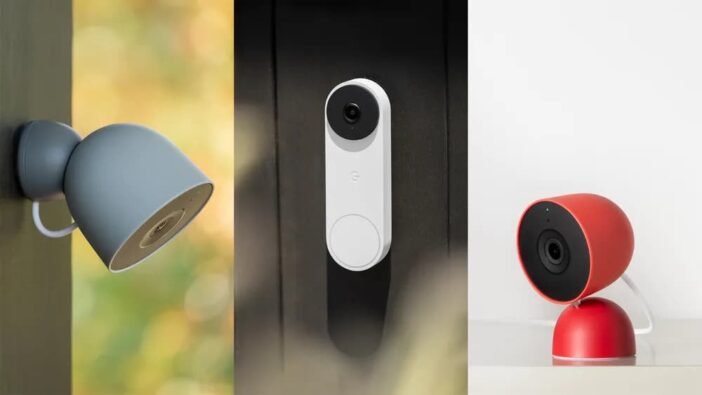
An additional dimension is offered by the Google Home Premium subscription, which unlocks the exclusive Gemini Live feature: interactions become richer, allowing the user to engage in real-time dialogue with their camera and receive personalized recommendations. The free video history, now extended to 6 hours, also offers doubled flexibility for viewing compared to the old model.
At the intersection of protection and comfort, Google also unveils a connected doorbell, enhanced by Gemini. This new addition integrates seamlessly into the Nest ecosystem to provide a coherent intelligent monitoring solution, reinforcing the promise of a safer and more personalized home. Faced with the multitude of offers on the market, these innovations provide a notable qualitative leap: users find their experience simplified, false alerts diminish, and contextual intelligence invades the most mundane management, as recounted by Sophie, a businesswoman from Lyon, who remotely manages the comings and goings in her residence thanks to her boosted Gemini cameras.
| Product | Resolution | Field of View | Integrated AI | Free History | Highlights |
|---|---|---|---|---|---|
| 3rd gen Nest indoor camera | 2K HDR | 152° | Gemini | 6 hours | Contextual notification, low light |
| 2nd gen Nest outdoor camera | 2K HDR | 152° | Gemini | 6 hours | Durability, smart alerts |
| Gemini connected doorbell | HD | 140° | Gemini | 6 hours | Visitor recognition, voice notifications |
The new Nest Indoor Cam is already available on the official website for €99.99, as well as the outdoor version for €149.99.
Google expands its home automation offering with the integration of Gemini for Home
The most significant evolution, beyond the hardware, lies in the widespread adoption of Gemini for Home across the entire Google range, from Nest Mini speakers to Nest Hubs, encompassing all generations of Google Home since 2016. The software transition, driven by a massive update of the Google Home app, will begin in the fall of 2025, thus ensuring that each user has native compatibility with Gemini without needing to replace their entire existing equipment.
This unique approach in the connected home landscape is accompanied by unprecedented levels of interaction: recent models benefit from the Gemini Live mode, which supports extended and dynamic dialogues, while earlier generations enjoy partial but already very advanced compatibility, offering automated scenarios adapted to modern life. The migration is gradual, allowing each household to customize the deployment according to its uses and preferences. This backward compatibility (rarely seen with competitors, it must be said) guarantees both the longevity of the installed base and access to new experiences signed by Google, including in France.
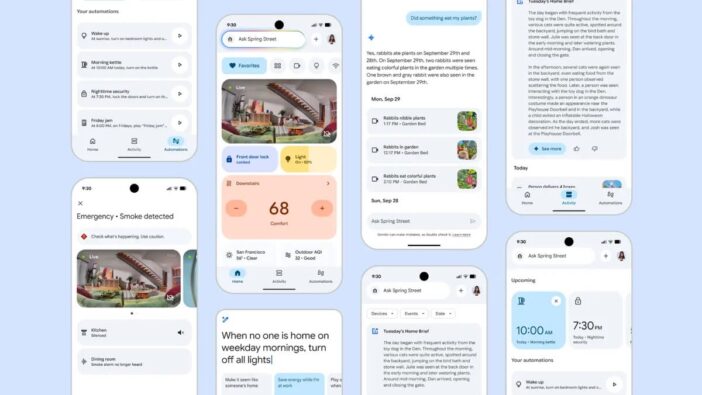
Ease of use, control of privacy settings, contextual intelligence are now the watchwords of Google Home automation. Security and data protection are reinforced through the smart alerts of the cameras, control of the microphone on the device, as well as the open architecture of Gemini, which continually adapts to European regulatory constraints.
| Device | Compatibility with Gemini for Home | Access to Gemini Live | Year of Release |
|---|---|---|---|
| Google Home Speaker | Native | Yes | 2026 |
| Nest Hub (2nd gen) | Yes | Yes | 2021 |
| Nest Mini | Yes | No | 2019 |
| Google Home (1st gen) | Yes | No | 2016 |
With this ambitious transformation, Google establishes Gemini as the benchmark for intelligent user experience, where each device becomes a contextual entry point into the home. The balance between hardware innovations – new speakers, cameras, connected doorbell – and software backward compatibility marks a turning point for the sector. This ability to unite old and new products within the same universe, driven by an ever-evolving AI, outlines the contours of a home that is as intelligent as it is user-friendly.




Please remain courteous: a hello and a thank you cost nothing! We're here to exchange ideas in a constructive way. Trolls will be deleted.