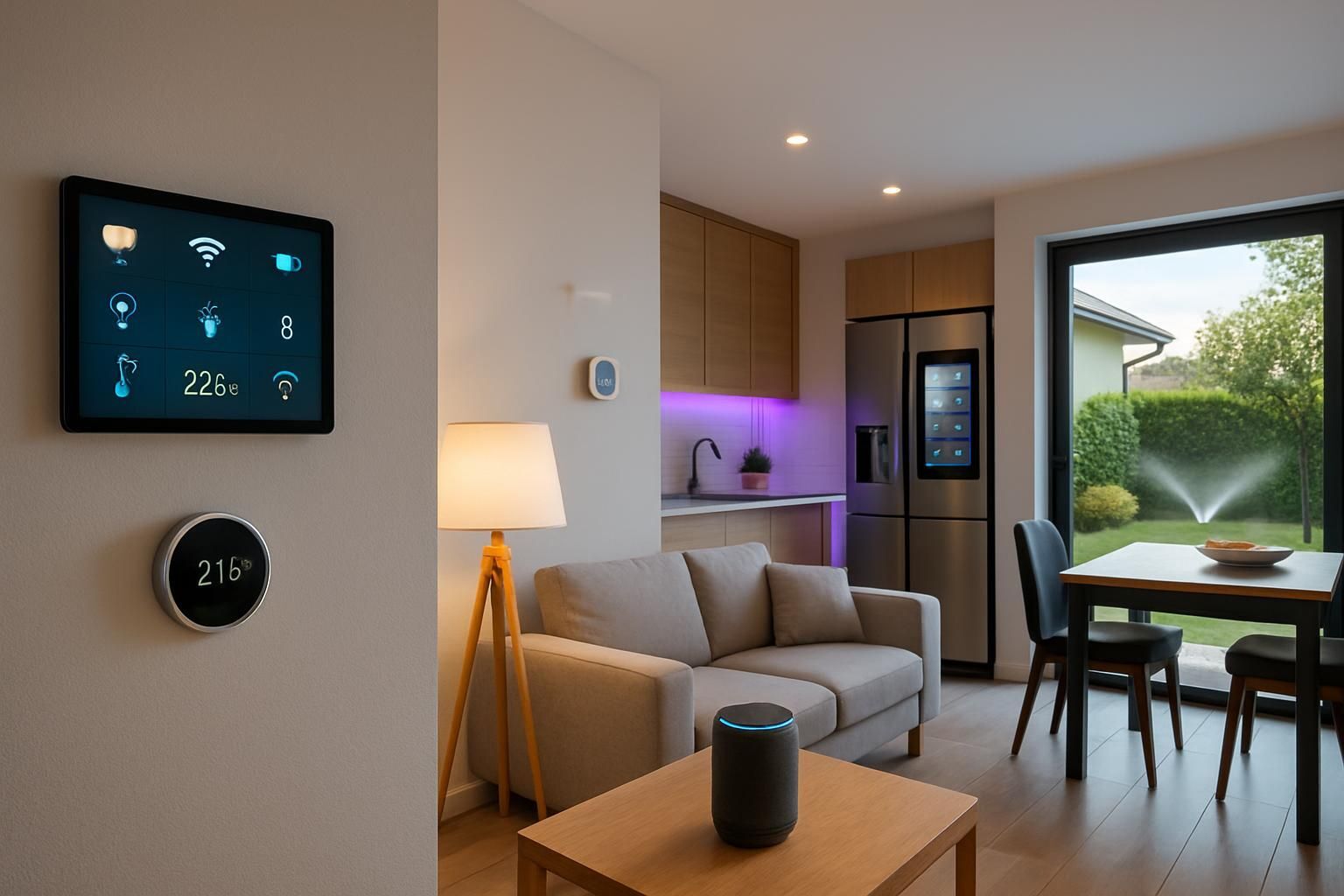
Home Automation: how does it work and why adopt it?

Résumer cet article :
Imagine coming home after a long day: your door opens without keys, the light gently turns on, the room is at the perfect temperature, and your favorite playlist welcomes you. Home automation has recently revolutionized the experience at home, multiplying possibilities for customization, comfort, and security. Now, it’s not just about automating a task, but living in a home that adapts, anticipates your habits, and simplifies your daily life. Thanks to a multitude of connected devices and interfaces accessible from a smartphone, it is entering every household, promising optimal management of energy, unparalleled peace of mind, and tailored comfort. Far from being reserved for a tech-savvy elite, home automation has been democratized thanks to the evolution of IoT (Internet of Things) and the decrease in costs, paving the way for scenarios as varied as they are innovative. Throughout this article, explore how this true digital brain transforms living spaces, whether you are already convinced or just curious to discover what makes a smart home so irresistible.
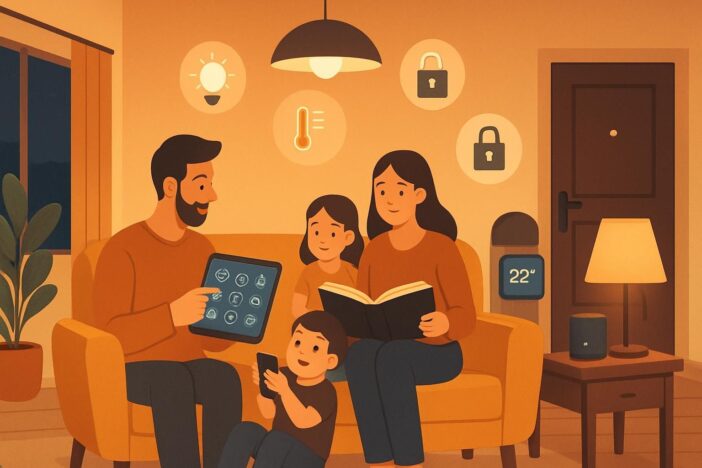
Home Automation: How Does It Work and Transform Your Daily Life?
Stepping into the world of home automation means entering a house that no longer waits for your commands, but anticipates your wishes. Technological advancements have allowed our relationship with our homes to shift from a static space to a living environment, capable of learning, analyzing, and responding to our habits. Whether you live in a city apartment or a house in the countryside, home automation offers solutions for every lifestyle.
Concrete Examples of Home Automation Serving the House
A connected home manages much more than just turning on a light. Let’s take Camille, an active city dweller: every morning, her roller shutters gently open as soon as her alarm goes off, the lighting adjusts to the daylight, and the heating sets the temperature. A humidity sensor detects the state of her plants and initiates watering only if necessary. An evening scenario lowers the brightness, locks the door via a connected lock, and activates the alert system. This automatic orchestration, made possible through configured scenarios, allows devices to communicate with each other and ensures real-time monitoring.
- Heating management: adapted to the weather and the presence of residents.
- Security monitoring: cameras, alarms, and notifications on smartphone.
- Smart lighting: automated adjustment based on presence or outside brightness.
Does Home Automation Really Make the House Intelligent?
The term smart home is no longer science fiction. Home automation is not just a collection of connected devices; it’s a centralized home automation system that utilizes data from actuators and sensors. By combining precise programming and learning routines through AI, the house becomes proactive: it infers the best way to optimize comfort while maximizing energy savings.
A telling example: in a home equipped with connected devices, entering a room triggers the lighting to adjust, while prolonged absence turns off the heating and lights, without manual intervention. Intelligence emerges from this perfect synergy tailored to each lifestyle.
| Home Automation Function | Benefit | Concrete Example |
|---|---|---|
| Automated lighting | Comfort and economy | Lights that adjust based on presence and brightness |
| Heating control | Energy savings | Temperature modulated based on occupancy |
| Connected security | Peace of mind | Alerts in case of intrusion or smoke |
How Does the Connected Home Anticipate Your Needs?
The strength of home automation systems lies in their ability to learn from your habits to better anticipate your expectations. The sensors scrutinize the slightest variation: presence, temperature, humidity level, door or window activity. By cross-referencing this information, the connected home can, for example, prepare bath water for your return or brew coffee when you wake up. In the world of home automation, everything becomes adaptable and customizable.
- Movement detection for remote control
- Automatic adjustment of blinds and roller shutters according to sunlight
- Smart garden watering via a humidity sensor
- Sending alerts in case of water leaks or abnormal temperature variation
This anticipatory capacity transforms the way individuals experience their homes, making them responsive, secure, and truly tailored.
Principle of Home Automation: Operation and Definition of a Connected Home
At the intersection of electronics and computing, home automation is based on a simple principle: allowing different devices and systems to communicate and act together to simplify household management. A connected home now encompasses lighting, shutters, heating, security, as well as entertainment and appliances within a centralized network managed by a home automation hub.
- Time-saving through automation
- Energy consumption management
- Reduction of human errors through programming
What Are the Key Components of a Modern Home Automation System?
The basic trio consists of sensors (which measure, detect, and analyze), actuators (which act), and the famous home automation hub (the conductor). Each plays a crucial role, ensuring the responsiveness, security, and precise control needed for modern household management.
Sensors, Actuators, and Home Automation Hub: The Winning Trio for a Smart Home
The sensors are the “eyes” of the house, monitoring temperature, brightness, and presence in real time. The actuators (shutter motors, switches, valves) are its “hands,” executing the commands received. And the home automation hub serves as the conductor, coordinating communication between all these systems via an intuitive interface.
| Component | Function | Example Brand |
|---|---|---|
| Presence sensor | Detect human presence | Aqara |
| Roller shutter actuator | Open/close shutters | Somfy, Nice |
| Home automation hub | Control and scenarios | Jeedom, Home Assistant, Homey, Delta Dore |
Home Automation and Communication Between Devices: Focus on Connected Protocols
The diversity of devices necessitates fluid and reliable communication. The Wi-Fi, Zigbee, Z-Wave, and Bluetooth protocols vary in effectiveness depending on whether you prioritize range, stability, low power consumption, or ease of adding new elements. For example, a connected lighting system under Zigbee can be controlled from the same interface as a Z-Wave smoke detector or a Wi-Fi lock, as long as they communicate through the central hub.
- Wi-Fi: ideal for high bandwidth and ease of installation
- Zigbee, Z-Wave: very low consumption, extensive network mesh
- Bluetooth: perfect for nearby devices (children, health…)
Why Is the Home Automation Hub the Central Brain of Your Installation?
Without the home automation hub, it is impossible to make so many devices from different brands communicate together. It centralizes, interprets, and executes all commands and scenarios. Whether you use Home Assistant, Jeedom, Homey, or solutions from Somfy, Delta Dore, or Nice, everything goes through this hub, which is now compatible with the main platforms and voice assistants (Google Home, Alexa, Siri).
- Creation of personalized scenarios (movie night, vacation departure)
- Multi-device and multi-room management
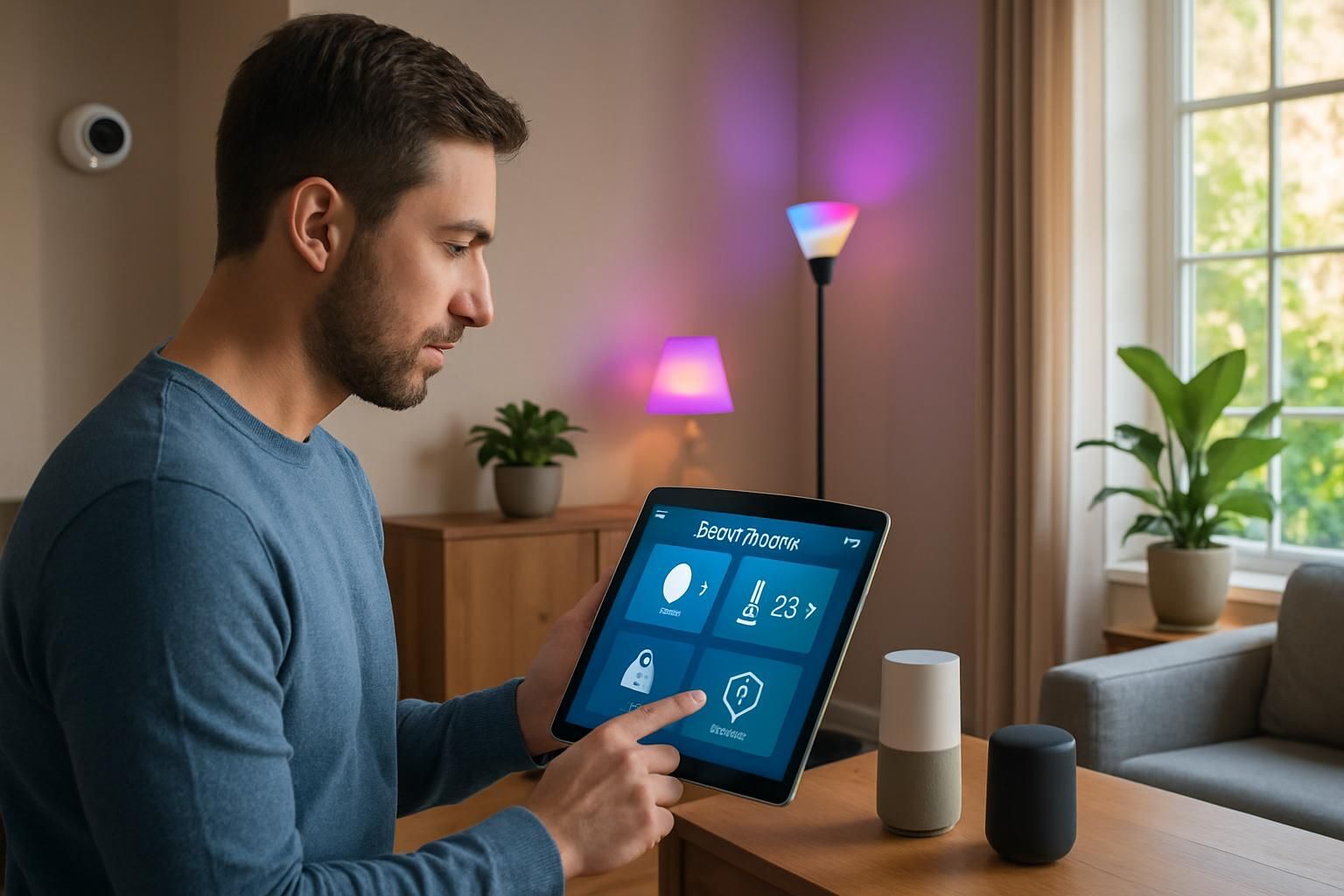
- Control from smartphone, tablet, or voice
The freedom offered by the home automation hub is found in the ability to integrate hundreds of devices, ensuring the scalability of your installation over time.
Home Automation Technologies: Wireless, Wired, PLC… How to Choose?
One of the main decisions when installing a home automation system lies in choosing the most suitable network technology: wired, wireless, or PLC. Each has its intrinsic advantages depending on the project (renovation, new construction, or simple addition to existing installations).
Advantages and Limitations of Home Automation Networks According to Your Needs
Wireless networks (Wi-Fi, Zigbee, Z-Wave) offer great flexibility, particularly appealing for renovations or for easily adding new devices at lower costs. Wired protocols (KNX, BUS) are favored for their robustness and reliability, ideal for a villa or new building. For hard-to-wire locations, PLC (Powerline Communication) utilizes the existing electrical network.
- Wireless: ease of installation, adaptability, rapid evolution
- Wired: stability, robustness, and security
- PLC: alternative to avoid heavy work
Home Automation in Renovation or New Construction: Which Solutions to Favor?
In new construction, opting for a wired home automation system like KNX anticipates all future needs. In renovation, wireless home automation stands out for its simplicity and flexibility. Consider the example of an old house where adding Wi-Fi or Zigbee modules avoids expensive renovation work. PLC often resolves the issue of thick walls in rural buildings.
| Context | Recommended Technology | Application Example |
|---|---|---|
| New construction | Wired (KNX), or hybrid network | Centralized control via Jeedom hub |
| Apartment renovation | Wireless (Z-Wave, Zigbee, Wi-Fi) | Adding Aqara sensors without any work |
| Stone house | PLC for difficult connections | Lighting controls without crossing walls |
Can Multiple Home Automation Technologies Be Mixed in the Same Home?
It is not uncommon to find multiple home automation protocols within the same house. Modern hubs, like Home Assistant or Homey, are designed to manage Wi-Fi, Zigbee, or Z-Wave devices together. It is the mix of technologies that gives home automation its full flexibility.
- Adding a Wi-Fi alarm to an existing Zigbee installation
- Centralized control via a single application
- Increasing compatibility between different ecosystems of devices
Interoperability is now the key to enjoying a connected home that is both versatile and scalable.
Security, Comfort, and Energy Savings: The Benefits of Home Automation in Daily Life
Home automation is so widely discussed because it ticks all the boxes: enhanced security, tailored comfort, and precise management of energy consumption. All of this can be controlled with a fingertip on a smartphone or via voice commands.
Remote Management and Real-Time Alerts: The Explained Home Automation Surveillance
Continuous monitoring becomes child’s play: you receive instant notifications on your phone in case of intrusion, smoke, or unusual power outages in a circuit. Cameras and opening sensors integrate seamlessly into your home, controlled from the same application as the heating or lighting.
- Presence simulations to discourage intrusions
- Managing guest access using temporary codes
- Remote video control via the mobile app
Connected security soothes the mind while remaining discreet and easy to use.
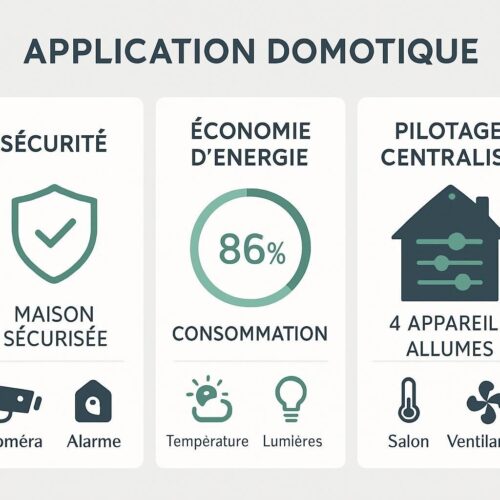
Home Automation and Energy Consumption Optimization: How Does It Work?
Optimizing energy consumption is a strong argument for home automation. With solutions like Delta Dore or Nice smart plugs, automatic regulation adapts the functioning of devices to avoid waste. The connected thermostat allows precise management of the heat in each room, and automation cuts off power to devices left on standby.
- Programming the heating based on actual occupancy
- Automatic turning off of lights and outlets that are not in use
- Detailed tracking via the app to identify energy-hungry devices
The reduction of bills and CO₂ emissions is tangible, and the return on investment is rapid due to the savings made.
| Home Automation Device | Impact on Consumption | Ecological Benefit |
|---|---|---|
| Connected thermostat | -20 to -30% on heating | Less waste, reduced emissions |
| Smart plug | Automatic shutdown of devices on standby | Reduction of baseline consumption |
| Smart watering system | Adjusted to the weather | Preservation of water resources |
Essential Home Automation Devices for Tailored Comfort
It’s impossible to provide a complete list as it keeps growing with advancements in home automation! A few classics stand out for fully enjoying comfort:
- Connected thermostats (Delta Dore, Nice) for adjusting temperature room by room
- Smart plugs: monitor and cut power consumption from a distance
- Connected locks: access management, keyless entry, guest control
- Autonomous vacuum robot
- Humidity sensor like those from Aqara, for plants or damp basements
- Connected irrigation timers that adjust their cycle to real-time weather
- GPS collars to track your pets’ movements
Each addition enhances the intelligence of the home and fine-tunes its management without daily effort.
Installing Home Automation at Home: How to Choose the Right System and Equipment?
Before getting started, it’s important to avoid pitfalls of incompatibility or over-equipment. Choosing the right hub and equipment involves careful consideration and sometimes, the help of a professional. Solutions are now affordable, and most leading brands guarantee simplicity and longevity.
Compatibility of Hub and Accessories: The Mistake to Avoid for a Flawless System
Ensuring that your accessories are compatible with the chosen home automation hub is THE reflex to have. Platforms like Home Assistant, Jeedom, or Homey offer a rich library of extensions, but not all devices are equal in terms of compatibility. Favor labels like “Compatible with Zigbee” or “Compatible with Z-Wave.”
- Check the official list of supported brands
- Avoid duplicating hubs or protocols if unnecessary
- Opt for scalable equipment
This is the key to a robust and future-proof home automation system.
Home Automation Mobile Applications: Control Your Home at Your Fingertips
Control, programming, notifications, everything now goes through a dedicated mobile application. The ergonomic interface centralizes commands, allows for the creation of advanced scenarios, and enables real-time tracking from anywhere.
- Intuitive applications compatible with iOS/Android
- Visual management of rooms and devices
- Configuration of alerts, tracking of energy and consumption
This digital extension of the home provides an unprecedented level of control, conducive to proactive domestic comfort management.
Should One Hire a Professional for Home Automation Installation?
Increasingly accessible for DIY installation, home automation is great for those who enjoy “doing it themselves.” However, a professional ensures a comprehensive study of the habitat, optimization of networks, and security (especially for complex or multi-system installations).
- Personalized advice and advanced parameter setup
- Secure installation without compatibility issues
- Facilitated maintenance in case of evolution or breakdown
This choice provides the peace of mind of a stable and well-integrated home automation system.
Accessible Home Automation: Towards Smart Homes for Everyone Through Innovation
Once reserved for a few enthusiasts, home automation has become democratized: affordable connected object kits from Aqara to ready-to-use solutions from Nice or Somfy, everyone can now harness technology to transform their home.
Evolution and Future of Home Automation: AI, Interoperability, and New Possibilities
The horizon expands every year: artificial intelligence, machine learning, increased interoperability between platforms, voice assistants… We can soon imagine homes capable of detecting a domestic incident and automatically notifying a trusted contact, or analyzing the weather to optimize the consumption of heavy appliances and resulting savings. IoT carries these new perspectives, rendering many old limitations obsolete.
- Native integration of new players (solar energy, home storage)
- Continuous improvement of connected security
- Natural voice interfaces and learning of resident behavior
Tomorrow, home automation will fade away, invisible yet omnipresent.
Home Automation and Accessibility: Increased Autonomy for All User Profiles
Connected technology is not just a modern gadget. For seniors or people with reduced mobility, it becomes essential: voice management, fall detection, and access control facilitate independence. Home automation solves many challenges related to age or disability, making the habitat safer and more intuitive.
- Automatic alerts in case of anomalies (fall, smoke, flooding sensors)
- Remote access management for caregivers
- Personalized interfaces based on needs (touch screens, voice commands)
This progress contributes to a universal accessibility and a real improvement in quality of life.
Why Adopting Home Automation Is Investing in a Comfortable and Responsible Future
Ultimately, embracing home automation means betting on a modern lifestyle that is comfortable and environmentally friendly. Energy optimization, security control, daily automation, or system adaptability enhance the home while protecting the planet. Easy to install, affordable, and scalable, home automation today harmonizes innovation with well-being.
| Key Advantage | Impact on Daily Life |
|---|---|
| Tailored comfort | Adaptation to the routine of each inhabitant |
| Enhanced security | Real-time supervision and remote control |
| Energy savings | Reduction of bills and ecological footprint |
| Property valuation | Attractiveness of the property due to its connected features |
FAQ on Home Automation
What are the essential protocols for an effective home automation installation?
For a seamless experience, prioritize open protocols like Zigbee or Z-Wave via Home Assistant, Jeedom or Homey. This ensures optimal interoperability between your connected devices and guarantees the longevity of your installation.
Does home automation require a permanent Internet connection?
Most installations require internet access for remote control and updates. Nevertheless, many scenarios remain active locally, ensuring security and automation even in case of network outages.
Is home automation really accessible in 2025?
Yes, thanks to modular solutions, affordable connected object kits, and the wide compatibility of home automation hubs, the initial investment is no longer a barrier. You can start with a few devices before gradually expanding your system.
What equipment should I choose to start home automation?
Opt for a starter pack including a hub (Homey, Jeedom…), a few essential sensors (motion, temperature), and connected plugs. Add devices according to your needs: thermostat, cameras, or smoke detectors.
Can I set up home automation myself or should I go through a specialist?
DIY installation is possible for wireless kits and simple connected objects. However, for a complete house or advanced security management, consulting a professional ensures a reliable and optimized home automation system.
Résumer cet article :
Ces articles pourraient aussi vous intéresser:
0 reaction